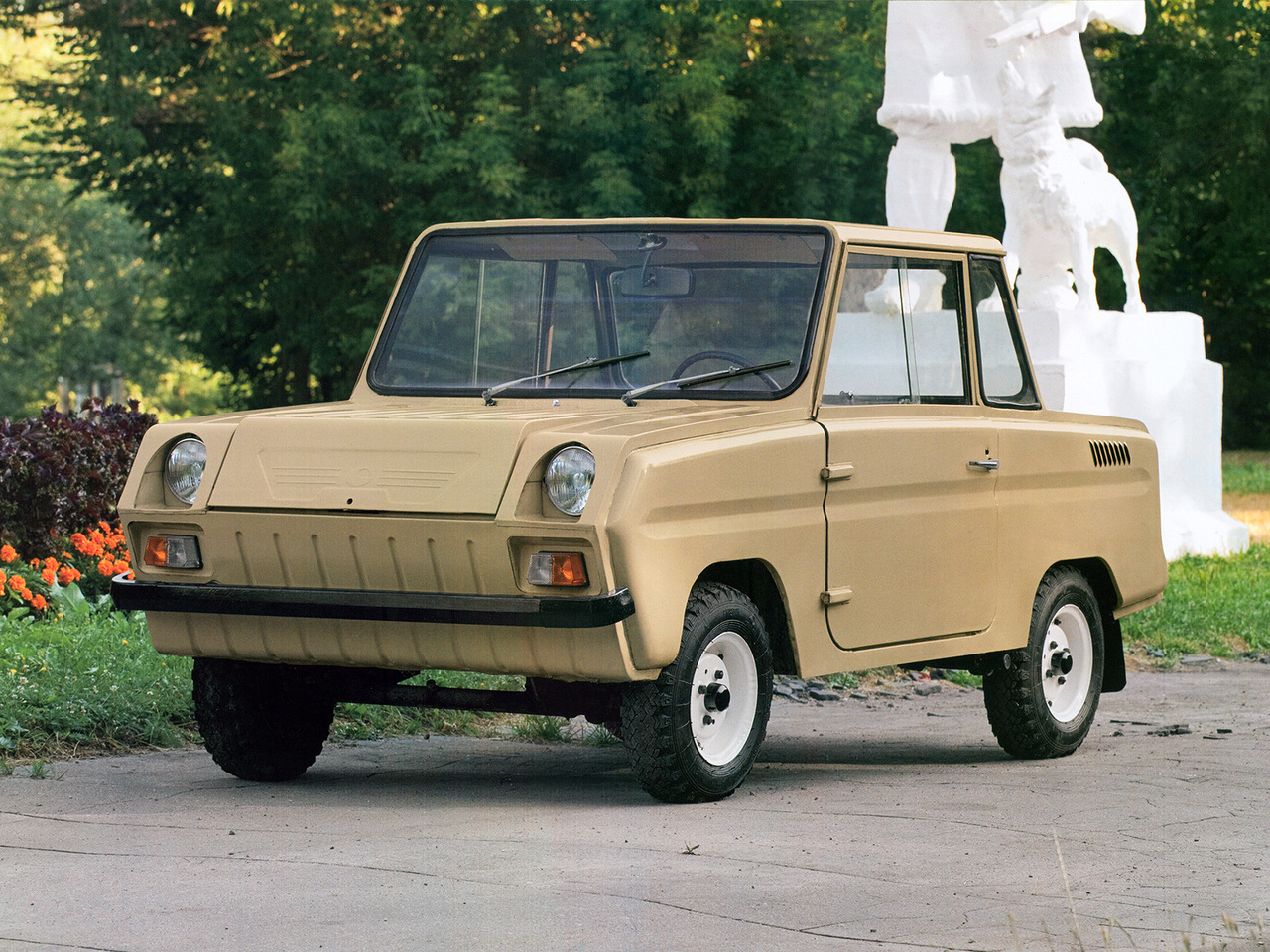
In the history of Soviet transport, a special place is occupied by vehicles created specifically for people with disabilities. One of the most well-known of these vehicles was the SMZ S-3D motor vehicle for disabled people, produced at the Serpukhov Motorcycle Plant.
The model appeared on the assembly line in 1970 and remained in production for almost three decades—until 1997. During this time, more than 223,000 units were built, making the S-3D the most mass-produced specialized vehicle for disabled people in the history of the domestic automotive industry.
A Compact Car for Everyday Mobility
The appearance and design of the motor vehicle for disabled people reflected a compromise between the capabilities of the industry and the task of providing transport to people for whom a regular car was inaccessible.
.jpg)
In terms of size, the SMZ S-3D was an extremely compact vehicle:
- length — about 2.6 m
- width — approximately 1.3 m
- wheelbase — about 1.8 m
- curb weight — 480–500 kg
Thus, the car was one of the smallest four-wheeled models produced in the USSR.
Motorcycle Engine
The motor vehicle for disabled people's power plant came from motorcycle technology. A single-cylinder, two-stroke engine with air cooling was used.
Initially, the engine developed 12 horsepower, but after a year and a half of production, a more powerful 14 hp version appeared.
Main engine specifications:
- working volume — about 346 cm³
- carburetor fuel system
- forced air cooling with a fan
The engine was installed transversely, which was a fairly progressive solution for compact cars. A similar layout was used, for example, in the famous Mini.
Dynamics and Fuel Consumption
Despite its light weight, the car's dynamic characteristics were very modest.
- maximum speed — 55 km/h
- acceleration to 40 km/h took more than 20 seconds
- power-to-weight ratio — about 28–30 hp per ton
But the fuel consumption remained very low—approximately 4.5–5 liters per 100 km.

A fuel tank with a volume of about 9 liters provided a range of approximately 180–200 kilometers.
One of the characteristic features of operation was the ingress of exhaust gases into the cabin through the rear of the body. This created rather specific conditions for the driver and passenger.
Suspension and Steering
Despite the simplicity of the design, the chassis of the motor vehicle for disabled people had a fairly high engineering level for its class.
The car received:
- independent torsion suspension of all wheels
- rack and pinion steering
- hydraulic brakes on all wheels
Small diameter wheels with narrow tires reduced rolling resistance and helped save fuel. However, on bad roads, this design worsened cross-country ability.
The minimum turning radius was approximately 4.5 meters, which made the motor vehicle for disabled people highly maneuverable in urban conditions.
Unusual Transmission
The gearbox had four forward gears and four reverse gears.
In fact, the car could develop the same speed both when moving forward and backward. In practice, this mode was almost never used, but structurally it was provided for.
The gear ratios were selected taking into account the low-power engine:
- the first gear provided high traction
- the fourth acted as an overdrive
Driving without pedals
The main feature of the car was the controls, adapted for drivers with disabilities.

There was no pedal assembly. Control was carried out using levers:
- the accelerator and clutch were located on the steering column
- the brake was controlled by a lever to the right of the driver
This scheme allowed the car to be controlled with one hand, which was an important requirement when creating the car.
Heating and operating features
The cabin heating system used a gasoline heater. In winter, its operation required attention and was sometimes accompanied by failures.
The absence of liquid engine cooling relieved owners of the need to drain water from the system in freezing weather. However, other problems appeared. For example, in wet weather the fuel pump could freeze, causing the engine to stop.
Even with the heater working properly, it was quite cold in the cabin in winter. At temperatures below –15 °C, maintaining a comfortable microclimate became difficult.
How motor carriages were distributed
SMZ S-3D was not sold freely. The cars were distributed through the social security system.
The conditions for obtaining depended on the disability category:
- people with first-degree disabilities received the car free of charge
- people with third-degree disabilities paid about 20% of the cost
The service life of one motor carriage was five years, after which a replacement with a new one was required. At the same time, the waiting list for receipt could stretch for several years.
A special driver's license was required to drive, which did not give the right to drive ordinary cars.
The design of the car was designed for a resource of several tens of thousands of kilometers, which corresponded to the small annual mileage of the owners.
Attempts to create a replacement
The idea of modernizing or replacing the SMZ S-3D arose repeatedly.
In the 1960s, the Sputnik project was developed with a fiberglass body and a four-stroke engine. However, the plant's production capabilities did not allow the production of such equipment.
In the 1990s, prototypes of "Kineshma" and "Pchelka" appeared - more modern cars with four-stroke engines with a volume of 0.5–0.7 liters and improved safety.
However, by this time the legislative framework had changed, and the certification of such equipment became extremely difficult. Serial production would require a complete modernization of the production line.
The value of the car
From a technical point of view, the SMZ S-3D was a fairly simple and even primitive car. It was distinguished by modest dynamics, limited reliability and specific operating conditions.
Nevertheless, for many people with disabilities, this motor carriage became the only opportunity to have personal transport and move freely outside the yard or the nearest area.
After production ceased in the 1990s, a full-fledged replacement for it never appeared, and the problem of affordable transport for people with disabilities in Russia became especially noticeable.