Today, finding a Ural-375 in good condition is becoming increasingly difficult. And these vehicles are not sought after by collectors or retro technology enthusiasts. Old gasoline "Urals" are still of interest to geologists, hunters, loggers, and expeditioners - those who truly need a heavy all-terrain vehicle for work far from roads.
The problem is that most surviving vehicles have long since lost their original engine. Instead of the standard gasoline V8, owners usually install YaMZ diesel engines. It's more practical, cheaper to operate, and significantly more economical. But with this, the vehicle loses some of its character - precisely what made the Ural-375 almost legendary.
It was all about the engine.

Seven-liter V8 for an army truck
Under the hood of the Ural was the ZIL-375 engine - a gasoline V-shaped "eight" with a working volume of 7 liters.
The characteristics by the standards of the late 1950s looked very serious:
- power - 180 horsepower
- torque - 465 Nm
- cast iron cylinder block
- aluminum heads
- carburetor fuel system
At the same time, the engine required AI-93 gasoline, which for military equipment of those years seemed very unusual. Most Soviet trucks then ran on much cheaper low-octane fuel.
However, there were quite pragmatic reasons for this decision. The chief designer of the Ural Automobile Plant, Anatoly Titkov, faced a difficult task: to create the most passable truck with a carrying capacity of 5 tons and a 6x6 wheel formula.
In the late 1950s, a suitable diesel engine simply did not exist in the USSR.
Yaroslavl YaMZ engines were:
- too heavy
- too large
- poorly suited for layout
.JPG)
Installing such engines would require serious redesign of the frame and vehicle structure. And the ZIL engine was already in mass production, was relatively compact, and had good power.
In essence, the engineers chose not the ideal, but the most realistic solution.
Later, attempts were made to create their own engine - for example, the Ural-640 project. But it never reached full-scale production. As a result, the gasoline ZIL-375 remained on the conveyor for more than thirty years - from 1961 to 1992.
Fuel consumption that seems insane today
This is where the main reason for disputes around the Ural-375 begins.
The vehicle's fuel consumption was enormous:
- early versions consumed about 70 liters per 100 km
- after modernization, consumption decreased to about 50 liters
- on heavy off-road in winter with a load, the vehicle could burn up to 100 liters
The total tank volume was 360 liters, and the cruising range was usually within 600–700 kilometers.
Today, such figures look shocking. But for the Soviet army of the 1960s, the situation was perceived differently. Gasoline was cheap then, and almost all army equipment ran on gasoline engines.
One supply system included:
- ZIL-131
- GAZ-66
- ZIL-130
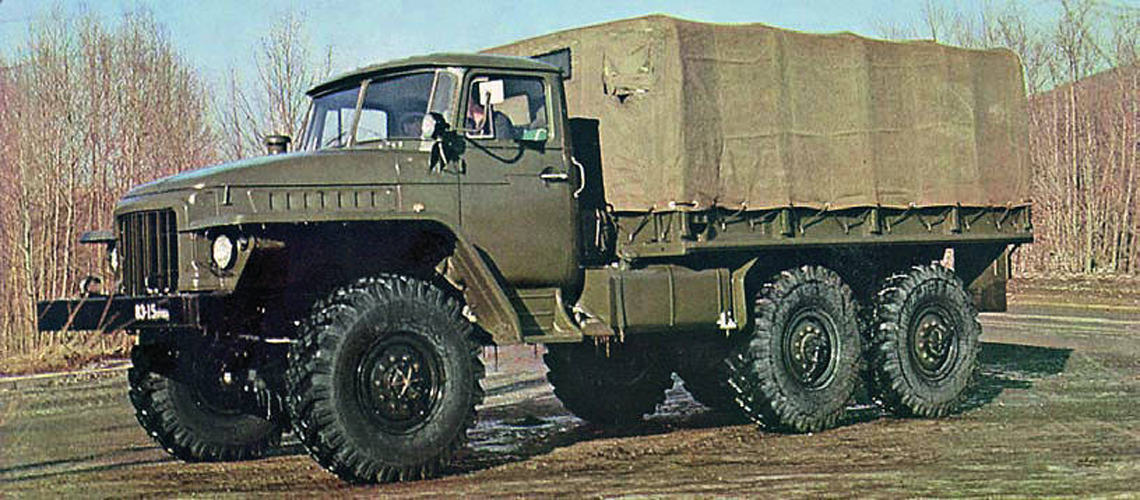
Using the same fuel simplified logistics and column maintenance.
Consumption became a problem later - in the late 1970s, when fuel costs rose, and efficiency began to play an increasingly important role even in the planned economy of the USSR.
It was then that the diesel Ural-4320 appeared, which gradually began to displace the gasoline model.
But it never fully replaced the Ural-375.
Why the gasoline Ural felt better off-road
Many drivers who worked on both the Ural-375 and the Ural-4320 still claim: the gasoline vehicle performed better on heavy ground.
The reason lay in the peculiarities of traction control.
The ZIL-375 engine lacked an all-mode speed governor. The driver directly controlled the engine's operation with the accelerator pedal. This allowed for very precise traction dosing.
On soft surfaces, this was of great importance:
- wheels less often slipped
- the vehicle moved more smoothly
- the driver felt the grip with the ground better

The diesel KamAZ-740, which was installed on the Ural-4320, had an automatic all-mode governor. When the load increased, the system itself increased fuel supply.
On hard roads, this helped. But in mud, snow, or on clay, automatic traction often led to wheelspin.
Many experienced drivers described the difference very simply: the gasoline Ural allowed the vehicle to "crawl" as smoothly and carefully as possible, while the diesel one more often tended to break the wheels into a skid.
That is why old loggers, geologists, and military personnel often spoke of the 375 with much greater respect than of its more modern diesel successor.
What else made the Ural-375 special
In addition to the engine, the vehicle had several extremely successful solutions.
One of the main advantages was the centralized tire inflation system. The driver could change the tire pressure directly from the cab depending on the surface.
For example:
- on sand, the pressure was reduced
- the contact patch increased
- the truck literally began to "float" on the surface
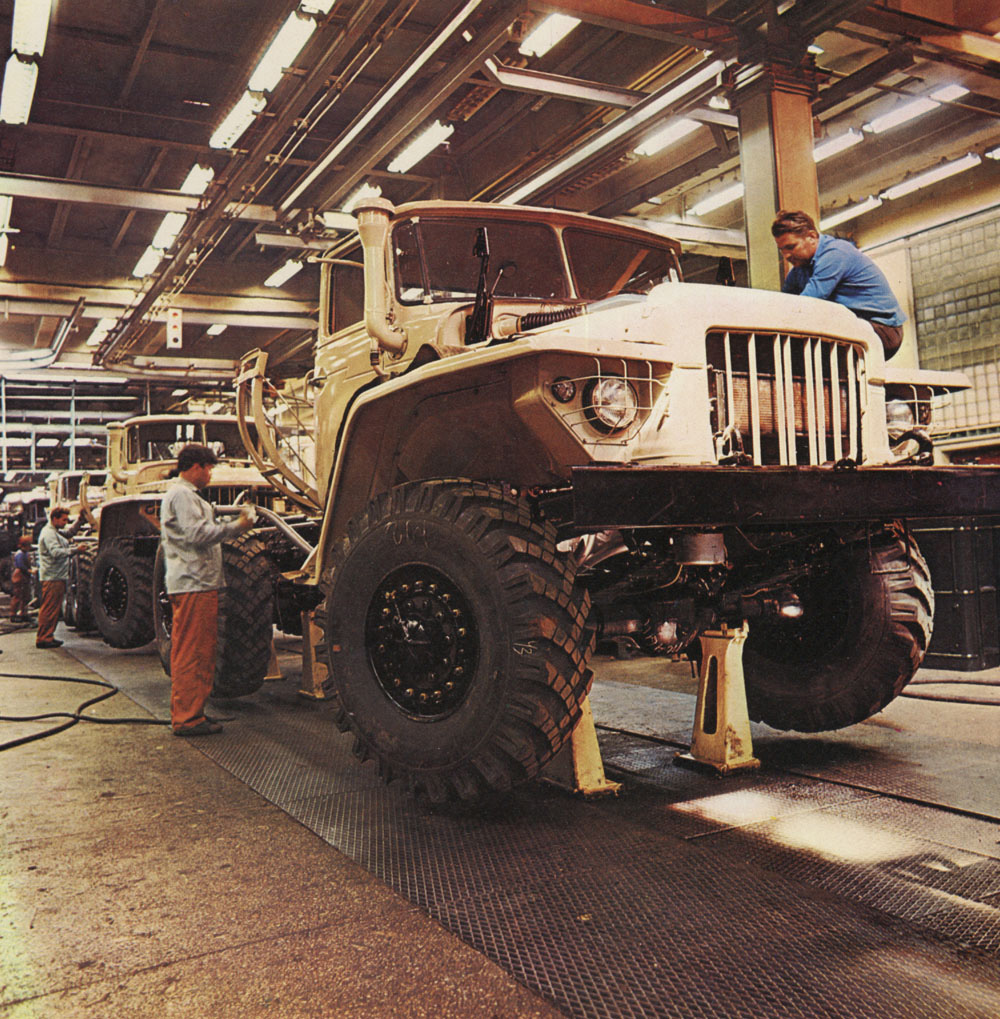
After returning to a hard road, the tires were inflated again to a normal level.
In addition, the Ural-375 received:
- three drive axles
- a transfer case with a low gear
- 400 mm ground clearance
- ability to overcome climbs up to 40 degrees
- ability to cross fords up to one meter deep
And all this - without complex electronics and often even without a winch.
Why the gasoline Ural disappeared
Despite all its advantages, the ZIL-375 engine had serious drawbacks.
The main problems were:
- huge fuel consumption
- relatively short service life
- the need for frequent overhauls
In practice, the engine often required serious repairs after approximately 150 thousand kilometers of mileage.
Diesel engines turned out to be much more profitable:
- fuel consumption decreased almost threefold
- service life was longer
- operation was cheaper
Economy ultimately defeated absolute passability.

Today, most surviving Ural-375s have already received YaMZ-236 or YaMZ-238 diesel engines. Fuel consumption for such vehicles usually decreases to 20–22 liters of diesel fuel.
But owners of old gasoline versions often say the same thing: after replacing the engine, the vehicle no longer drives as it used to.
This is the main paradox of the Ural-375. The engine that made it an off-road legend simultaneously caused this vehicle to become history.