The automotive industry of the GDR was noticeably inferior to that of West Germany in terms of production scale and technical diversity. East German enterprises mainly produced relatively simple and conservative vehicles. Nevertheless, it was here that one of the most recognizable commercial vehicles of the socialist bloc emerged – the Barkas family of light trucks, vans, and minibuses.
The model's history began in the first half of the 1950s. At that time, specialists from the national enterprise VEB "Central Workshop for the Development and Design of Trucks," located in Karl-Marx-Stadt on the site of the former Auto Union and DKW plant, were faced with a challenging task. The GDR leadership demanded the creation of a fundamentally new compact delivery vehicle capable of reaching speeds of up to 100 km/h. The project was to be based on a versatile light truck platform suitable for the production of all-metal vans, minibuses, and flatbed trucks.
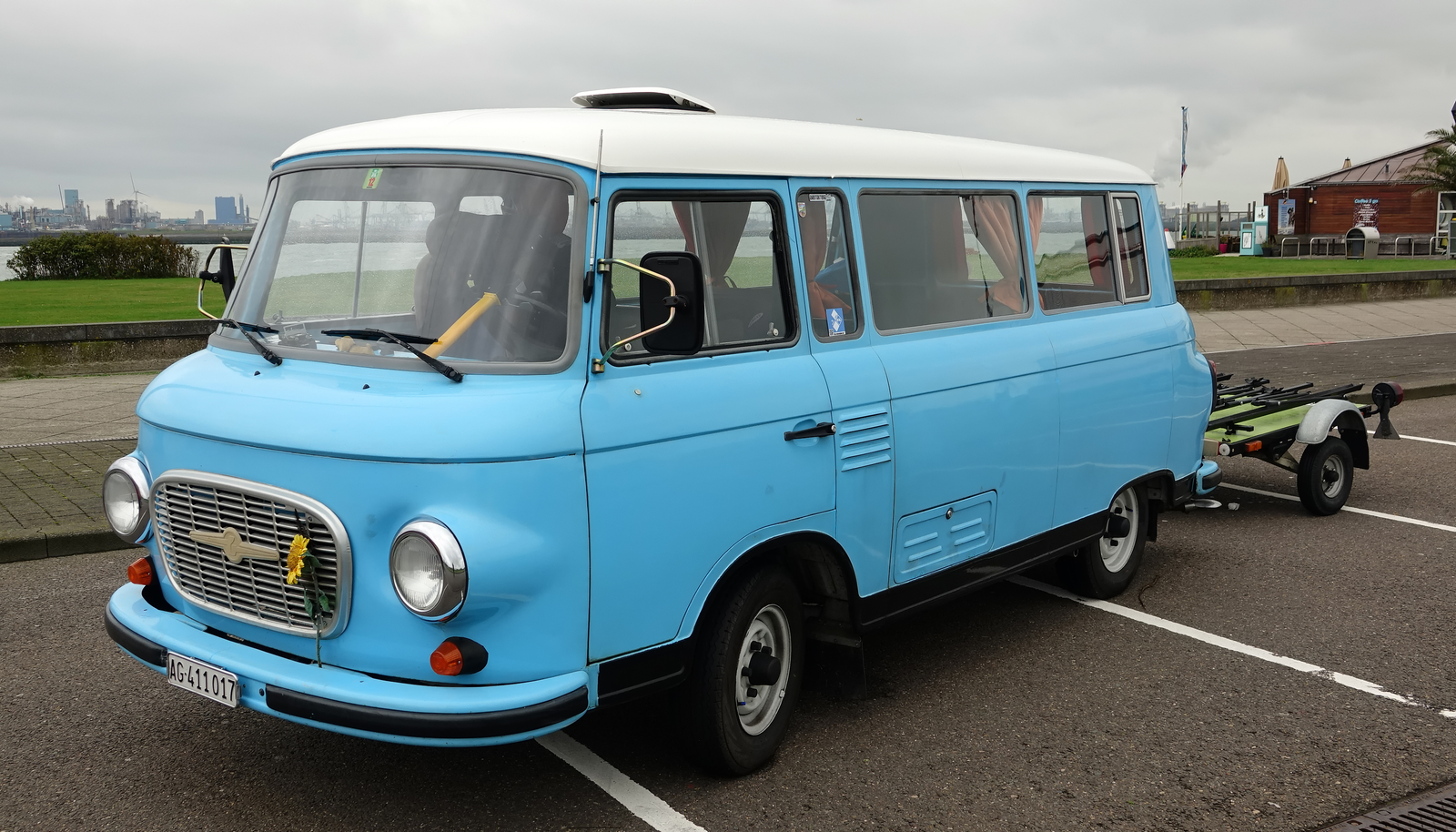
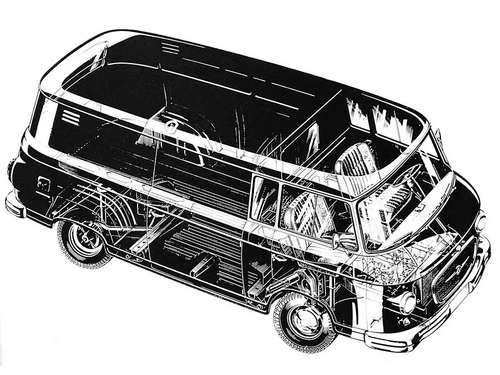
The result was the Barkas L1 prototype. For its time, the vehicle was not just modern, but in many ways ahead of its competitors. Its design incorporated solutions that were considered very progressive at the time:
- front-wheel drive;
- cab-over-engine layout;
- monocoque body;
- independent torsion bar suspension on all wheels.
Additional advantages included compact dimensions and low weight. However, the main advantage of Barkas was considered to be its ease of operation, ensured by a completely flat cargo compartment floor.
The loading height of the vehicle subsequently was only 400 mm – a figure that was considered a record for its class. For comparison, for most bonneted and frame vans of that period, including the Soviet UAZ-452 and RAF-977, the floor level exceeded 700 mm.
The choice of a monocoque body and compact design was explained not only by engineering considerations. In the mid-1950s, the GDR experienced a severe shortage of quality rolled metal, so it was necessary to use materials as economically as possible. In addition, to reduce production costs, the developers used the engine and transmission from the Wartburg 311 passenger car. This solution was also logical because the units for the "Wartburg" were already produced at the Barkas-Werke engine plant in Karl-Marx-Stadt as part of industrial cooperation.
Certification tests for the experimental Barkas L1 were completed in 1958, but the car only reached mass production several years later. Assembly line production began on June 14, 1961, and the model received the index Barkas B1000. The number in the name reflected the payload capacity – one ton. At the same time, the total weight of the vehicle reached 2240 kg. The novelty was presented to the general public a year later at the prestigious Leipzig Fair.
Production was distributed among several enterprises. Bodies were produced in Karl-Marx-Stadt, where two-stroke power units were also manufactured. Final assembly of the vehicles was carried out at the plant in Hainichen.
Despite the successful technical basis, further development of the model proceeded very slowly. Most modernizations were carried out simultaneously with the updating of Wartburg passenger cars. Over time, the power of the two-stroke engine was increased from 28 to 45 hp, the car received a trauma-safe steering column, a fully synchronized gearbox, and a dual-circuit braking system.
The most significant changes appeared only at the end of the model's career. In late 1987, the hinged side door was replaced with a more convenient sliding design. Two years later, in 1989, the car was equipped with a licensed four-stroke Volkswagen EA111 engine with a volume of 1.3 liters and a power of 55 hp, familiar from the Polo and Golf models.
The vehicle's equipment also gradually expanded. Seat belts and an electric windshield washer appeared in the cabin. Passenger versions were equipped with an autonomous gasoline heater, similar to that used on the "Zaporozhets". To improve ventilation, a special hatch was provided in the cabin roof.
The Barkas lineup was distinguished by a large number of modifications. The family included:
- all-metal van B1000 KA;
- cargo-passenger version B1000 KM;
- minibus B1000 KB;
- ambulance B1000 KK.
In addition, less common versions were produced: the semi-frame flatbed truck B1000 HP and the chassis B1000 FR, designed for installing various special equipment.
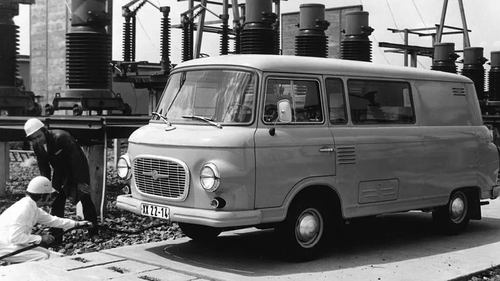
The shortage of larger trucks in the GDR led to the emergence of very unusual developments based on Barkas. Three-axle tow trucks, open excursion road trains, and even semi-trailer tractors were created on its chassis.
From an ergonomic point of view, the car combined characteristic German practicality with an extremely utilitarian approach. The seats with leatherette upholstery had a simple shape without pronounced lateral support, and the front panel was made of metal.
Most of the products of the East German automotive industry practically did not go beyond the socialist camp. The reason was the constant internal shortage of vehicles. Barkas was supplied to the Warsaw Pact countries in limited quantities. Separate batches were exported to Hungary, Bulgaria, Albania, and Egypt, but the bulk of the produced cars remained in the GDR itself.
These cars were not officially imported into the Soviet Union. They began to appear on domestic roads only after the reunification of Germany. During the entire production period, 177.8 thousand vehicles of the Barkas 1000 family were manufactured.
Read more articles:
- MAZ-200: the truck that built the post-war USSR
- Knocking, swaying, and leaking: symptoms of faulty struts
- How "Niva" inspired the creators of Suzuki Vitara
Comments