The heaviest rains caused by Typhoon Mesaak led to massive floods in China's Guangxi autonomous region and left thousands of residents without electricity. Amid power outages, owners of new energy vehicles began using the Vehicle-to-Load (V2L) function, turning their cars into mobile power sources.
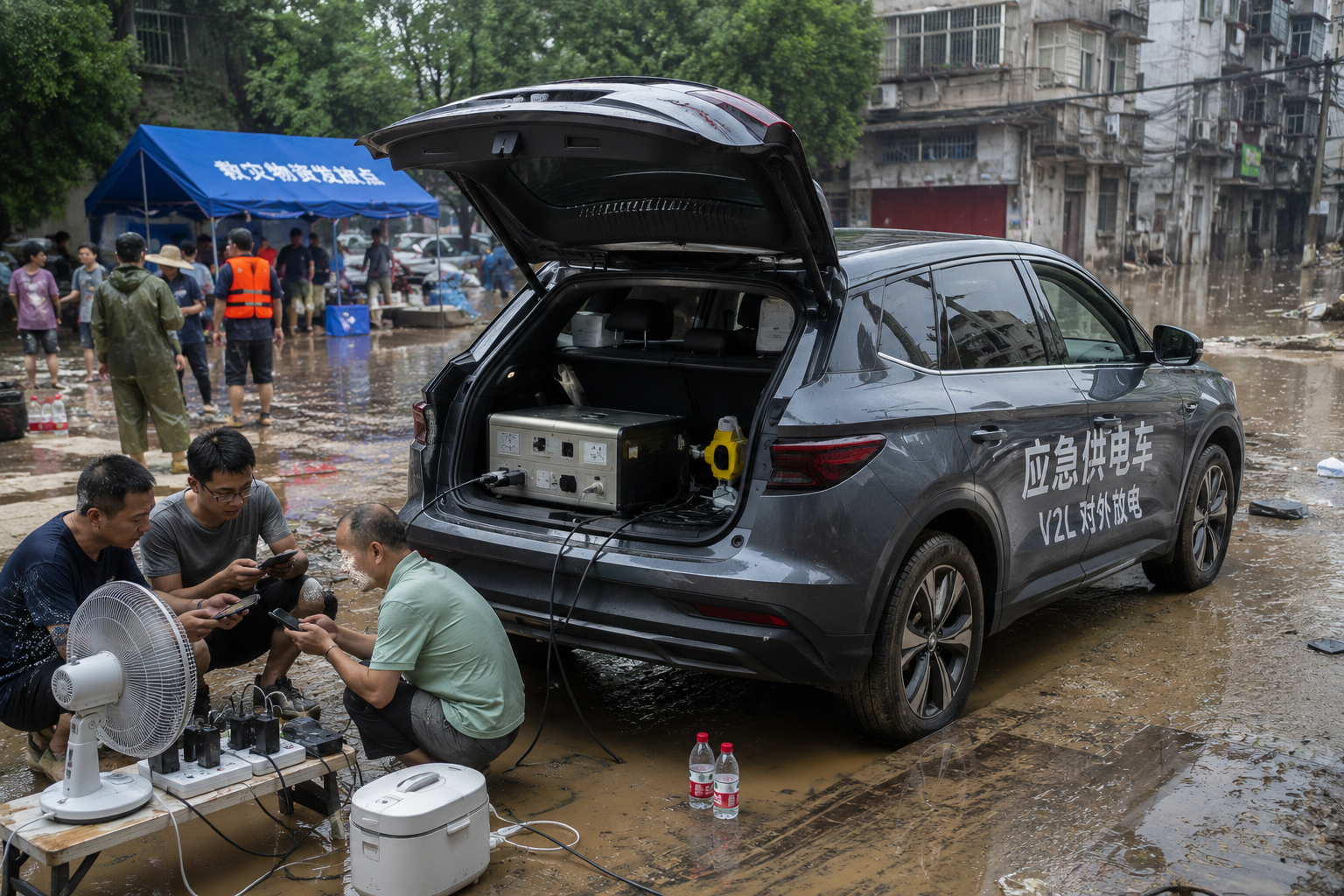
Residents charged mobile phones and other small electronics from cars, and BYD owners organized volunteer convoys to deliver humanitarian aid. A similar practice was already used during the devastating floods in China's Henan province in 2021, but today it has become noticeably more widespread due to the growing fleet of electric vehicles.
V2L technology allows the car's traction battery to be used as an external AC power source. This uses a bidirectional on-board charger that converts the battery's DC power into the familiar 220V for connecting household appliances. Most modern Chinese electric vehicles and plug-in hybrids are capable of delivering up to 3.3–6.6 kW, which is enough to charge phones, power laptops, lighting, refrigerators, or small electrical appliances. Some specialized models have significantly higher power. For example, the Geely Riddara RD6 pickup truck supports three-phase V2L with a power of up to 36 kW.
The practical value of the technology is becoming increasingly noticeable as the popularity of new energy vehicles grows. According to China EV DataTracker, in June 2026, their share in the Chinese market reached 62.9%. This means that during natural disasters, more and more cars are able to perform not only a transport function, but also provide emergency power supply.
Read more materials:
- Ayrton Senna's helmet sold for 50.8 million rubles: the artifact from the Honda era was valued higher than many supercars
- Italdesign rethought the Honda NSX: the iconic coupe was transformed into a modern grand tourer without technical modifications
- Zeekr 7 GT received five Euro NCAP stars: experts found only one serious drawback