Many self-proclaimed "experts" on cars like to repeat that it is better not to touch the throttle valve without urgent need. Their argument is simple: the equipment allegedly works more reliably if it is not disturbed. In general, it is difficult to argue with this, but this rule applies only to new cars that are operated in almost sterile conditions. The real life of the average Russian driver looks quite different: roads, fuel, and the environment are rarely ideal.
What the Regulations Say
Interestingly, neither the maintenance regulations nor the operating manual usually have clearly defined deadlines for cleaning the throttle valve. Instead of specific numbers, the manufacturer limits itself to a wording like "if there is contamination, the unit should be cleaned with a special agent, without using abrasives, powders, and solid objects." That is, the decision on the need for cleaning is actually shifted to the car owner.
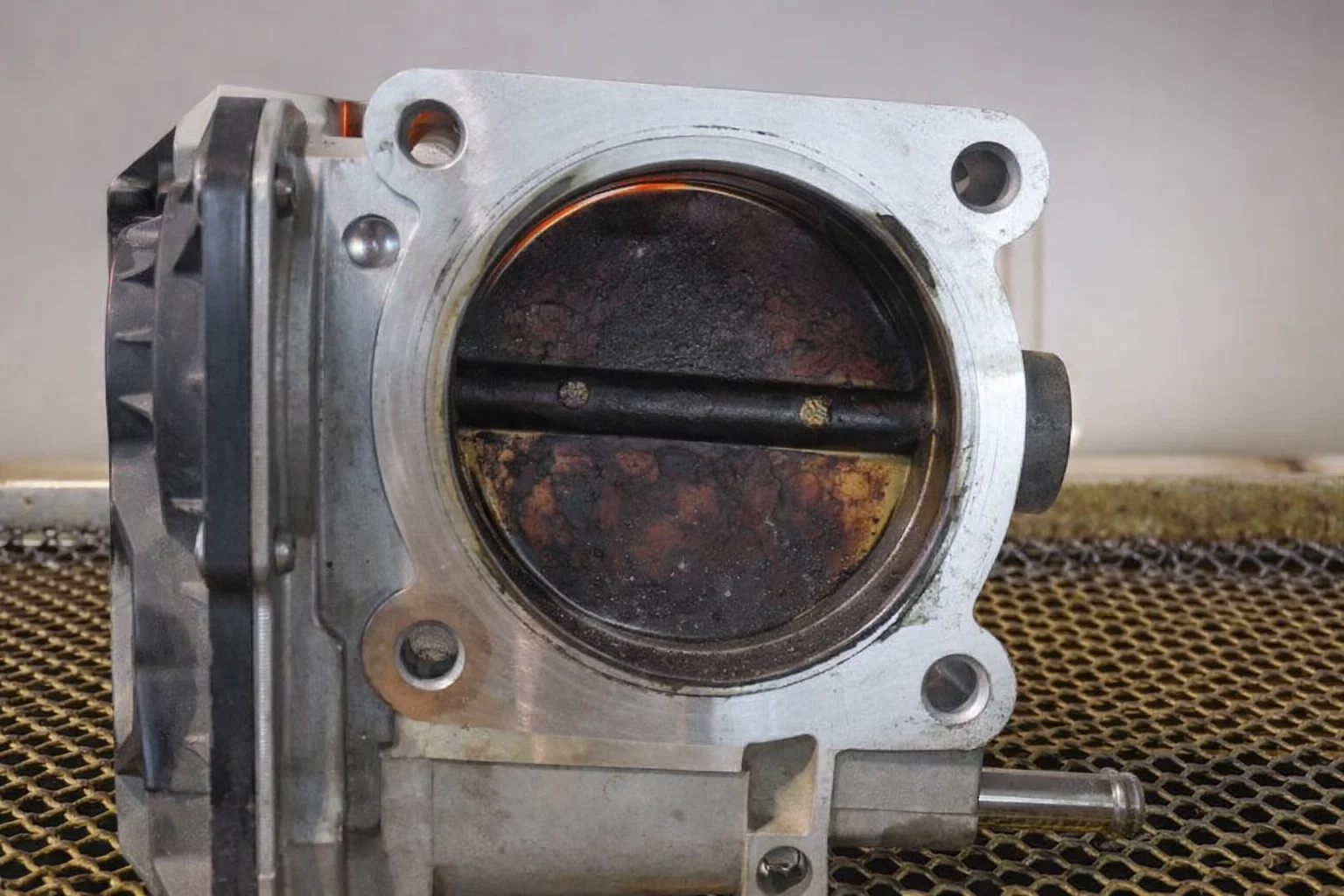
The practice of car services shows that this procedure is most often resorted to after a mileage of about 30 thousand kilometers. However, this figure cannot be considered universal. Much depends on the quality of gasoline and the conditions in which the car drives every day: one thing is calm suburban routes, and quite another is dense city traffic.
Nevertheless, the mark of 30 thousand km can quite be used as a guideline. After reaching it, it makes sense to remove the air filter and air duct to at least visually assess the condition of the throttle unit.
Where Does the Dirt Come From
If the car spends most of its time outside the metropolis, away from dense traffic and exhaust gases, the valve usually remains relatively clean. In this case, it is enough to carefully wipe the working edge and gap with a soft knitted cloth, slightly moistened with acetone, removing dust and light soot.
The pattern here is obvious: the more regularly the air filter is changed and the fewer combustion products under the hood, the slower the throttle valve gets dirty. The overall air pollution also plays a significant role. Constant standing in traffic jams inevitably leads to the accumulation of more deposits on the surface of the unit.
Sometimes the concentration of dust and soot is so high that after two or three months, the round plate of the valve is again covered with a dense dark brown coating, resembling plasticine in consistency.
Why Cleanliness Still Matters
At first glance, it may seem that contamination of the throttle valve is not too serious a problem. Modern cars have long abandoned carburetors, where the condition of the valve directly affected the idle speed. There are indeed no carburetors, but the idle mode has not disappeared. As a result, the need for periodic cleaning of the unit remained at about the same level as in the days of carburetor "Zhiguli".
The difference between cars of the Soviet era and modern models mainly comes down to the design. In old cars, the valve plate was thicker and at the same time did not always fit snugly to the mixture formation zone. In new cars, the geometry of the unit is verified much more accurately, the position of the valve is controlled by instruments, so it is really not worth disassembling the mechanism once again.
However, if the part has not been cleaned even once since the purchase, unstable idling becomes almost inevitable. The question remains the same: how to clean correctly without harming?
Proven Method
The most reliable method has not changed much over the past three decades. It is optimal to remove the throttle unit completely, apply a small amount of acetone to it from a hand sprayer, then wrap the part with a clean cloth, also moistened with solvent, and place it all in a plastic bag. In this form, the unit is left for several hours, or better - for a day.
After aging, the part is removed and a soft brush or cloth soaked in acetone or other solvent is used to carefully wash off the softened deposits to clean metal. It is important to observe the measure: no scraping with a knife, sandpaper, or other solid objects. The throttle valve is not a spark plug with burnt carbon deposits.
After completing the cleaning, it is useful to blow the unit with compressed air. If particles of soaked dirt remain in the hinges or channels, the air flow will easily remove them to the outside.
If You Don't Want to Remove the Unit
There are situations when there is simply not enough time or desire for dismantling. In this case, cleaning without removing the throttle valve from the manifold is allowed. The principle remains the same: the unit is treated with a cleaning spray for an hour and a half, after which the remaining dirt is removed with a brush and blown with air from a garage compressor.
Separately, it is worth mentioning special aerosols for cleaning carburetors. In fact, it is the same acetone, but with anti-corrosion additives. They do not harm the metal and, according to the masters, really reduce the re-adhesion of the smallest dust to the surface of the valve.
The mechanism of action of such protection is not entirely obvious - it is usually associated with static electricity. Nevertheless, the opinions of specialists agree on one thing: the tool works and does it quite effectively.
Read more materials on the topic:
- When blue exhaust is dangerous for the engine
- How to choose windshield washer fluid for a car
- How to choose wheel disks and not make a mistake