ZIL was considered the flagship of the Soviet automotive industry for many years. The enterprise produced not only trucks but also executive cars for the country's top leadership. Immediately after the war, the plant mastered the production of the famous ZIS-110 — the first truly large Soviet limousine of that level.
However, by the end of the 1940s, the enterprise clearly understood that a car designed according to pre-war canons was rapidly becoming obsolete. That is why, in 1949, the plant proactively began work on a completely new model — the future ZIL-111.
First Prototypes and the "Moskva" Project
The earliest experimental models were named "Moskva" and were initially designated as ZIS-111. Later, the situation changed: in 1956, the Stalin Plant was renamed the I. A. Likhachev Plant. After that, the project was officially named ZIL-111.
_-_31.jpg)
The first prototype was built on the ZIS-110 chassis. The car's exterior was designed by artist-designer V. N. Rostkov. This particular prototype was showcased at the All-Union Agricultural Exhibition.
But the car did not make the expected impression. By the time it was shown, its styling was already perceived as outdated. The fact is that American automotive fashion of the mid-1950s changed incredibly quickly. While Soviet engineers were refining the car, manufacturers from Detroit managed to completely update the appearance of their models.
In addition, Rostkov's car lacked a distinct individuality. Despite its impressive appearance, the limousine resembled several American cars at once. Its design was essentially a mixture of various stylistic solutions popular in the USA in the early 1950s.
Why Rostkov's Project Was Not Approved
The second prototype received some changes:
- double side molding
- new mascot figurine on the hood
- refined decorative elements
_-_34.jpg)
However, these updates did not save the situation. The plant management decided to bet on another design option proposed by designer L. M. Yeremeyev.
By that time, Yeremeyev already had serious experience. He previously worked at GAZ and participated in the creation of:
- ZIM sedan
- the first GAZ-21 "Volga"
- the future "Chaika"
Later, it was precisely because of this that some stylistic features of the "Chaika" began to overlap with the ZIL-111.
At the same time, the new project could not be called completely original either. The appearance of Yeremeyev's car clearly showed the influence of American Packard cars of 1955–1956. The similarity was especially noticeable with the Packard Patrician.
In 1957, the third prototype appeared, already made in the Packard style. Various options for decorative details, moldings, and hood design were worked out on it. The final version was the fourth prototype — with a wavy side molding and chrome trim for the taillights.
The First Soviet Limousine with a V8 and Air Conditioning
Small-scale production of the ZIL-111 began in November 1958. For the Soviet automotive industry, this car became iconic for several reasons.
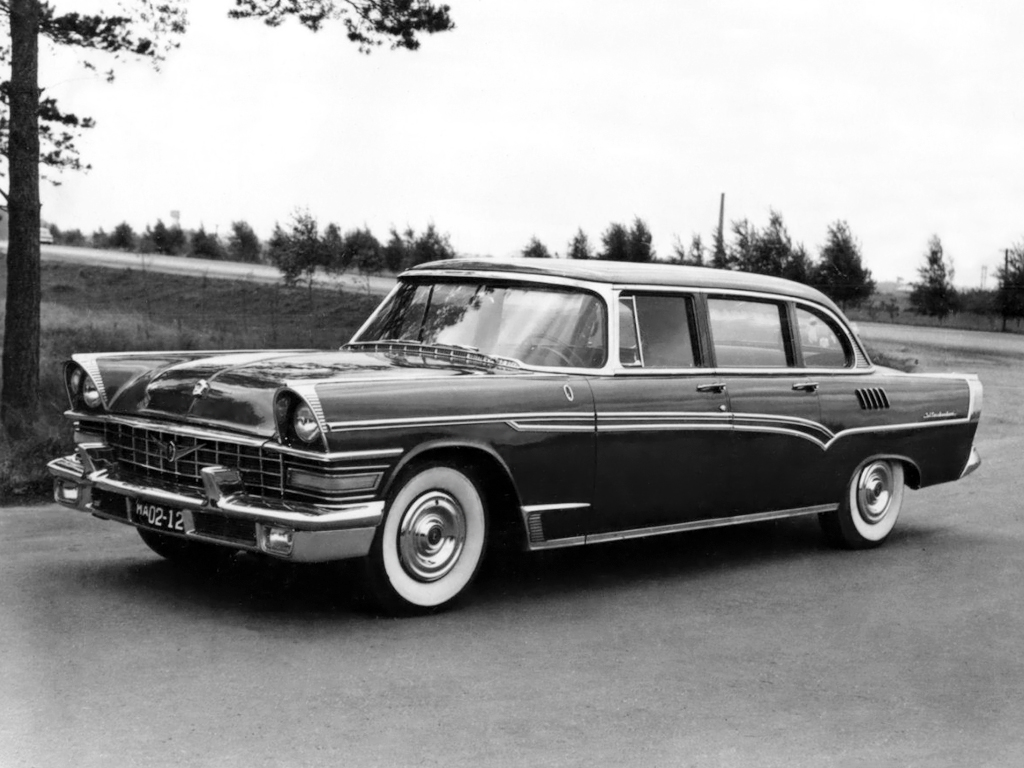
The ZIL-111 was:
- the first Soviet production car with a V8 engine
- the first domestic car with air conditioning
- one of the most technically advanced cars of its time in the USSR
Air conditioning appeared on the ZIL-111A modification, introduced in 1959.
Under the hood of the limousine was a 6-liter V8 engine with a four-barrel carburetor. Its power was 200 horsepower, and torque reached 442 Nm.
A two-speed automatic transmission with a push-button selector worked with the engine.
Despite the solid equipment, the dynamics of the huge limousine were quite calm. The car, over 6.1 meters long and weighing about 2.6 tons, accelerated to 100 km/h in about 23 seconds. The maximum speed did not exceed 170 km/h.
Comfort Was Key
High dynamics were not considered a priority for the ZIL-111. The main task of the car was to ensure comfortable and safe movement for party and state leadership.
Therefore, the equipment list looked quite impressive by USSR standards:
- power windows
- power steering
- radio with remote control
- power-operated partition
- air conditioning
In 1962, a new all-wave radio receiver AV-60 based on transistor elements was even developed for the ZIL-111G version. The 4 W device was equipped with four speakers and an external control panel.
Parade Phaeton and Major Restyling
In 1960, the family was supplemented by the open parade phaeton ZIL-111V. The car received a seven-seater body and a soft folding roof with an automatic hydraulic drive.
One of the design features was four side windows in chrome frames, fully retractable into the doors. Thanks to this, with the roof down, the car looked especially impressive and elegant.
In 1962, the model was significantly updated. The new version received the index ZIL-111G. After the restyling, the car changed almost completely.
The massive rear fins disappeared from the exterior — by that time, this design element had completely gone out of fashion.
The front part of the body changed the most:
- a wide radiator grille appeared
- twin headlight units were installed
- the overall style began to resemble the 1961 Cadillac of the early 1960s

Later, the ZIL-111D phaeton also debuted. In essence, it was an updated open version of the 111V model, made in the style of the 111G. Only eight such cars were assembled.
A Rare but Important Car
The total production run of the ZIL-111 turned out to be relatively small — about 110 cars. This is almost twenty times less than the production volume of its predecessor, the ZIS-110.
Despite its small-scale production, the ZIL-111 played an important role in the history of the Soviet automotive industry. It became a transitional stage between post-war executive cars and more modern government limousines of the 1960s.
In the middle of the decade, the plant was already working on the next generation — the ZIL-114. Serial production of the new model began in 1967. At that time, the enterprise probably did not yet assume that this particular car would be the last completely new passenger car development in the history of the plant.