Many drivers notice a strange effect: in the evening, the light from oncoming headlights starts to blur, and the windshield looks as if it's covered with a thin, matte haze. Moreover, this problem appears even in cars that have recently been washed.
At first glance, it seems that the glass is simply dirty from the outside. However, in most cases, the reason is completely different – a greasy film forms on the inner surface.

The main problem here is not just about the appearance. Such a coating significantly impairs visibility:
- intensifies glare
- reduces contrast
- tires the eyes faster
- especially bothersome at night
That's why even relatively minor contamination starts to seriously irritate during evening drives.
Where does the greasy film come from?
The main source of the coating is inside the car itself. Almost all interior materials gradually release microscopic volatile substances.
This primarily applies to:
- dashboard plastic
- rubber seals
- floor mats
- sound insulation
- various trim elements
In hot weather, the process intensifies especially noticeably. Evaporation settles on the colder glass surface and gradually forms a thin, sticky layer.
Additionally, the situation is worsened by:
- dust
- exhaust gas particles
- aerosols from the ventilation system
- tobacco smoke and nicotine residue from smoking drivers
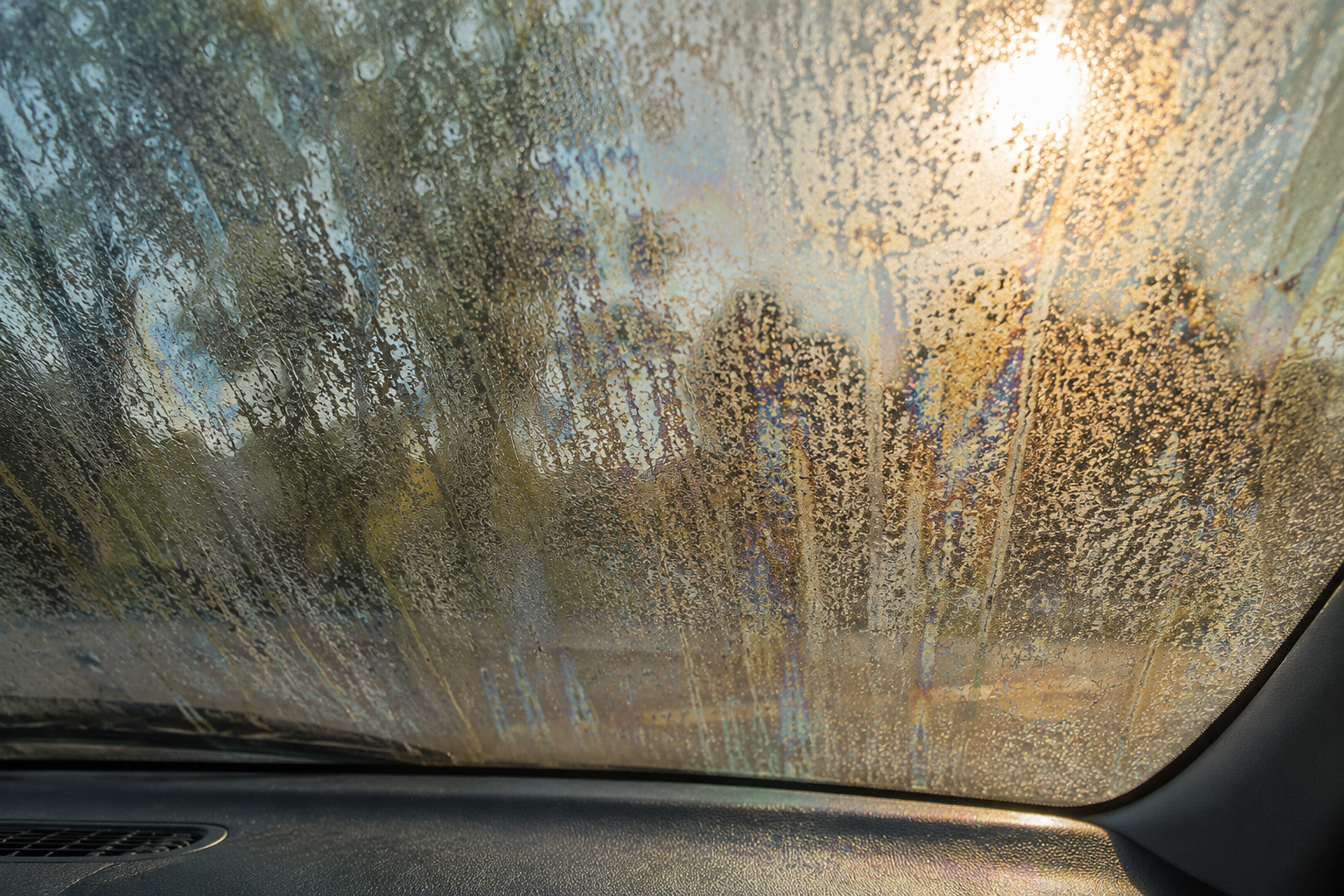
As a result, contamination appears on the inside of the glass that is practically impossible to remove with ordinary water.
It is important to consider that the glass gets dirty differently from the outside and inside. The outer side suffers from precipitation, dirt, and road dust, while the inner side is covered precisely by greasy and chemical evaporations.
Therefore, a simple wipe with a cloth usually gives only a temporary effect.
Why standard chemicals are often useless
Many household cleaners can only remove the top layer of contaminants. The greasy base remains on the surface.
Because of this, the cloudy film returns again after a few days.
Aggressive chemicals create an additional problem. Some products, after drying, leave a thin micro-film that begins to attract dust and dirt even more actively.
As a result, the glass can become cloudy literally a few days after cleaning.
How to properly remove the coating
The main task is not to smear the contamination, but to dissolve it.
Simple remedies are suitable for this:
- a weak solution of isopropyl alcohol
- table vinegar, diluted with water in approximately a 1:10 ratio
Such compositions effectively destroy the greasy base of the film and do not leave heavy residues.
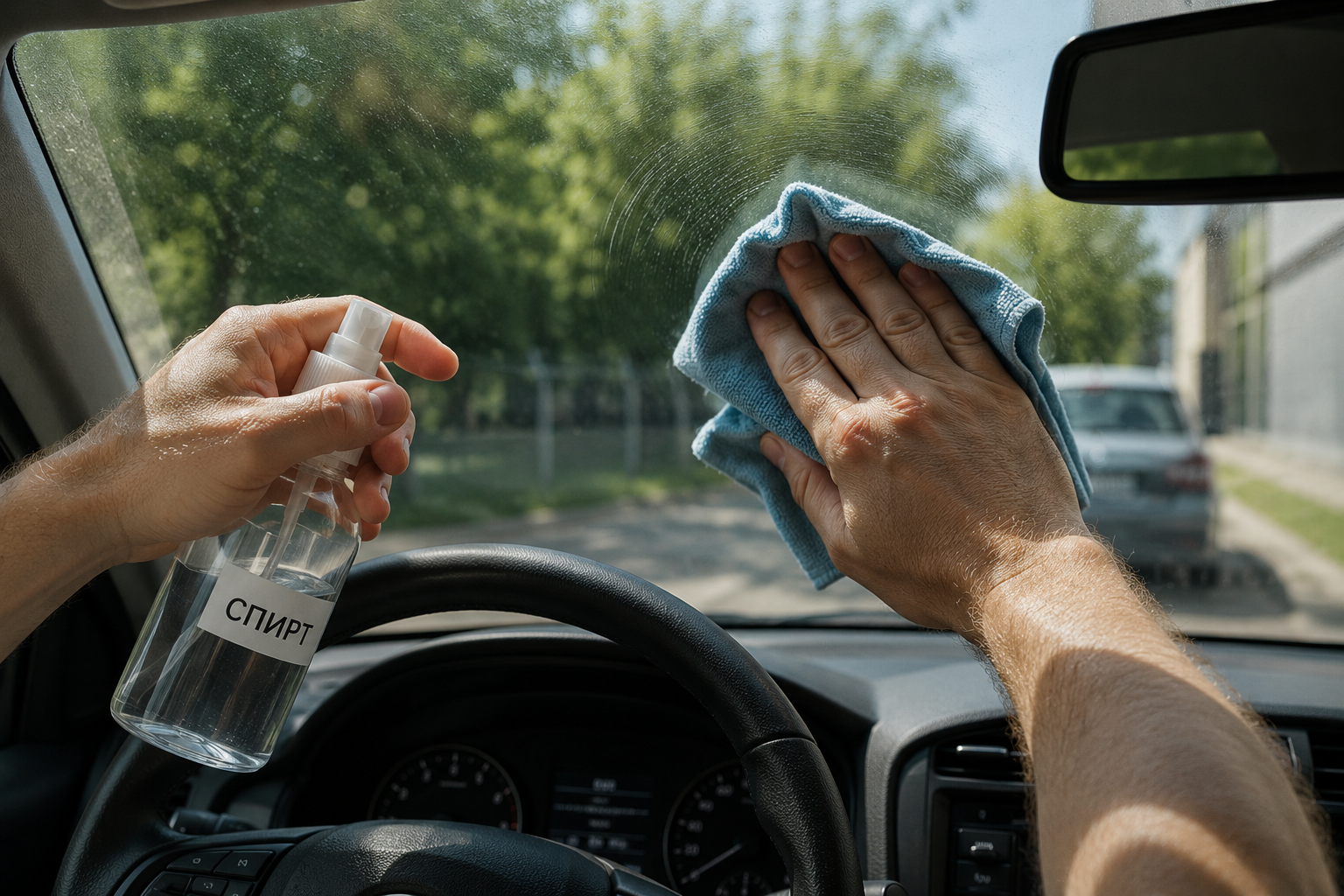
The cleaning process usually looks like this:
- the glass is first wiped with a damp microfiber cloth
- then the surface is polished with a dry, clean cloth
- any remaining moisture and streaks are completely removed
Experts advise using microfiber specifically. It does not leave lint and helps to avoid characteristic streaks, which are especially noticeable at night.
After thorough cleaning, the glass becomes completely transparent, and the surface is no longer oily to the touch.
Why the problem reappears
It is impossible to completely eliminate the formation of film. Interior materials continue to release evaporations constantly, especially in summer.
However, the rate of contamination can be significantly reduced.
For this, it is recommended to:
- regularly change the cabin filter
- do not overuse air fresheners
- periodically clean the ventilation ducts
Clean glass is not just a matter of neatness. Good transparency directly affects driving comfort and safety. Especially at night, when excessive glare and diffused light tire the eyes faster.
Read more materials:
- Why the Soviet all-terrain vehicle needed a gasoline V8
- Why Lada never got its own "Quattro"
- How to avoid car breakdowns on a summer trip
Комментарии