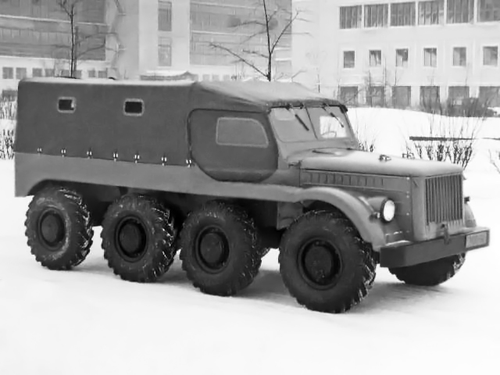
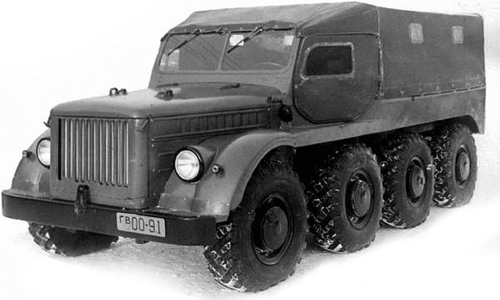
Even among numerous Soviet all-terrain vehicles, the GAZ-62B looked unusual. The machine received an eight-wheeled chassis with four axles, two of which were steerable. Such a scheme for the domestic automotive industry of that time was a real experiment and was supposed to provide exceptional cross-country ability in swamps, snow, and other difficult terrains.
However, the unusual layout was only part of an ambitious project. In fact, the GAZ-62B was created as a test platform to check the ultimate capabilities of a new kinetic transmission and an original multi-axle chassis. That is why this all-terrain vehicle is still considered one of the most interesting and little-known developments of the Soviet automotive industry.
The Army Needed a New Generation Vehicle
Work on the project began in 1956 at the Gorky Automobile Plant. In those years, the Ministry of Defense actively stimulated the creation of high-cross-country vehicles. Similar tasks were received by several design bureaus and automobile plants in the country.
Similar projects were worked on by:
- Gorky Automobile Plant;
- Ulyanovsk Automobile Plant;
- Moscow Plant named after Stalin, later becoming ZIL.
The military was looking for a universal vehicle capable of confidently moving not only off-road but also on ordinary public roads.
That is why the tracked scheme was abandoned. Despite its high cross-country ability, tracked vehicles were poorly suited for long-distance driving on asphalt and required more complex maintenance.
The designers were faced with a difficult task. The new all-terrain vehicle had to:
- transport people and equipment;
- confidently move on highways;
- overcome dirt roads;
- maintain cross-country ability in swamps and weak soils.
To achieve these goals, it was necessary to significantly reduce ground pressure, provide all-wheel drive, and at the same time maintain a relatively small vehicle mass.
The chief designer of the project was V. N. Kuzovkin, who managed to propose a very unusual solution.
From GAZ-62 to GAZ-62B
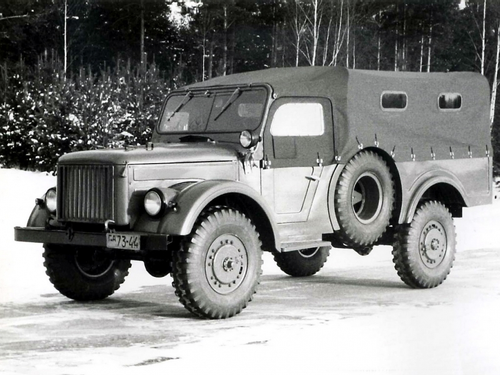
The existing GAZ-62 served as the basis for the new machine.
This car was considered one of the most durable in the Soviet automotive industry and was distinguished by high reliability. Many technical solutions were borrowed from the design of the American Dodge WC-52, which had proven itself well during World War II.
At the same time, a number of original units were developed for the new model:
- new chassis;
- special transmission;
- modernized axle layout.
As a result, a completely different car appeared, little resembling the original machine.
Unusual Four-Axle Scheme
The main feature of the GAZ-62B was the so-called composite chassis.
Formally, the design could be represented as a combination of two two-axle bogies connected by a common frame.
The torque transfer was as follows:
- the first axle was connected via a transfer case;
- the second and third axles received drive via a common driveshaft;
- rotation was distributed by a system of bevel gears.
Control was carried out by the two front axles, which was supposed to increase the maneuverability of such a long machine.
However, the main load fell on the front bogie. The engine and a significant part of the transmission units were located here, so the structure had to be seriously reinforced.
As a result, the vehicle's mass reached 4167 kilograms in curb weight, and its carrying capacity was about 1.2 tons.
The Best Engine of Its Time
A six-cylinder engine from the GAZ-12 was chosen for the all-terrain vehicle.
At that time, this 3.5-liter, 90-horsepower engine was considered one of the best power units produced by Soviet industry.
Its capabilities were sufficient to accelerate the heavy eight-wheeled vehicle to 80 km/h on paved roads.
For such an unusual machine, the figures looked quite decent.
Cross-Country Ability Admired by Testers
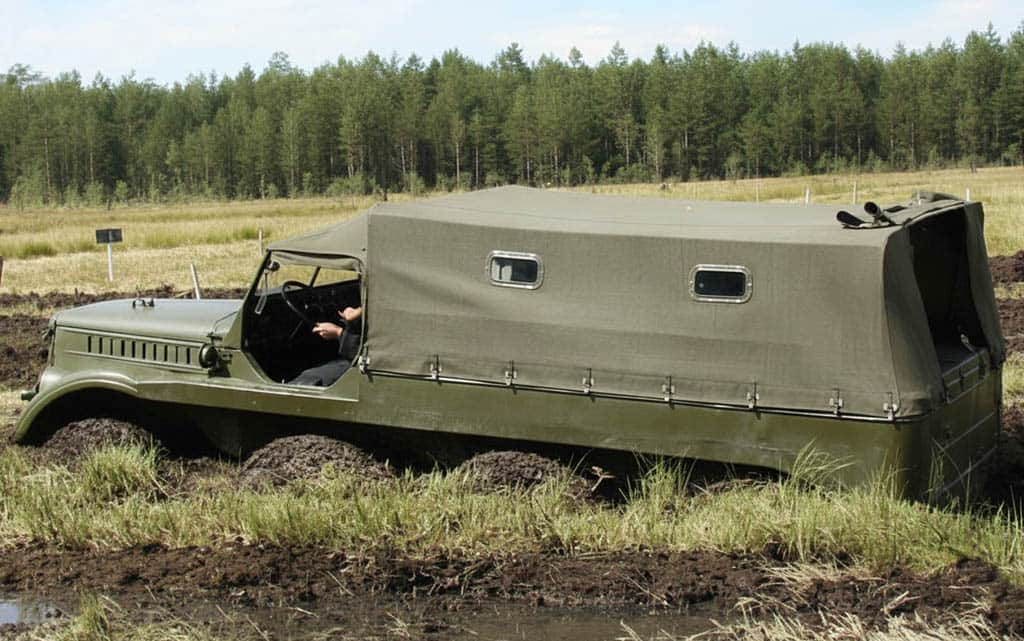
During proving ground tests, the GAZ-62B demonstrated impressive capabilities.
High cross-country ability was provided by several factors:
- all-wheel drive;
- multi-axle scheme;
- centralized tire inflation;
- wide 10.00-16 tires.
The machine felt especially good on soft soils and swampy areas.
The results were so interesting that an amphibious vehicle, the GAZ-62P, was subsequently created based on the all-terrain vehicle, capable of not only overcoming swamps but also moving on water.
Problems Revealed by Tests
Despite the successes, it was not possible to completely eliminate the shortcomings.
The main complaints concerned the transmission and control system.
During tests, it was found that the vehicle poorly tolerated wheel lift. The lack of effective locking mechanisms led to a loss of traction in difficult sections.
Maneuverability also raised serious questions.
For the normal operation of two steerable axles, a complex system of steering rods with different wheel turning angles was required. Theoretically, the scheme worked, but in practice, high loads quickly disabled:
- kingpin joints;
- steering knuckles;
- individual elements of the steering mechanism.
The machine retained the ability to maneuver, but the resource of the units was insufficient for long-term operation.
Amphibious Vehicle for Landing
One of the most unusual offshoots of the project was the GAZ-62P amphibious vehicle.
It was developed as an assault vehicle capable of disembarking from a ship directly into the water and then independently reaching the shore.
However, the military abandoned this idea.
The customer needed universal equipment for wide application, and a specialized amphibious vehicle did not meet the set tasks.
Why the Project Was Not Continued
After the completion of tests, attempts were made to adapt the GAZ-62B to the role of a medium-duty, high-cross-country truck.
However, serious limitations emerged at this stage.
The machine turned out to be:
- too heavy;
- complex to manufacture;
- expensive to operate;
- very fuel-inefficient.
An additional problem was the high precision required for manufacturing transmission units.
For prototypes, the necessary tolerances could still be maintained manually, but organizing full-scale mass production proved extremely difficult.
As a result, the Gorky Automobile Plant built only a limited number of two-axle GAZ-62s, which were sent to the troops for experimental operation. And further development of the multi-axle version did not follow.
A Machine That Remained a Legend
Despite the project's closure, specialists highly appreciated the capabilities of the GAZ-62B.
According to the recollections of testers and mechanics, this all-terrain vehicle demonstrated outstanding cross-country ability and confidently overcame areas inaccessible to most of the equipment existing at that time.
That is why the GAZ-62B is still considered one of the most interesting experimental developments of the Soviet automotive industry.
The GAZ-62B appeared during a period when Soviet designers were actively looking for new ways to improve the cross-country ability of army equipment. The unusual eight-wheeled chassis, original kinetic transmission, and impressive test results made the machine truly unique.
However, the complexity of the design, high fuel consumption, and difficulties in serial production put an end to the project's further fate.
Nevertheless, the GAZ-62B forever remained a vivid example of the engineering courage of the Soviet school of automotive engineering and one of the most unusual all-terrain vehicles ever created in the USSR.
Read more materials:
- Chinese car: what awaits after the warranty
- Why Volga Siber could not save the legendary brand
- CVT: the main horror story or a brilliant gearbox?
Comments