Today, the name Mercedes-Benz is primarily associated with executive sedans, but sports cars have always held a special place in the history of the German brand. One of the most famous representatives of the SL family was the Mercedes-Benz W113, which received the unofficial but world-renowned nickname Pagoda. This model not only continued the traditions of the legendary 300 SL but also completely changed the perception of what a modern sports-touring car should be.
It all started with victories on the race tracks
After the end of World War II, Mercedes-Benz gradually restored its position and returned to major motorsport.
The Mercedes-Benz 300 SL (W194) racing car, which debuted in 1952, became a true symbol of this return. In its first and only official season, the car achieved impressive results, winning almost all major competitions.
Among its main achievements:
- a prize-winning place in the “24 Hours of Le Mans” marathon;
- victory in the Carrera Panamericana;
- triumph at the Nürburgring Grand Prix.
These successes convinced the company's management that sporting victories could be a powerful tool for brand promotion. That is why it was soon decided to create a road version of the famous racing car.
The legendary 300 SL proved too complex and expensive
Thus, the Mercedes-Benz 300 SL (W198) was born.
Despite its civilian purpose, the car largely retained the character of its sporting predecessor. It was distinguished by high speed, required serious driving skills, and did not hide its racing origins.
However, there was another problem.
The cost of the model reached 29,000 German marks, so only very wealthy clients could afford such a car.
Mercedes-Benz quickly realized that the market needed a more affordable sports model.
The first step was the Mercedes-Benz 190 SL
The basis for the new car was the production Mercedes-Benz W120, better known as the “Ponton”.
On its platform, a modernized M127 inline six-cylinder engine with a working volume of 2.2 liters, equipped with a Bosch mechanical fuel injection system, was placed.
The engine power was 130 hp.
Thus, the Mercedes-Benz 190 SL appeared, occupying the niche of a more affordable sports car.
However, by the mid-1960s, the life cycle of both the 190 SL and 300 SL came to an end. This opened up an opportunity for designers to create a completely new model that would incorporate the company's accumulated experience.
An outstanding team of engineers worked on the new SL
The development of the car was entrusted to the young French designer Paul Bracq.
The project was supervised by several well-known Mercedes-Benz specialists:
- Technical Director Fritz Nallinger;
- Chief Engineer Rudolf Uhlenhaut;
- Engineer Béla Barényi, one of the founders of modern passive car safety systems.
It was the combination of design and engineering experience that allowed for the creation of a completely new image for the Mercedes-Benz sports car.
The new design was both strict and elegant
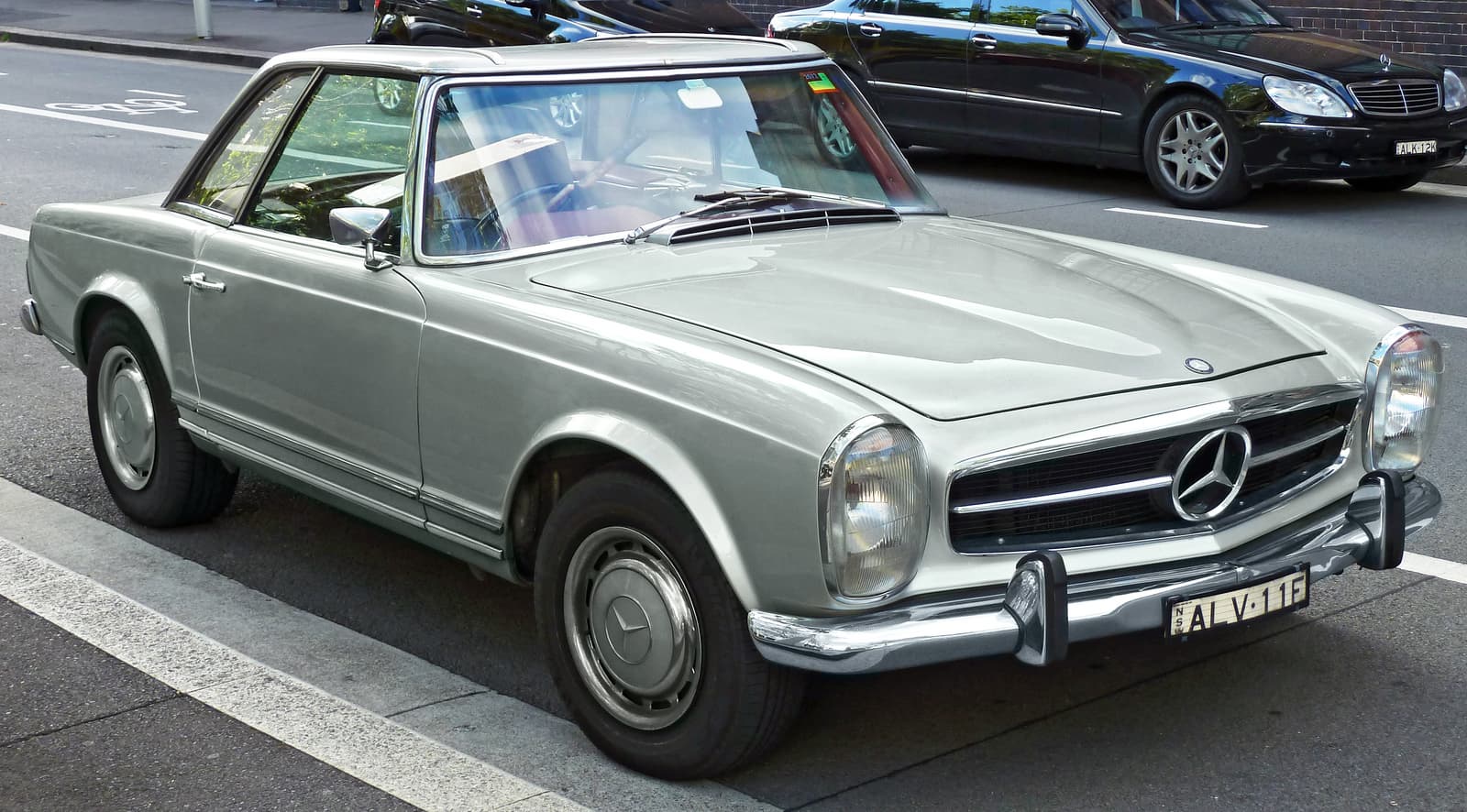
Compared to previous models, the appearance of the W113 changed significantly.
Smooth, rounded lines were replaced by strict geometric shapes, flat surfaces, and clearer proportions.
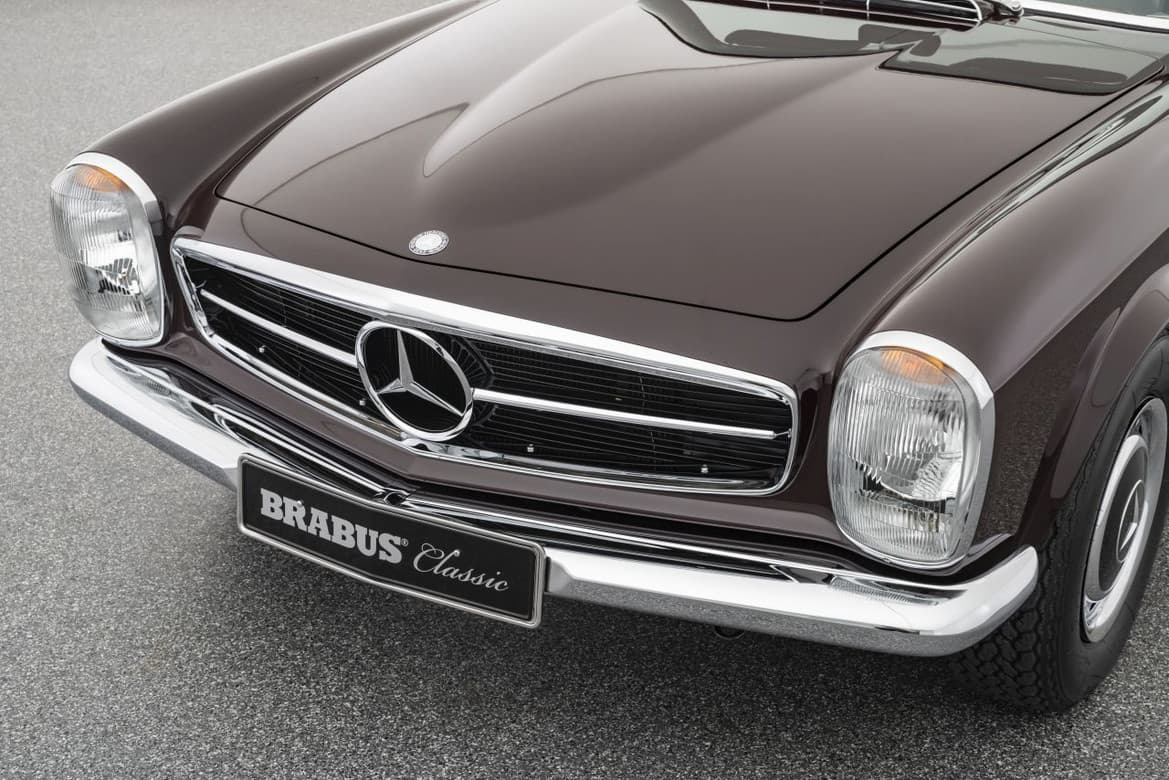
The front of the car was distinguished by:
- large vertical headlights;
- a wide horizontal radiator grille;
- a large signature Mercedes-Benz three-pointed star.
The official premiere of the model took place on March 14, 1963, at the Geneva Motor Show.
During the presentation, Fritz Nallinger formulated the main idea of the project: engineers managed to create a fast and safe sports car that simultaneously provided a high level of comfort.
This concept was fully reflected in the car's exterior. A long hood, a compact two-seater cabin, a short rear body, and a large glass area formed a silhouette that could not be confused with competitors.
Where did the name Pagoda come from?
Two versions of the car were offered to buyers.
One could choose:
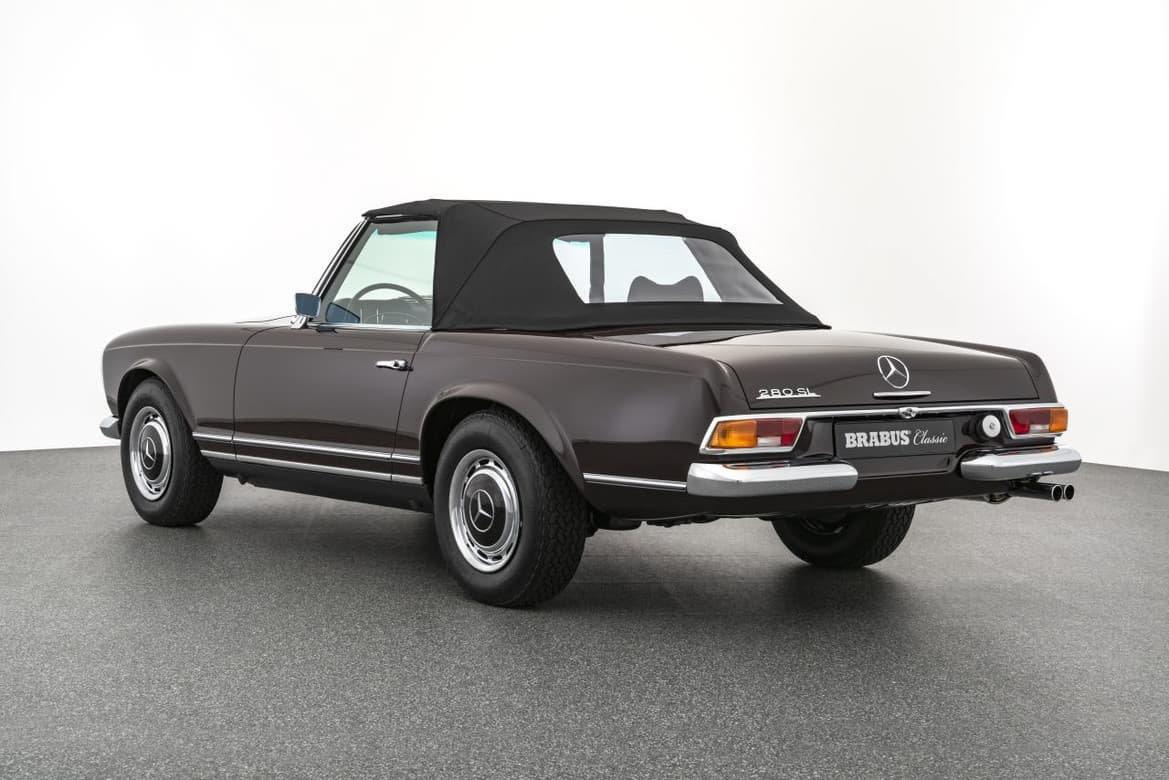
- a classic roadster with a soft folding top;
- a version with a removable hardtop.
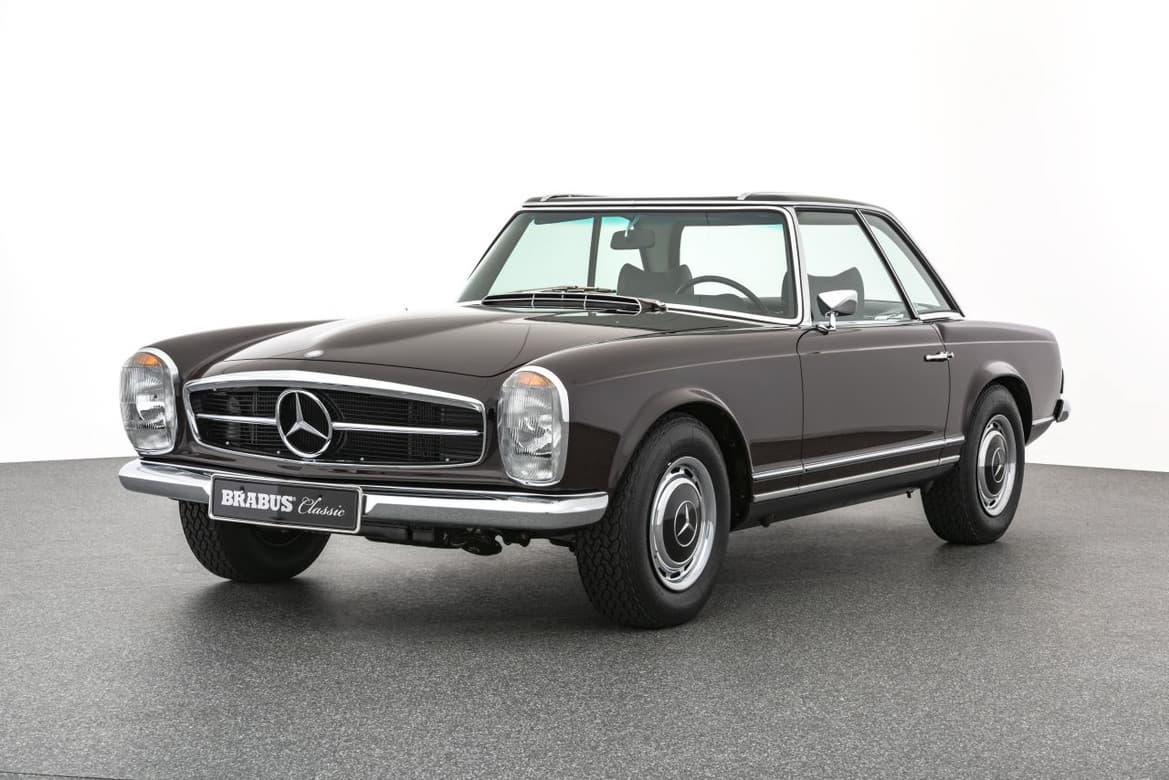
The cost of the 230 SL was 21,300 German marks, and the hardtop version cost only 150 marks more.
It was this hardtop that later gave the car its world-famous nickname.
Béla Barényi designed the roof in such a way that it simultaneously provided additional safety in the event of a rollover, protected passengers from bad weather, and allowed the upper surface to be used for luggage transport.
For this, the central part was made slightly concave. One journalist compared this shape to the roof of an oriental pagoda, after which the name Pagoda was forever attached to the model.
Sporty character without unnecessary strain
The car entered the market under the designation Mercedes-Benz 230 SL.
Under the hood, an inline six-cylinder engine with 150 hp was installed, allowing it to reach speeds of up to 200 km/h.
In terms of its capabilities, the new model occupied an intermediate position between the previous 190 SL and 300 SL.
The chassis included:
- independent front suspension with double wishbones;
- coil springs;
- telescopic shock absorbers;
- anti-roll bar;
- signature Mercedes-Benz rear suspension with a single-pivot swing axle and a horizontally mounted central spring.
Sales started in the summer of 1963, and almost immediately the car gained widespread popularity.
One of the reasons for its success was the option to order an automatic transmission — a solution that was practically unheard of in sports cars of this class before.
In addition, power steering was offered to buyers for the first time.
Thus, Mercedes-Benz finally abandoned the idea that a sports car must necessarily require serious physical effort from the driver.
Comfort did not hinder excellent handling
Despite the increased attention to ease of use, the W113 did not turn into an ordinary cruising convertible at all.
The car received:
- an effective braking system;
- excellent handling;
- balanced chassis settings.
Its character became less sharp compared to previous SL models, but it was precisely the combination of comfort and dynamics that proved to be the main advantage of the new car.
Engineers paid great attention to safety
During the development of the W113, designers faced a difficult task.
It was necessary to create a maximally rigid body while maintaining compliance with the requirements of the Sport Leicht — “sporty light” class.
To compensate for the weight of the strong steel frame, a number of external elements were made of aluminum.
Light alloy was used for:
- hood;
- trunk lid;
- door panels;
- outer sill trim.
The interior was also designed with safety requirements in mind.
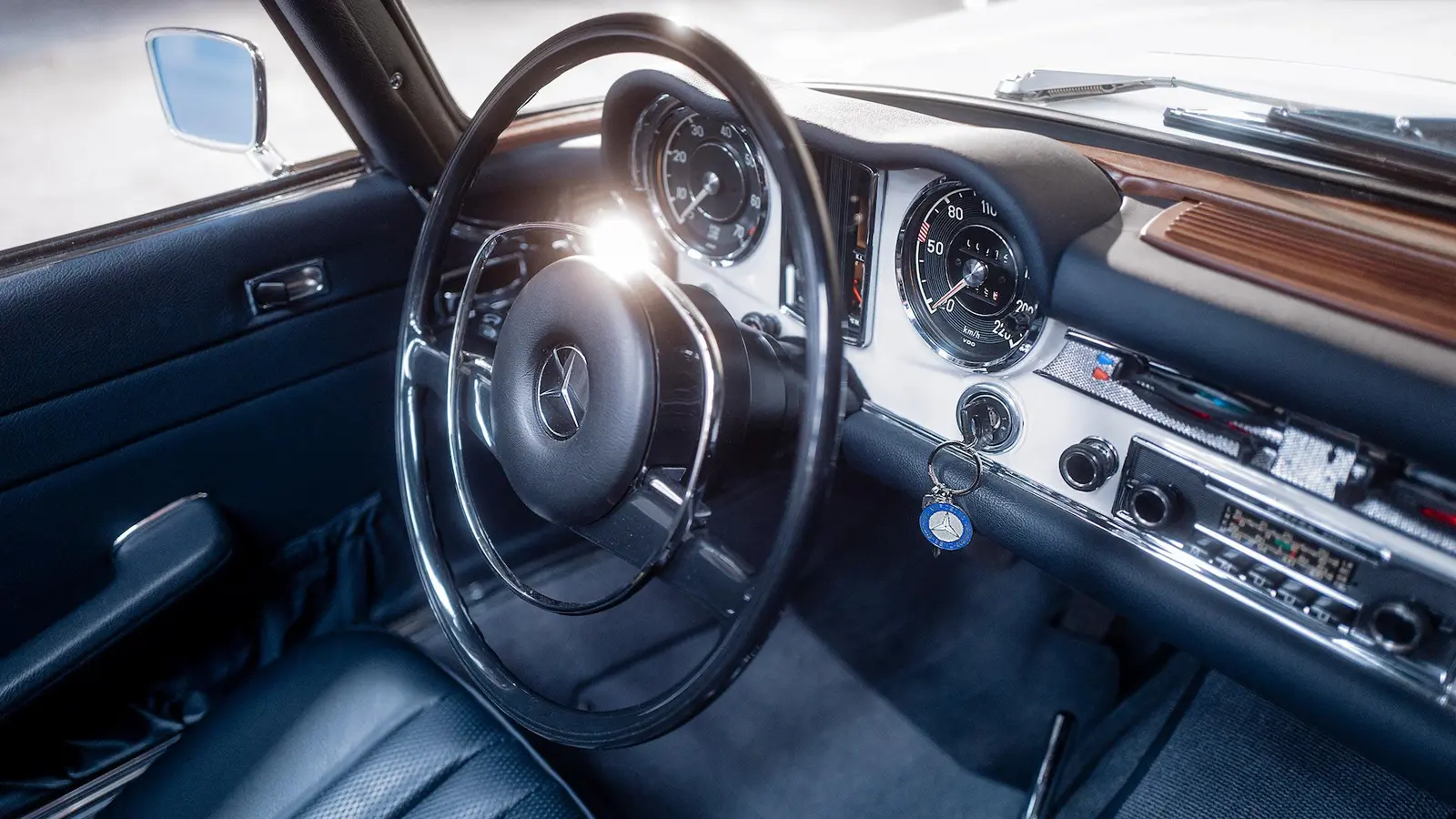
The dashboard received soft trim without sharp elements, the steering wheel was equipped with an injury-safe central pad, and the signature multifunctional lever to the left of the steering wheel combined control of turn signals, wipers, and washer.
Standard seats were upholstered in artificial leather, and natural leather was offered for an additional fee.
Model evolution continued until the end of production
At the end of 1966, the 250 SL debuted, equipped with an M129 engine with 150 hp.
Already in January 1968, it was replaced by the 280 SL, which received an M130 engine with 170 hp.
The most powerful version showed very decent performance:
- acceleration to 100 km/h — just over 9 seconds;
- maximum speed — 200 km/h.
At the same time, the car did not strive to impress with complex technical solutions — its capabilities were fully sufficient for confident competition with sports cars of its time.
Basic anatomical seats were upholstered in high-strength MB-Tex vinyl, and the list of optional equipment included a dual-zone ventilation system with separate slider controls for the driver and passenger, an analog Kienzle clock, illumination for the lockable glove compartment, sun visors with a vanity mirror, a signature Becker radio, and a set of leather suitcases specially made to fit the luggage compartment dimensions.
The American market ensured the model's huge success
One of the most important markets for the Mercedes-Benz W113 was the United States.
Approximately 40% of all manufactured cars were supplied there.
Production of the model continued almost without significant changes until 1971.
During this period, Mercedes-Benz produced about 49,000 cars, of which 19,500 found buyers in the USA.
For the company, this result was outstanding. The combined circulation of the 300 SL and 190 SL models never exceeded 30,000 units, while the “Pagoda” alone significantly surpassed this figure.
The Mercedes-Benz W113 forever entered history as a car that completely changed the philosophy of the SL family. It convincingly proved that a sports car can simultaneously be dynamic, safe, comfortable, and suitable for everyday use. It is thanks to this combination of qualities that the “Pagoda” remains one of the most recognizable and respected models in the history of the German brand.
Read more materials:
- It's too early to write off ICEs: automakers have brought the efficiency of gasoline engines to a new level
- Mercury Bobcat: The Forgotten Hero of American Automotive Industry
- UAZ-300: The Forgotten Project from Which the "Bukhanka" Grew