Before the appearance of KamAZ vehicles, the Minsk Automobile Plant remained one of the leading manufacturers of heavy trucks and quarry dump trucks in the USSR. Over the years, the enterprise accumulated significant experience in creating eight-ton machines, so it might have seemed that designers had already managed to foresee most operational problems.
However, each new model had its own peculiarities. The MAZ-5549 was no exception — a dump truck that simultaneously boasted outstanding endurance, high performance, and a very difficult character. The machine required great experience and attention from the driver, but with proper operation, it responded with exceptional reliability.
From MAZ-503B to MAZ-5549
The model's history began much earlier than the official appearance of the MAZ-5549 index. Although the vehicle received this designation only in 1976, its predecessor was actually the MAZ-503B, production of which started back in 1965.

This machine formed the basis of the future dump truck, subsequently receiving a number of design improvements. One of its main advantages was the YaMZ-236 diesel engine with a V-shaped six-cylinder. It developed 180 hp and provided torque at the level of 650–670 N·m.
It was this engine that largely determined the machine's popularity among drivers. Many agreed to work on the Minsk dump truck precisely for the Yaroslavl diesel, despite the far from comfortable operating conditions.
The main disadvantages of the first machines were:
- very strong cabin vibrations;
- unsuccessful ventilation system that sucked road dust inside;
- poor efficiency of the standard heater in winter.
Due to the poor performance of the heater, drivers often had to install additional heating radiators themselves and use various makeshift solutions. Despite this, the YaMZ-236 engine confidently coped with heavy climbs and broken roads. Even in severe frosts or regular overheating, the power unit continued to work, keeping the vehicle itself in service.
Why the Dump Truck Developed a Difficult Character
In 1976, the model officially received a new designation — MAZ-5549. At the same time, the car was slightly updated externally: the location of the headlights and the color of the turn signals changed.
There were also changes in the cabin. A sprung seat was provided for the driver, but the first batches of cars were still equipped with the old rigid seats. Therefore, many owners had to modify the seat themselves, installing spring suspension, or look for an opportunity to replace it with a new design.
Such a decision was dictated not by a desire to increase comfort, but by a real necessity. The cabin was rigidly attached to the frame, so engine and transmission vibrations were transmitted almost without attenuation. During movement, the load was so high that long hours behind the wheel became a serious test.
A similar problem was characteristic of many Soviet trucks. Designers of the Minsk Automobile Plant tried to at least partially reduce the impact of vibrations, but the enterprise's capabilities were limited.
In foreign models of that time, the cabin was often designed in such a way that it acted as a kind of balancer relative to the engine. Creating such a design required numerous prototypes and prolonged tests, and the Minsk Automobile Plant could not afford such expenses.
As a result, the cab-over-engine layout was simply shifted forward, hoping to reduce the load on the rear axle. Theoretically, the idea seemed justified, but in practice, the driver, along with the cabin, constantly experienced strong vertical rocking, as if on a swing.
Design Flaws
Moving the cabin forward led to another peculiarity. The front of the car turned out to be overloaded, so on sandy sections, the MAZ-5549 often got stuck. If the front wheels sank into loose soil deeper than the tire profile height, it was almost impossible to get out on its own.
No less serious difficulties were created by the lifting mechanism and the attachment of the body to the frame. The design did not provide for additional or intermediate subframes that could redistribute the load from a fully loaded body.
Because of this, another characteristic problem arose. If the dump truck began unloading on an uneven surface, sand or gravel could shift to one side. As a result, the load was distributed unevenly, which led to serious consequences.
The most common were:
- frame twisting;
- damage to spring mounts;
- breakage of individual leaves of the spring pack.
The situation was aggravated by the fact that the rear suspension was constantly operating almost at its limit.
Therefore, the operation of the MAZ-5549 required careful attention to all the machine's features. Any mistake could lead to serious loads on the structure, but with proper operation, the dump truck demonstrated a very high margin of safety.
Why Drivers Valued the MAZ-5549
Despite numerous shortcomings, the Minsk dump truck was held in high regard among drivers. Many indeed preferred to switch to more modern and comfortable KamAZ trucks, but in the most difficult conditions, the MAZ-5549 often proved to be the most reliable assistant.
When it was necessary to fulfill the production plan at any cost, the machine justified the trust. Even an overloaded body did not become an insurmountable task for it. The transmission could make noise, the car could creak and work hard under load, but the dump truck continued to do its job. At construction sites, bodies were often loaded significantly more than the established norm, and the MAZ-5549 coped with such operation.
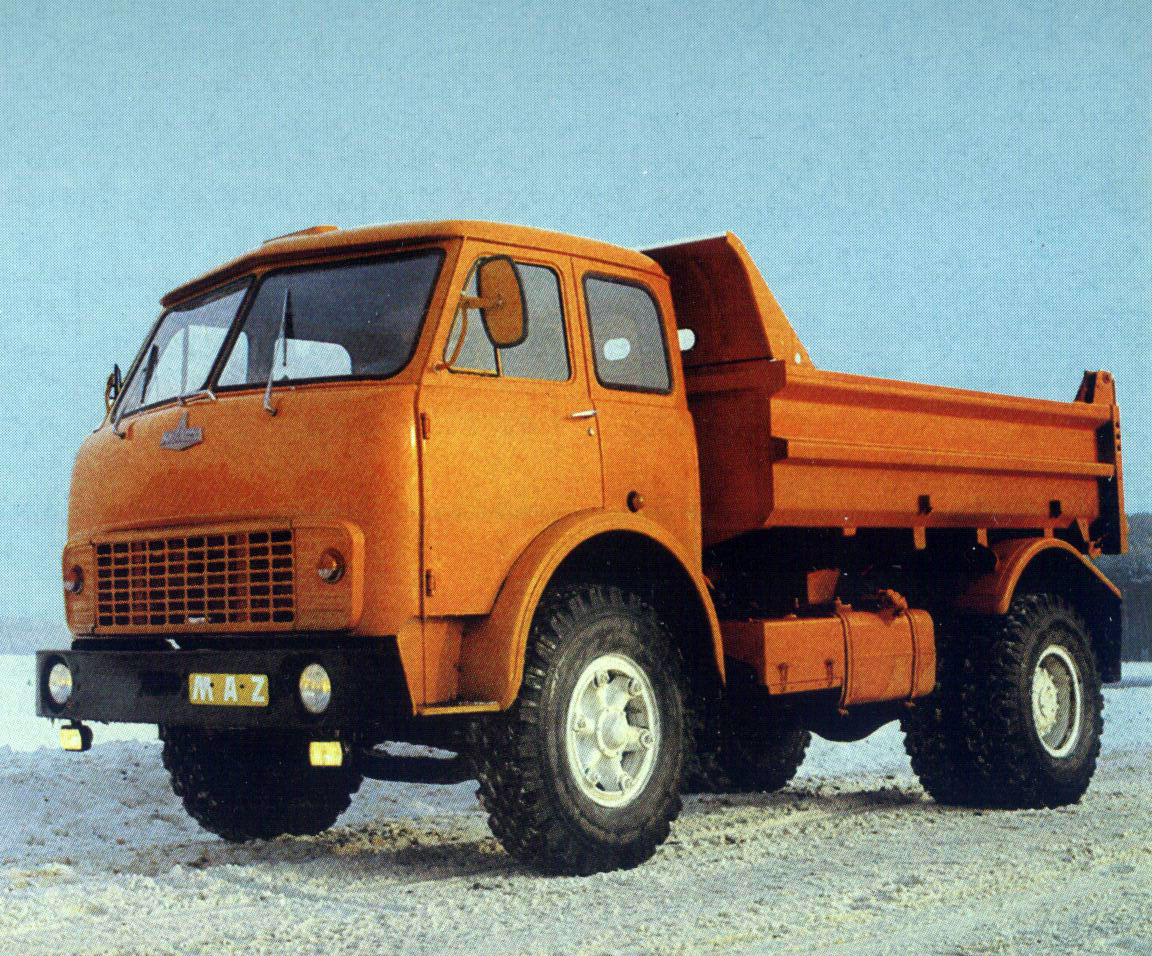
The machine's advantages were especially evident in winter. In frosts of about 30 degrees, many KamAZ trucks were not allowed on the line, while the MAZ with a YaMZ diesel started without serious difficulties. Of course, drivers had to contend with the poor performance of the heater and the freezing of moisture in the receivers, but such problems were usually eliminated by their own efforts.
Working on the MAZ-5549 was never easy. The dump truck required experience, accuracy, and an understanding of all design features. But in difficult conditions, the machine rarely failed, which is why it earned a reputation as one of the most reliable Soviet construction trucks.