Today, it's hard to imagine a gas station without gasoline and diesel fuel. But in the 19th century, the situation was completely different: gasoline was more of a hindrance than a help to oil refineries. Kerosene was considered the main product – it was poured into lamps, used for cooking, and bought in stores almost like an ordinary household item.
Gasoline, which was obtained among the first light fractions during oil distillation, remained practically unclaimed for a long time. Due to its high flammability, it was not stored in large quantities, and there were almost no suitable applications. Excesses could be burned in special pits or even dumped into rivers. A small part of the product was sold through pharmacies: it was used to treat wounds and remove stains from clothes.
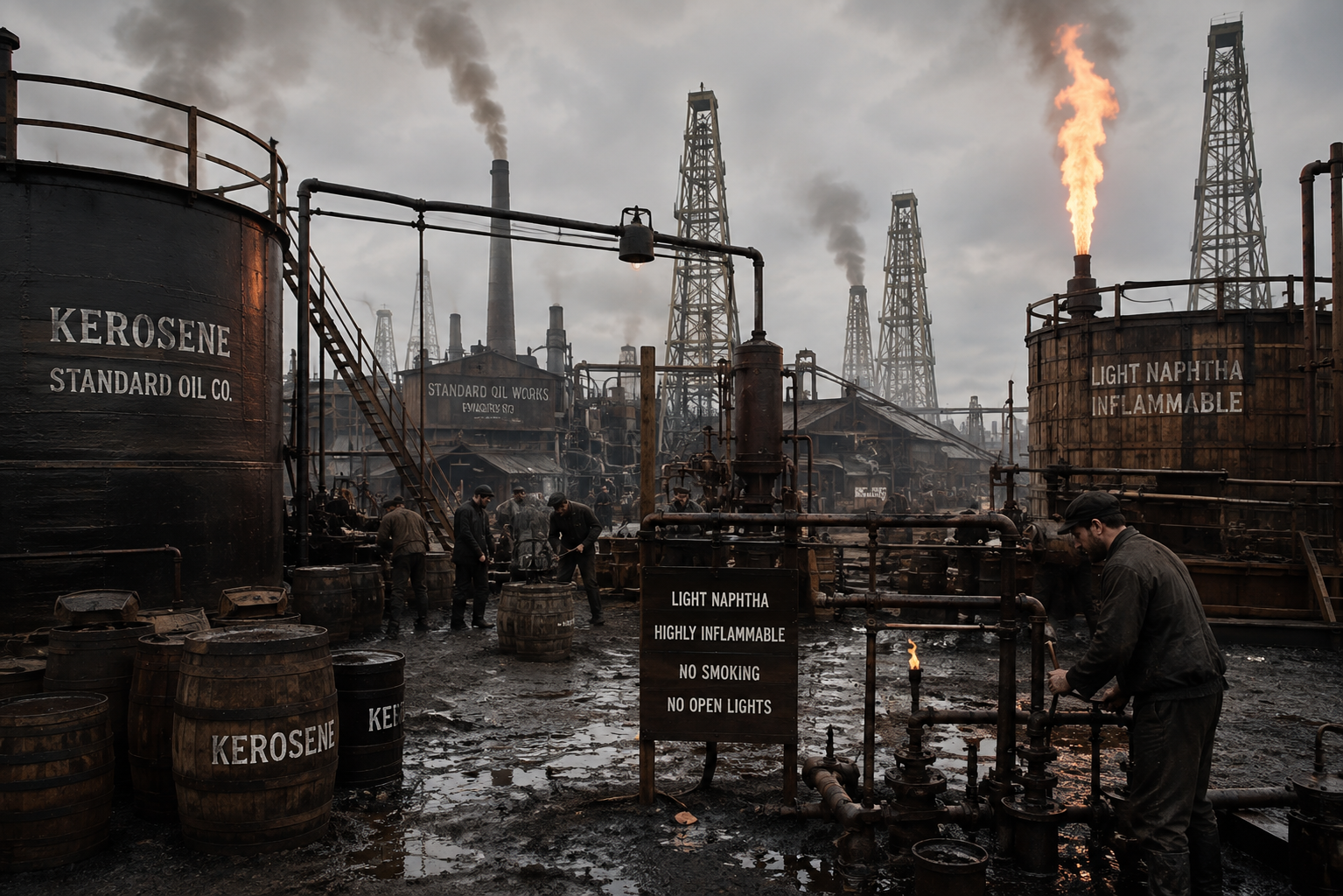
However, in just a few decades, the situation changed dramatically. Electric lighting practically destroyed the former role of kerosene lamps, and the rapid spread of automobiles turned gasoline into a valuable fuel. Kerosene itself found other uses – in aviation and heating. Attempts were made repeatedly to make it work in piston car engines, but it never became a mass automotive fuel.
The gasoline engine is too demanding for kerosene
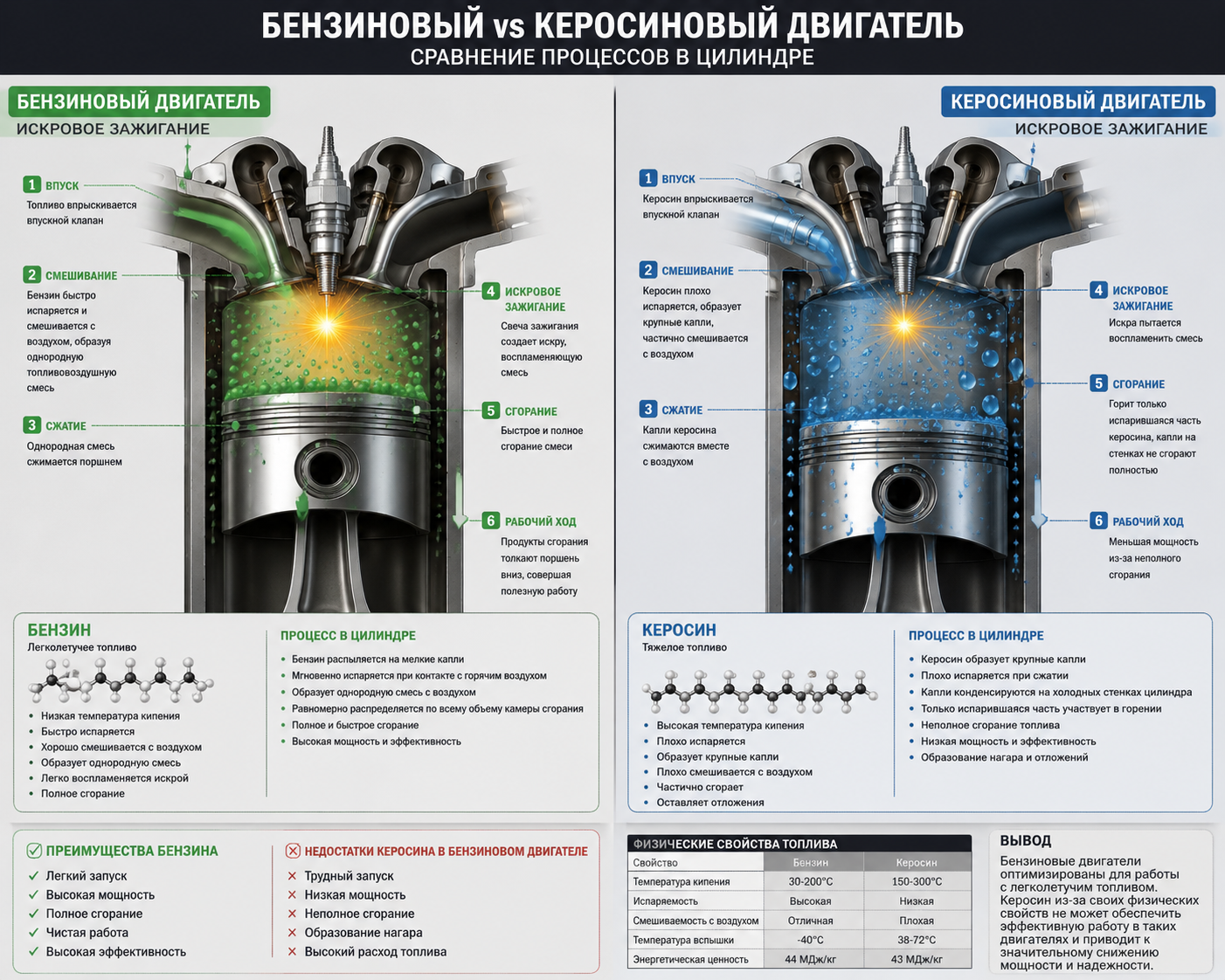
The main problem lies in the very principle of the gasoline engine's operation. It is not liquid fuel as such that ignites in the cylinder, but its vapors mixed with air. Gasoline is almost ideal for this: it evaporates easily and forms a combustible mixture quickly enough even at low temperatures.
Kerosene has completely different characteristics. Its boiling point is approximately in the range of 150 to 250 degrees, so it evaporates much worse in a cold cylinder. Instead of a full fuel-air mixture, part of the kerosene remains liquid and settles on the walls.
The result is predictable: the spark plug cannot properly ignite such a mixture. An oily coating appears on the electrodes, the engine starts to misfire and eventually stalls. Unburned fuel then flows down the cylinder walls and washes away the oil film. Dry friction occurs, which can quickly lead to serious engine wear.
There is also a second problem – the fuel's tendency to ignite from compression. It is the resistance to such self-ignition that is characterized by the octane number. Modern gasoline engines use a high compression ratio – 11, 12, and sometimes even 13 units. The more the mixture is compressed, the higher the potential power and efficiency of the engine.
Under similar conditions, kerosene can ignite earlier than the moment set by the ignition system. Detonation occurs: the engine starts to run roughly, overheat, and shock loads gradually damage its parts.
For the engine to be able to use kerosene normally, the compression ratio has to be significantly reduced. But along with it, both power and efficiency fall. Therefore, kerosene engines, which were still created, usually had low output and high fuel consumption.
This feature is especially poorly combined with the operating mode of a conventional car. A passenger car constantly changes its load: in the morning it needs a cold start, then a short trip, a stop at a traffic light, acceleration, and then braking again. A kerosene engine, on the contrary, needs other conditions:
- stable operating temperature;
- relatively uniform load;
- long continuous operation.
That is why a tractor turned out to be a much more suitable carrier for such a power unit than a city car.
Why tractors could run on kerosene
A good example is the tracked "Stalinets", which used ligroin, i.e., heavy fuel, similar in properties to kerosene. Its compression ratio was only 3.96. For starting and subsequent operation, the design provided for two fuel tanks.
The large one held 390 liters of the main cheap fuel, and the small one had a volume of only 16 liters and was intended for gasoline. Starting was performed exclusively on gasoline. After that, the engine had to be warmed up to operating temperature and only then switched to the main fuel.
The instruction explicitly required not to supply kerosene or ligroin until the engine temperature reached 90 degrees. A cold engine could not work normally on such fuel, but after warming up, it calmly withstood long work under load.
Henry Ford's Fordson had a similar story. This tractor largely used the same components as the Ford T passenger car. The engine developed the same 20 hp, but the operating conditions completely changed the fuel requirements: in the field, the tractor could run on kerosene, while the road vehicle needed gasoline.
The Soviet SKhTZ 15/30 already developed 31.5 hp, but its operating speed remained very low – from 3.5 to 7.5 km/h. A total of almost 400 thousand such tractors were produced.
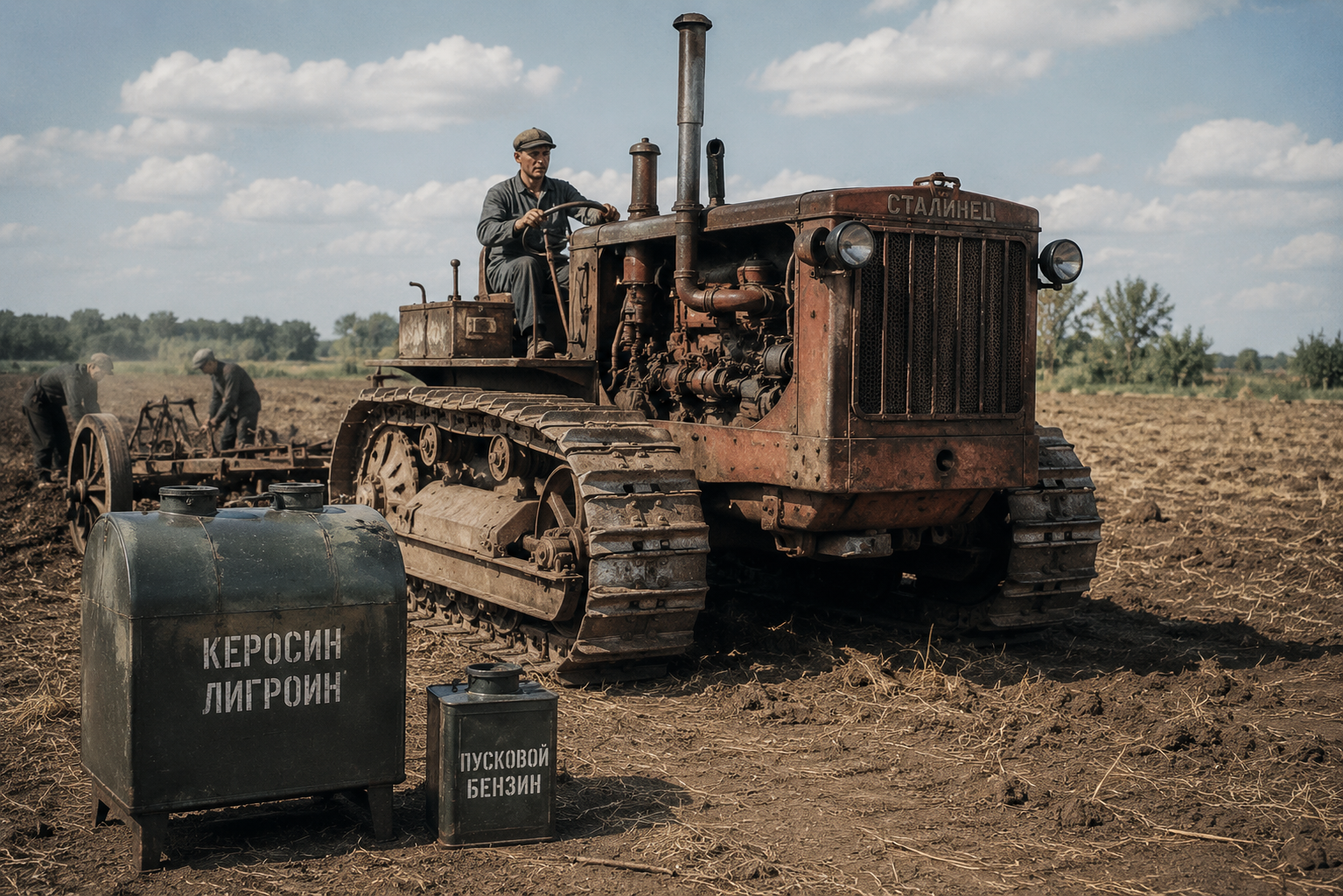
For such machines, a kerosene engine was quite acceptable. The tractor moved for hours at a constant speed, practically did not change the load, and did not stop at every intersection. The engine had time to warm up and maintained its operating temperature.
Cheap fuel as a state task
In the 1930s, in the Soviet Union, the conversion of equipment to heavy fuel became not just a technical issue, but a state task.
The reason was quite pragmatic. During oil refining, kerosene and gas oil were obtained along with gasoline, but the demand for some of these products quickly decreased. Electric lighting displaced kerosene lamps, and large volumes of unclaimed fuel accumulated in warehouses.
At the same time, the production of heavy fuel cost about four times less than gasoline. The economic sense was obvious: instead of looking for a new market for the excess product, it was possible to adapt the equipment to it.
One of the most interesting attempts was the first domestic automotive diesel "Kozhu". Its name was composed of Stalin's party nickname and his real surname.
It was a six-cylinder engine with a volume of 10 liters and a power of 87 hp, which was installed on a five-ton Yaroslavl truck. During the Moscow – Tbilisi – Moscow run, cars with this engine kept pace with foreign cars. The engine's ability to start in the cold was especially noted.
However, it did not reach mass production. The enterprise that was supposed to produce the engine was reoriented to the production of aircraft engines.
As a result, the place of cheap heavy fuel in automotive transport was taken not by kerosene, but by diesel fuel. Diesel fuel turned out to be better adapted to work in diesel engines: it is thicker, has more pronounced lubricating properties, and ignites more easily from compression.
What happens if you pour kerosene into a modern diesel engine
With a diesel engine, the situation is more interesting. If you pour kerosene into a modern diesel engine, the engine will most likely be able to run on it for some time. But for modern fuel equipment, such an experiment is highly undesirable.
Here, an indicator inverse to the gasoline octane number is important – the cetane number. It shows how readily the fuel ignites under pressure. For kerosene, this indicator is approximately at the level of 35–40 units, while for diesel fuel, the norm starts from 51.
The lower the cetane number, the longer the time between fuel injection and its ignition. Because of this, the engine's operation becomes harsher.
But the problem is not only in combustion. Diesel fuel simultaneously serves as a lubricant for the elements of the fuel system – in particular, the high-pressure fuel pump and injectors. Kerosene is significantly drier and can wash away the protective film from parts.
In old diesel engines with large operating clearances, such fuel handling could remain almost without consequences for years. Modern equipment with micron tolerances is much more sensitive.
That is why drivers who used to dilute winter diesel fuel with kerosene often added a small amount of oil to the tank. Without additional lubrication, the service life of the fuel pump could sharply decrease.
The gas turbine almost gave kerosene a second chance
If the piston engine is too demanding on fuel characteristics, one could try to change the power unit itself. A gas turbine, for example, does not have to deal with the process of mixture ignition in the cylinder: the fuel burns continuously.
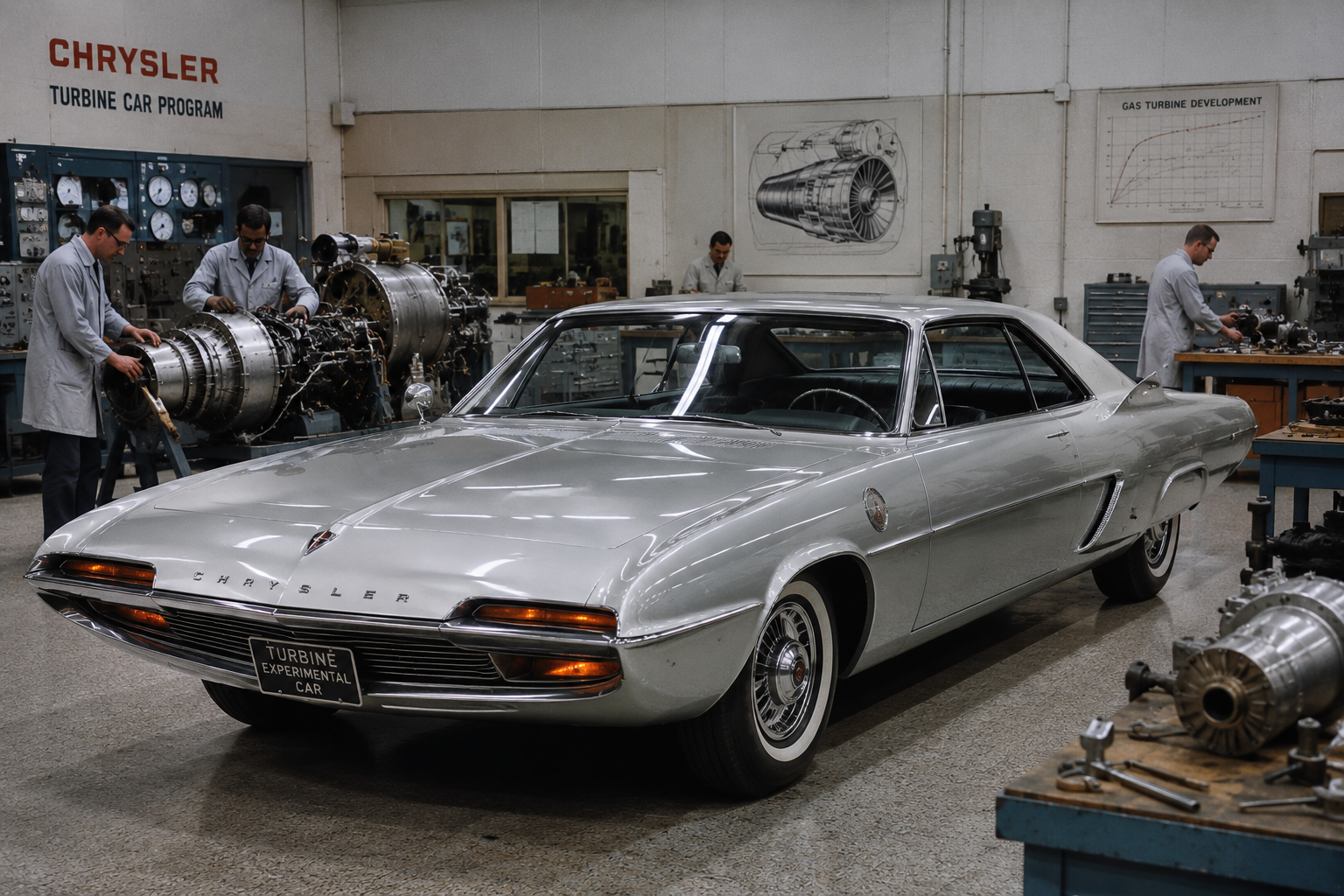
In 1963, Chrysler built 55 experimental cars with gas turbine engines. The bodies for them were handmade in Italy, and 50 cars were given to ordinary Americans, who were selected from approximately 30 thousand applications.
The list of suitable fuels looked unusually wide. The cars could use:
- diesel fuel;
- lighting and aviation kerosene;
- unleaded gasoline regardless of its octane number.
At the same time, the engineers themselves considered kerosene to be the optimal option.
To demonstrate the car's capabilities, the company even fueled them with very exotic liquids – peanut oil, tequila, and perfume. However, leaded gasoline, which 98% of American cars used at the time, was contraindicated for the gas turbine.
The experiment also revealed serious shortcomings. In urban mode, consumption was about 30 liters per 100 km, and after pressing the gas pedal, the engine reacted with a delay of almost two seconds.
The program continued until 1967, after which the experimental cars were decided to be destroyed. Tanks were punctured, bodies were burned, and the remaining structures were sent under a press. Chrysler feared that a preserved car would fall into the hands of resellers, who would replace the gas turbine with a conventional engine, and the project's reputation would suffer.
Only nine of the 55 cars have survived to this day.
Why the gas turbine did not defeat the diesel engine
In the late 1970s, gas turbines were also tried on Mack semi-trailer trucks. By some parameters, the technology looked very promising.
The turbine power unit weighed about 800 kg, while a diesel engine of comparable power weighed almost 1.5 tons. Fuel consumption per ton of transported cargo was 9% lower.
Drivers liked such equipment. The turbine practically did not vibrate, ran quietly at idle, provided smooth traction without jerks, and braked well with the engine on descents.
However, the gas turbine had a fundamental drawback: it was most efficient when operating at full power. For freight transport, this is a serious problem, since legal restrictions often do not allow full use of the vehicle's carrying capacity to protect roads.
At half load, the advantage disappeared, and the diesel engine again became more economical. Additional disadvantages were hot exhaust and a high noise level when operating at maximum power.
In the 1980s, new generations of diesel engines appeared, which further reduced the technological gap. The gas turbine truck project was eventually closed.
Kerosene finally lost the battle for ground transport – although it did not completely disappear from the automotive sphere.
Kerosene is still in diesel fuel
In severe frosts, kerosene actually returns to car tanks, although it is called differently at the fuel pump.

Arctic diesel fuel is essentially a heavy version of kerosene. Kerosene fractions are used as a base, then additives are introduced to improve ignitability, and mineral engine oil is added, which is necessary for lubricating the fuel equipment.
What motorists used to mix themselves in a barrel when preparing equipment for frosts is now produced industrially.
However, this approach does not provide savings. The average price of diesel fuel is 88.48 rubles per liter versus 78.58 rubles per liter for AI-95, and the arctic variety costs even more.
It turns out to be a paradoxical story. Kerosene did not become a mass fuel for passenger cars because piston engines turned out to be too demanding on its properties. But it did not completely disappear from the world of cars either.
It's just that instead of a separate canister of kerosene, today technologically prepared diesel fuel is used, in which its properties are already adapted to a modern engine.
Read more materials:
- New rules for motorists from September 1
- How UAZ conquered off-road outside the USSR
- Why the police choose BMW for patrols