Translated with AI from the Russian original.
“Speed bumps” are designed to slow cars down, but driving over them incorrectly can accelerate wear on tires and suspension components. In a British survey of 2,000 drivers, one in five reported that they had already paid for repairs after hitting a speed bump. Tires and suspension elements were the most frequently mentioned damage.
Meanwhile, many motorists continue to drive over such sections too quickly or misuse the pedals. As a result, the load on the wheels, shock absorbers, and rubber-to-metal bushings increases. There are four common mistakes that are best avoided.
Driving over a bump at high speed
Sometimes it seems that driving over a speed bump quickly is better: the car body does not have time to sway heavily, so the jolt feels less pronounced inside the cabin. However, subjective comfort does not mean that the suspension experiences less stress.
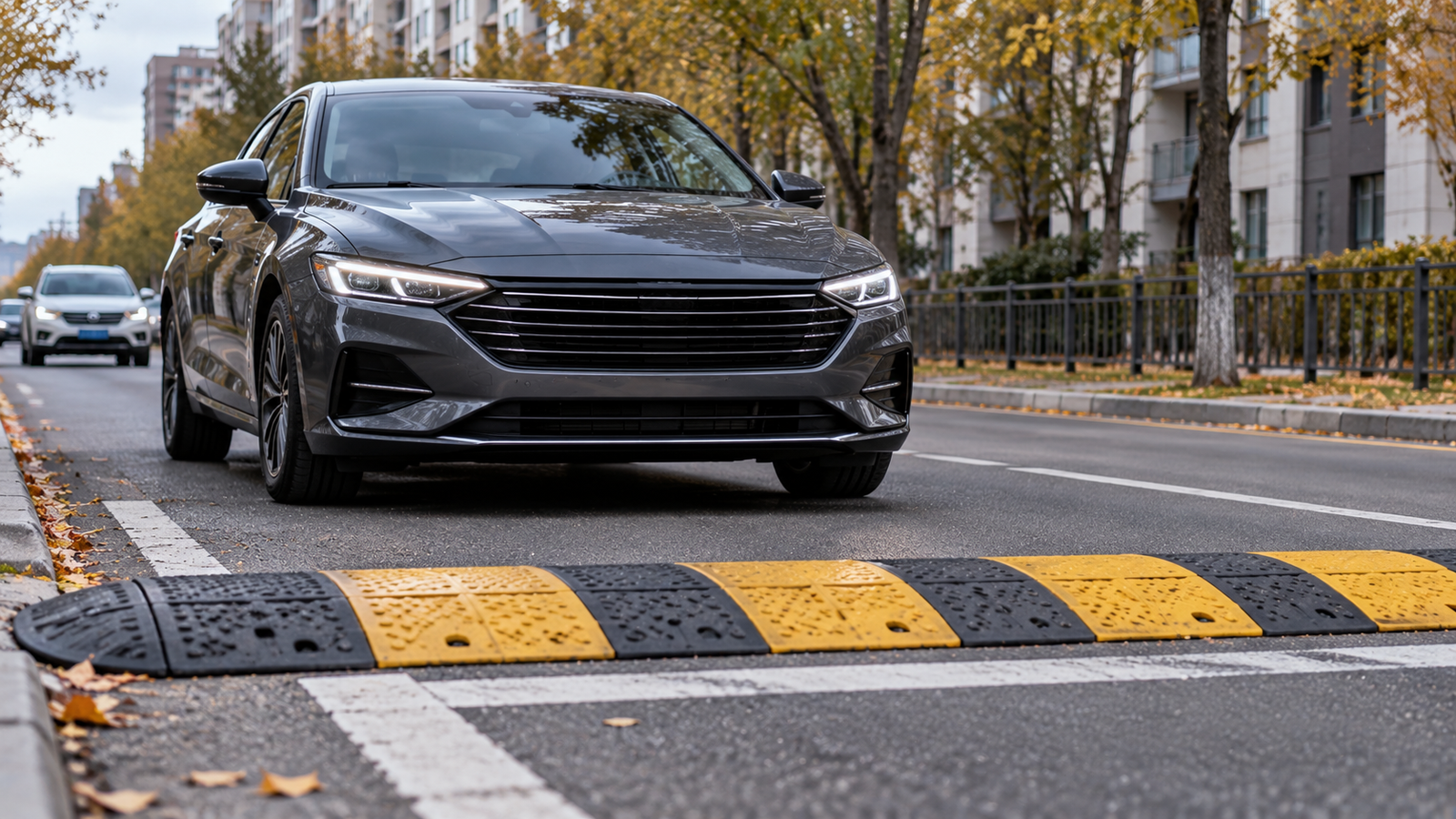
Hitting a bump quickly forces the wheels to move sharply upward and then return to their original position. The higher the speed and the steeper the bump profile, the greater the dynamic loads on the tires, wheels, and suspension components can be. Tall, short bumps are especially hazardous as they deliver a sharp impact.
However, one cannot reduce the load to a simple formula stating that doubling the speed always quadruples the impact. The result depends on the shape of the bump, vehicle weight, suspension characteristics, tire pressure, and other factors.
On an older car with worn shock absorbers and bushings, the consequences may show up faster. But a new car is not immune to damage either if it hits an excessively tall bump at high speed. Low-profile tires and wheels with little cushion between the tire and rim are particularly sensitive to sharp impacts.
Accelerating before the rear wheels clear the bump
The second mistake is stepping on the gas right after the front axle has cleared the bump. During acceleration, the load shifts backward, the body squats, and the rear suspension takes on extra stress at the exact moment the wheels hit the bump.
If the speed bump is tall, a low-clearance vehicle may scrape its underbody or the rear of the car against it. Therefore, do not accelerate until the rear wheels have completely cleared the obstacle.
It is just as important to avoid sudden maneuvers. Smooth movement at a steady, low speed helps the car navigate the bump without excessive weight transfer between the axles.
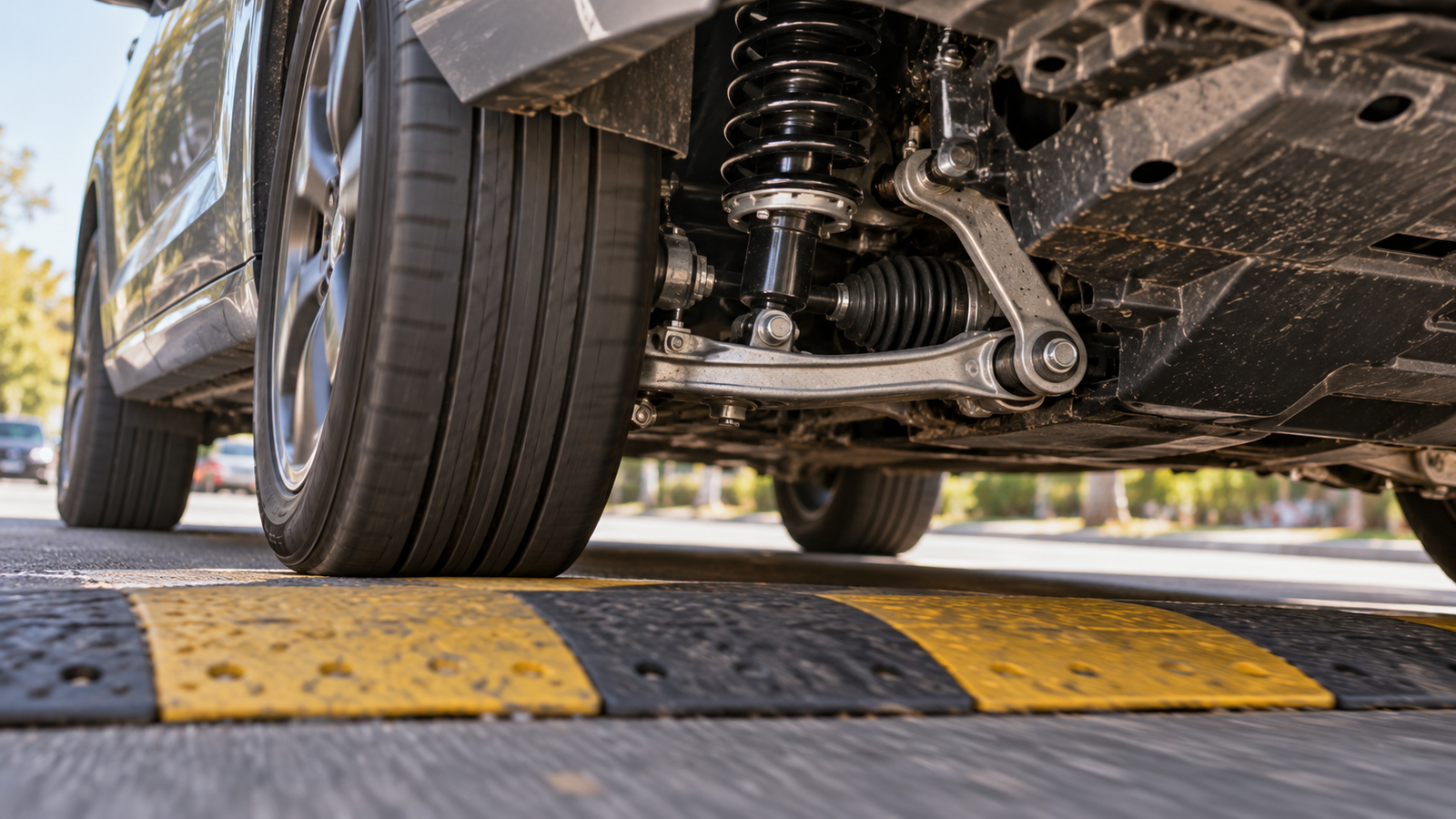
Coming to a complete stop right in front of a speed bump is not always justified either. It can disrupt traffic flow and cause a rear-end collision if the driver behind does not anticipate sudden braking. Speed should be reduced in advance, taking into account the distance to the following vehicle.
Trying to bypass the bump with one wheel
Some drivers try to straddle a speed bump between the wheels or hit it with only one side of the vehicle. Others cross the bump diagonally, hoping that the load will be spread out over time.
However, there is no universal rule that this approach cuts the suspension load in half. Crossing diagonally may indeed mean that the left and right wheels do not hit the ridge at the same time, but the stress on individual components depends on the bump’s geometry and the vehicle’s design. Additional body twist and uneven suspension travel can also be undesirable.
The main thing is not to veer into oncoming traffic or an adjacent lane to avoid the bump, and not to make sudden steering movements. If the bump spans the entire width of the lane, it is safer to slow down and cross it straight on, unless traffic conditions dictate another maneuver.
Damaged rubber sections pose a separate hazard. Fasteners, metal debris, and sharp edges of a broken section can puncture or damage a tire. Do not aim a wheel into a narrow gap between sections without ensuring the passage is safe.
Braking directly on the bump
Braking hard the moment you hit the bump increases the load on the front suspension. During deceleration, the vehicle’s weight shifts forward, the front springs compress, and suspension travel is reduced. If the wheel hits a sharp bump at that instant, the risk of a severe impact increases.
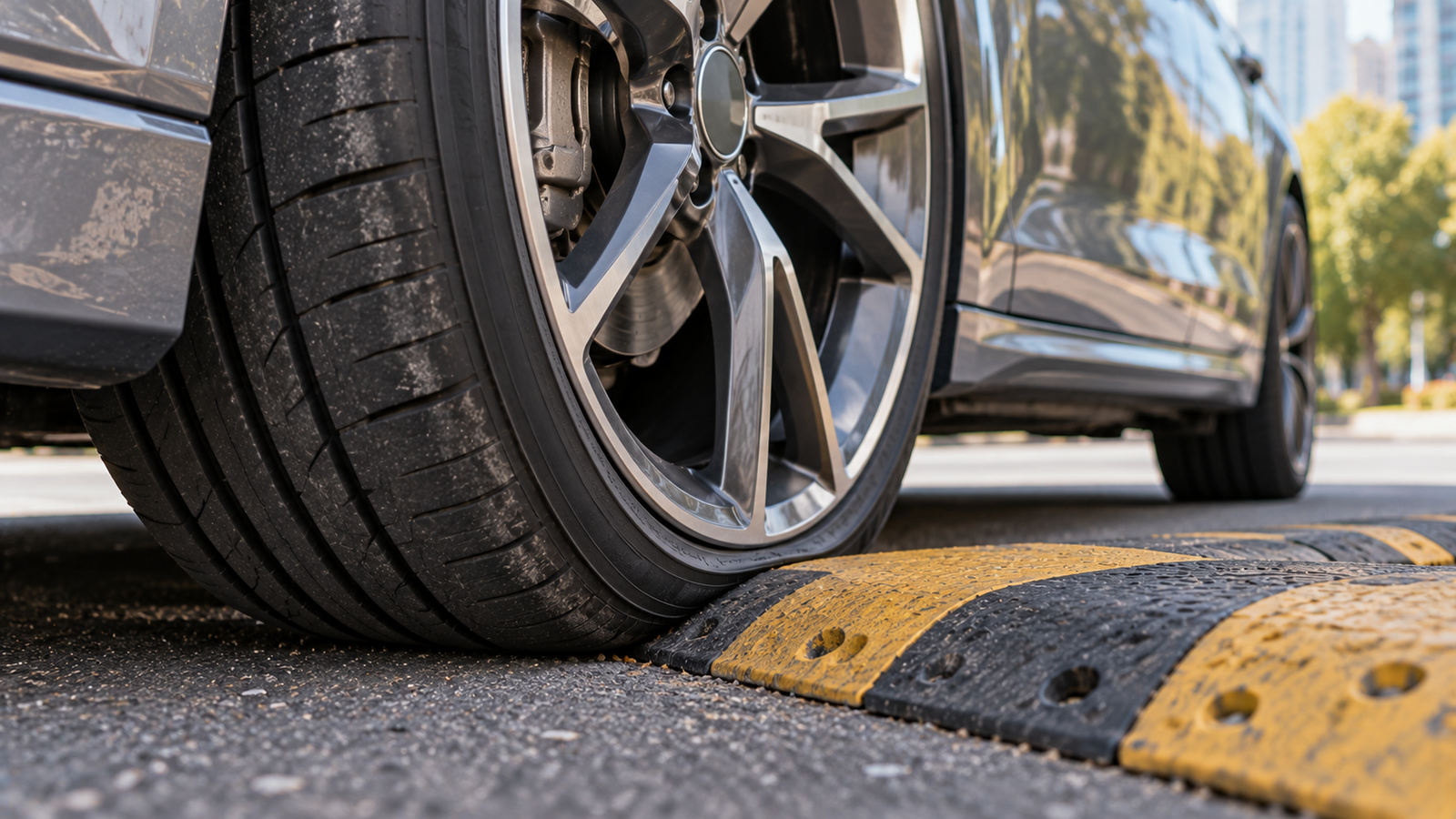
Assessing the situation in winter is especially tricky when a speed bump is hidden under snow or hard to spot on wet asphalt. If a driver spots the obstacle late, one cannot simply advise them to maintain speed or accelerate: the decision must depend on distance, road grip, and vehicles behind.
The most reliable approach is to slow down well ahead of the bump, then roll over it smoothly without sharp braking or accelerating. If braking right in front of the bump is unavoidable, safety takes precedence over attempts to unload the suspension: choose a speed that keeps the car under control without endangering other road users.
Nor should you resort to tricks like abruptly releasing the brakes just before the bump. They require precise timing, depend on suspension specs and road conditions, and a mistake can lead to a violent jolt or loss of control.
What determines the load on the suspension
The same bump affects different cars differently. What matters is the height and length of the ridge, the steepness of its profile, vehicle speed, vehicle weight, tire pressure, ground clearance, and the condition of the shock absorbers.
The bump’s material is also important. Asphalt designs typically differ in profile from modular rubber segments, which can have sharper edges. At the same time, a short bump is not necessarily more dangerous than any long one: the total stress is determined by a combination of factors, not just length.
Nor can one set a universal lifespan for a shock absorber or suspension bushing. It depends on the vehicle model, parts quality, mileage, road conditions, and driving style. Repeated harsh impacts can accelerate wear, but claiming that a specific mistake will ruin a part after an exact number of miles is incorrect.
How to properly drive over a speed bump
When you see a warning sign or a speed bump, slow down in advance to a safe speed. Do not rely on a single number for all cars: consider the bump’s profile, ground clearance, and the recommendations on road signs.
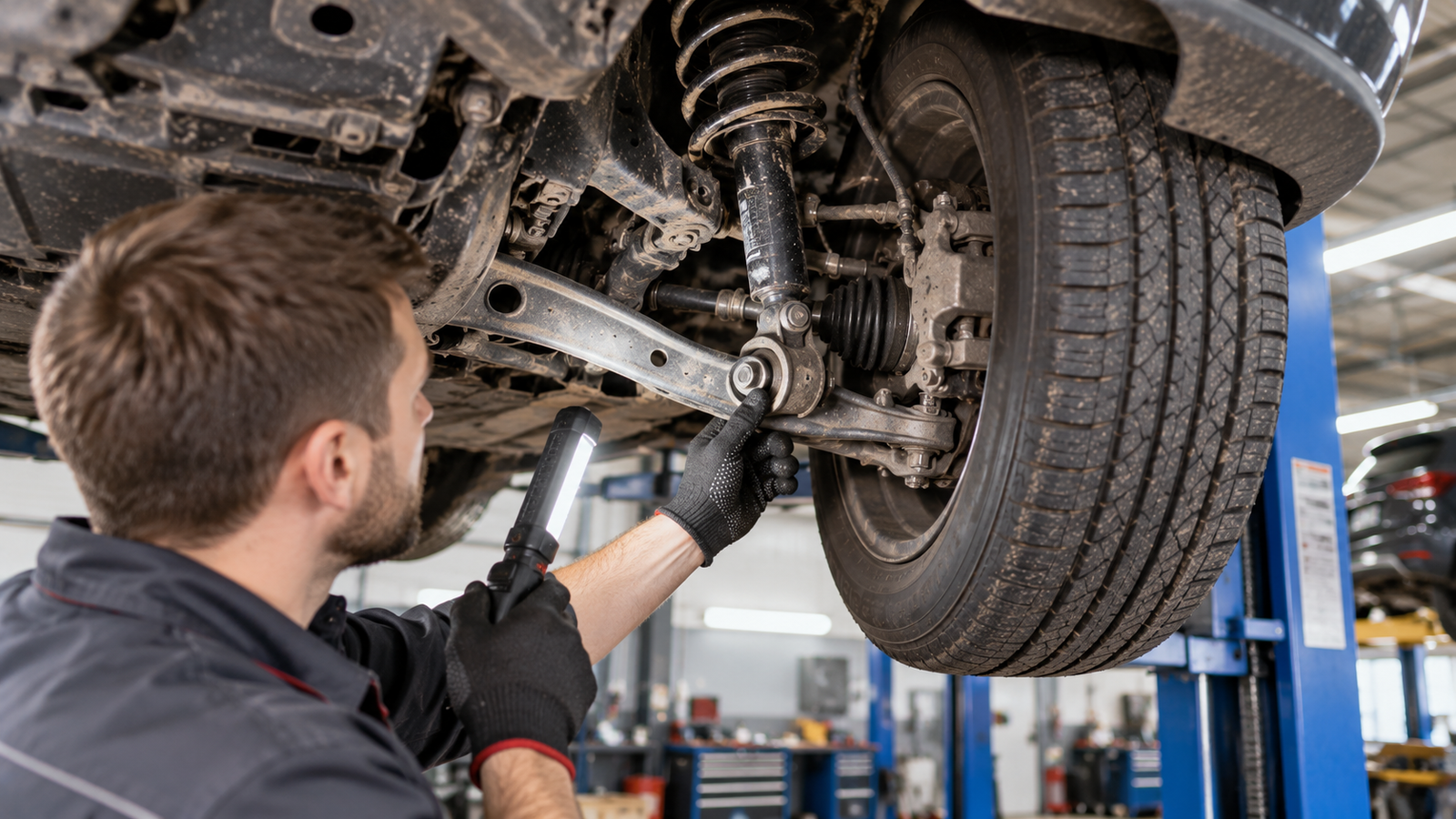
Before the bump, try to move smoothly without braking abruptly at the last moment. Cross the ridge without accelerating, maintaining a steady line. Once the rear wheels have crossed the bump, you can gradually resume your normal speed, taking traffic conditions into account.
If vibrations appear after a hard hit, the car starts pulling to one side, a knocking noise develops, or tire pressure drops noticeably, check the wheels and suspension. These symptoms do not always indicate a major failure, but they should not be ignored.
The golden rule is simple: a speed bump is designed to reduce speed, not test a vehicle’s durability. Slowing down early and rolling over smoothly helps minimize impact loads and reduces the risk of damaging tires, wheels, and suspension.
Read more articles:
- How to inspect a used car body before buying
- “Cyber-Sheriff”: how patrol car roof cameras track down debtors
- Volvo seat belt: what Nils Bohlin actually invented