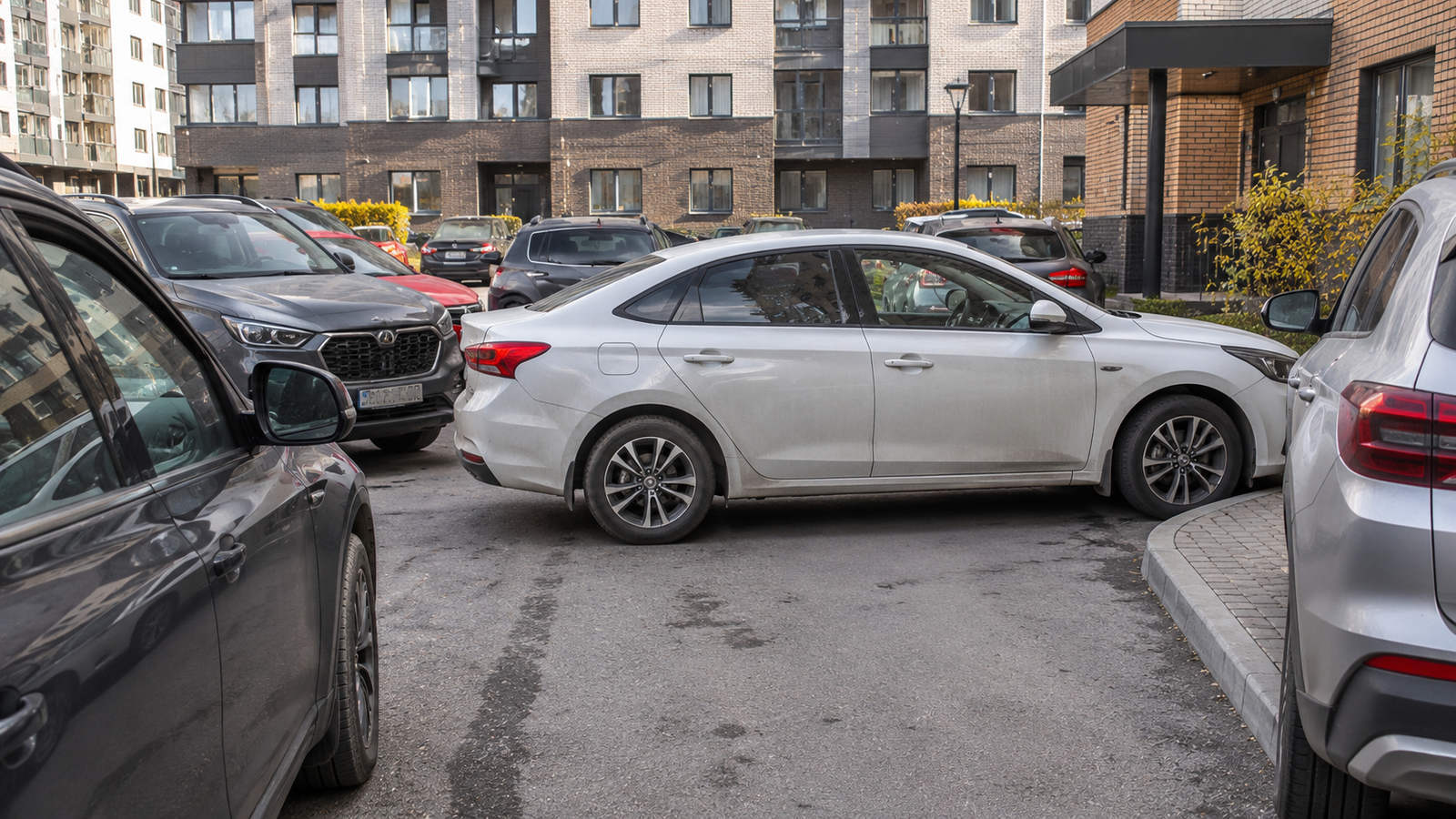
Drivers have already sent each other more than 2.3 million notifications via the messaging service on Gosuslugi. The most frequent reason is that a car is blocking the driveway: this template accounts for 42% of all messages. Inquiries related to road accidents are almost four times fewer. The problem is particularly common in courtyards of new residential buildings, where parking spaces are scarce and cars are left in several rows. In the morning, a car owner might discover that leaving is impossible. In such a situation, it is better to first try to find the driver rather than move someone else’s vehicle on your own: even an attempt to roll it back a few meters can lead to serious legal consequences.
It is worth starting by inspecting the car: a phone number is sometimes left under the windshield, on the dashboard, or behind the wiper. If there is no note, you can ask the concierge, security, janitors, or neighbors about the owner, or contact a local drivers’ community, attaching a photo of the vehicle showing its license plate.
At a shopping mall, management can sometimes announce the car’s license plate over the loudspeaker. If the car belongs to a carsharing or delivery service, company contacts are usually displayed on the body. Carsharing services have the ability to contact the renter directly, although the resolution speed depends on the specific company. Another method is to send a notification via Gosuslugi or the “Gosuslugi Auto” app. All you need is the license plate number, provided the owner added the vehicle to their profile and has not disabled incoming messages. Ready-made templates are available to users, such as “Car is blocking the driveway” and “Car is being towed.”
You can reply using one of the suggested phrases. The sender’s identity is not disclosed to the owner, but they receive a pin on the map showing where the notification came from. Users can also exchange phone numbers in the chat if both parties are willing. At the same time, the service limits messaging frequency: you can send a message about the same vehicle no more than once a day, and send up to five messages in total per day.
If you fail to reach the owner, you can contact the police at 102 or the emergency services at 112. You must provide the duty officer with the address, make, color, and license plate number of the vehicle blocking the exit. The officer may try to contact the owner directly and, if necessary, dispatch a patrol unit to the scene.
Waiting may take a considerable amount of time, so it is advisable to document the situation with photos or video: the license plate, the position of the vehicles, and the impossibility of driving out. According to traffic regulations, stopping and parking must not create obstacles for the movement of other vehicles. A violation entails a fine, the amount of which depends on the circumstances and location: in particular, for a number of violations it is 2,000 rubles, and in Moscow and St. Petersburg — 3,000 rubles.
In cases provided by law, the vehicle may be impounded and towed to a specialized impound lot. However, it is important to distinguish between a courtyard and a roadway: a courtyard is considered adjacent territory, but inside it there may be areas where stopping and parking regulations apply. Therefore, the classification of the violation depends on the specific location, not just on the fact that the car is parked in a courtyard.
You should not move someone else’s car on your own, push it with your bumper, or squeeze past it with a risk of collision. If the car is damaged, you will be liable for the resulting damage, and leaving the scene of an accident can lead to license suspension or administrative arrest. You must also not damage the body, break windows, or puncture tires: depending on the amount of damage, liability may be administrative or criminal.
Moving someone else’s car without the owner’s consent is also risky. Under certain circumstances, such actions may be subject to criminal liability, although rolling a car away does not in itself automatically make someone a car thief: the intent and circumstances of the movement are crucial for establishing a crime.
If the car genuinely needs to be moved, the lawful option is to contact the police and await the decision of authorized officers. And if a driver incurred confirmed expenses or losses due to the blocked driveway, such as losing money on travel tickets, they can try to recover them from the at-fault party through court. This will require evidence of the violation itself, the damages incurred, and the causal link between the actions of the car owner and the resulting expenses.