Chinese authorities have unveiled the requirements of the new national standard GB/T 46991.1-2025, which regulates how accurately an electric vehicle must display the state of its traction battery. The document was prepared with the participation of the Ministry of Industry and Information Technology of the People's Republic of China (MIIT) and the Standardization Administration of China (SAC).
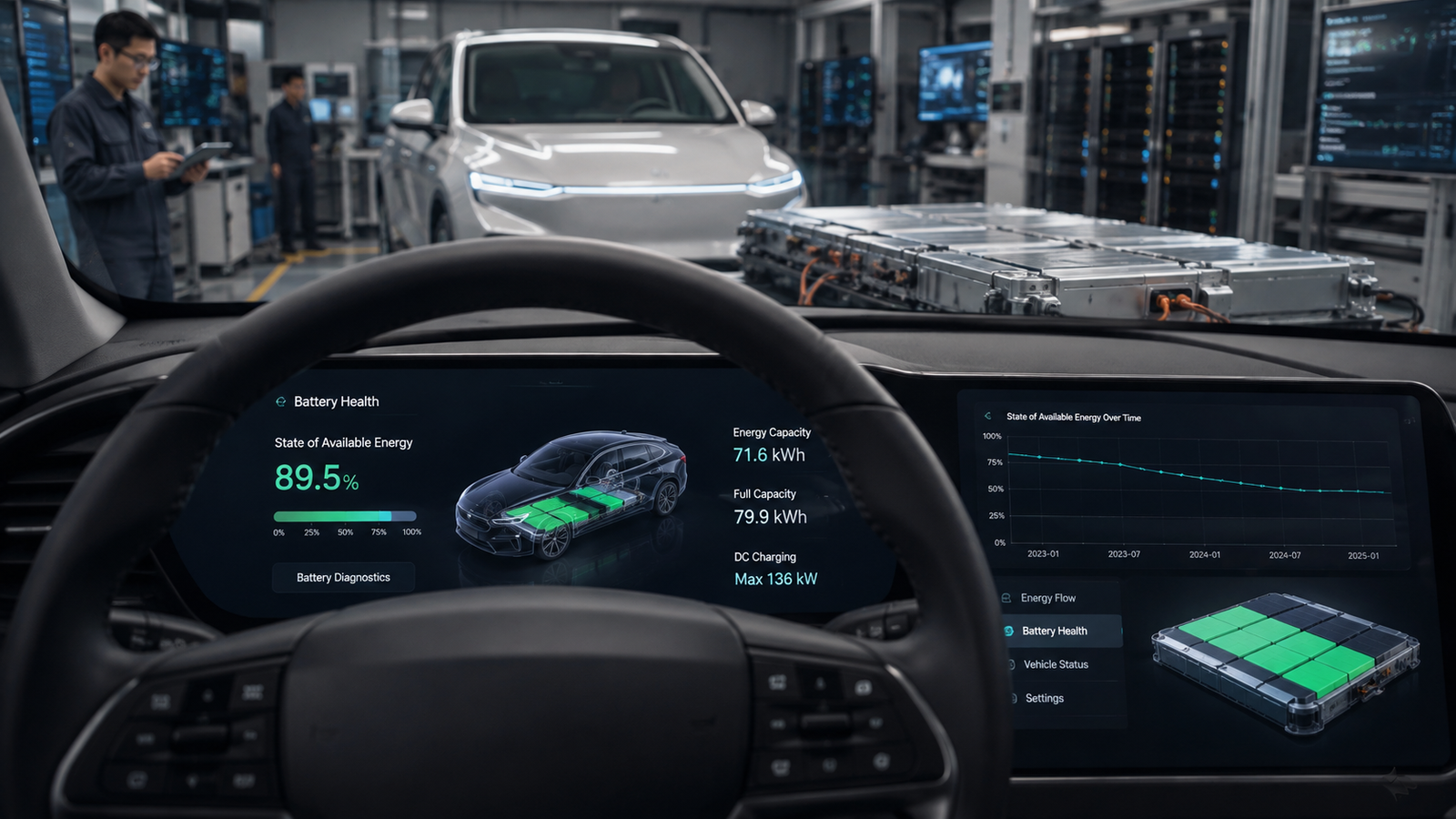
The main innovation concerns the State of Available Energy (SOAE) indicator — the level of available battery energy compared to its state in a new car. Unlike the usual charge indicator (SOC), this parameter reflects the degree of battery wear.
According to the standard, the difference between the displayed SOAE value and the actually measured value should not exceed 5%. This should make information about the battery's condition more objective during vehicle operation, sale on the secondary market, and consideration of warranty cases.
Another innovation is the Virtual Mileage indicator. It takes into account energy consumption when the car is not moving: for example, during the operation of the climate control system, electronics, or other systems while parked. Such consumption will be converted into equivalent mileage, and the calculation error should not exceed 3%.
The standard also defines benchmarks for battery capacity retention. After 5 years or 100,000 km, the battery must retain at least 82% of its initial available energy. After 8 years and 160,000 km, the minimum indicator is 75%, and after 10 years and 200,000 km, it is at least 70%.
Read more materials:
- Policeman turned into a bush: an unusual raid in the USA helped catch dozens of drivers with phones behind the wheel
- Chinese electric sports car with the spirit of Lotus comes to Europe: 429 hp and 2.9 seconds to 100 km/h without touchscreens
- Volkswagen unveiled the most expensive Amarok: more expensive than the Ford Ranger Raptor, but without a power boost
Комментарии