In the late 2000s, major automotive rubber product manufacturers Continental and Dayco introduced Belt-in-Oil technology, simply called “belt in oil.” At the time, the solution looked very promising: it was assumed that it would make engines more efficient, more compact, and quieter, and would eventually become a common element of power units.
However, widespread implementation revealed a serious problem. Manufacturers using the “wet” timing belt faced technical difficulties, recall campaigns, and reputational losses. The reason was that real operating conditions differed significantly from laboratory tests.
Why was a belt in oil needed at all?
In the 21st century, automotive engineers had to constantly look for new ways to improve engine efficiency due to tightening environmental requirements. The struggle was literally for every gram of harmful emissions, so even small design improvements could make a difference.
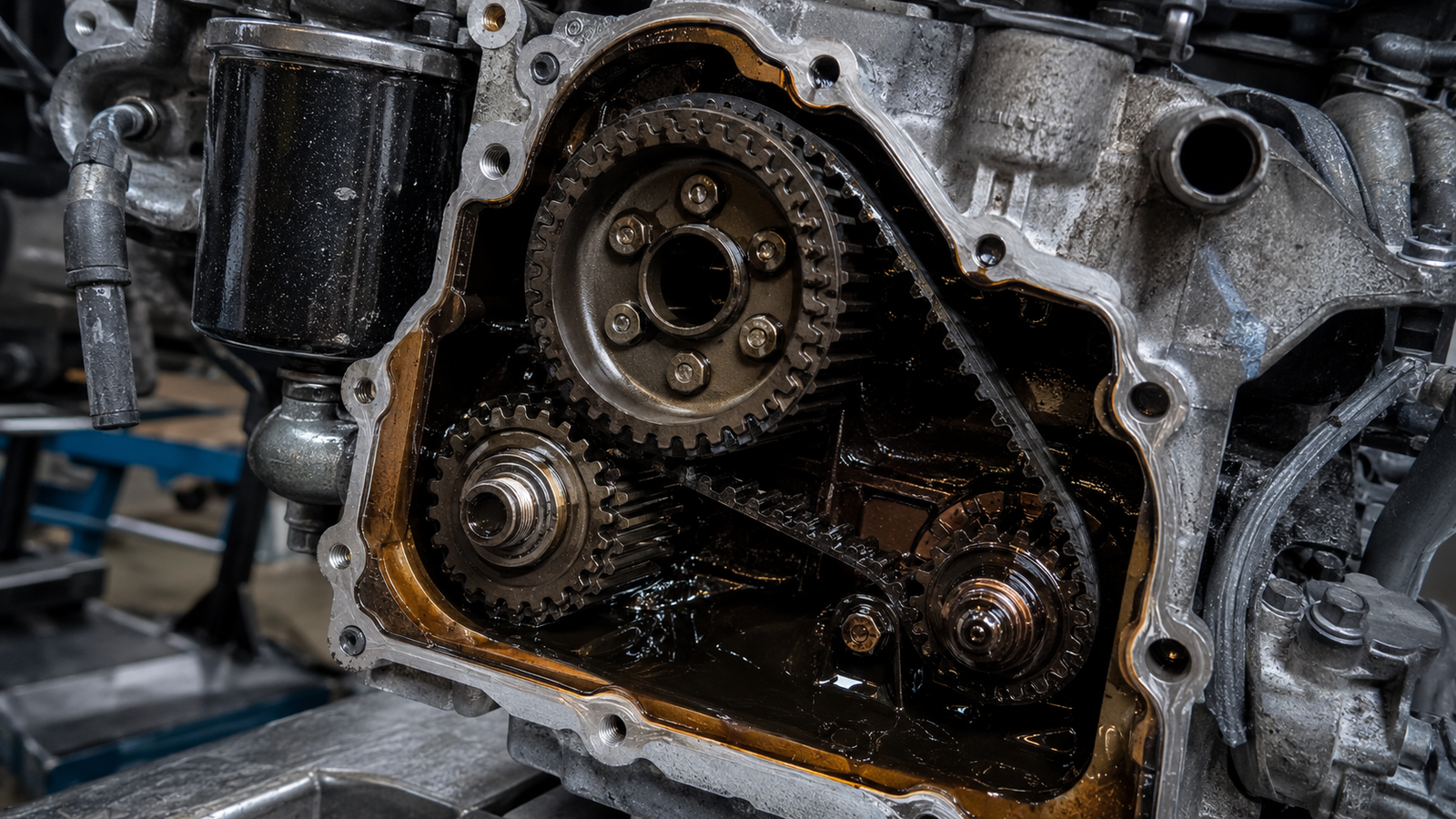
One such solution was a timing belt operating directly in engine oil. The idea was primarily related to increasing efficiency, but it also had other potential advantages.
The timing chain drive is durable and reliable, but when working with gears, relatively large friction losses occur. A belt works more efficiently under similar conditions, which allowed its use to reduce carbon dioxide emissions by 1–2%.
There was another problem. The chain at that time was considered noisier, and its placement required additional space under the hood. A conventional dry belt won in these parameters but had its own disadvantages. Therefore, engineers tried to combine the advantages of the two solutions by placing the belt inside the engine.
In theory, the design looked convincing. For Belt-in-Oil, a special material was used – hydrogenated nitrile rubber, designed to withstand engine oil and high temperatures. The belt itself was located directly in the cylinder block.
This solution allowed:
- saving space under the hood;
- eliminating camshaft and crankshaft oil seals within the timing mechanism;
- reducing friction losses;
- achieving a claimed service life of over 200,000 km by some manufacturers.
The latter indicator was supposed to make the “wet” belt comparable in durability to a chain. But it was operation that showed that laboratory advantages do not guarantee the same result on the road.
Which engines received the “wet” belt
After successful laboratory tests, the technology quickly began to appear on production cars. Several engine families received the most widespread distribution.
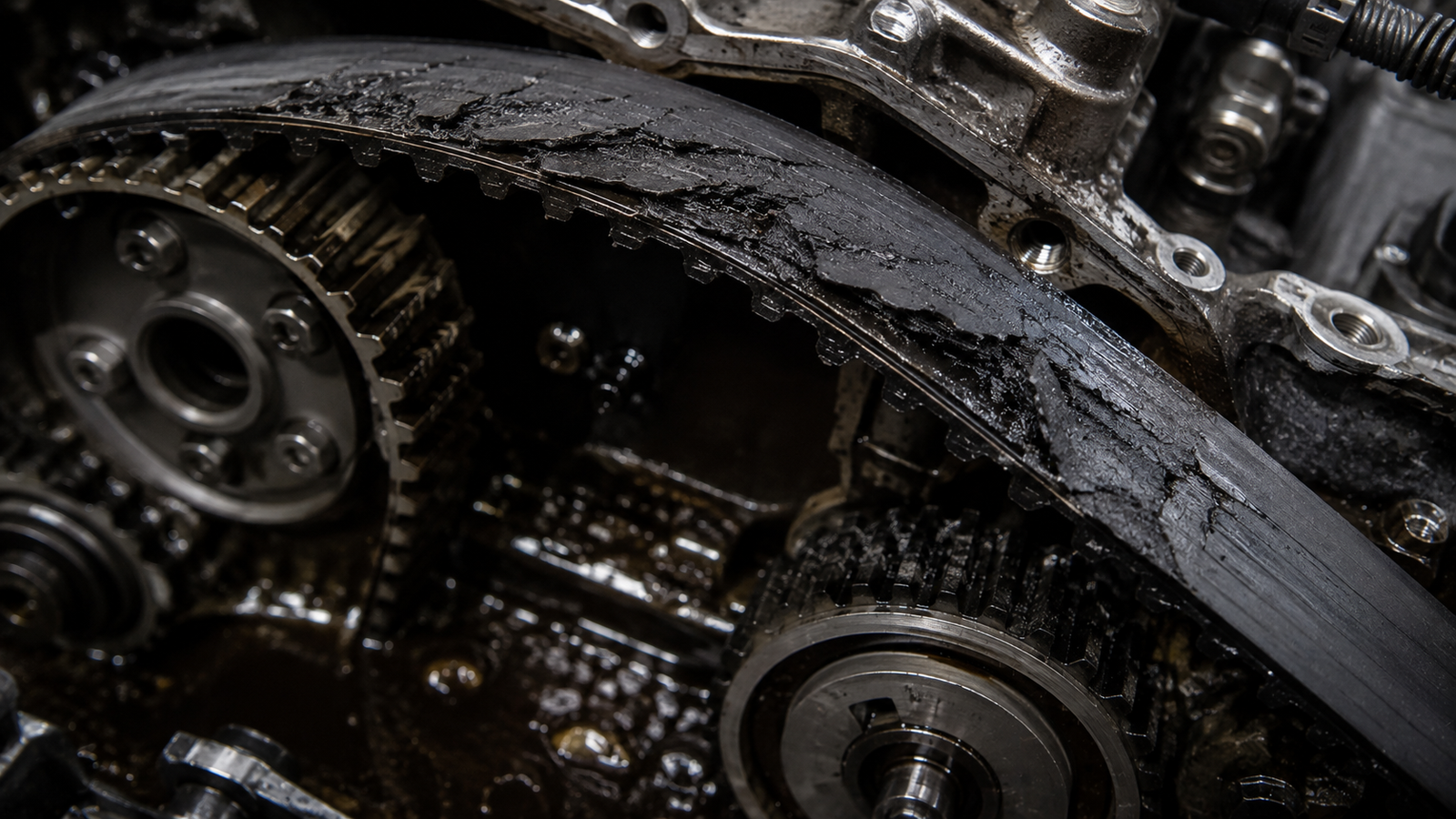
This included the three-cylinder 1.2-liter PureTech gasoline engine from the Peugeot-Citroen-Opel concern, the three-cylinder 1.0-liter Ford EcoBoost, and the four-cylinder 2.0-liter Ford EcoBlue diesel engine.
In addition, Honda used Belt-in-Oil on its 1.0-liter VTEC Turbo gasoline engines.
On paper, all these engines corresponded to the initial concept of the technology. However, it soon turned out that the main enemy of the belt was not only under the hood but also directly in the engine oil.
Why oil was not the only problem
The “wet” belt itself was indeed resistant to engine oil. But during operation, the oil did not always remain clean.
This was especially evident in direct injection engines. Under certain conditions, the fuel concentration in engine oil can reach 10%. Winter operation of the car over short distances became a particularly unfavorable mode.
As a result, a mixture of fuel, condensate, and soot formed in the oil system. It was this “cocktail” that negatively affected the belt and literally destroyed its material.
Then a whole cascade of problems arose. Particles and delamination products of the belt entered the lubrication system. They could clog the oil pickup and oil channels, after which the engine began to experience a lack of lubrication.
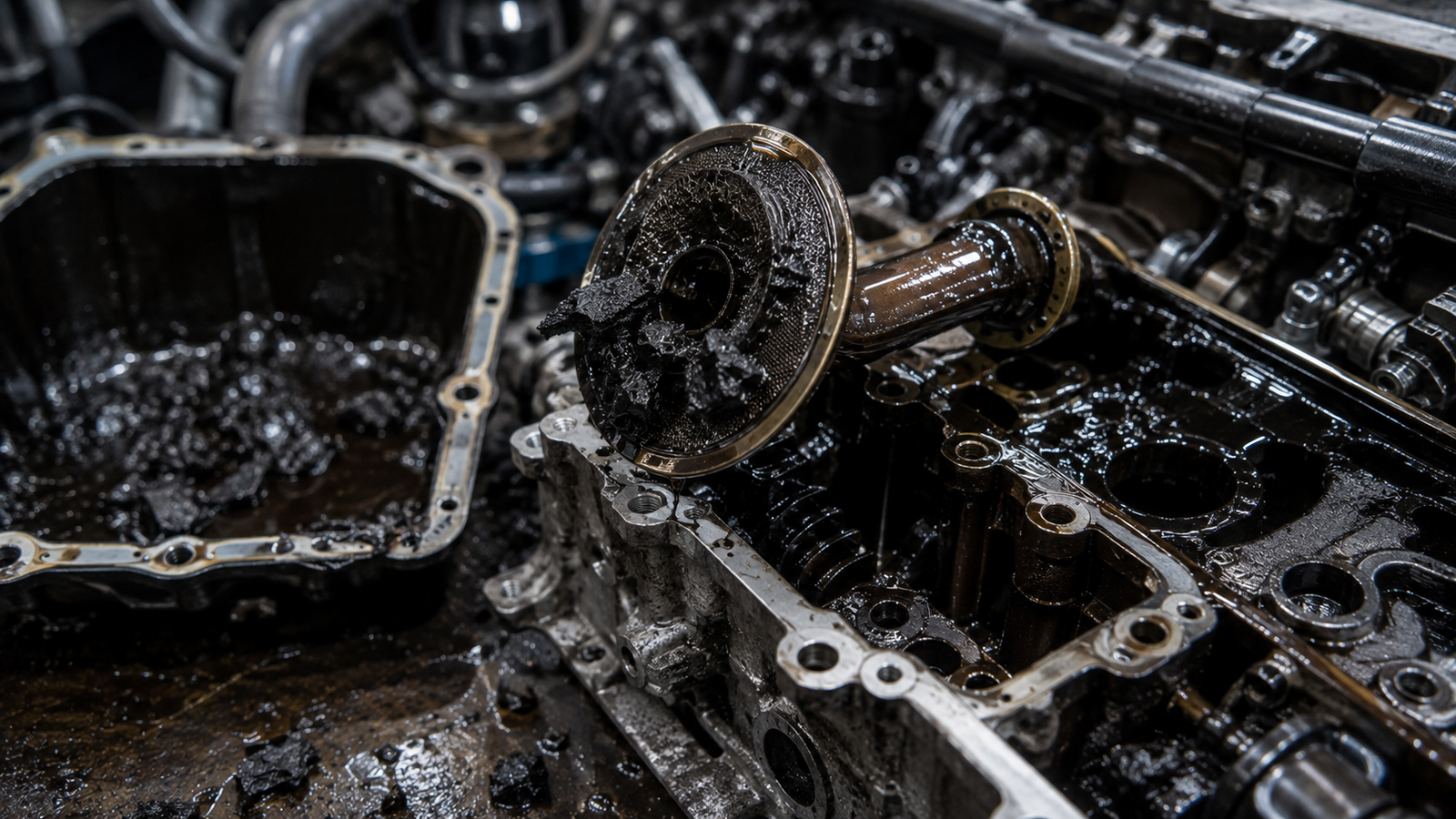
The consequences became significantly more serious than usual premature belt wear:
- oil supply to engine components deteriorated;
- wear of parts increased;
- elements of the oil system became contaminated;
- in some cases, brake problems arose.
The last point is especially characteristic of PureTech engines. Modern small-displacement engines are not always able to create sufficient vacuum in the intake manifold for the brake booster to operate, so an additional vacuum pump is used in the design.
On PureTech, this pump is driven by the camshaft and requires constant lubrication. A deteriorating belt could clog the oil channels of the vacuum pump. As a result, the mechanism overheated and failed.
This particular problem became one of the reasons for large-scale recall campaigns for Peugeot, Citroen, and Opel cars with PureTech engines.
The main problem is real-world operation
Laboratory tests showed that the technology was viable. But road operation placed much stricter demands on it.
It turned out that the “wet” belt is extremely sensitive to several factors at once. For normal operation, it required:
- timely maintenance;
- using engine oil with suitable characteristics;
- filling the car with quality fuel.
If these conditions were violated, the service life was significantly reduced. Instead of the 200,000 km declared by manufacturers, the belt could actually last two to three times less.
A paradox emerged: the technology was created, among other things, for a service life comparable to a chain drive, but in real-world operation, premature wear actually deprived it of a significant part of its initial advantages over a conventional dry belt.
From mass adoption to abandonment
Despite all the problems, the technology managed to gain very widespread use. During the period of mass implementation, about 15 million cars with “wet” timing belts were produced, and many of them continue to be operated.
However, by the end of the 2010s, automakers began to rapidly abandon this scheme. At the same time, ready-made kits from third-party manufacturers appeared on the market, allowing some engines to be converted to another timing drive.
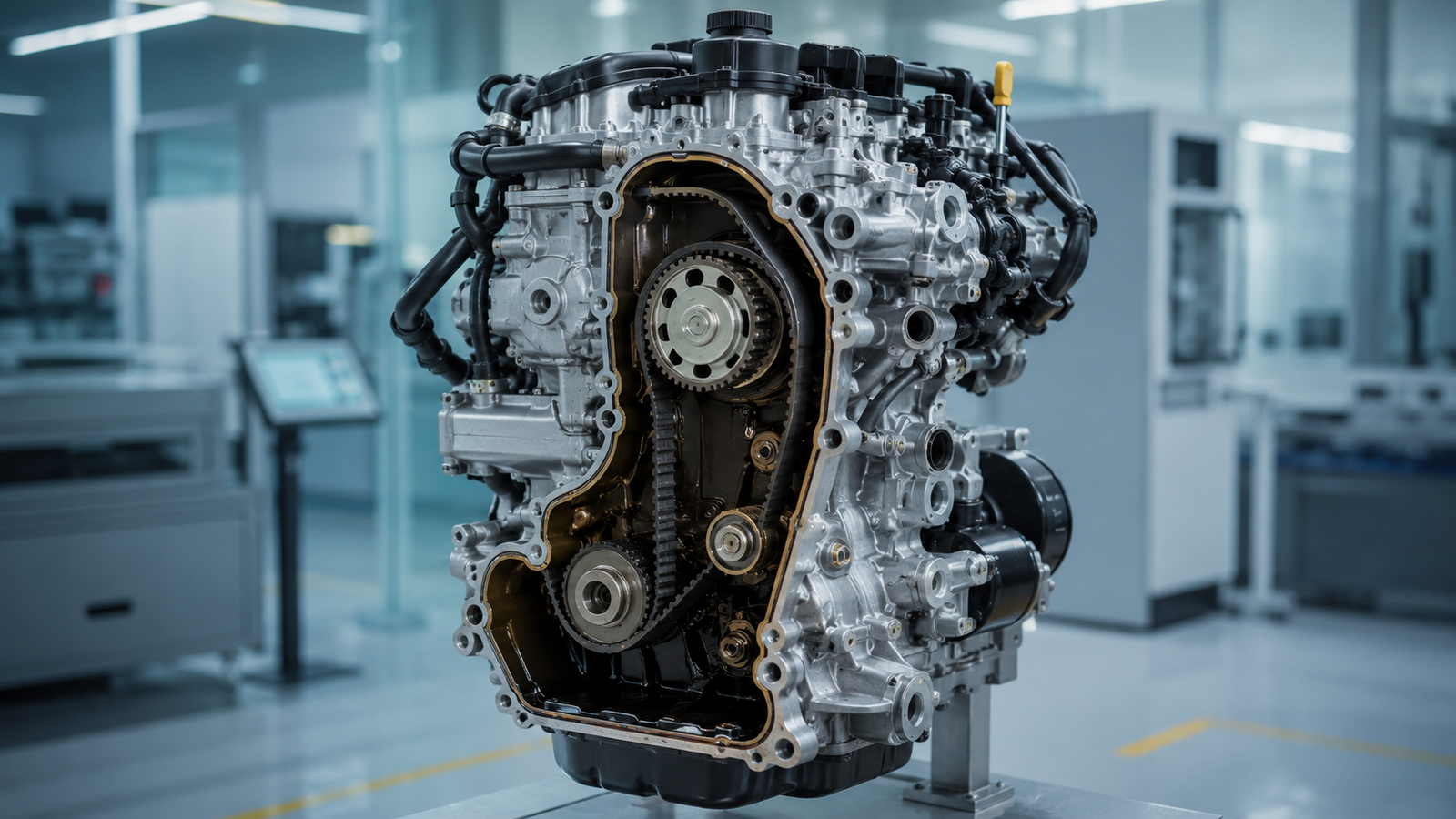
In particular, the PureTech engine can be relatively inexpensively converted to a chain drive, thereby eliminating the problems associated with the “wet” belt.
For the Russian market, this story turned out to be less extensive. Such engines are practically not found here, as manufacturers brought cars with simpler power units to the Russian market.
The Belt-in-Oil story clearly shows the difference between a promising engineering idea and its behavior in real-world operation. In the laboratory, the belt material withstood oil and high temperatures, and the design itself allowed for reduced friction, space saving, and a long service life. But in a real engine, the oil turned out to be a complex mixture containing fuel, condensate, and soot.
As a result, the solution, which was supposed to be one of the directions for the development of traditional engines, brought manufacturers much more problems than expected. The technology gained widespread use, but then just as quickly began to leave the market.
Read more materials:
- Ford Crestline: a car with a window in the hood
- Frame vs. Monocoque: which body is more durable
- Volvo P1900 and P1800: an unusual history of sports cars