Many motorists press the A/C button almost automatically: in summer — to cool the cabin, in winter — to quickly get rid of fogged-up windows. However, not everyone considers what exactly is activated after it's turned on.
In reality, it's not just about blowing cold air. Pressing it activates a full-fledged climate control system with a compressor, refrigerant circulation, and an additional load on the engine.
What the A/C button means
A/C stands for Air Conditioner — a car air conditioner.
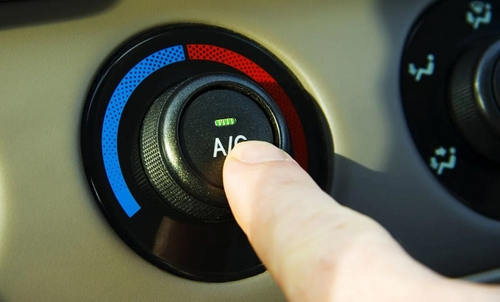
When the driver presses the button, the air conditioning system's compressor engages. Usually, an indicator light on the dashboard illuminates, confirming that the system is active.
Then, a full cycle of air conditioner operation begins:
- the compressor starts refrigerant circulation
- air passes through the evaporator
- the airflow is cooled
- excess moisture is simultaneously removed from the air
If the button is turned off, the compressor itself stops working, but the fan continues to circulate air through the cabin's air ducts.
How a car air conditioner works
The air conditioning system consists of several main elements.
The compressor plays the main role. It compresses gaseous freon, which sharply increases the refrigerant's temperature.
After this, the hot freon enters the condenser, which is usually located in front of the engine radiator. There, it is cooled by the oncoming airflow and changes from a gaseous to a liquid state.
Then the system works as follows:
- the liquid passes through the thermostatic expansion valve
- the pressure sharply drops
- the freon expands and cools
- the cooled refrigerant enters the evaporator
It is in the evaporator that heat is absorbed from the air passing through the ventilation system.
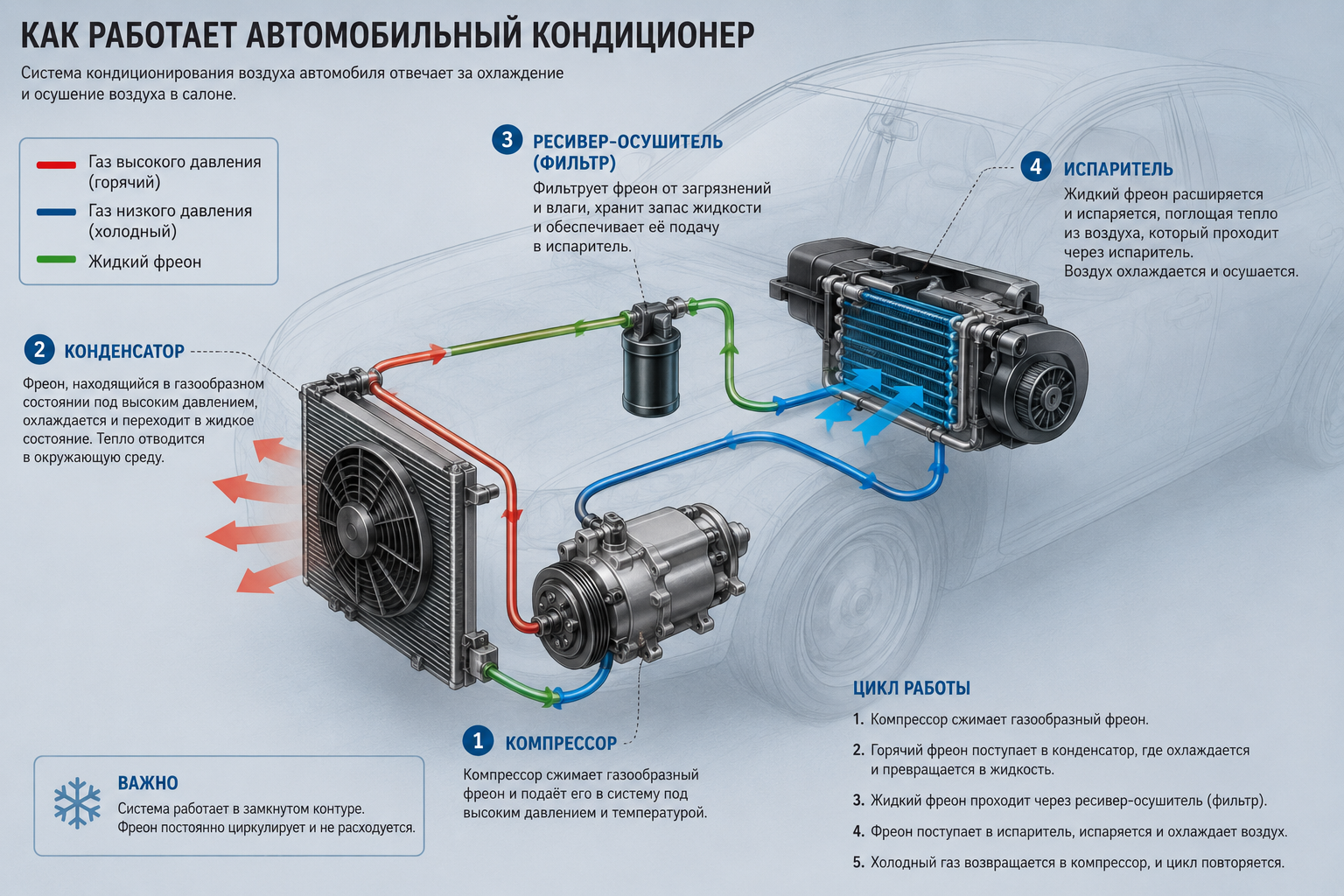
Next, the fan supplies already cooled and dehumidified air to the cabin. After this, the freon returns to the compressor, and the cycle repeats.
As long as the A/C button remains on, the system operates continuously.
Why the air conditioner removes fogging
Many have noticed that with the air conditioner on, windows stop fogging up even in winter.
The reason is that the air conditioner not only cools the air but also removes moisture from it.
When the airflow passes through the cold evaporator:
- moisture condenses
- water collects on the surface
- then it is discharged outside through the drain
That's why water droplets often appear under the car in summer — this is a normal result of the system's operation.
The dehumidification function makes the air conditioner especially useful:
- in rainy weather
- in winter
- with high humidity
- during rapid cabin warm-up
Even if the heater is set to warm, turning on the A/C helps remove moisture from the windows faster.
Does A/C increase fuel consumption?
Yes, the air conditioner does affect fuel consumption.
The compressor is driven by the engine, so the engine has to expend additional energy for its operation.
This is especially noticeable in cars with small engines, where a slight decrease in dynamics may be felt after turning on the air conditioner.
On average, fuel consumption increases by approximately:
- 0.3 liters per 100 km
- 0.5 liters
- sometimes up to 0.7 liters
In city traffic jams, the impact is usually felt more strongly.
In modern cars, electronics try to compensate for the load. In many systems, the compressor does not operate constantly but regulates power depending on temperature and conditions.
When the air conditioner is really needed
In summer, the purpose of the system is obvious — cooling the cabin. But the capabilities of A/C are not limited to this.
It is useful to turn on the air conditioner:
- when windows fog up
- in the rain
- in winter with high humidity
- for system prevention

Experts also advise running the air conditioner for at least 5–10 minutes once a week, even in cold weather.
This allows:
- maintaining oil circulation within the system
- lubricating seals
- reducing the risk of refrigerant leakage
- maintaining compressor performance
When it's better not to overload the air conditioner
Although the system is designed for regular operation, in some situations its use is not very effective.
For example:
- with fully open windows
- on very short winter trips
- when the engine overheats
If the windows are open, the air conditioner is essentially trying to cool the outside, which increases the load on the engine and fuel consumption.
In winter, with an unheated engine, the activated A/C can slightly slow down the cabin's warm-up. Therefore, it is sometimes more reasonable to wait until the engine reaches operating temperature first.
If the car has engine cooling problems, the additional load from the compressor can exacerbate overheating.
How A/C differs from climate control
In cars with climate control, the A/C button often works automatically.
When the driver selects Auto mode, the electronics independently decide:
- when to start the compressor
- how intensely to cool the air
- how to maintain the set temperature
With manual control, the driver turns the air conditioner on and off independently.
If A/C is off, the ventilation system still continues to operate. The air can be warm or cold depending on the heater settings, but without full cooling and dehumidification.
That's why many mistakenly turn off the air conditioner in winter, not realizing that along with it, the function of removing moisture from the cabin disappears.
What happens if you don't use the air conditioner for a long time
Completely avoiding the use of the air conditioner is also harmful.
If the system remains unused for months:
- seals dry out
- gaskets lose their tightness
- the risk of freon leakage increases
In addition, moisture gradually accumulates inside the system, and bacteria and an unpleasant odor can appear on the evaporator.
Periodic activation of the air conditioner helps avoid such problems and extends the service life of the entire system.
Ultimately, the A/C button is far from just "turning on the cold." It controls a complex system that affects not only comfort but also driving safety, visibility, and the condition of the car itself. Understanding its operating principles allows you to use the air conditioner consciously, rather than pressing the button automatically in any weather.
Read more materials:
- Why the Soviet NAMI-044E turned out to be too early
- Why tires of tractors and combines were whitewashed in the USSR
- What the percentage on the sticker under the hood means