Suspension malfunctions rarely go unnoticed. Even minor wear of its components gradually affects the car's behavior, reducing comfort and driving safety. That is why it is important to recognize the signs of shock absorber malfunction in time and not delay repairs.
Where to start the diagnosis
The first check can be done independently without special equipment. It is enough to carefully inspect the suspension elements and pay attention to several characteristic signs.
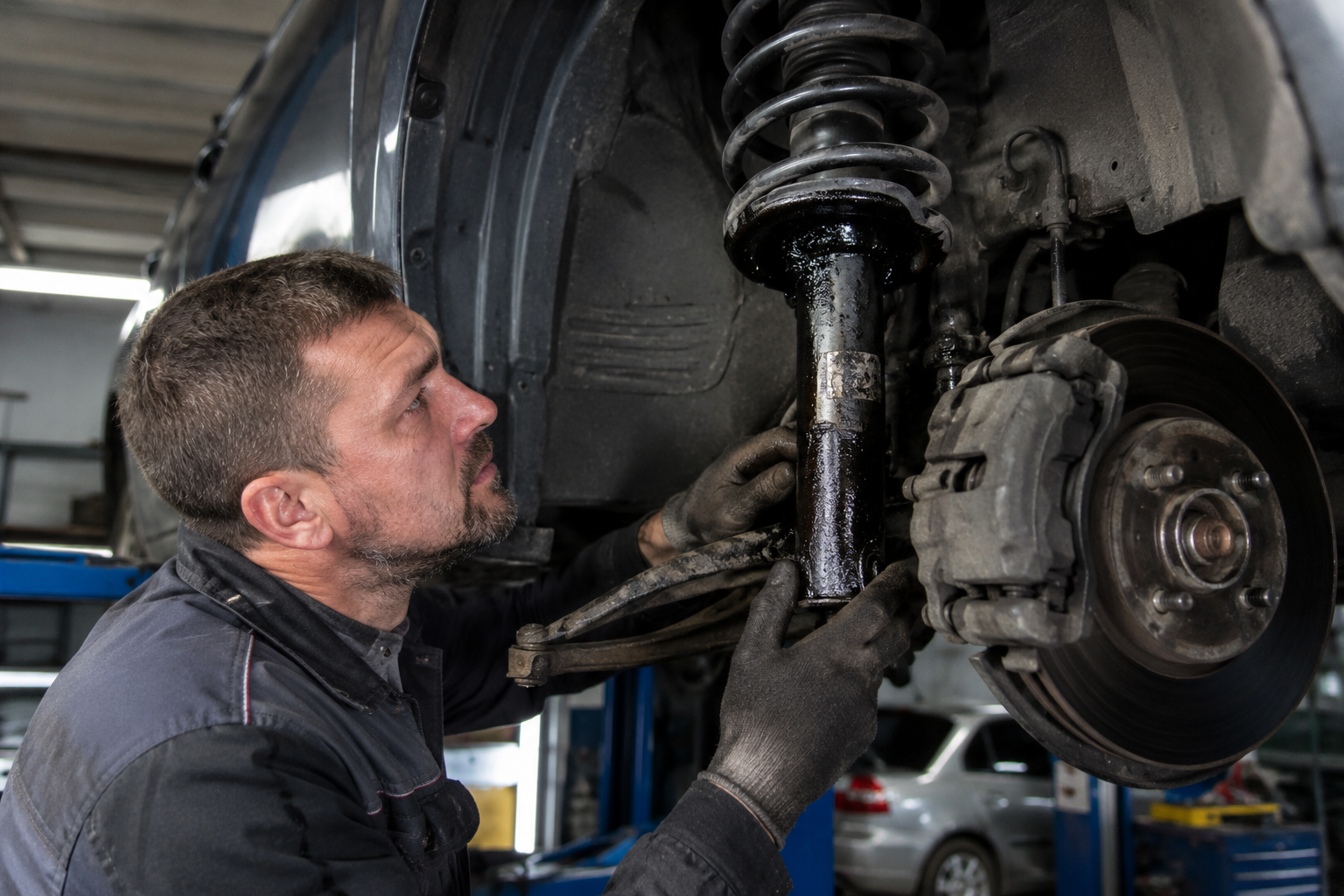
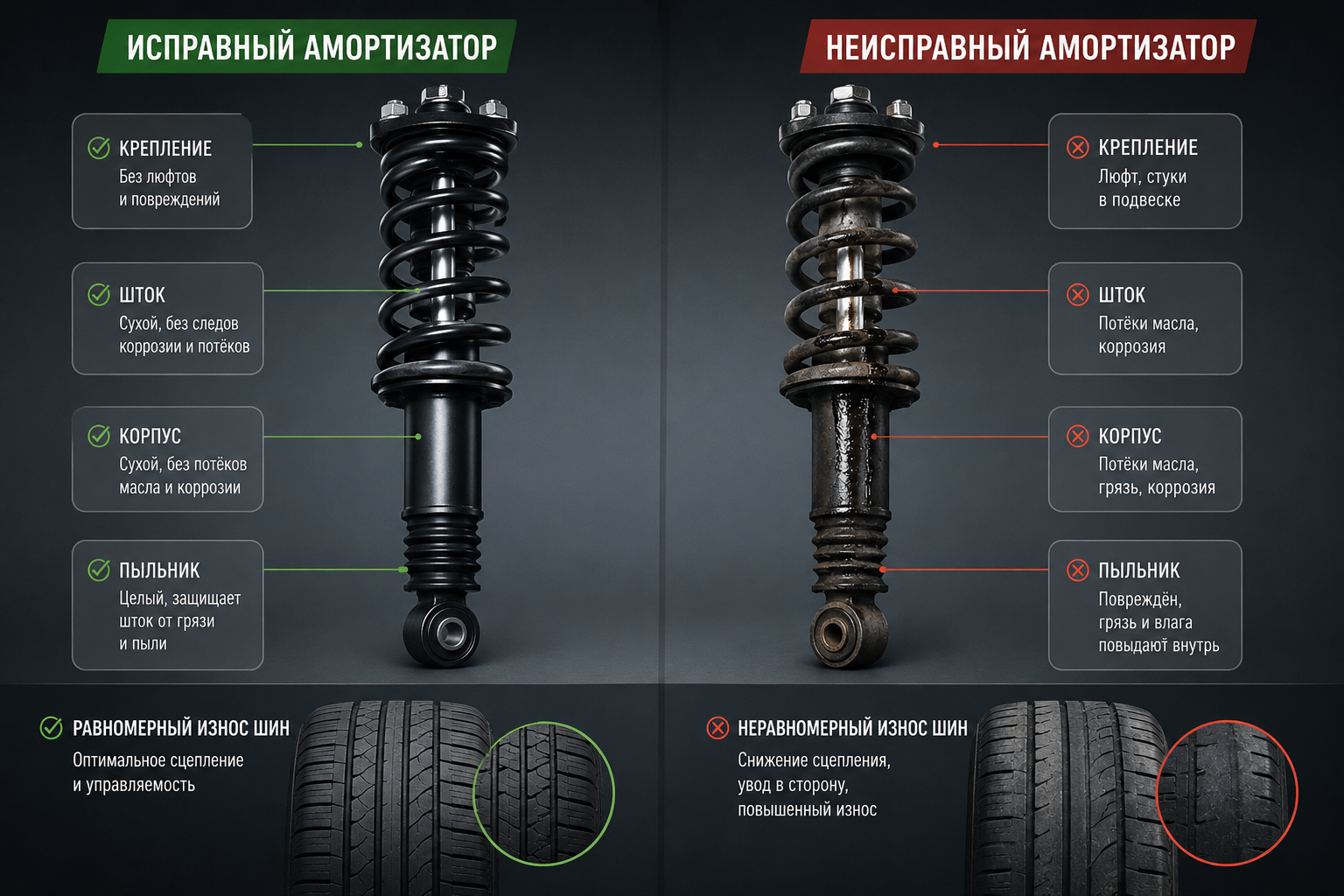
Main visual symptoms of wear:
- traces of oil leakage on the strut body;
- uneven tire tread wear;
- damage to the dust boot;
- destruction or deformation of the bump stop.
The most obvious sign is oil leakage. If the strut surface is covered with an oily film with adhering dirt, this indicates a breach of tightness. In this case, the shock absorber loses its operational properties. Slight sweating in the upper part of the rod is still acceptable, but pronounced leaks are a serious reason to replace the part.
An equally important sign is unusual tire wear. The appearance of individual worn areas or wavy marks on the tread is often due to the wheel losing constant contact with the road and starting to bounce due to a faulty shock absorber.
Protective elements deserve special attention. A torn dust boot allows dirt and moisture to access the rod, which accelerates seal wear. A damaged bump stop, in turn, ceases to protect the suspension from strong impacts during full compression.
What symptoms appear while driving
Even if there are no external signs of malfunction, the car's behavior on the road can tell a lot about the condition of the shock absorbers.
Most often, drivers encounter the following symptoms:
- knocking in the suspension when driving over bumps;
- excessive body roll;
- noticeable body lean in turns;
- frequent suspension bottoming out;
- vibrations on bad roads;
- reduced braking efficiency.
A classic sign is an extraneous knock when driving over potholes or speed bumps. However, a much more dangerous situation is when the car starts to noticeably rock after driving over bumps. The car may nose-dive sharply when braking or continue to oscillate after overcoming an asphalt wave.
Worn struts also worsen stability in turns. The body leans more, and the steering response becomes less predictable. If the suspension regularly bottoms out in potholes, this also indicates that the shock absorbers are no longer able to effectively dampen oscillations.
An additional symptom may be vibration occurring on roads with surface defects. All this negatively affects the car's handling and increases the braking distance, as the wheels maintain less contact with the road surface.
How modern struts are designed
Many passenger cars use MacPherson strut suspension at the front. In such a design, the strut simultaneously performs the functions of a shock absorber and a suspension guide element.
It works in conjunction with other components:
- suspension spring;
- upper shock absorber mount;
- dust boot;
- bump stop.
It should be noted that the source of extraneous noises is not always directly related to the shock absorber. Sometimes the cause of the knock is a worn upper mount, so the diagnosis should be comprehensive.
The service life of shock absorbers largely depends on the quality of roads and operating conditions. On average, the resource ranges from 60 to 150 thousand kilometers. Gas-oil shock absorbers are usually considered more durable.

At the same time, rear shock absorbers often last longer than front ones, as they experience less load during driving.
Simple self-check
You can assess the condition of the struts using a basic test.
To do this, you need to press down on the car's fender and release it sharply. If the shock absorber is working correctly, the body stabilizes almost immediately - usually one to one and a half oscillations are sufficient.
When the car continues to rock after release, this indicates a decrease in damping efficiency. However, this method only allows for an approximate assessment of the suspension's condition.
The most accurate information is provided by diagnostics on a vibration stand in a specialized service.
Why shock absorbers are replaced only in pairs
One of the most common mistakes is replacing only one strut on an axle.
Even if a leak appeared on only one shock absorber, the second usually has a comparable degree of wear. Installing a new element next to an old one leads to a difference in suspension characteristics.
The consequences can be as follows:
- worsened handling;
- increased body roll;
- unstable car behavior;
- uneven load distribution.
Therefore, replacement is always performed as a set - either both front struts or both rear shock absorbers.
What are the dangers of driving with faulty struts
Ignoring the first signs of wear can lead not only to reduced comfort but also to serious safety problems.

Faulty shock absorbers can cause:
- increased braking distance;
- worsened wheel grip on the road;
- loss of stability on uneven surfaces;
- accelerated wear of other suspension parts.
In addition, constant impacts and vibrations increase the load on silent blocks, ball joints, and upper strut mounts. As a result, the cost of subsequent repairs turns out to be significantly higher.
Is wheel alignment needed after replacement
If the car is equipped with MacPherson strut suspension, after replacing the struts, it is necessary to adjust the wheel alignment angles.
During dismantling and installation, the suspension geometry is disturbed, so without the wheel alignment procedure, the following problems may appear:
- accelerated tire wear;
- car pulling to one side;
- worsened directional stability;
- reduced steering precision.
That is why adjustment after repair is considered a mandatory step, allowing to fully restore the correct operation of the suspension and preserve tire life.
Read more materials:
- The Chinese automotive industry enters a new phase: the era of easy growth ends, the struggle for survival begins
- The most unusual car of the early XX century
- The only victory of the socialist automotive industry: the Dacia phenomenon