Almost every driver has at least once pulled up to a gas pump and only at the last moment realized that the fuel filler flap is on the opposite side of the car. As a result, they either have to stretch the fuel hose across the car or move the car, delaying the queue. Although such a situation seems accidental, the location of the fuel filler neck is determined by very specific engineering solutions that have evolved over decades.
Several factors influence the choice of the flap's location: the traditions of a specific manufacturer, the car's design features, safety requirements, and even the specifics of the markets for which the model was created.
No universal rule exists
The main thing to consider is that there has never been a single international standard for the location of the fuel filler flap. While the steering wheel position directly depends on the side of traffic in a country, manufacturers choose the location of the fuel filler neck independently.

That's why cars of the same brand can differ significantly from each other. Sometimes the flap is on different sides even for models of the same family if they belong to different generations or were developed for different markets.
For this reason, it is impossible to determine the side of the fuel tank solely by the car brand.
How it all began
In early cars, the location for the fuel tank was chosen primarily from a design perspective. Engineers needed to place it so that it would not interfere with the engine, suspension, exhaust system, spare wheel, and other components. Therefore, the fuel filler neck was routed to where it was technically easiest to implement.
Later, as the automotive industry became more mass-produced, many companies developed their own engineering traditions.
Historically, most European manufacturers, including Volkswagen, Mercedes-Benz, BMW, and Audi, more often placed the flap on the right side of the body. Japanese car manufacturers, on the contrary, preferred the left-hand location in many models, although here too much depended on the specific market and car features.
Is it related to the steering wheel position?
There is a common belief that the side of the flap is determined by driver convenience. According to this version, if the fuel filler neck is located near the driver's door, it is easier to control the refueling process without walking around the car.
However, this pattern does not always work. Many models, on the contrary, have the flap on the passenger side. In this case, the driver exits the car from the sidewalk or safe zone, rather than opening the door towards the roadway.
There is another explanation. The layout of gas stations in different countries has historically developed differently, so manufacturers targeting certain markets could take into account the peculiarities of local infrastructure even at the car design stage.
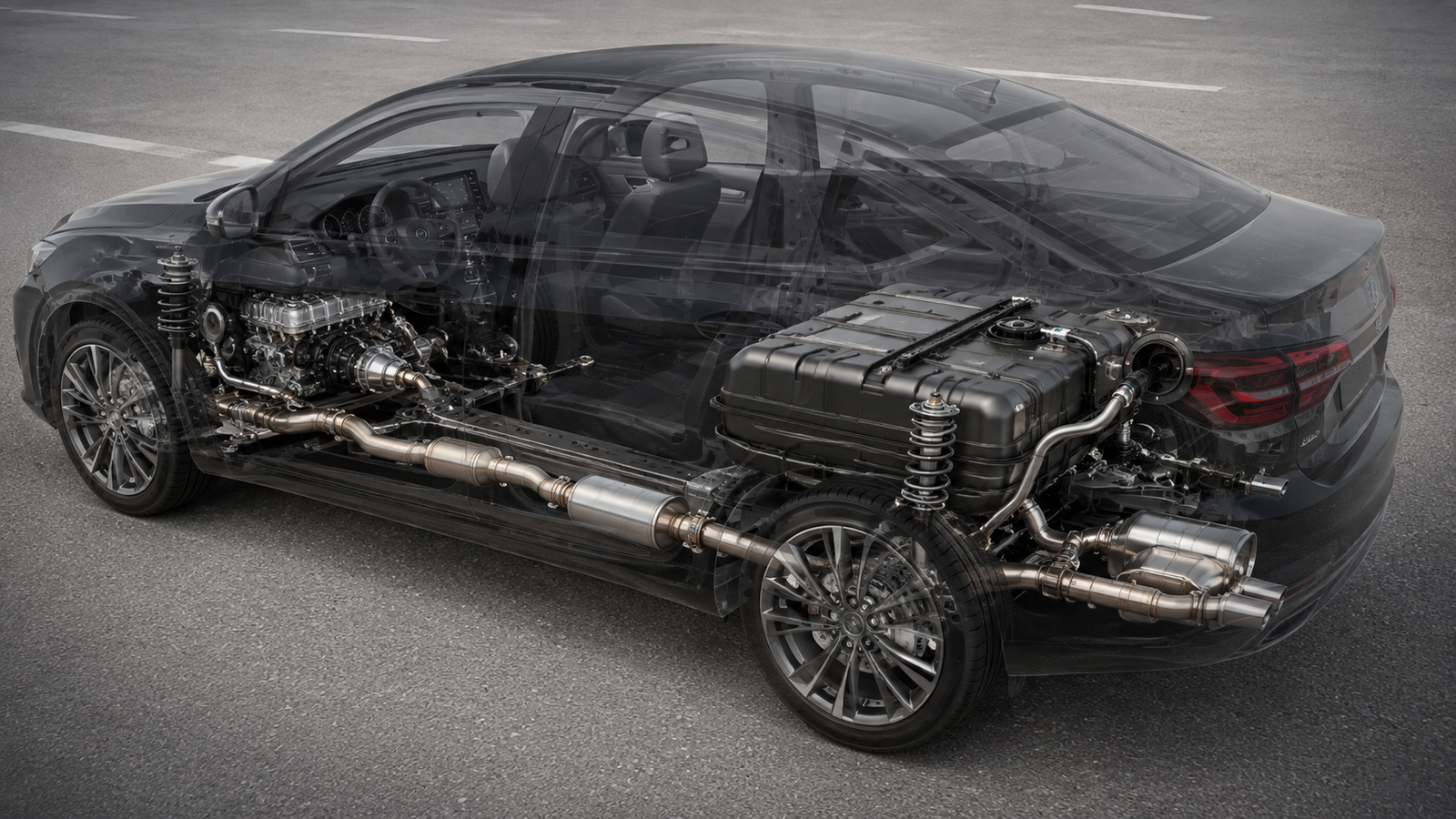
The choice of side could be influenced by:
- features of gas station organization;
- safety requirements for the driver exiting the car;
- model orientation to a specific market.
Why car layout is crucial
In many cases, the location of the fuel tank is determined not by driver convenience, but by the car's design features.
Engineers need to place the fuel tank, exhaust system, suspension, and other elements so that they do not interfere with each other and maintain the car's safety during operation and potential accidents.
Special attention is paid to the exhaust system. The fuel filler neck is tried to be placed as far as possible from the most heated elements, reducing the likelihood of dangerous situations.
If the exhaust system runs along the center of the underbody, the space for the tank becomes more free. In this case, engineers choose the side of the body where it is easier to route the fuel line without crossing important car components, including suspension elements or the driveshaft in rear-wheel drive and all-wheel drive models.
Unification of modern platforms
Modern cars are increasingly built on modular architectures that are used for a large number of models from different brands.
A good example is the Volkswagen Group's MQB platform. Dozens of cars of various brands, including Skoda and SEAT, are produced on its basis. The location of the fuel tank is determined at the platform design stage and then maintained for almost all models using this design, regardless of the country in which they are sold.
This approach allows solving several problems at once:
- reduce development costs for new models;
- simplify car production;
- maintain uniform service schemes and technical documentation;
- facilitate subsequent car maintenance.
It is unification that often explains why a manufacturer adheres to the same side for the flap for decades. The reason is not so much technical necessity as economic feasibility: there is no point in changing a proven design without good reason.
A hint that not everyone knows
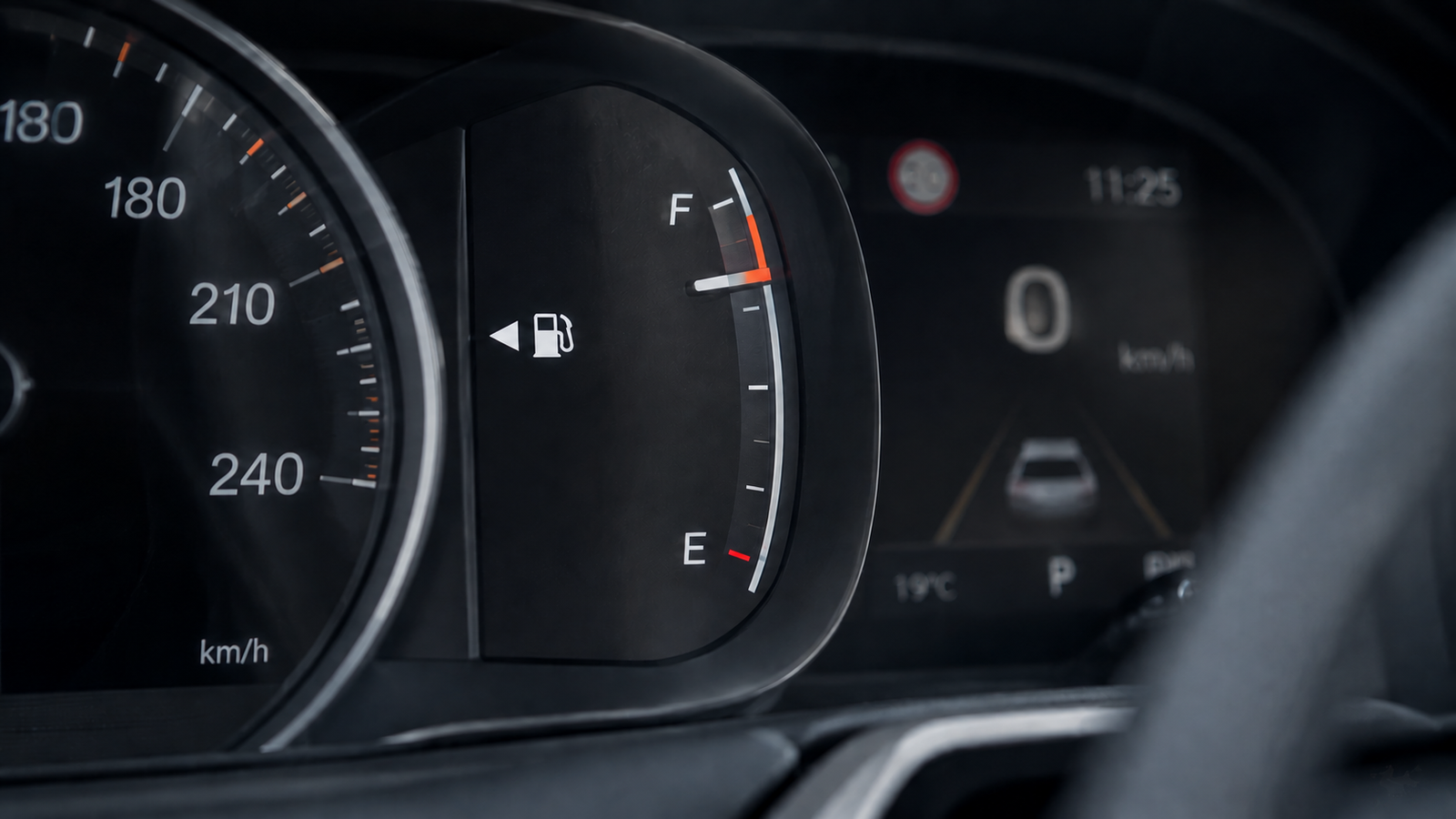
Modern drivers do not need to memorize the location of the fuel tank for each model. On most cars produced since the 2000s, there is a small arrow next to the fuel gauge. It shows which side of the body the flap is on.
This simple detail is especially useful for those who regularly use carsharing, rental cars, or often switch from one car to another.
With the development of electric vehicles, the situation has become even more interesting. The charging connector is no longer tied to the layout of the internal combustion engine or exhaust system. Therefore, the port for connecting the cable can be located at the front, rear, on any of the fenders, or even in place of the familiar radiator grille. Now engineers are more often guided by the convenience of connecting to charging stations, rather than by the limitations characteristic of cars with traditional power plants.
Why there is no single solution
The location of the fuel filler flap cannot be explained by any single reason. It is simultaneously influenced by the manufacturer's engineering traditions, the car's layout features, safety requirements, the design of the exhaust system, and the principles of unification of modern platforms.
Therefore, even experienced motorists sometimes make mistakes when switching to an unfamiliar car. Fortunately, the problem has long been solved by a small arrow next to the fuel gauge. It relieves the driver of the need to memorize the features of each model and once again reminds that even such a seemingly simple car detail is the result of many engineering solutions.
Read more articles:
- MAZ-5549: The Heavy Character of the Legendary Dump Truck
- Where did the non-punishable 20 km/h threshold come from?
- The most unusual places for the fuel filler neck in automotive history
Комментарии