In the year when the Urals Automobile Plant produced more than 10 thousand trucks, only 63 units of four-axle cab-over-engine vehicles were produced. A year earlier, there were 96, and a few years later – 64.
At the same time, production was not stopped, and the truck itself was not considered a failure. It has been produced since 1989, its developers received a state award for it, and the machine still operates throughout the country, transporting cranes and drilling equipment. It's just assembled almost piece by piece.
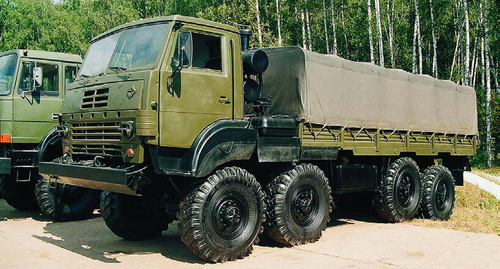
One of the designers once called this vehicle a "unfortunate machine" in a conversation with journalists. And the history of the four-axle "Ural" indeed turned out to be difficult.
Why the Hooded All-Terrain Vehicle Needed a Cab-Over-Engine Design
The first experiments with different layouts in Miass began in the late 1960s. Then two trucks were built with identical units but different cabs. For the first, a cab from a production "Ural" was used, which was widened by 300 mm. To do this, it was cut along the line of the windshields and an additional metal strip was inserted.
The second prototype received a cab located above the engine. A fiberglass body was made for it. The remaining elements were tried to be kept identical: engine, axles, gearbox, and tires. Thus, the designers could compare the two options as accurately as possible. The difference in dynamics, maximum speed, and off-road behavior turned out to be insignificant. However, the cab-over-engine design provided a specific advantage in size.
The cargo platform became 800 mm longer, and the overall length of the vehicle decreased by 400 mm compared to the production all-terrain vehicle. As a result, the truck could carry more cargo, took up less space on the road, and turned more willingly. But the final decision was determined by another point in the technical specification. A machine capable of floating had to appear in the new family.
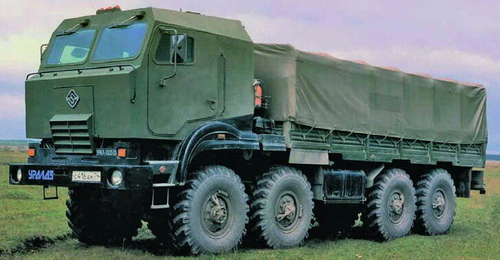
At that time, it was believed that building a full-fledged floating truck with a long hood in front was almost impossible. Therefore, the four-axle option was initially designed with a cab-over-engine layout. Later, this thesis was still refuted. A floating version was made based on a conventional hooded "Ural": the body was sealed, polyurethane foam floats were installed, and a propeller was placed in the stern. On water, the machine developed 8 km/h and could carry 4.5 tons of cargo.
It turned out paradoxically: the argument for which it was necessary to change the layout ceased to be decisive, but the four-axle truck was already being designed as a cab-over-engine. This solution also had disadvantages. The doors opened backward, but this hardly improved visibility in the mirrors. And to access the engine, the cab had to be tilted forward with a winch – it was impossible to lift it manually.
Why the Four-Axle "Ural" Was Left Without Its Own Engine
Initially, the entire new family was planned to be equipped with engines from the Kama Automobile Plant. A whole line of diesel engines with the same cylinder bore and piston stroke was assumed: six-, eight-, and ten-cylinder versions. A suitable option could be selected for each truck. However, KamAZ brought only one of them to serial production – an eight-cylinder engine, and the four-axle machine required a ten-cylinder one.
Such an engine was indeed assembled in several prototypes, installed on a truck, and tested. But then problems arose. The ten-cylinder diesel turned out to be significantly heavier and more complex than the eight-cylinder one, while consuming more fuel. It was decided not to launch it into production. Along with this project, the first version of the four-axle "Ural" effectively ended.
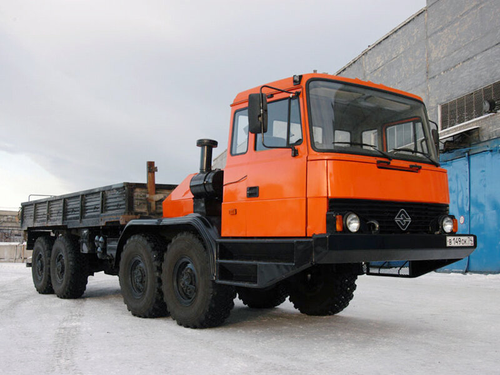
The next vehicle – the very "Ural-5323" – received a KamAZ V8 with turbocharging, producing 260 hp. But the Urals Plant constantly lacked these engines. At the same time, Miass tried to develop its own diesel engine back in the 1960s. It was brought to bench tests, and the first experimental cab-over-engine machines even received this engine. But the project did not go beyond the bench: there was neither the necessary site nor sufficient funding to organize its own engine production.
Diesel from Another Republic
The idea of its own engine was revisited after German trucks performed well on the Baikal-Amur Mainline (BAM). About 10 thousand such machines were brought for construction, and air-cooled diesel engines proved to be very successful. Their design had several obvious advantages. There was no radiator or water pump, no antifreeze was required, which meant nothing could freeze or leak in winter. In addition, an air-cooled diesel was lighter than a water-cooled one and cheaper to produce.
The USSR acquired a license, the engine was named "Ural-744", after which a new question arose: where to organize its production? The problem was that the engine was German, meaning it came from a NATO country. German specialists had to come to the production site, launch the equipment, and train Soviet workers. But Miass was a closed city. Outsiders were not allowed there, and foreigners even less so.
Therefore, the site was chosen in Kustanai – several hundred kilometers from Miass, already in another union republic. The construction of the engine plant stretched for almost ten years. The plan was ambitious: it was supposed to produce tens of thousands of engines annually, with about half of all "Urals" to be equipped with the Kustanai diesel.
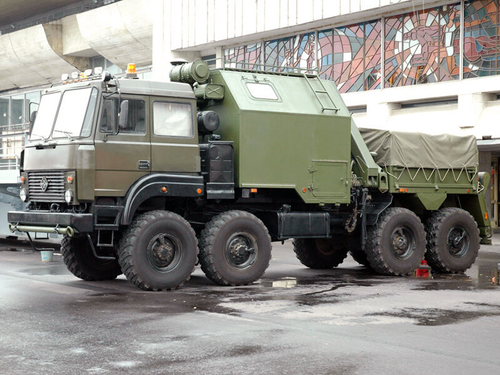
Documentation for the 234-hp version was prepared, equipment was delivered, and the first engines were produced by the enterprise literally on the eve of the collapse of the Soviet Union. After that, the engine turned out to be effectively foreign not only by origin but also by place of production. The joint venture with the German side remained in independent Kazakhstan and soon disintegrated.
Throughout its operation, the Kustanai Diesel Plant produced only 405 engines. Not per year – in total. The situation was exacerbated by another event. In April 1993, the engine production at KamAZ, from where the Urals Plant received its usual eight-cylinder engines, burned down.
Thus, Miass almost simultaneously lost both sources of power units: both the promising licensed diesel and the KamAZ V8. The four-axle truck had to be urgently converted to a Yaroslavl engine with 300 hp and a gearbox from the same manufacturer. And the promising family, for which most of this work was created, was gradually closed.
The Cab That Didn't Make It to Testing
The situation with the cab also turned out to be difficult. Initially, it was planned to produce it independently in Miass, but this idea could not be realized. Cabs had to be received from KamAZ literally piece by piece. At the same time, they were designed for a completely different truck. To install such a cab on a four-axle "Ural" chassis, it had to be manually modified.
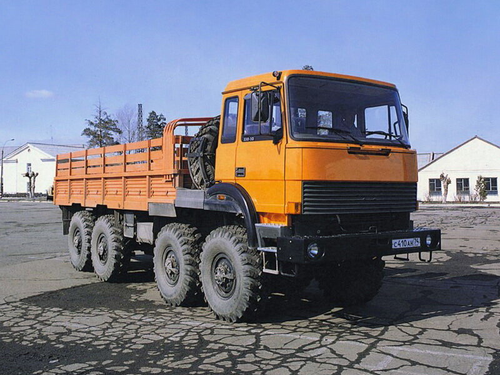
Full-scale conveyor production was out of the question under such conditions. Machines were assembled for years on slipways almost as individual items. One of the experimental dump trucks was loaded onto a platform and sent for northern tests. The vehicle reached its destination without a cab – it burned down somewhere along the way. The machine was returned to Miass. By that time, a joint venture with Italians had already appeared at the plant.
An Italian design was installed on the cab-less chassis. This is how the first "Ural-5323" appeared with the cab that subsequently became characteristic of this family. The Italian side contributed not so much money to the joint venture as equipment: tooling, machines, and dies for the production of the construction series cab. Miass mastered its production. Serial machines with this cab began to appear in the early 2000s, and a year later, a version with a sleeping berth appeared. However, the four-axle model only reached the main conveyor 13 years after the start of its production.
How the Cab Changed
The driver received a cab 2100 mm wide at the doors, a two-meter sleeping shelf, and a sufficiently high roof, allowing one to stand inside almost without bending. The main drawback remained the engine compartment protrusion. It rose 48 cm above the floor. In the first versions, the hump was even higher and ran almost through the entire cab. But the floor itself was quite low: two steps were required for boarding instead of three.
Along with the new cab, a new painting technology also came to the Urals Plant. The welded body was completely immersed in a sequence of special baths. Then the primer coating was deposited directly onto the metal using electric current and then baked at a temperature of 180 degrees. This technology allowed processing even those places that are impossible to reach in the usual way – the internal surfaces of welds and closed cavities. Thanks to this, the cab began to rust 3-4 times later.
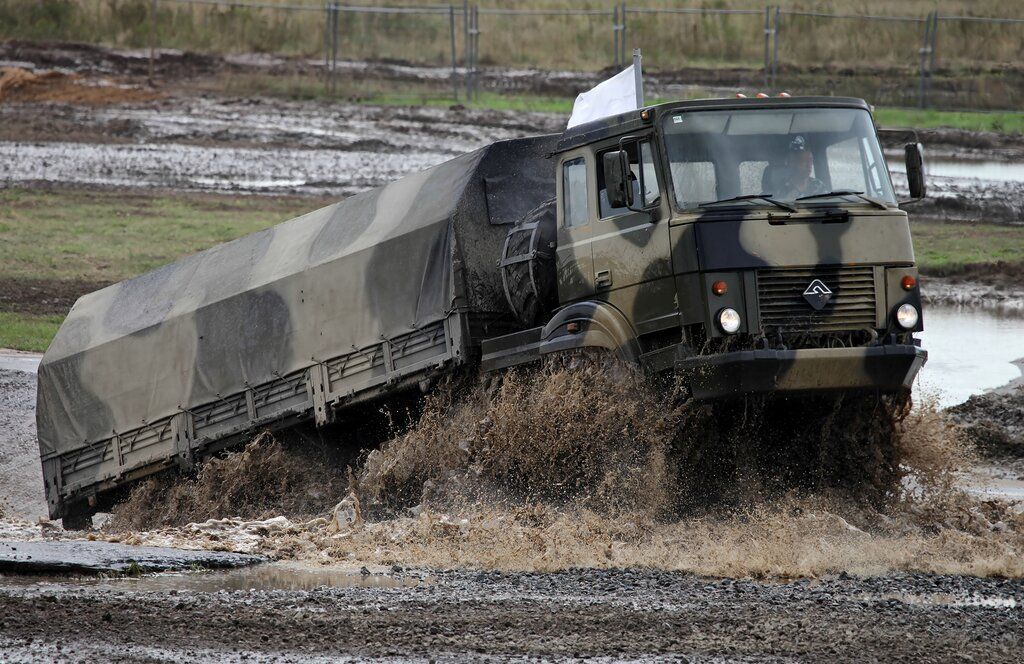
The same technological line was subsequently used for the cabs of conventional hooded "Urals". As a result, the four-axle machine, which itself never became mass-produced, helped introduce new technology throughout the enterprise.
The Price of Four Driving Axles
Four driving axles provide serious off-road capability, but it comes at the cost of weight, complexity, and fuel consumption. The vehicle has eight driving wheels, eight hubs, four axles, and an air supply system for each wheel.
All this adds approximately 2.5 tons of weight, which the truck constantly carries with it regardless of whether it is loaded or moving empty. The curb weight of the four-axle version is 12 tons versus 9.5 tons for the three-axle "Ural".
When driving calmly, fuel consumption is approximately 40 liters per 100 km. The fuel tanks have a volume of 300 and 210 liters, thanks to which the cruising range can reach 1000 km. For a heavy all-terrain vehicle, this is quite acceptable. But the three-axle "Ural" can carry 10.5 tons, is cheaper and easier to maintain, and reaches almost the same places in terms of off-road capability. The difference in carrying capacity is 3.5 tons.
Therefore, civilian versions of the four-axle truck gradually began to disappear. The machine has been preserved where its advantages are truly necessary: when a long frame is required for heavy equipment and the ability to transport up to 14 tons of cargo off-road.
Today, such "Urals" are used in a variety of specialized versions:
- crane manipulators;
- oil drilling rigs;
- pontoon machines;
- fire tanks with a volume of 13 cubic meters;
- mobile stations capable of producing up to 10 cubic meters of drinking water per hour.
Why the Machine Still Continues to Live
The modern "Ural-5323" is already very different from the first vehicles that were assembled on slipways. Today it has:
- an engine with 328 hp;
- a nine-speed gearbox;
- ABS;
- cruise control;
- a platform almost 7 m long;
- a carrying capacity of 14.1 tons.
But it never became mass-produced.
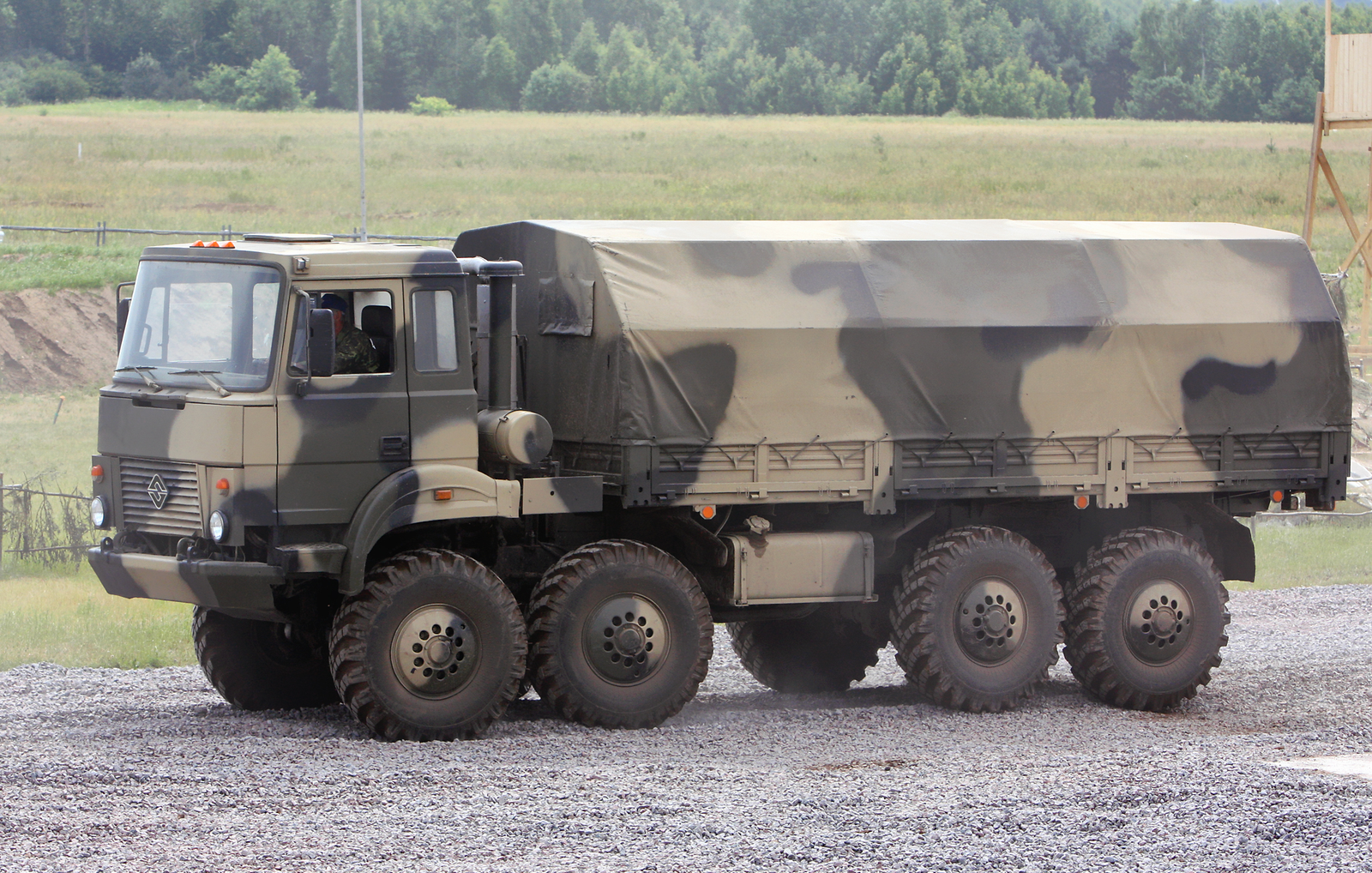
When the Italian dies were transferred to the Urals Plant, the estimate was about 9 thousand cabs per year. In reality, the entire cab-over-engine line, along with the four-axle model, produces only 2-3 thousand cabs from this equipment. At the same time, the dies, designed for huge production volumes, have not been worn out in three decades.
The history of the four-axle "Ural" in this sense is indicative. The machine, which was designed as part of a large family, constantly faced a shortage of engines, problems with cab production, and changes in the industrial system. It survived the disappearance of one engine, the loss of a second source of power units, the collapse of the country, the relocation of production, and a change in the technological base. And yet it did not disappear itself.
Even if the plant produces it in dozens or small series instead of thousands of units per year, where a combination of a long frame, four driving axles, and the ability to transport heavy equipment off-road is required, alternatives are still not always found.
Read more materials:
- Why the unique AZLK S-1 never became serial
- Spoiler on a racing helmet: benefit or just style
- Which engines are best suited for chip tuning
Comments