In the summer of 1939, three jerrycans disappeared from a warehouse at Berlin's Tempelhof Airport. Formally, this was a minor shortage: there were thousands of them in the warehouse. But these three containers went on a long journey that ultimately helped change the attitude of the American military towards fuel containers.
The jerrycans were taken by an engineer from a Berlin pressing plant – an enterprise where they were being prepared for mass production. Together with his American colleague Paul Place, he was completing a homemade car and was going to cross half a continent on his way to India.
Before starting, a simple problem arose: there was nowhere to put the water supply. Three empty jerrycans were attached to the underside of the car. Against the background of huge warehouse stocks, their disappearance went unnoticed.
Competition for a new army container
The history of this design began in the autumn of 1936. The German military announced a competition for a new 20-liter fuel container. The previous container had a volume of 45 liters, it had to be carried with a bent arm, and at the first impact, the body often split at the seam.
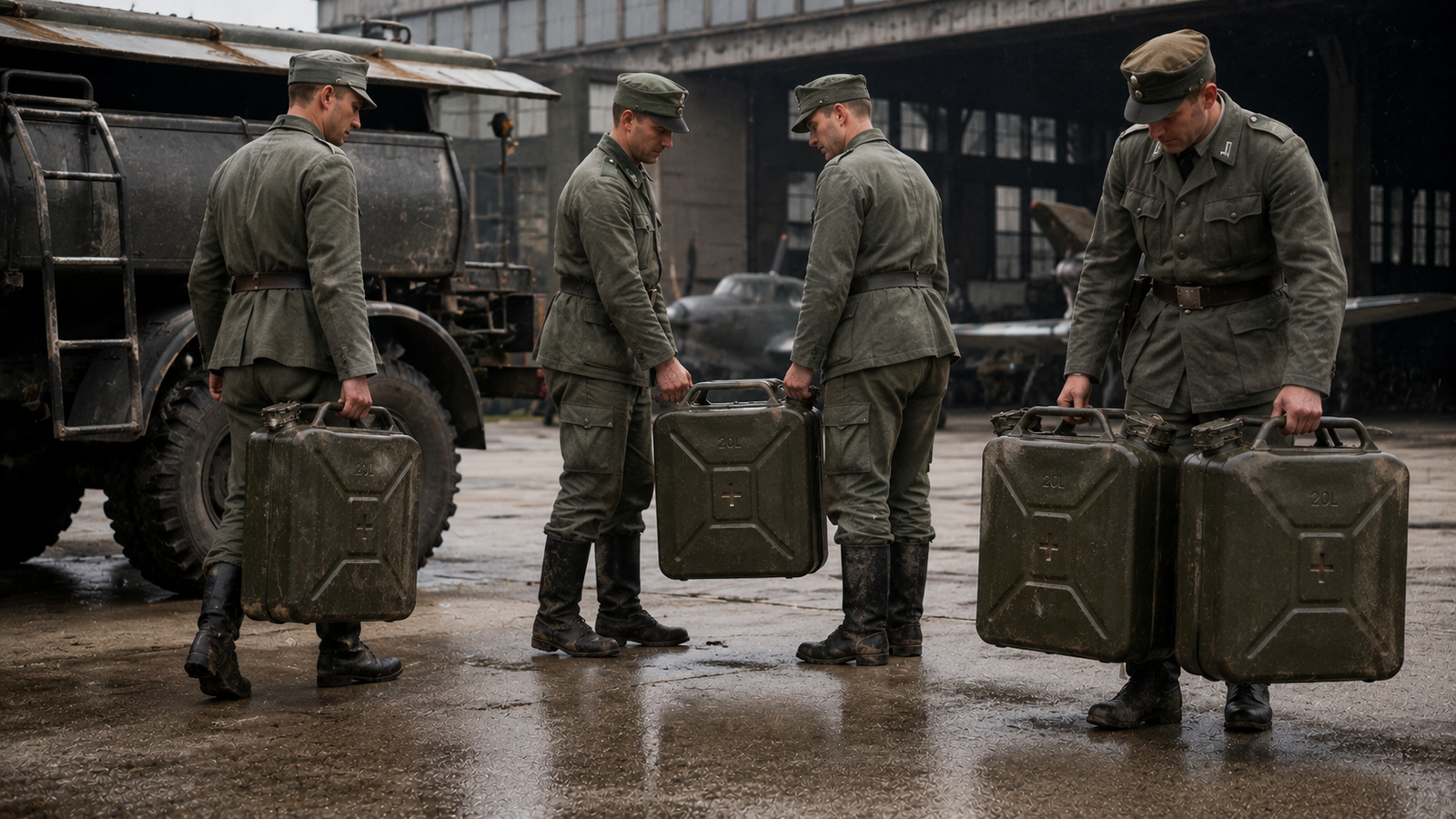
The winner of the competition was the Müller factory in Schwelm, Westphalia. The work was led by senior engineer Vinzenz Grünvogel. The technical specification had one unusual requirement: one person should be able to carry two full jerrycans or four empty ones at once.
This explains the characteristic design of the upper part of the body. Three handles appeared on the jerrycan:
- the central one was intended for carrying one container;
- the two outer ones allowed it to be carried by two people;
- when using the outer handles together, several empty jerrycans could be carried.
The middle handle works in the usual way. One full jerrycan weighs about 20 kg, and it can be carried independently. If the container is lifted by two people, each person takes one of the outer handles, so that the load is distributed between two people and does not interfere with normal walking.
But the design allowed the handles to be used even more interestingly. If two jerrycans are placed close together, their outer handles will touch and allow one hand to hold both at the same time. As a result, two empty jerrycans could be carried in each hand – four in total.
The outer handles also have another purpose. They allow the container to be passed along a chain. One person holds the jerrycan by the handle furthest from their neighbor, the next person takes the free nearest one. The container is passed from hand to hand without having to put it on the ground. When unloading a car, this scheme effectively turns people into a kind of conveyor belt.
The secret of the design was hidden inside
The development was carried out in secrecy from the very beginning. One of the features of the new jerrycan was a protrusion above the neck. It created an air pocket, thanks to which the container did not start to leak when heated. In addition, the design allowed the jerrycan not to sink when falling into water.
The lock was made just as simple. It could be opened with bare hands, without a key and without using a funnel.
The inner surface of the body was covered with a special compound, originally developed for steel beer barrels. Thanks to this, the same container could be used for different tasks: transporting gasoline in it, and then drinking water.
The patent application was filed on June 22, 1938, but it was not published. The document became publicly available only on July 5, 1956 – 18 years after filing.
By the autumn of 1939, thousands of finished jerrycans were already in warehouses. The reason for the secrecy was quite practical. Military equipment required containers that could be lifted and carried manually.
The British army at that time used 18-liter tin containers, nicknamed "flimsy". In the sun, such jerrycans swelled, the seams began to leak, and a funnel was required to fill them.
Fuel losses during transportation were enormous. According to the British commander in North Africa, up to 30% of fuel was lost on the way from the base to the end consumer.
The journey of three jerrycans to India
Meanwhile, Place's car and his German colleague successfully crossed 11 borders. In the middle of India, a plane from Berlin was sent for the German engineer. Before his departure, he handed the American full documentation for the production of the jerrycan – the one he knew thanks to his work at the factory.
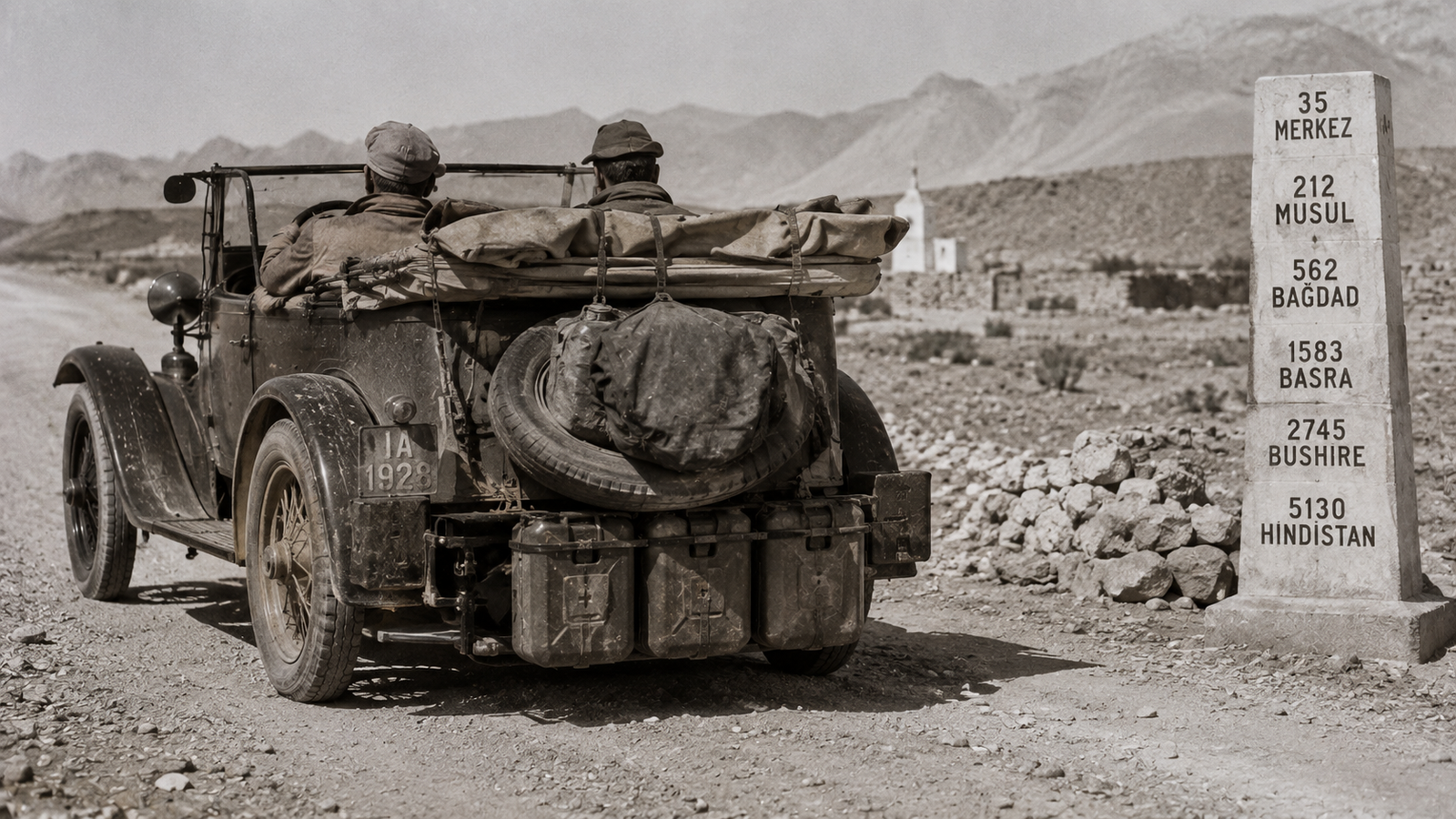
Place continued his journey alone. He reached Calcutta, left the car in storage, and flew to Philadelphia.
Place told the American military about the German jerrycan, but without the sample itself, his words were not given sufficient importance. He did not dare to transport the containers as separate cargo, so the entire car was sent home.
The route turned out to be unusual: first the car passed through Turkey, and then went via the Cape of Good Hope.
In the summer of 1940, the car finally arrived in New York. The three jerrycans remained attached to the underside all this time. One of them was sent to Washington, where the new sample was studied and it was decided to replace the existing cylindrical 40-liter container, which had survived since the last war.
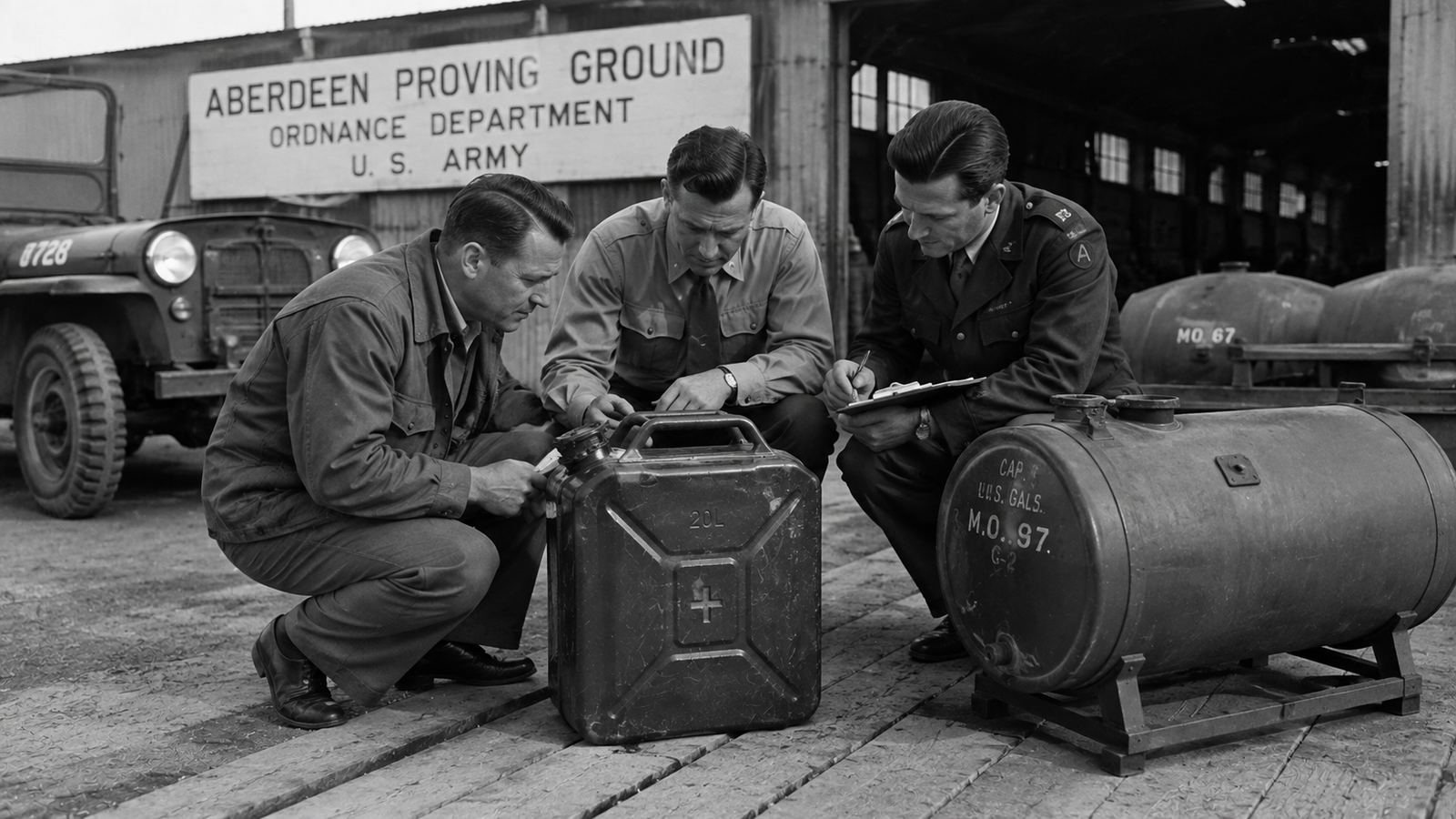
The German specimen was delivered to a test site in Maryland. The Americans used its main external solutions:
- dimensions;
- overall silhouette;
- handle design.
But the internal coating of the German sample was decided to be completely removed.
One telegram changed American plans
In September 1942, two American engineers involved in quality control arrived in Cairo. Two weeks remained until the Battle of El Alamein.
The British military explained the situation to them without further ado: they considered only German containers suitable, but they could only be obtained by capturing them from the enemy.
American engineers went to rear warehouses and saw the real picture with their own eyes. Barrels were unloaded, fuel was poured into familiar tin containers, and puddles of gasoline remained underfoot.
After the trip, a telegram was sent to Washington. It claimed that 40% of the gasoline supplied to Egypt was lost due to spills and evaporation. At the same time, the engineers themselves took the figure at random – they wanted Washington to finally realize the scale of the problem.
The reaction was immediate. A request came from the capital demanding confirmation of the data. After receiving the report, the Americans abandoned the development of another of their own jerrycan variant. The production of containers for the upcoming landing in Europe was completely entrusted to the British.
Millions of jerrycans across Europe
By May 1945, about 21 million jerrycans had been distributed across Europe. No one was in a hurry to return empty containers. In October 1944 alone, 3.5 million units were reported lost.
The problem reached such a point that schoolchildren in France were offered a reward for collecting empty jerrycans. Children collected about a million copies.
Such containers were supplied to the Soviet Union under Lend-Lease. Their own production began after the war – for this, presses brought from Germany were used.
The design itself has changed surprisingly little since then. The characteristic three handles have been preserved, although the need to carry four empty jerrycans at once has long disappeared. The recognizable cross on the side of the body also remained.
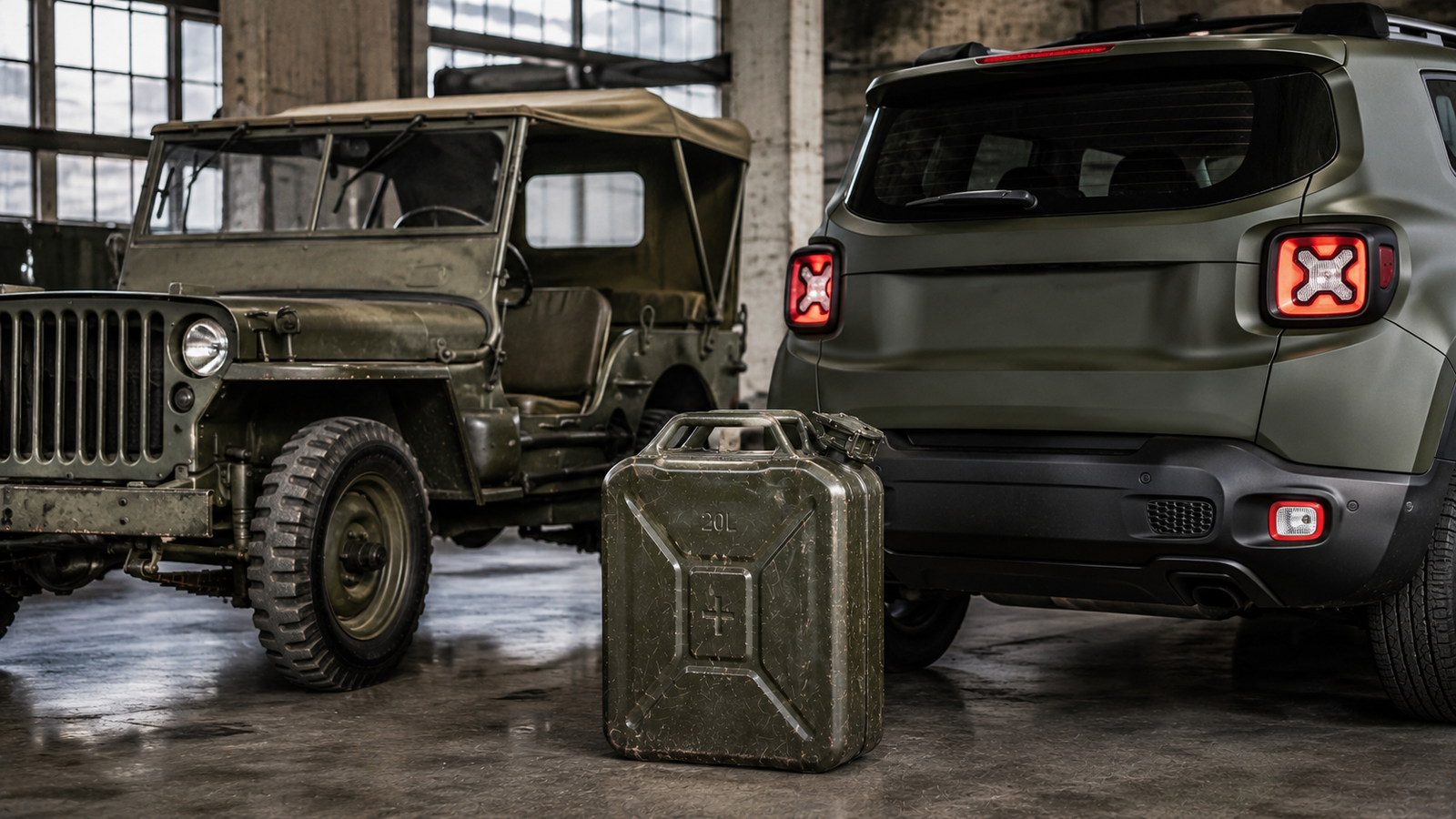
Later, this design element received an unexpected continuation in the automotive world. The cross appeared in the design of the taillights of the Jeep Renegade crossover – as a kind of reference to the very jerrycan that was once carried on the back of a "Willys".
Read more materials:
- Toyota Mark II: why it is still loved
- Fifth wheel: an American in 1932 invented how to park sideways
- Why a car battery has 12 volts