If you delve into the design of a car's electrical system, a natural question arises: why exactly 12 volts? Why not 6, 24, or 48? The answer is related to several characteristics at once — the design of a lead-acid battery, the necessary starter power, the current magnitude, wire gauge, safety, and component cost.
The basis of a conventional car battery is a lead-acid electrochemical system. Voltage is generated due to the potential difference between lead, lead dioxide, and sulfuric acid. One battery cell in a charged state produces approximately 2.1 volts. Its nominal voltage is conventionally taken as 2 volts. The size of the plates does not affect this value: it primarily determines the battery's capacity and its ability to deliver high current.
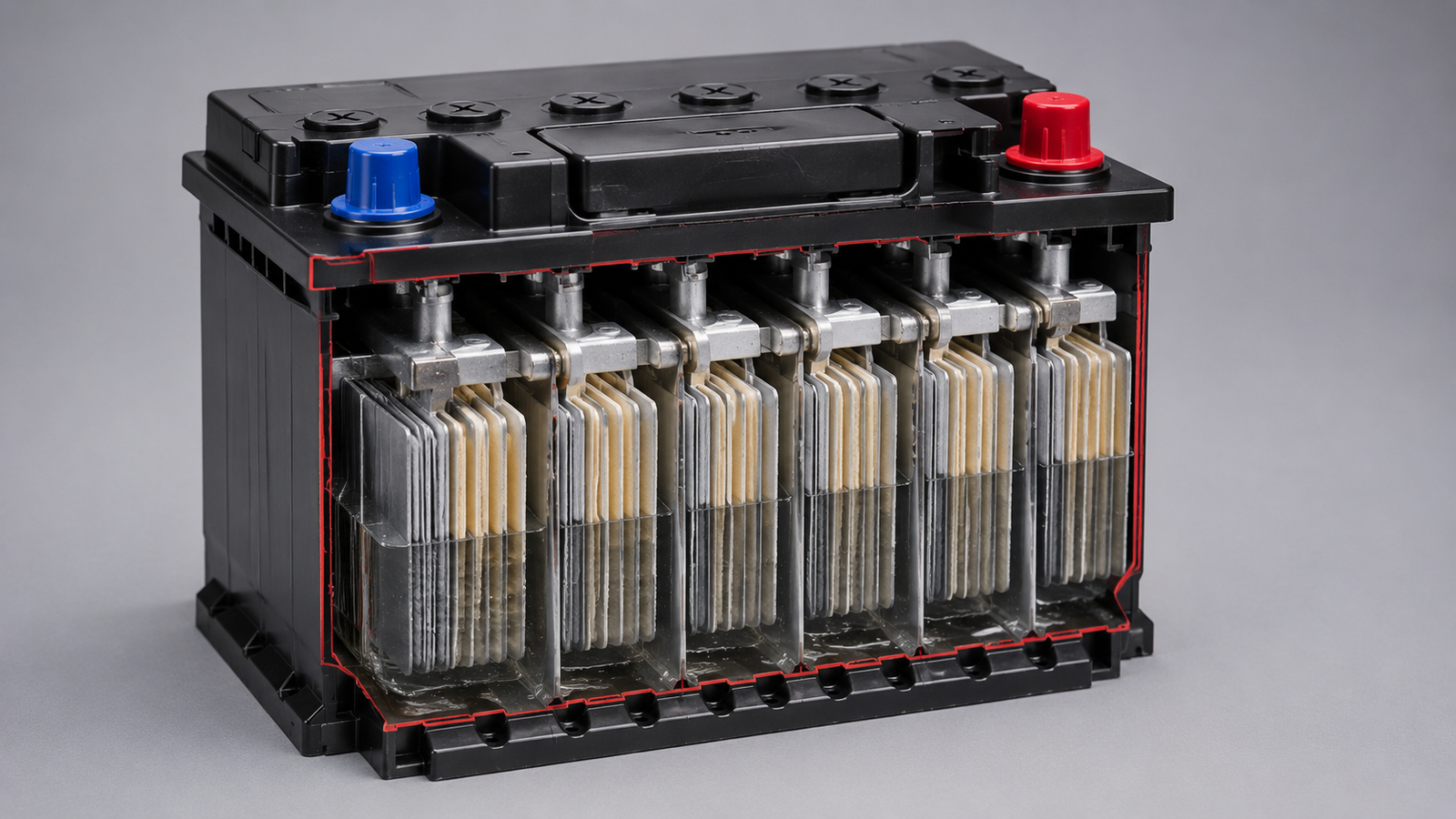
To obtain the required voltage, individual cells are connected in series. Six such cells give: 2 × 6 = 12 volts. Exactly six cells allow for a sufficiently compact battery capable of providing the necessary power to start the engine. Fewer cells would result in insufficient voltage, while increasing their number would make the battery more cumbersome.
Why 6 volts used to be enough
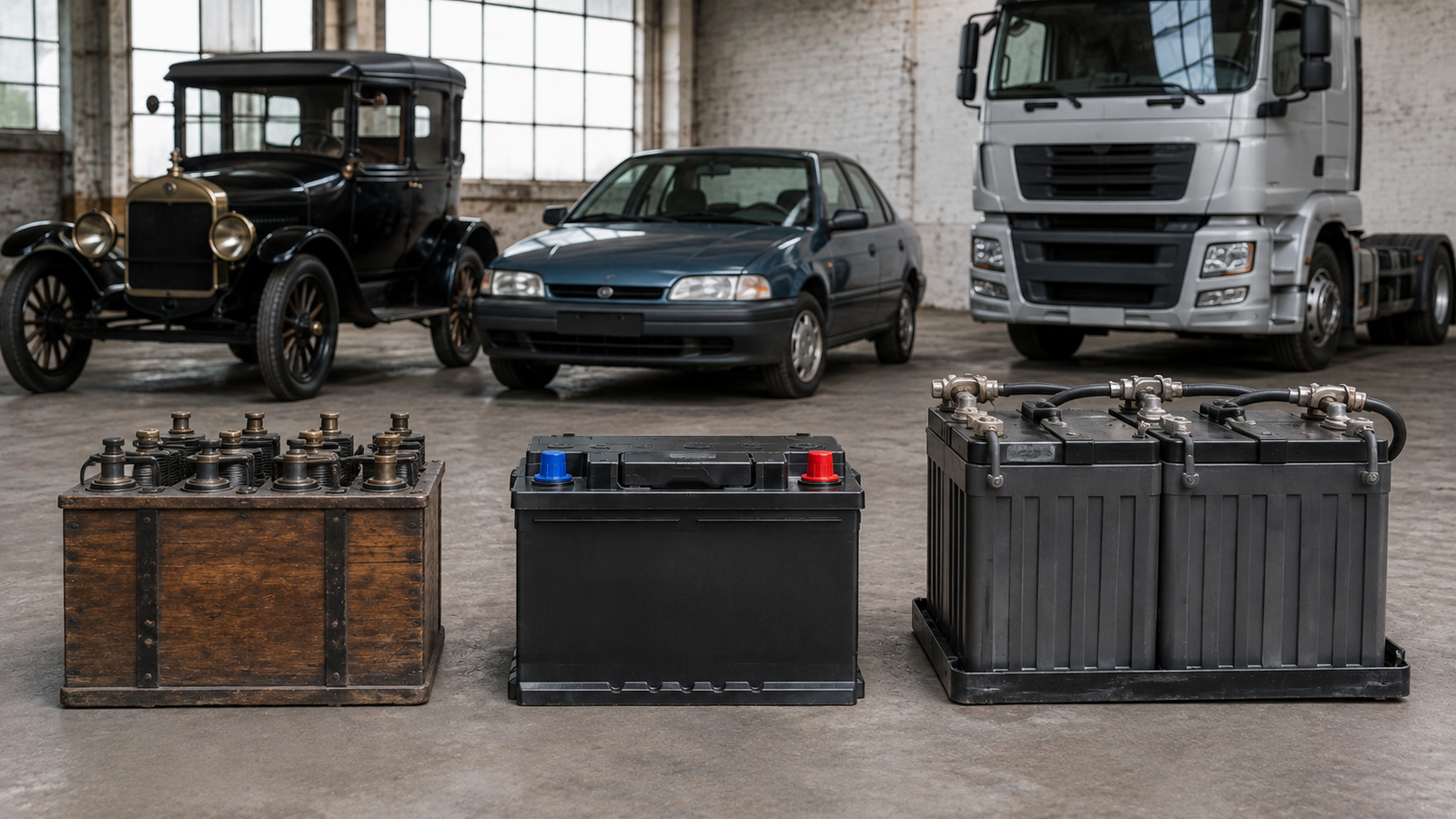
The modern standard did not appear immediately. Until the 1950s, 6-volt batteries, consisting of three cells, were predominantly used in cars. For cars of that time, such a system was sufficient. It could power the main consumers:
- headlights;
- a simple starter;
- ignition coil.
But cars themselves gradually became heavier and more technically complex. After World War II, engine power increased, and with it, the amount of electrical equipment grew. Heaters, power windows, radios, and other energy consumers appeared in cars. The six-volt network gradually ceased to cope with the increased load.
Why the transition to 12 volts was logical
In the 1950s, the automotive industry began to switch to 12-volt systems. With a twofold increase in voltage, it was possible to transmit twice as much power without the need to increase wire thickness. At the same time, the current in the circuit decreased, and with it, electrical losses and wiring heating were reduced.
It was the combination of these factors that made 12 volts a convenient solution for passenger cars. Over time, this scheme became a global standard. But the next question arises: if increasing the voltage from 6 to 12 volts provided advantages, why not go further and immediately switch to 24 or even 48 volts?
Why passenger cars were not given 24 or 48 volts
Further voltage increases would have their advantages, but new problems would also arise simultaneously.
The first of these is safety. In dry conditions, voltages up to 50 volts are considered relatively safe, although the actual risk of electric shock depends on many factors. A 12-volt system does not require reinforced insulation and special protection. In case of accidental contact with a bare wire, the risk of fatal injury is significantly lower, which is especially important during car repair and maintenance.
The second problem is related to the electric arc. When a DC circuit is broken, an arc can form between the contacts. It gradually destroys the contacts of relays, switches, and fuses. The higher the voltage, the stronger this effect, which means that the corresponding electrical fittings must become more massive and expensive.
Finally, there is the factor of industrial inertia. Over decades, a huge infrastructure has formed around the 12-volt system. Components, tools, and spare parts are produced for it, and relevant standards have been developed.
A complete transition to a different voltage would require replacing a huge amount of equipment, including:
- generators;
- starters;
- lamps;
- fuses;
- electronic components.
Economically, such a transition would be impractical.
Why trucks have 24 volts
The situation is completely different for heavy equipment. Trucks, buses, and special vehicles use a 24-volt system. The reason is primarily related to the power of the starters. Starting large diesel engines requires a very high current. If 12 volts were maintained, wires of enormous cross-section — practically finger-thick — would have to be used to transmit the necessary power.
Doubling the voltage solves this problem. For the same power, doubling the voltage allows the current to be halved. 24 volts are more convenient for heavy equipment, where electrical loads are significantly higher.
Where 48 volts came from
Modern premium hybrid cars also feature 48-volt subsystems. They are used for individual powerful consumers, including electric stabilization drives, air conditioners, and starter-generators.
However, 48 volts did not completely replace the familiar car network. This is an auxiliary system designed for individual consumers. Most of the car's equipment still operates on 12 volts. This includes onboard electronics, lighting, and control systems.
Voltage is not the whole story
When starting the engine, not only the voltage indicator is important. The key factor is the current that the battery can deliver to the starter. Current is measured in amperes. Its magnitude depends on the internal resistance of the battery and the resistance of the starter.
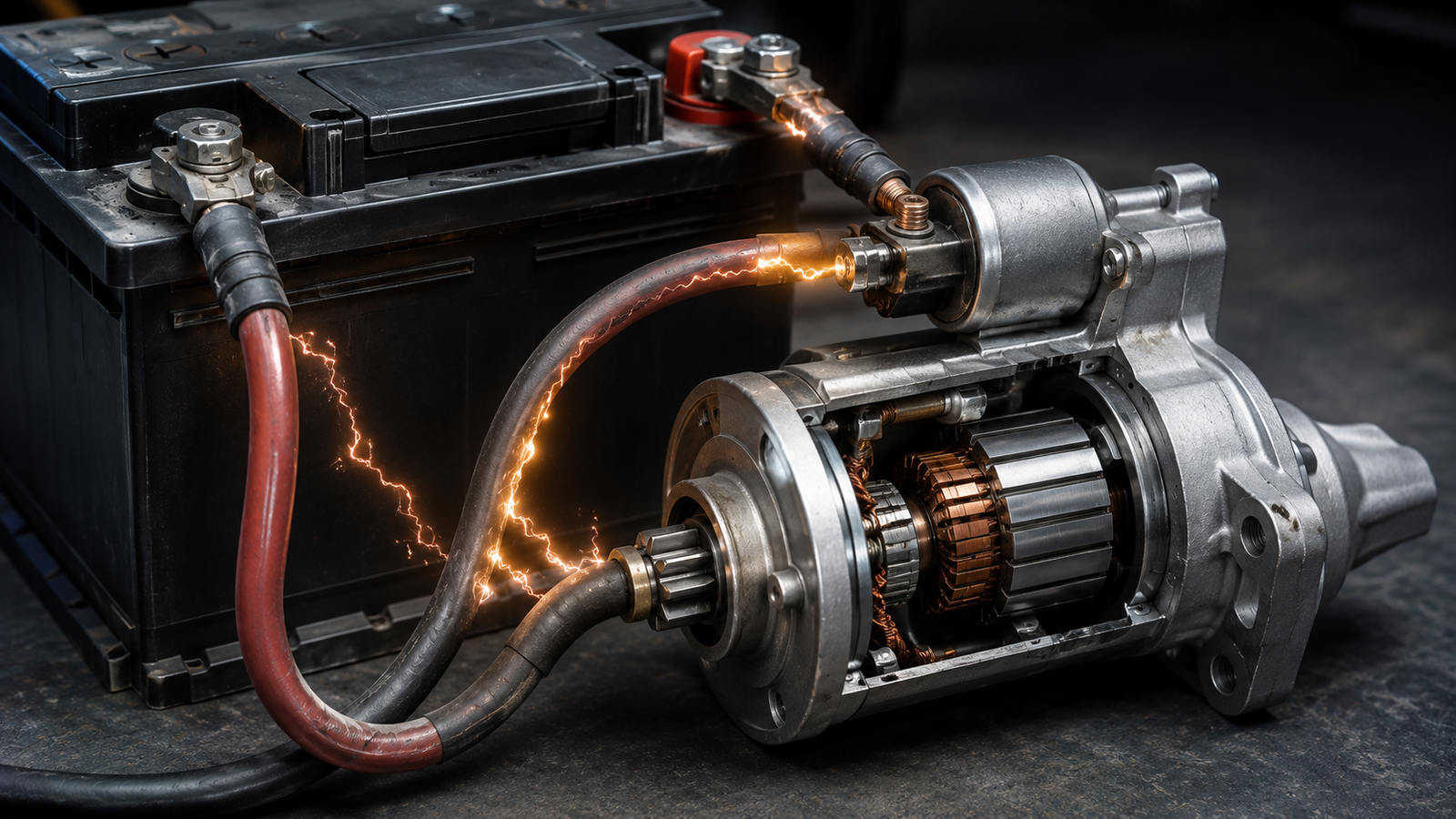
For a standard 12-volt battery, the cold cranking current can reach 400–800 amperes or more. Several factors influence this indicator:
- battery capacity, measured in ampere-hours;
- plate area;
- electrolyte temperature;
- terminal condition.
As the temperature decreases, the battery's ability to deliver current decreases. The reason is the increase in internal resistance, which is why starting the engine becomes a more difficult task in winter.
How voltage, current, and power are related
Starter power can be calculated using the formula:
P = U × I.
If the voltage is 12 volts and the current reaches 500 amperes, we get:
12 × 500 = 6000 watts, or 6 kW.
Now imagine that the car system still operates on 6 volts. To get the same 6 kW, a current of 1000 amperes would be required. This would mean the need to use much thicker wires and massive contacts.
At 24 volts, the situation would be reversed: 250 amperes would be enough for the same power. From the point of view of power transmission, this is more convenient, but increasing the voltage would bring problems with safety and electrical erosion of contacts. As a result, the 12-volt system turned out to be a kind of equilibrium point. It allows for the necessary starter power without turning the wiring into an excessively heavy and expensive structure.
Why voltage doesn't change, but batteries become more powerful
Modern manufacturers continue to improve car batteries, but the nominal voltage of a standard battery remains the same. Development is primarily due to increased starting capabilities. Manufacturers are improving the chemical composition of batteries and the design of plates, thanks to which batteries are able to deliver increasingly high current.
It turns out that 12 volts is not a random number or a historical convention that people simply don't want to abandon. It was the result of a compromise between several requirements. Several factors work in favor of this system:
- necessary power to start the engine;
- acceptable current magnitude;
- reasonable wire gauge;
- cost of electrical components;
- safety during maintenance.
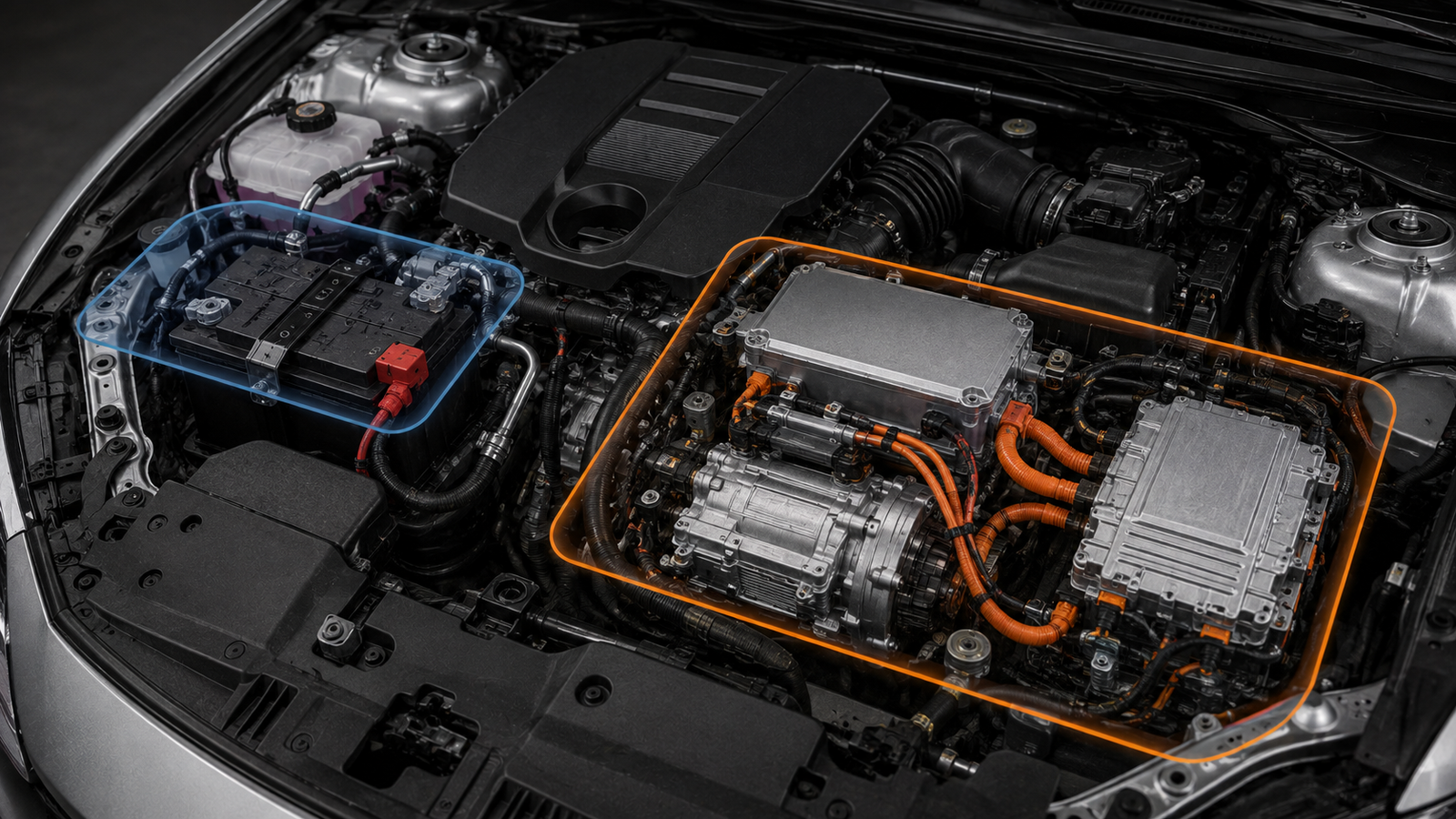
That is why passenger cars continue to use a 12-volt network, heavy equipment — a 24-volt one, and 48-volt solutions are mainly used as auxiliary subsystems for individual powerful consumers.
At the heart of all this remains a simple engineering principle: increasing voltage indeed allows current to be reduced at the same power, but at the same time increases safety requirements, contacts, and components. Therefore, different solutions were chosen for different types of equipment — and for a conventional passenger car, 12 volts turned out to be the most balanced option.
Read more materials:
- VAZ-2801: USSR electric car that drove around Tolyatti
- Why in the USSR wipers were "bathed" in gasoline
- Cars with Kyrgyz plates: where's the catch