Translated with AI from the Russian original.
A malfunction in the turbocharging system may not always be obvious. There is no separate warning light on the dashboard specifically for a turbocharger malfunction. At best, the regular Check Engine light will come on, but even that doesn't necessarily mean the problem is related to the turbo.
An accurate answer can only be obtained after diagnostics and reading fault codes. This is one of the main difficulties: the car can continue to drive for quite a long time, gradually losing power, and the owner may not even suspect that problems with the turbocharger are already beginning.
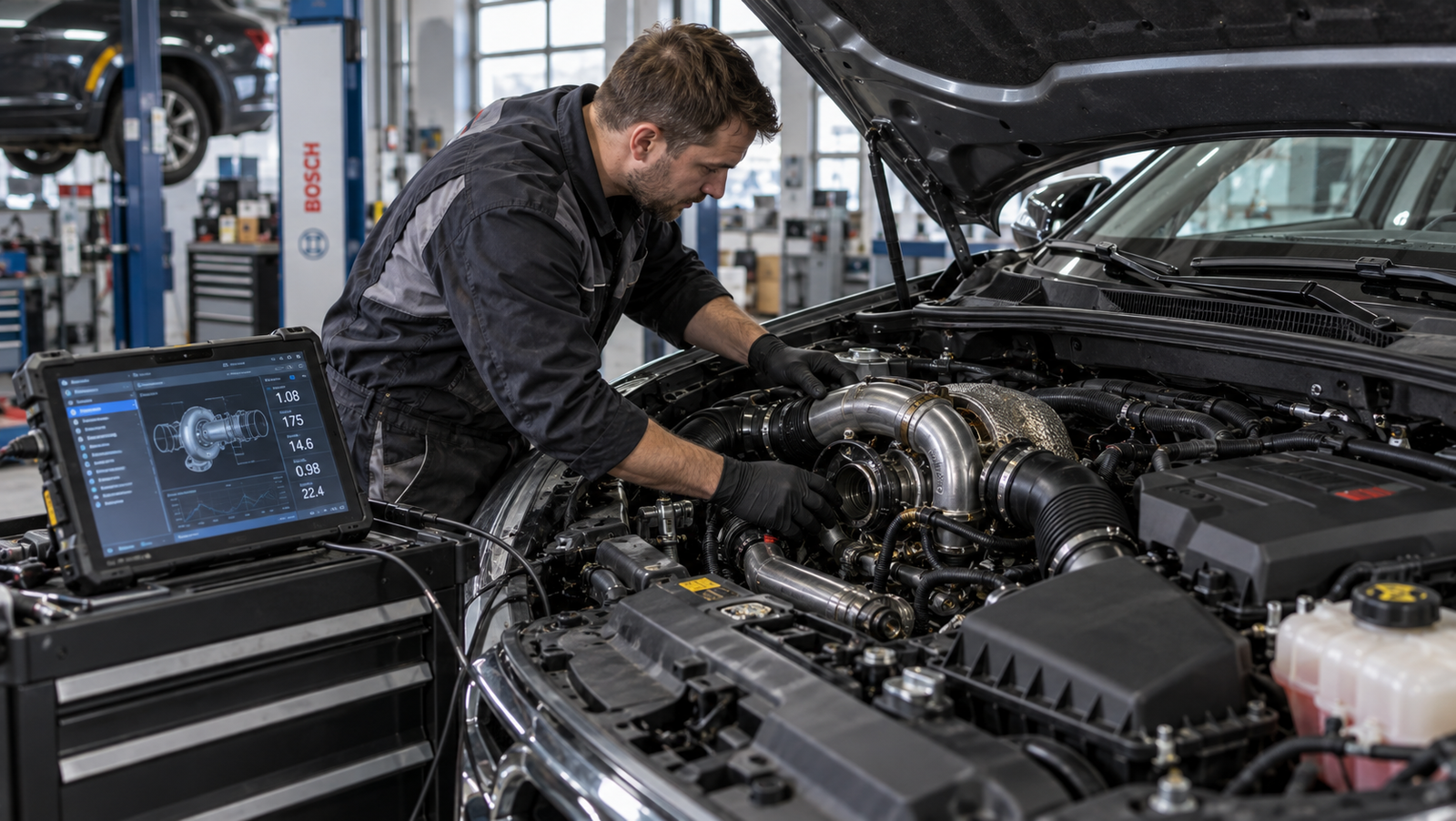
Sometimes the situation develops completely differently. The turbo starts to be almost immediately accompanied by bluish smoke from the exhaust pipe when pressing the accelerator pedal. Here, different versions appear: low-quality or unsuitable fuel, problems with engine oil, or indeed a faulty turbocharger.
What makes a turbocharger fail
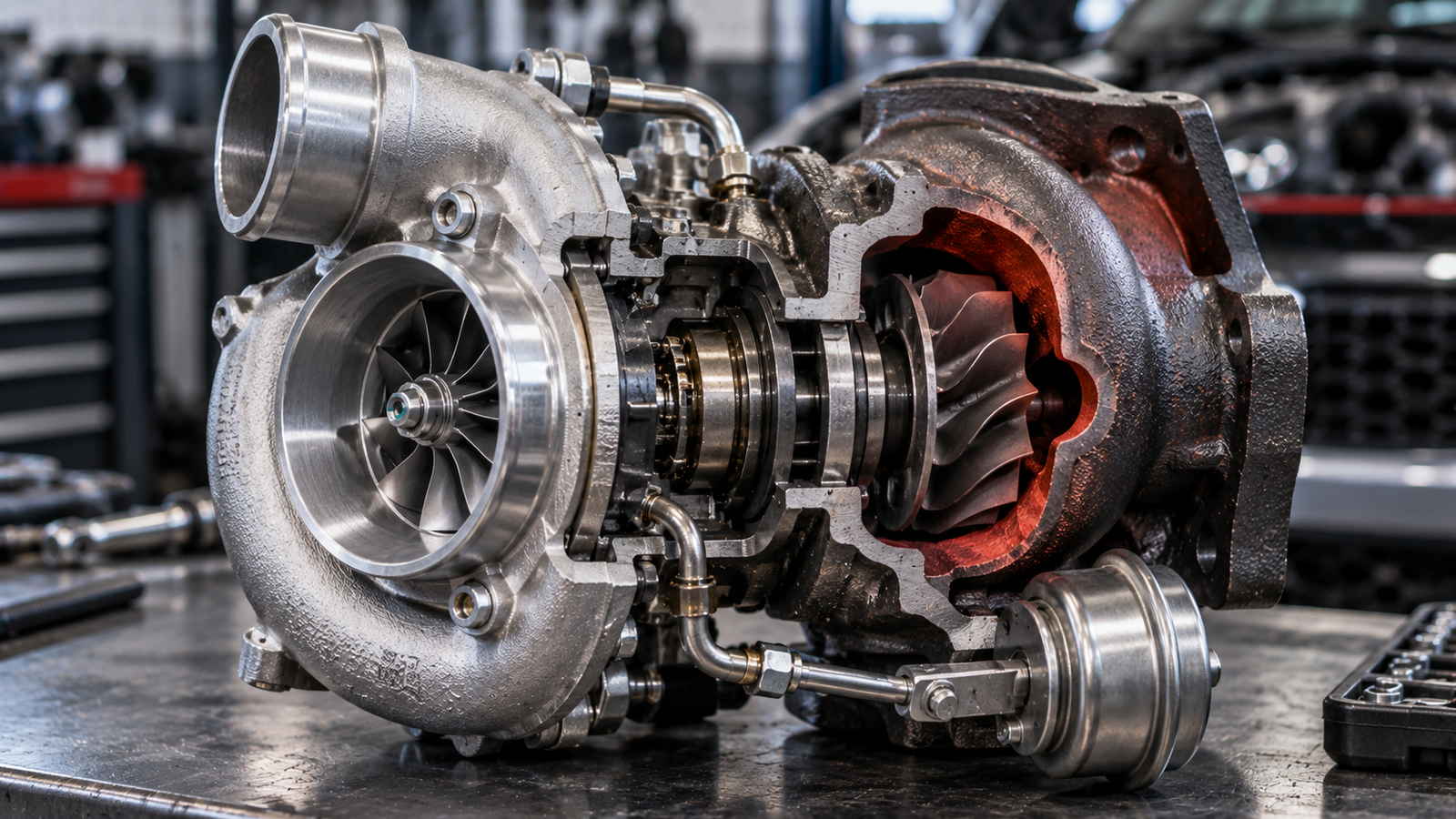
The principle of operation of a turbocharger is quite simple: the energy of exhaust gases is used to supply more air to the cylinders. Thanks to this, the engine gains power and becomes more efficient. In some cases, this allows for a simultaneous reduction in fuel consumption with a relatively small displacement.
The turbocharger design includes three main parts:
- hot section, working with exhaust gases;
- cold section, which compresses the incoming air;
- cartridge with rotor and compressor wheel.
The flow of exhaust gases spins the rotor, which in turn drives the compressor wheel. It compresses fresh air and directs it into the intake manifold.
However, the operating conditions of a turbocharger are very harsh. Temperatures can reach 900 degrees Celsius, and rotational speeds can range from tens to hundreds of thousands of revolutions per minute. Therefore, even a relatively small violation of operating conditions can lead to a serious malfunction.
Contaminated or low-quality engine oil that is changed too infrequently is especially dangerous. Abrasive particles, along with the oil, get into the turbocharger bearings and gradually destroy them.
No less unpleasant consequences arise from problems with oil supply and cooling. Coked oil supply or drain lines, as well as impaired normal cooling, lead to lubricant overheating. The oil begins to coke, after which the turbocharger can seize.
Cheap filters, low-quality oils, and excessively long service intervals also play a role.
In essence, a turbocharger rarely fails on its own. As a rule, a breakdown is the result of improper operation or non-compliance with maintenance regulations.
Check Engine light came on – is the turbocharger to blame?
A lit malfunction lamp in itself proves nothing. It is merely a signal that the car needs to be checked and the cause of the error determined.
In practice, owners often arrive with the Check Engine light on and are confident that the problem is with the turbocharger. After diagnostics, it turns out that the turbocharger is fine. The cause is much more often found in the fuel system or electrical equipment.
Therefore, replacing the turbocharger just because the indicator light came on is definitely not worth it.
Smoke from the exhaust pipe
White or bluish smoke may indicate engine oil entering the intake tract and subsequently burning with fuel in the cylinders. However, it is important to consider not only the color of the smoke but also when it appears.
Bluish smoke after sharply pressing the accelerator pedal can indeed be related to the turbocharger. Thick white smoke when starting the engine at idle should also be a cause for concern, especially if it looks almost like a smoke generator.
But there is a completely different scenario. If, after a cold start, light whitish smoke, similar to steam, comes out of the exhaust pipe for some time and then disappears, the cause is most likely condensation. However, the source of the problem may also be in another engine system.
Black exhaust is a separate situation. It appears when there is not enough air for fuel combustion, meaning more fuel is supplied than necessary relative to the available amount of air. One of the reasons could be insufficient boost pressure.
Engine runs, but the car has lost power
Loss of power is one of the most noticeable signs of boost problems. The car continues to drive, but the previous thrust is gone. A pronounced turbo lag may appear, and during acceleration, it feels as if someone is holding the car back.
At the same time, the Check Engine light may not come on. The engine will run, but it will no longer provide full boost.

That is why you cannot rely solely on the dashboard. A change in the car's behavior can sometimes be the first sign of a malfunction.
Whistling, noise, and metallic grinding
A certain noise during turbocharger operation is not in itself a sign of a breakdown – a healthy engine's turbocharger also makes sounds.
It's another matter if the nature of the noise has suddenly changed. A sharp whistle that intensifies with increasing RPMs, and especially metallic grinding, can indicate problems with the turbocharger's bearings or blades.
However, extraneous noise can easily be mistaken for an air leak in the intake tract. Therefore, a final conclusion again requires more thorough diagnostics.
Oil is consumed, but everything is dry under the car
Engine oil level should be checked regularly. If it drops from the maximum to the minimum mark before the next oil change, and there are no drips or traces of leaks under the car, the oil may be escaping through the turbocharger.
This problem is especially evident during long highway drives and high engine power operation. At this moment, the turbocharger rotates at maximum speed, and engine oil consumption can noticeably increase.
However, even here, one symptom is not enough to unequivocally blame the turbocharger.
One symptom means nothing yet
There is no universal sign of a faulty turbocharger that allows for an immediate diagnosis. The situation must be assessed comprehensively.
The most characteristic signals are as follows:
- increased exhaust smoke;
- the car has lost power;
- the malfunction light has come on;
- the engine has started consuming more engine oil;
- an unusual whistle or metallic noise has appeared.
If several of these signs appear simultaneously, the probability of serious turbocharger problems becomes significantly higher.
But even their combination does not give a hundred percent guarantee. Very similar symptoms can be caused by malfunctions in the fuel system, electrical equipment, ignition system, or mechanical problems with the engine itself.
Therefore, a turbocharger malfunction can only be definitively confirmed after detailed diagnostics.
Repair or replace the turbocharger?
When a car arrives at a service center with such symptoms, one of the first questions from the owner usually sounds the same: can the turbocharger still be restored, or will a new one have to be purchased?
Complete turbocharger failure does not happen all the time. If the problem was noticed early enough and the visit to the service was not delayed, in many cases, a complete replacement of the unit is not required.
Typically, restoration may include:
- installation of a new repair kit;
- shaft balancing;
- geometry cleaning;
- in extreme cases – replacement of the cartridge assembly.
But there are also damages where repair loses its economic sense. For example, the shaft may break, the geometry blades may bend, or the hot section may crack due to overheating.
It is also worth considering the design where the hot part of the turbocharger is made as a single element with the exhaust manifold. In such a situation, the cost of individual parts for restoration may be higher than the price of a new turbocharger assembly.
Then buying the entire unit turns out to be simpler and more profitable.
A lot depends on how quickly the owner reacts to the first signs. If you immediately go for diagnostics and do not continue to operate a faulty turbocharger, in 90% of cases, it does not come to its complete replacement – a relatively minor restoration is sufficient.
If you continue to drive until the last moment, the consequences can be much more serious. In an advanced case, it can lead to engine seizure, after which a major overhaul will be required.
What you can check yourself
For an initial check, you will need a screwdriver, a flashlight, and some free time. However, you should start not with disassembly, but with listening to the engine.
First, evaluate its operation at idle, then increase the RPMs several times and listen to the sounds. Normal operation should not be accompanied by sharp extraneous noises, especially metallic whistling or grinding.
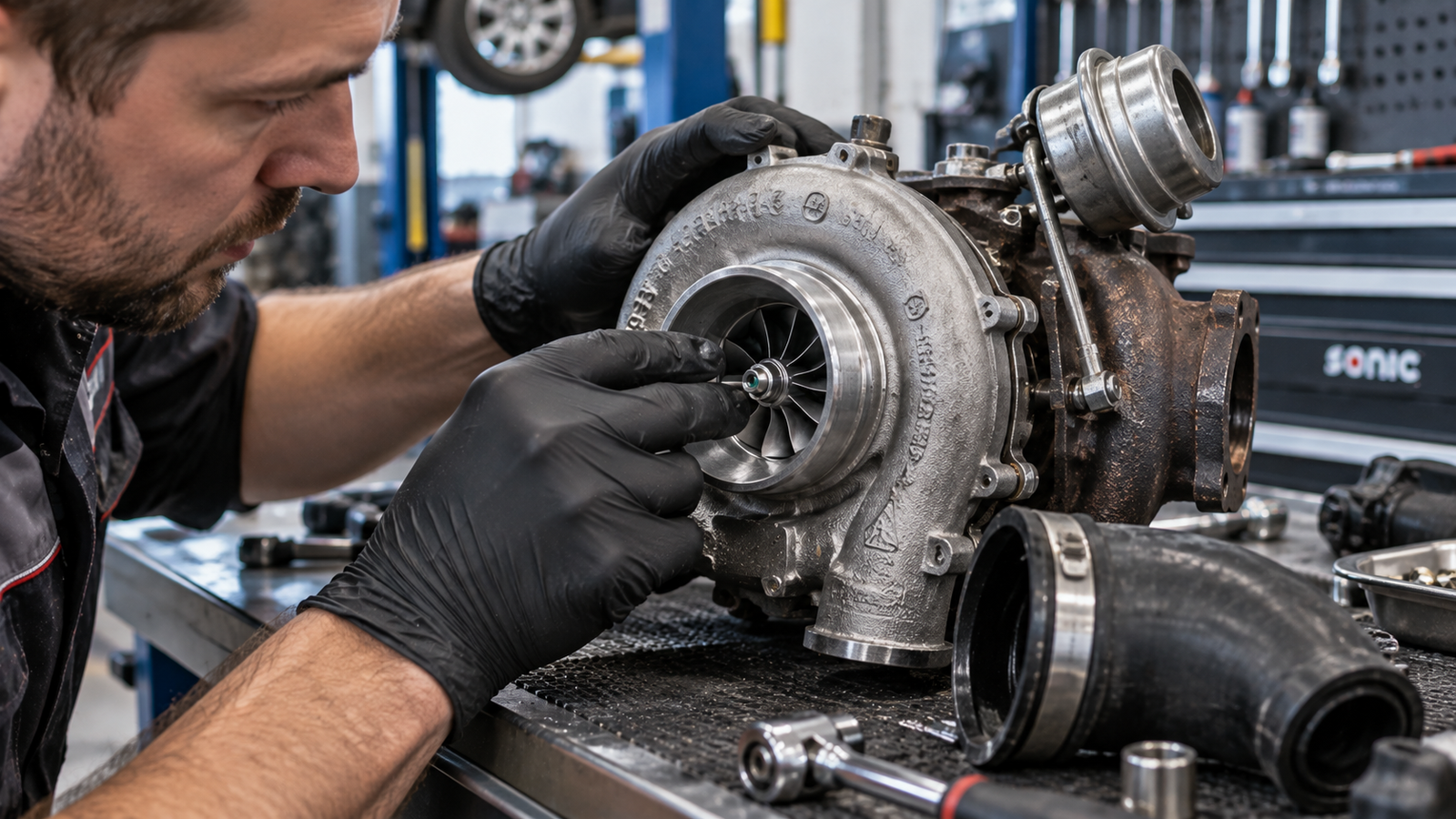
The next step is a visual inspection of the compressor wheel. To do this, remove the intake air duct and check the condition of the wheel. It should look clean, without carbon deposits or mechanical damage.
If everything looks fine externally, you can assess the shaft play. To do this, carefully grasp the nut with your fingers and check the shaft by moving it up and down.
A small radial play is permissible in itself. However, noticeable play along the axis of rotation already indicates possible bearing wear.
However, self-checking remains only preliminary. Even a visually perfectly sound turbocharger can have internal damage. Externally, it may not make noise, the wheel may not have noticeable play, but inside there may already be cracks, signs of wear, or shaft deformation.
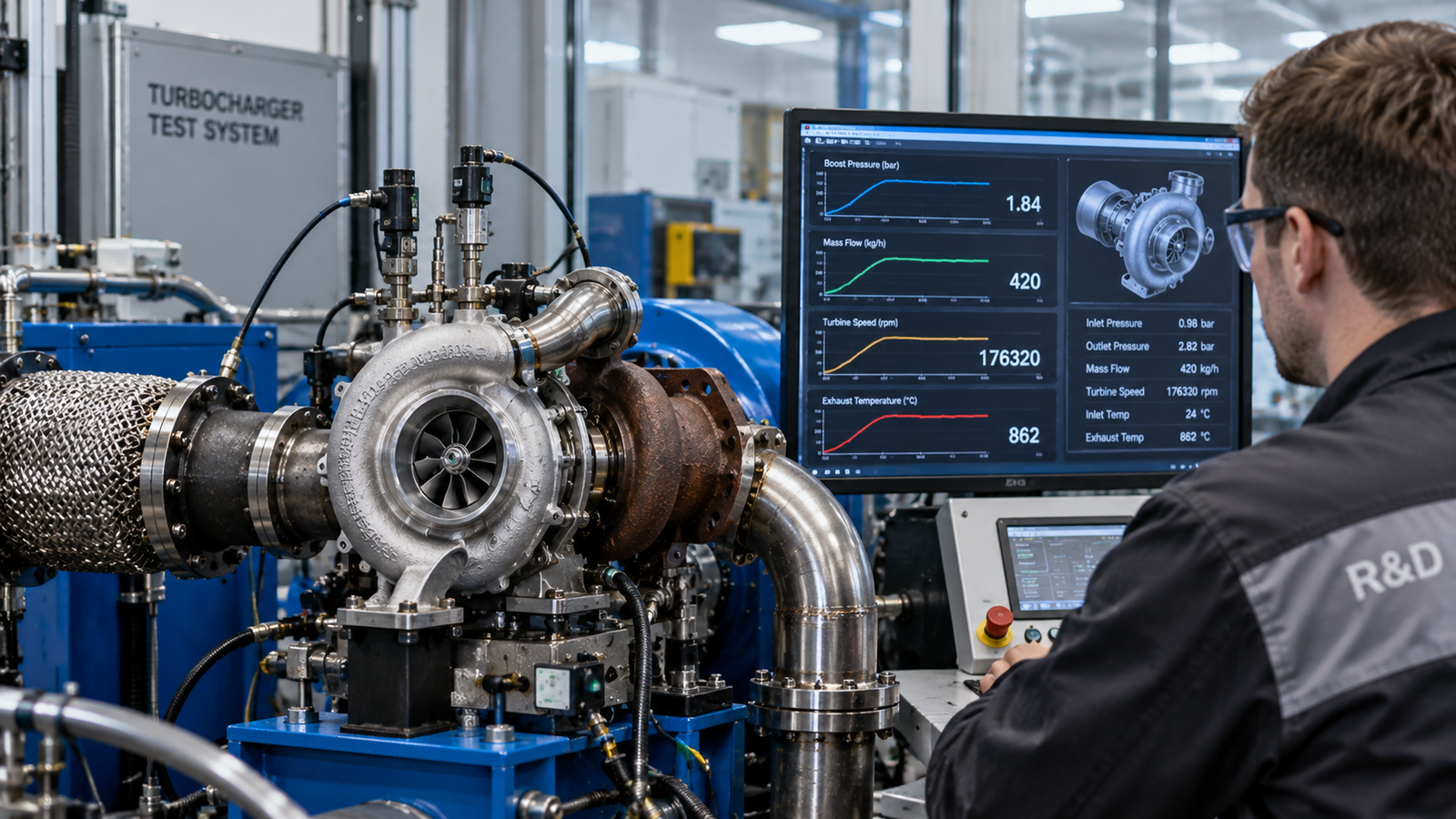
A full check is carried out on a special stand where the turbocharger can be tested under load. Therefore, self-inspection is only the first filter, and the final diagnosis must still be made by a specialist at a service center.
How to extend the life of a turbocharger
A turbocharger usually does not fail without any prior signals. Increased smoke, loss of power, and increased oil consumption allow the problem to be noticed before serious damage to the unit.
If addressed in time, the turbocharger can be restored in most cases. In practice, this applies to about 7-8 out of 10 turbochargers if the owner does not delay contacting the service.
The main preventive rule is related to oil. It must be of high quality, and its replacement must be regular. At the same time, the oil and air filters must be changed.
The scheme "I'll add a liter and change it sometime later" is not suitable for a turbocharged engine. Normal maintenance here directly affects the turbocharger's lifespan.
The second important condition is proper operation. After intensive driving, the engine should be allowed to idle for a couple of minutes. During this time, the turbocharger will cool down, and the engine oil will not overheat and burn.
It is timely maintenance and careful attention to the first changes in the car's operation that prevent a relatively simple turbocharger repair from escalating into an expensive unit replacement or, even worse, a major engine overhaul.
Read more materials:
- Car discount, tax, and OSAGO: who is eligible for benefits
- Gasoline was once burned as waste. Why kerosene never became automotive fuel
- Return of a legend: what the 2028 Toyota Celica will be like