In the USA, there is no single federal law that obliges owners of passenger cars to undergo regular vehicle inspections. This is a matter that each state decides independently.
Therefore, the rules in two neighboring states can differ radically. In New York and Pennsylvania, a car must be inspected annually. But in New Jersey, located between them, there is no mandatory vehicle inspection for ordinary cars.
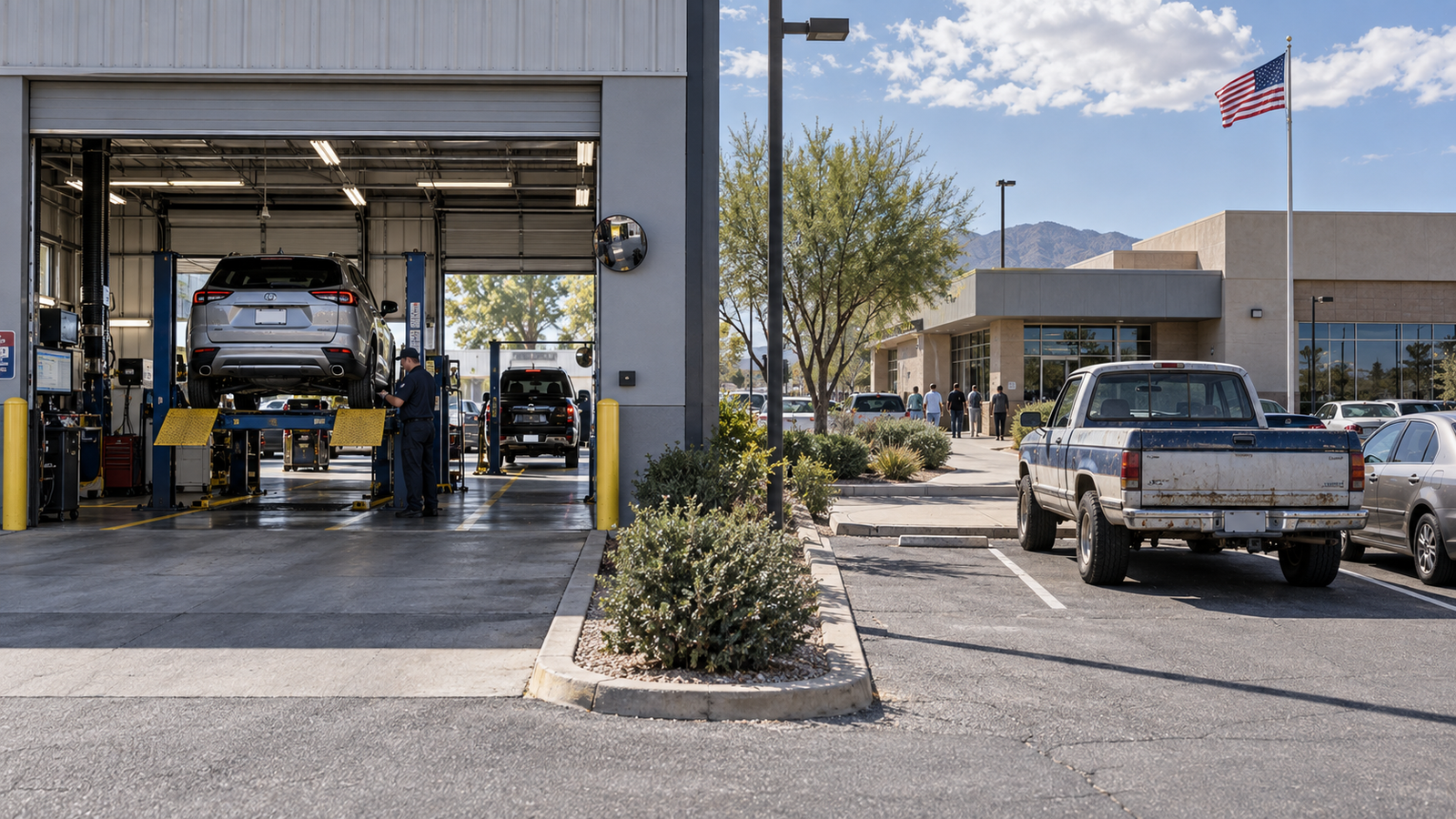
This system did not develop by chance. Moreover, American authorities tried to make periodic vehicle inspections almost nationwide, but ultimately abandoned the idea of forcing all states to maintain it.
How America Tried to Introduce a Unified Vehicle Inspection
In the 1960s, Washington began promoting mandatory vehicle inspection programs at the state level. Federal authorities declared: states must create their own system of periodic inspections, and refusal threatened a 10% reduction in federal funding for road construction.
The measure proved not very effective. By 1975, periodic vehicle inspection existed in only 31 out of 50 states, although the federal program provided for its implementation. The threat to deprive states of part of their road money was never put into practice.
In 1976, the rules changed, and the federal ability to withhold part of the funding for the absence of such a program was significantly limited. After that, states had much more freedom in deciding whether vehicle inspection was necessary. Historical GAO materials confirm that 1975 was the peak moment: then periodic inspections were in effect in 31 states and the District of Columbia.
But the main question remained: does mandatory inspection really make roads safer?
Accidents Checked — No Clear Effect Found
Federal authorities needed to understand how justified this entire system was. One of the indicators considered was accidents related to technical malfunctions of vehicles.
The logic was obvious: if regular control really works, states with mandatory vehicle inspection should have fewer accidents due to brake failures, tire problems, and other malfunctions. However, no convincing difference was found.
Later, this topic was repeatedly studied at the federal level. According to the GAO, the technical condition of a vehicle accounts for only about 2–7% of road accidents, while driver actions and other factors play a much larger role. At the same time, the agency itself emphasized: it is extremely difficult to assess the direct effect of vehicle inspection programs on accident rates.
As a result, after the change in federal rules, states began to abandon mandatory inspections one after another. The program required money and created inconvenience for motorists, and convincing evidence of a significant reduction in accident rates could not be obtained.
What Happens Where Vehicle Inspection Still Exists
To understand how American vehicle inspection differs from what we are used to, North Carolina can be taken as an example.
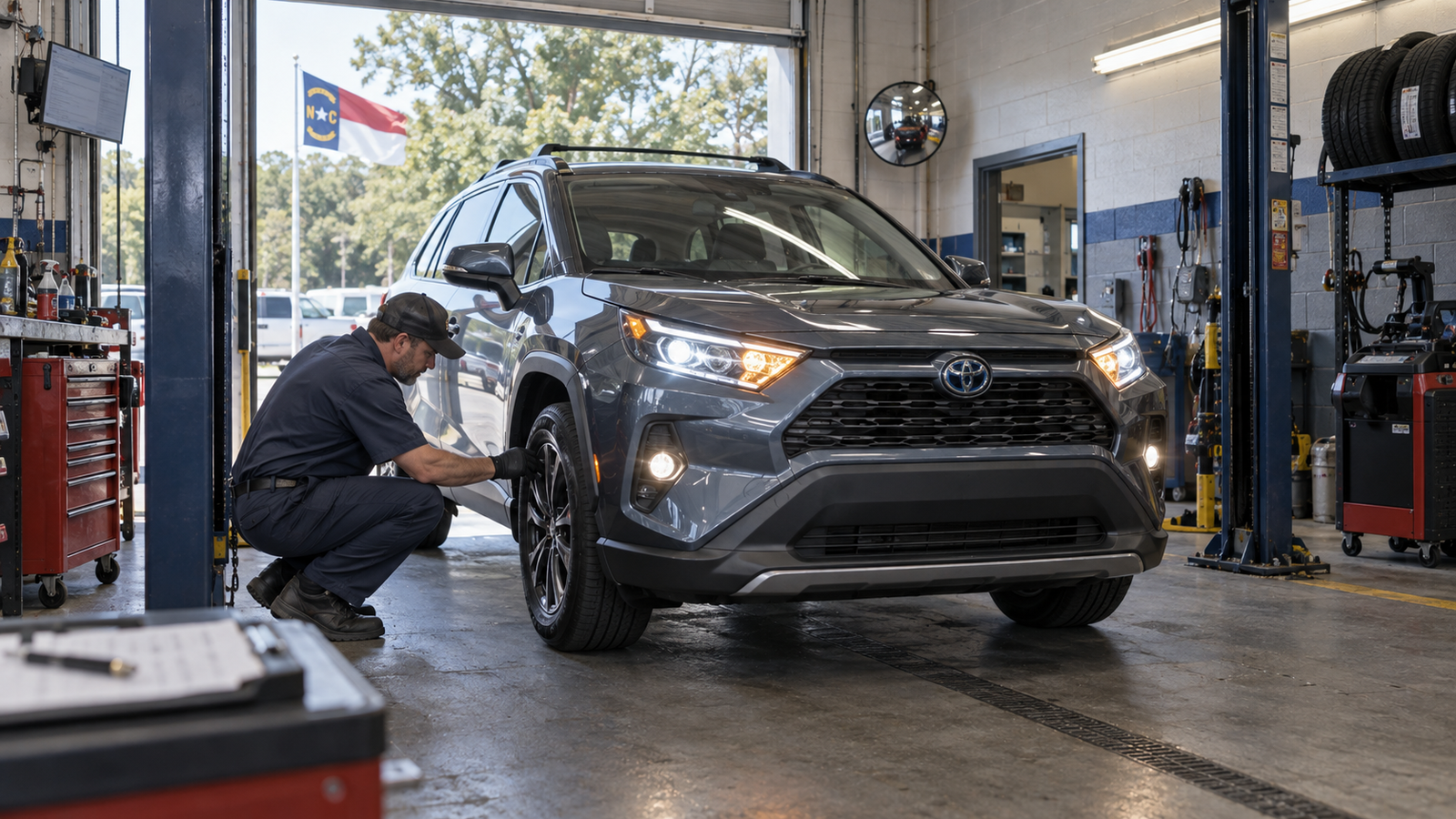
Here, the inspection point can be a regular licensed car service. The entire procedure takes approximately 15 minutes and costs about 30–40 dollars.
Formally, the mechanic checks quite a few elements:
- brakes;
- headlights and turn signals;
- steering;
- tires;
- exhaust system;
- tint level of windows.
But the inspection itself largely comes down to the principle of "works or doesn't work." The mechanic presses the brake pedal, turns on the turn signals, inspects the tire tread, and measures the light transmission of the glass with a special device.
No complex stands with rollers that separately measure the effectiveness of each brake mechanism, or deep computer diagnostics are performed during such an inspection.
You Can Register a Car Without Even Showing It
If a state does not require vehicle inspection at all, a natural question arises: how does the state know that the car exists and is actually owned by the person?
In practice, the answer is very simple — by documents.
For example, when registering a car purchased at an auction in Florida, it was enough to go to the DMV — the local agency that deals with driver's licenses, car registrations, license plates, and documents.
The employee checked the papers, entered the information into the computer, and issued the license plates. The owner fills out a separate sticker for the mileage independently.
The car itself does not even have to be near the inspector. The car can be in the parking lot while the documents are being processed.
That is, when registering, the state is primarily concerned with establishing several things: who is the owner, whether the necessary documents are processed, whether taxes are paid, and whether insurance requirements are met.
And the technical condition of the car in such a system largely becomes the owner's problem.
Two Types of America: Rust and Sun
On American roads, it is especially noticeable how much climate and road infrastructure affect the condition of cars.
The country can be conditionally divided into two large regions.
In southern states like Florida, both Carolinas, Texas, Arizona, and California, car bodies often last much longer. There are no harsh winters with constant road treatment with reagents, so cars suffer significantly less from corrosion.
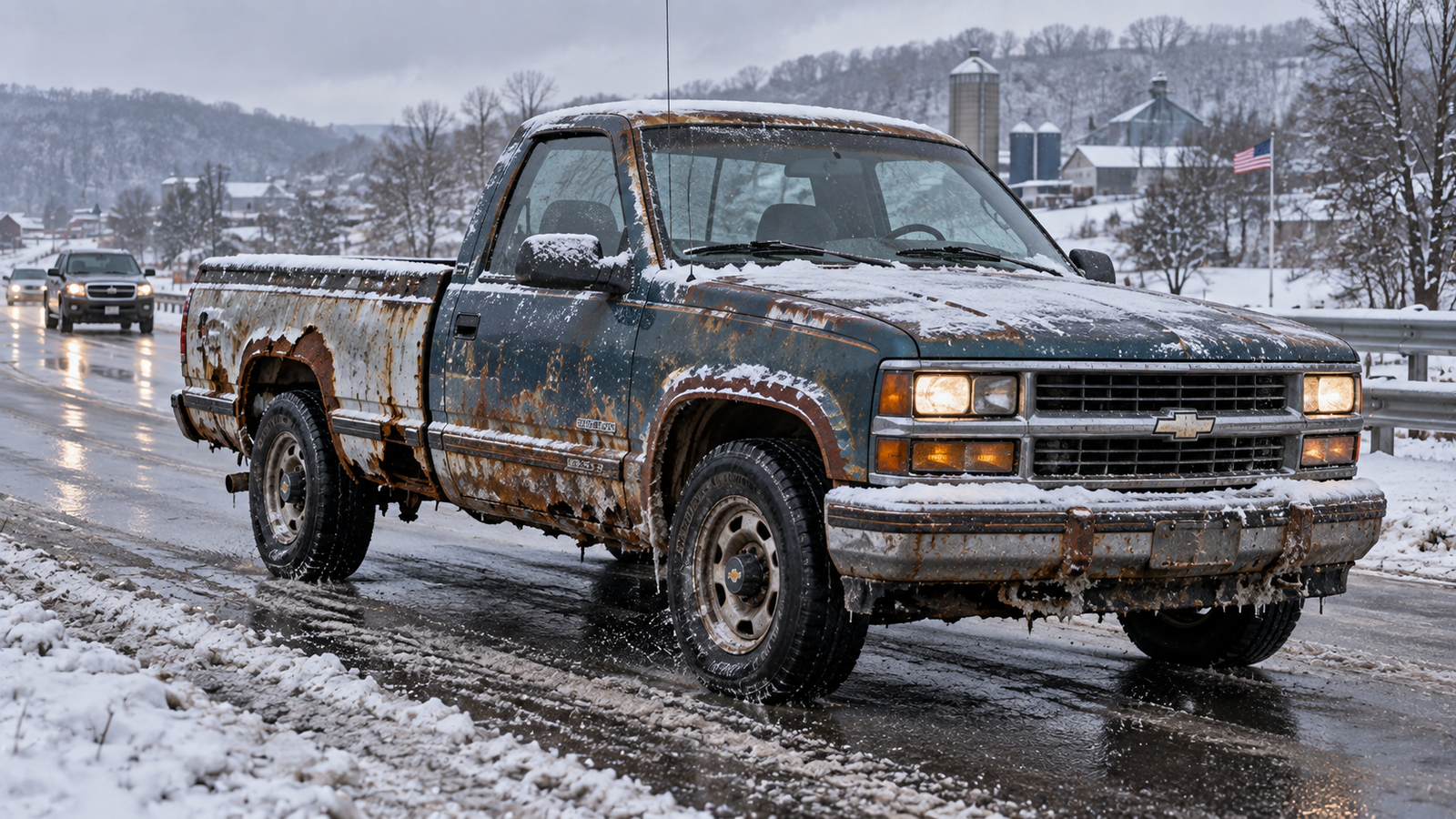
In the Northeast, the situation is completely different. Michigan, Ohio, Pennsylvania, New York, and the New England states actively use reagents in winter. From November to March, cars regularly receive salt baths, and rust becomes one of the main problems.
It is curious that mandatory vehicle inspection has been preserved precisely in many northeastern states. There, corrosion can be a direct cause of failing the inspection.
And nearby are Michigan, Ohio, Illinois, and Wisconsin: roads there are also treated with salt, but there is no mandatory vehicle inspection.
Therefore, you can find cars on the roads that would hardly pass an inspection in another state.
And the problem is not always just rust. Sometimes elementary shoddy work is much more striking:
- a bag is stretched instead of a broken side window;
- the car drives for months on a spare tire;
- the pickup truck is missing a rear bumper;
- huge wheels protrude far beyond the arches;
- homemade elements stick out from under the body.
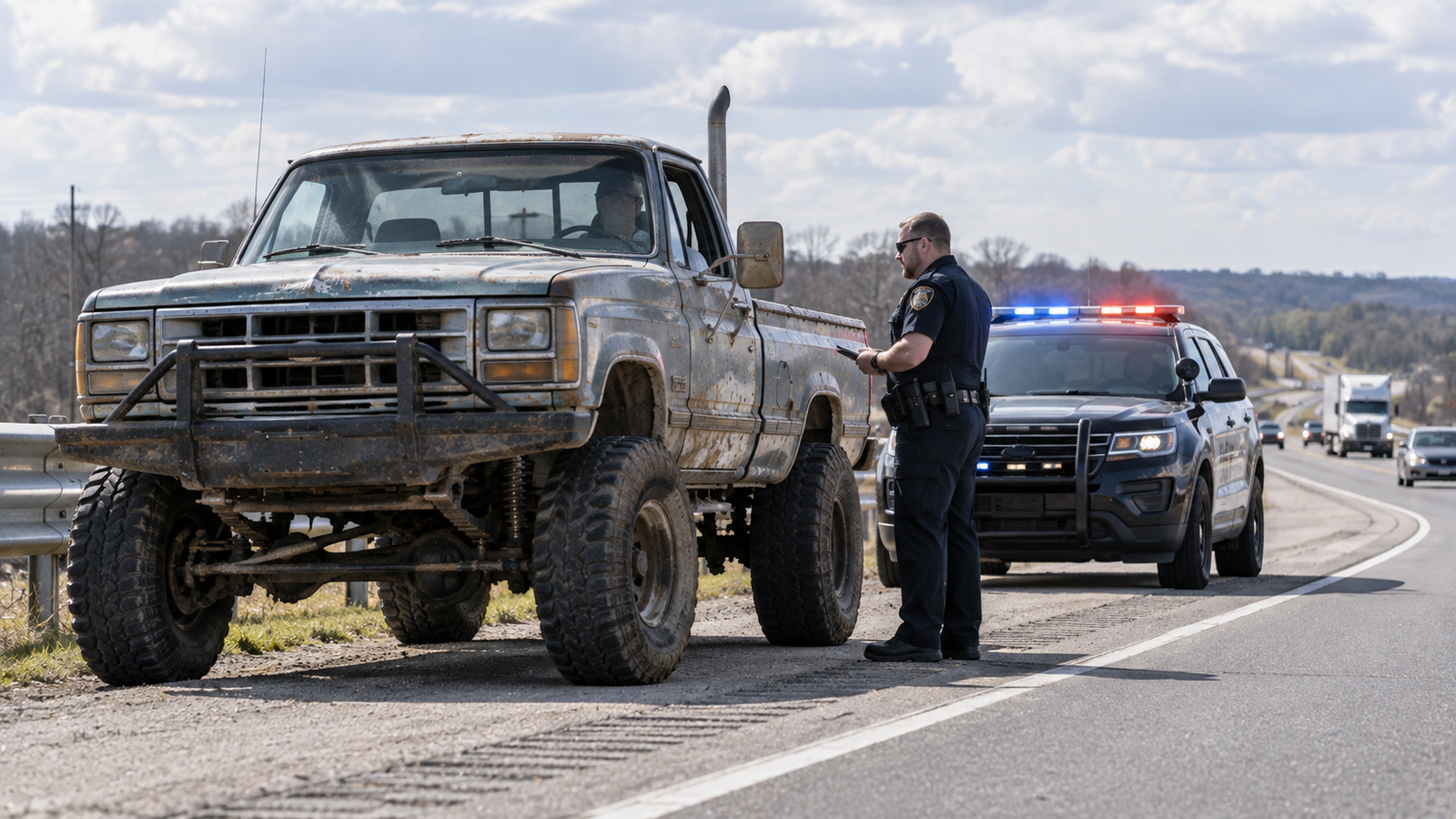
Some lifted pickups are especially dangerous. Their wheels can protrude significantly and throw stones at cars following behind.
Police Instead of a Vehicle Inspection Station
If there is no regular inspection, who then controls the condition of cars?
Formally — the police.
But police control is arranged completely differently. An officer can stop a car if they notice a non-working turn signal, a completely worn tire, or another obvious malfunction.
Depending on the violation, the driver can receive a fine of about 150–200 dollars or a so-called fix-it ticket — a prescription to fix the problem.
After repairs, the owner receives confirmation from the car service, provides it to the court, and the violation is removed.
This results in a peculiar control model: the state does not inspect every car in advance, but intervenes when a malfunction becomes noticeable.
Tuning Without Separate Permission
The absence of mandatory vehicle inspection also strongly affects car culture.
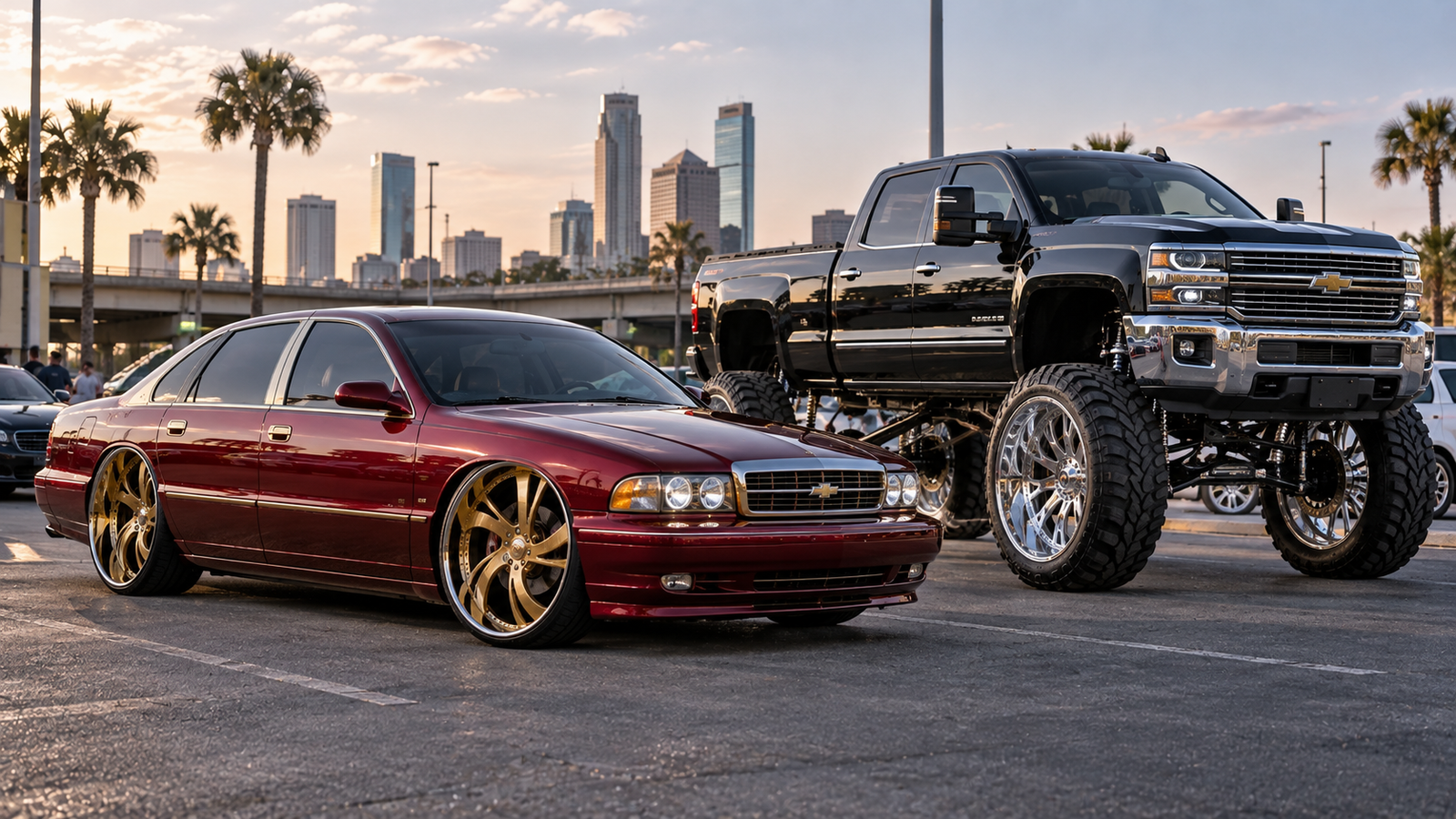
This is especially noticeable in Florida. There you can see old Chevrolet Caprice and Impala on huge wheels with a diameter of 28–30 inches, pickups with a half-meter lift, underbody lighting, loud exhaust systems, and a variety of homemade solutions.
If the owner wanted to install a lift kit on a pickup — they ordered the kit, installed it, and drove off. In some cases, the engine can also be replaced with a completely different one. Installing a Chevrolet V8 in an old car has long ceased to be something exotic for American car culture.
At the same time, it would be wrong to claim that there are no rules at all. They exist, but control often takes place not at a special station, but directly on the road.
For example, in North Carolina, front side windows must transmit 35% of light. In Florida, the requirements are different — 28%.
But if the state does not require regular technical inspection, the detection of a violation depends mainly on road control.
When a car undergoes its first inspection after moving from Florida to North Carolina, local mechanics will find a tinting problem.
However, even here there is a small market for circumventing the rules: some stations are willing to turn a blind eye to overly dark windows for an additional 20 dollars.
Environmental Violations — A Separate Story
There is an area where the absence of a regular vehicle inspection does not mean complete freedom — environmental requirements.
Federal rules prohibit removing catalytic converters, diesel particulate filters, or urea systems from diesel vehicles.
But federal agencies generally do not stop every individual car. Their attention is focused on companies that produce and sell equipment for such modifications.
One such case occurred with a company from Burlington. In 2024, it received a fine of 10 million dollars. The company was engaged in the production and sale of delete kits — kits for removing environmental systems — and installed them on approximately 300 diesel pickups.
At the same time, in 2025, the Trump administration began actively advocating for expanding the ability of owners to repair cars themselves. In June, Trump signed a memorandum on the right to repair, stating that people should not be persecuted merely for repairing their own car.
A few days later, nine people involved in delete tuning were pardoned, including the owner of that very company from Burlington.
However, this does not mean that environmental requirements have disappeared: the federal ban on removing emission control systems continues to exist.
In practice, however, the situation looks different in individual states. For example, in neighboring South Carolina, catalytic converters continue to be massively removed. Formally, this is a federal violation, but the absence of mandatory vehicle inspection makes systematic control significantly more difficult.
Does Vehicle Inspection Really Save Lives?
At first glance, it seems logical: if no one regularly inspects cars, roads should be filled with cars with failed brakes, bald tires, and faulty steering.
But statistics do not provide such an obvious answer.
In 2015, the US Government Accountability Office (GAO) studied the effectiveness of technical inspection programs. In accident materials, there is a separate category that allows determining whether a car malfunction was the cause of the accident.
It turned out that the technical condition of the car is indicated in only about 2–7% of accidents. In the vast majority of cases, the causes are related to driver behavior and other circumstances.
For additional comparison, states that abandoned mandatory inspections were considered. In particular, New Jersey and Oklahoma were analyzed.
Before the abolition of vehicle inspection, the share of accidents related to car malfunctions was approximately 2–3%. After the abolition, it did not change significantly.
But there is an important caveat here: the GAO did not state that vehicle inspection is proven useless. The agency indicated that its effect is difficult to separate from other factors, and the inspections themselves do indeed allow detecting faulty cars and forcing owners to fix problems. For example, in Pennsylvania in 2014, more than 529 thousand vehicles failed the inspection — about 20% of the total number inspected.
Is There a Real Danger from a Faulty Car?
Even if a technical malfunction rarely causes the accident itself, the consequences of such an accident can be more serious.
The data provided for Texas indicates that if a technically faulty car is involved in an accident, the probability of anyone dying increases approximately threefold.
But here too there is a problem with the frequency of control.
A tire can be perfectly normal on the day of inspection, and turn bald a few months later. Brake pads also do not have to wear out strictly by the date of the annual inspection.
Therefore, an annual inspection is physically unable to constantly maintain the car in perfect condition.
In America, the Car is Controlled Not by an Inspector, But by a Wallet
Then why aren't US roads filled with completely dilapidated cars?
Perhaps one of the answers is economics.
Car repair in America is expensive. The average cost per hour of labor at a car service across the country is about $140.
Therefore, the owner of an old car faces a fairly simple choice: repair the car if it's still worth it, or get rid of it when the cost of restoration approaches the price of the car itself.
As a result, old "clunkers" go to the junkyard, are sold at auction, or are simply replaced by another car.
It turns out that in this system, the role of a peculiar filter is played not only by the state, but also by the cost of repairs.
Why Vehicle Inspection Still Exists
If regular inspection does not demonstrate an obvious impact on the number of accidents, the question arises: why keep it at all?
There are several answers. The system creates jobs, brings money to vehicle inspection stations, requires equipment and administration. In addition, it does indeed allow identifying some dangerous malfunctions — even if proving its direct impact on overall accident rates is difficult. This is precisely the more cautious position taken by the GAO.
And the abandonment of mandatory vehicle inspection has an unexpected side effect.
A huge car tuning culture has formed in the country. Hot rods, lowriders, muscle cars, and all sorts of extreme modifications have become part of American car culture.
For many owners, the absence of the need to constantly prove to the state that the car meets standards is perceived as an element of personal freedom.
This well describes the American approach to a car: the car belongs to you, which means you want to be able to modify it to suit your needs.
And a paradoxical picture emerges. In one state, a car undergoes a mandatory annual inspection, while in another, it can be registered almost exclusively by documents. Somewhere, overly dark tinting will result in the film being removed, and somewhere such a car can drive on the roads for years.
At the same time, official studies do not provide a simple answer that one model is unequivocally safer than another. Perhaps that is why the American system remains so diverse from state to state.
Read more materials:
- Supreme Court Explained Controversial Overtaking Rules
- Why the Russian 7-Speed Automatic Did Not Go into Production
- Why the Engine Stalls During Acceleration
Комментарии