In some BMW, Mercedes-Benz, Audi, and Volvo vehicles, the battery is located in the trunk rather than under the hood. This solution helps free up space in the engine bay, adjust axle weight distribution, and shield the battery from high engine temperatures. However, this layout also has drawbacks: maintenance becomes more complicated, the battery may perform worse in winter, and if the electric trunk lock malfunctions, accessing it becomes a problem.
In a late-1990s BMW 7 Series, one could encounter such a situation: the battery went flat, so the car was connected to an external power source via special terminals under the hood. The electrical equipment began working: the doors unlocked with the key, and the on-board systems turned on. However, the trunk lid remained locked, and that was precisely where the battery was located.
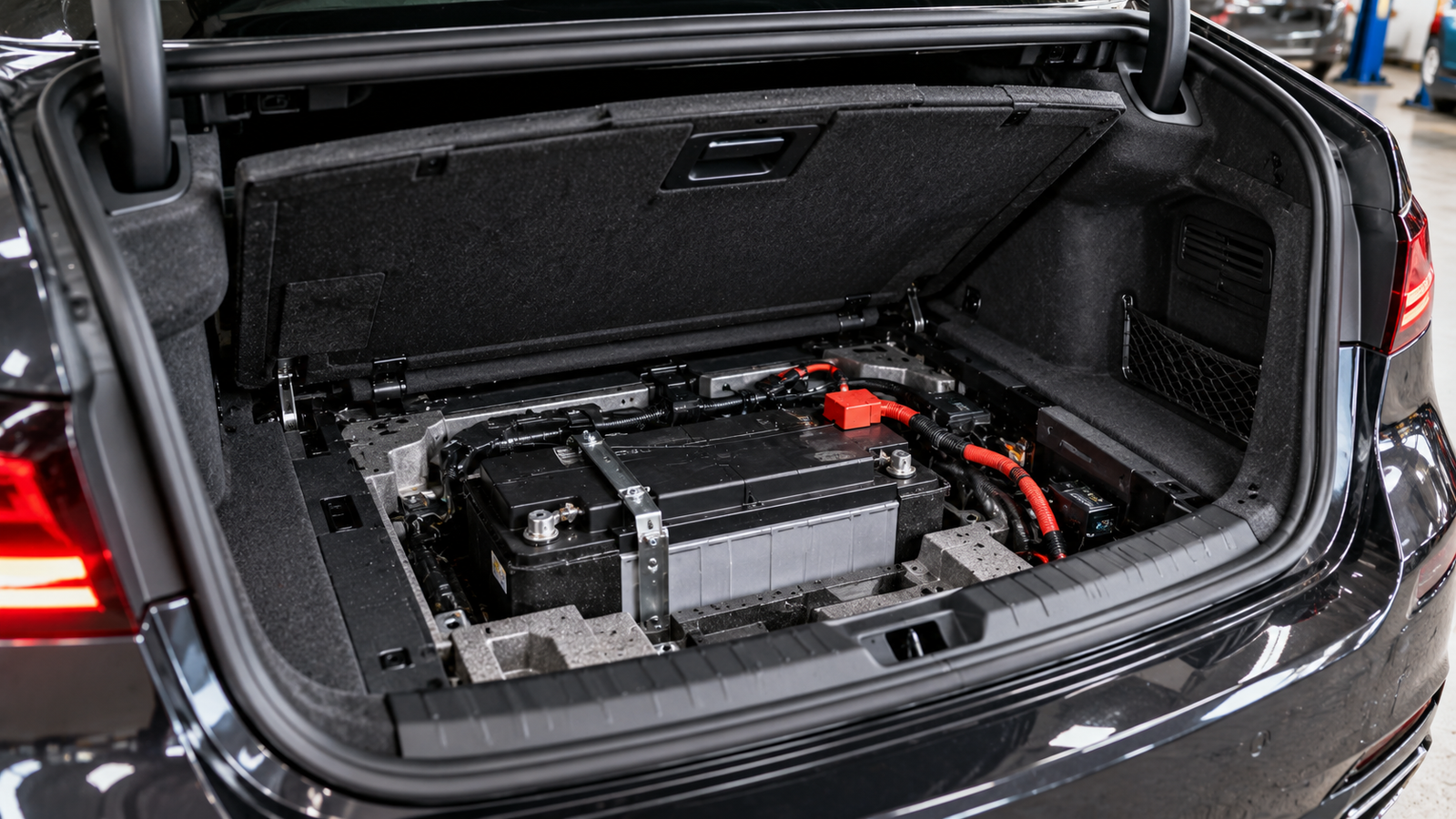
The lock could only be opened after 24 hours. This case clearly illustrates one of the peculiarities of vehicles with a trunk-mounted battery: when the battery is completely discharged, accessing it can sometimes prove difficult.
Why the battery is relocated from under the hood
One of the reasons is a lack of free space. In vehicles with large engines, the engine compartment is packed with the powertrain and auxiliary equipment. Therefore, the manufacturer may choose a spot in the trunk for the battery.
There is also another reason — weight distribution. A battery typically weighs 15–20 kg. On its own, this weight is not huge, but its placement affects the load on the front and rear axles. Moving the battery to the rear allows slightly unburdening the front of the vehicle and increasing the load on the rear.
For BMW, axle weight balance has traditionally been of great importance. In several models, the company sought to bring weight distribution close to a 50:50 ratio. Moving the battery to the trunk became one of the ways to achieve this result.
In addition, the battery is sensitive to high temperatures. Heat accelerates chemical processes inside the battery and can shorten its service life. Under the hood, especially near the engine, temperatures can be significantly higher than in the trunk. Therefore, placing the battery at the rear of the body helps reduce its exposure to heat from the powertrain.
What drawbacks this layout has
Moving the battery to the rear requires routing a heavy-duty power cable from the trunk to the starter and other electrical consumers. It carries a high current, so the wire must have an adequate cross-section and reliable insulation. The additional cable adds to the vehicle's weight and partially diminishes the benefit of relocating the battery.
BMW experienced issues with connecting such cables. Specifically, on certain 5 Series and 6 Series models, the cable from the battery connected to the underbody wiring through a special junction point near the trunk floor. If the connection was improperly made or loosened over time, the contact could overheat.
In some cases, this created a risk of damage to surrounding materials and fire. BMW conducted a massive recall campaign involving the inspection and elimination of the issue in the electrical connection. In the original report, its scale was estimated at approximately 1.3 million vehicles.
There are also specifics related to ventilation. When charging, a lead-acid battery can emit hydrogen. At certain concentrations, its mixture with air becomes explosive. If the battery is installed in the trunk or passenger compartment, the manufacturer provides a way to vent gases outside.
For this purpose, there is a vent port on the battery casing to which a special hose is attached. It is routed through the body to the outside of the vehicle. If only one port is used, the second one must be sealed with a factory-designed plug. When replacing the battery, it is essential to connect the ventilation properly.
Why a trunk-mounted battery is inconvenient in winter
This arrangement has another drawback: the battery does not receive heat from the running engine. After start-up, a battery under the hood gradually ends up in a warmer environment, whereas in the trunk, the temperature can remain close to that outside.
In freezing temperatures, chemical processes inside the battery slow down. Available cranking power decreases, and charging may proceed less effectively. Therefore, in winter, a battery installed in the trunk sometimes finds itself in less favorable conditions than an under-hood battery.
At the same time, performance is influenced not only by the mounting location, but also by the battery's condition, its type, capacity, temperature, and the specifics of the specific vehicle's charging system.
Another difficulty is accessing the battery. To reach it, the owner may need to empty part of the trunk, remove trim, or lift the floor panel. For routine checks or replacement, this is not always convenient.
Manufacturers therefore provide dedicated jump-start terminals under the hood. Usually, there is a positive terminal under a protective cover and a separate ground point. Wires from an external power source or charger are connected to them in accordance with the vehicle owner's manual.
These terminals also help when a dead battery prevents the electric trunk lock from opening. Connecting external power can restore central locking functionality and make it possible to open the trunk lid in the standard way.
That is exactly how the BMW 7 Series owner managed to resolve the problem: after reconnecting the jumper cables, the trunk opened.
Why BMW installs a pyrotechnic charge on the positive terminal
A long power cable running from the battery to the front of the vehicle passes through a significant portion of the body. In a severe accident, it can be damaged. If the wire remains connected to the battery, damaged insulation or contact with metal components can lead to a short circuit and sparking.
To reduce this risk, some BMW vehicles use a pyrotechnic disconnect switch integrated into the positive battery terminal. In a serious collision, the system receives a signal from the passive safety control module and cuts the power circuit.
A small pyrotechnic charge triggers inside the device. It moves a contact element, breaking the battery's connection to the main power cable. This reduces the risk of a short circuit in the damaged section of the wiring.
At the same time, some electrical systems may retain power via dedicated circuits. This is necessary for equipment that must function after an accident, including certain safety system components and hazard warning lights.
After the pyrotechnic disconnect switch has deployed, normal engine starting is typically impossible until the electrical circuit is restored and the system is inspected.
Read more articles:
- Four mistakes when driving over “speed bumps” that damage the suspension
- How to check the body of a used car before buying
- “Cyber-Sheriff”: how roof-mounted cameras on patrol cars look for debtors