Chinese authorities are introducing new requirements for battery technologies that could significantly impact the solid-state battery market. Starting July 1, standard GB/T 43568-2026 will come into effect, establishing clear criteria for classifying new-generation batteries for the first time. The main change concerns the content of liquid electrolyte. According to the new rules, batteries with a liquid electrolyte content of 5% to 20% will no longer be able to be positioned as fully solid-state. Such solutions will be classified into an intermediate category of hybrid or semi-solid-state batteries.
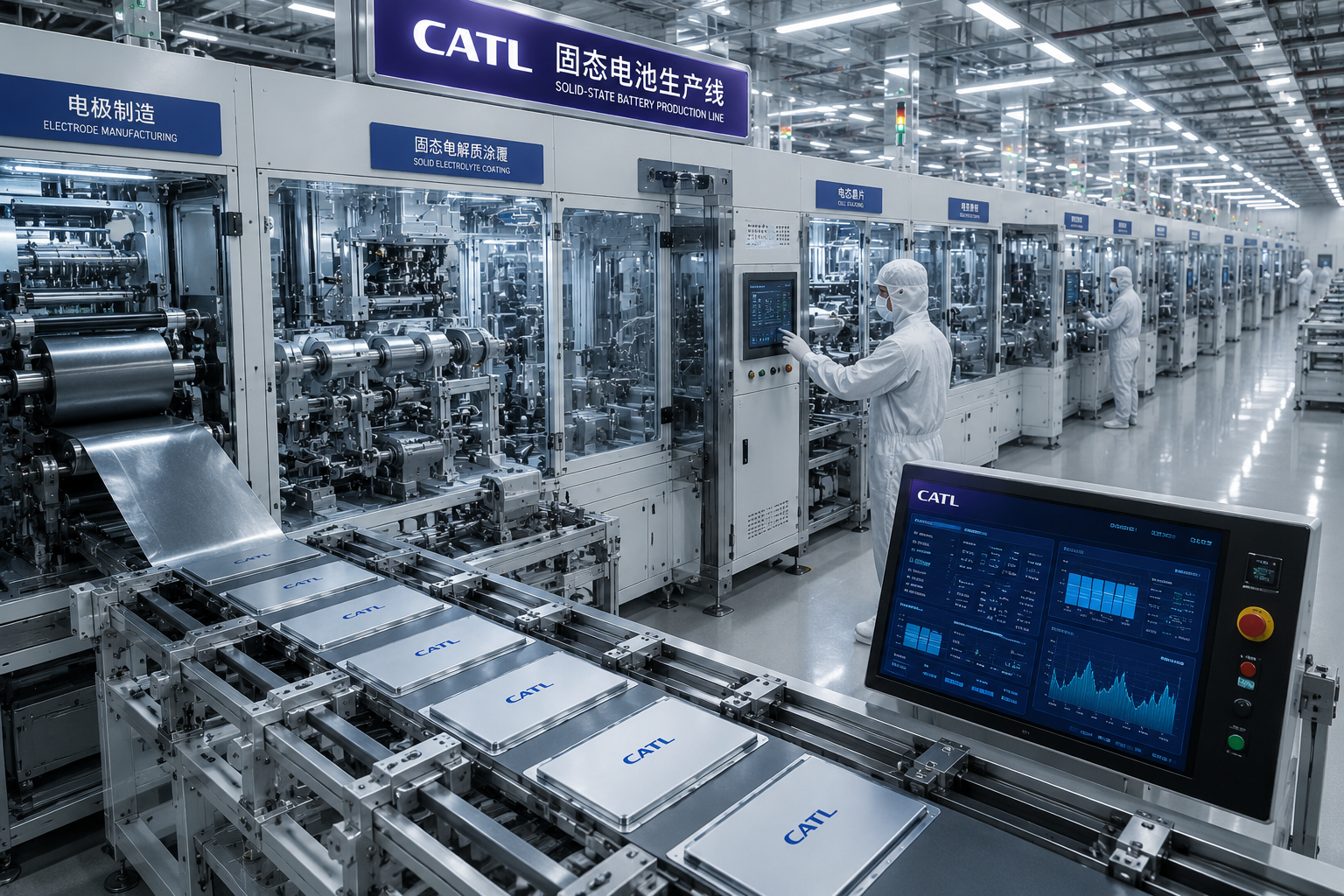
Only systems where the liquid electrolyte content does not exceed 5% will be able to obtain the status of a full-fledged solid-state battery.
This is an important point for the industry: in recent years, many manufacturers have actively announced a transition to solid-state technologies, but in practice, most projects were in the segment of semi-solid-state solutions.
The new requirements also change the assessment of future investments in production. It turned out that a significant part of existing lithium-ion battery production lines can be used to produce hybrid batteries with minimal modernization. According to industry experts, this will require changing less than 10% of the equipment.
In fact, this reduces the need for large-scale replacement of production capacities. Earlier, analysts expected that the transition to new technologies would create demand for equipment worth almost 59.2 billion yuan.
The position of the largest manufacturers looks particularly indicative. Earlier, CATL CEO Robin Zeng already warned that mass production of full-fledged solid-state batteries remains a matter of the future due to unresolved technological problems. This primarily concerns the stability of interfaces between materials and the durability of elements during long-term operation.
Meanwhile, the market continues to rely on traditional lithium-ion batteries. According to China EV DataTracker, in May, CATL maintained its leadership with a 46.7% market share and an installed capacity of 33.08 GWh. BYD took second place with 11.87 GWh and a 16.8% share.
Comments