Toyota has found an unusual way to determine which 3.4-liter twin-turbo V6 V35A-FTS engines need replacement. This refers to engines installed in the Toyota Tundra, Lexus LX600, and GX. Inside some engines, metal particles could remain after block processing, potentially damaging the main bearings and leading to serious failure.
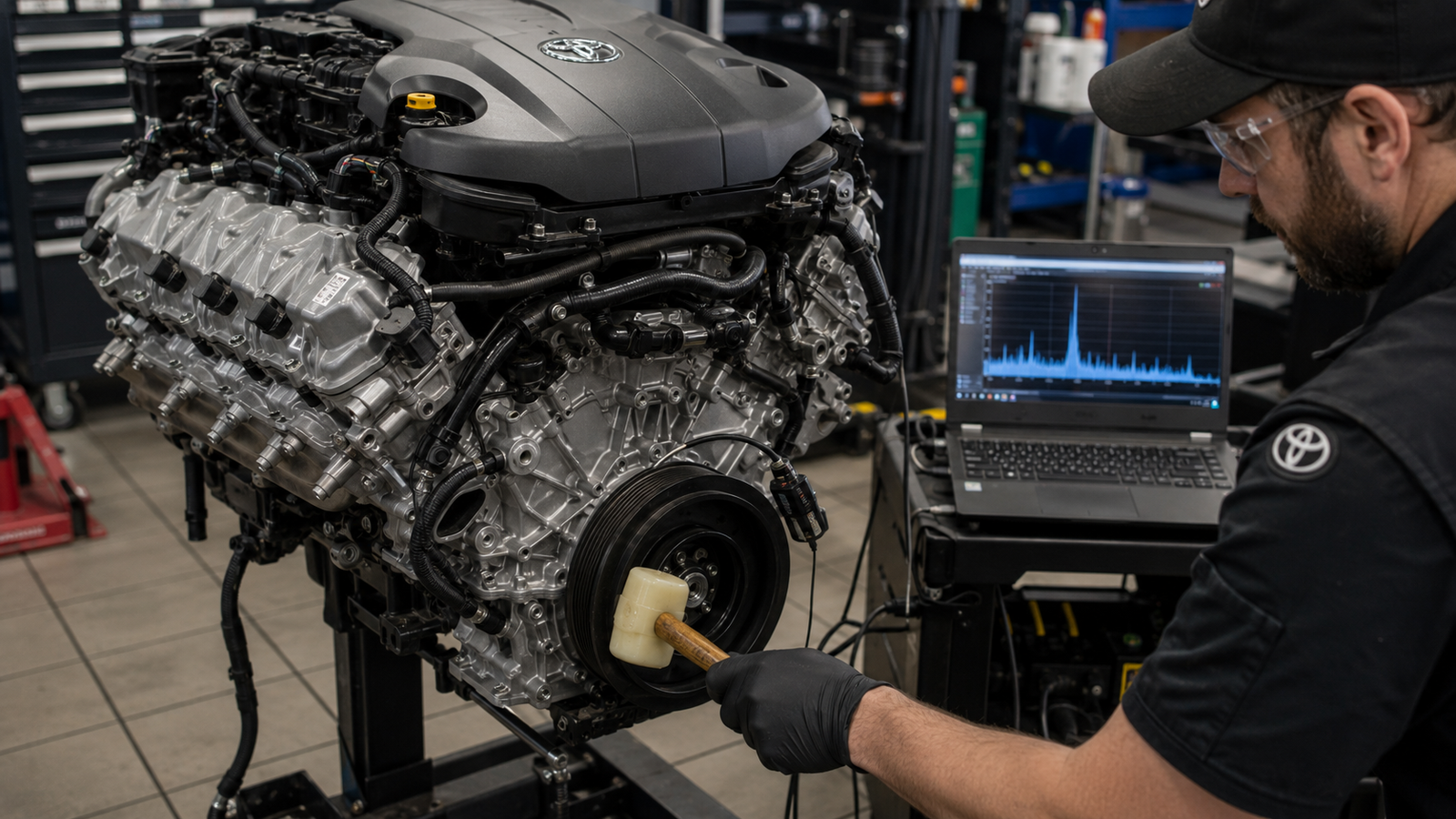
Instead of replacing all engines from the large-scale recall campaign, dealers received a special diagnostic procedure. First, the engine is warmed up to a specified temperature, drive belts are removed, and a special accelerometer is installed on the crankshaft pulley.
Then, a technician strikes the pulley three times with a 250-gram plastic hammer. The sensor records the resulting vibrations, and the program analyzes their frequency and compares the result with benchmarks for healthy and faulty engines.
The logic of the method is based on physics. If metal debris has already damaged a main bearing, its vibration characteristics differ. Therefore, the software can identify a potentially problematic engine without complete disassembly.
However, the solution has an obvious limitation: the diagnosis shows the engine's current condition, but does not guarantee that it will not encounter a problem in the future. This is why some owners may be distrustful of such a check.
Read more articles:
- Ford turned the Ranger Super Duty into a fire truck: it got pumps and 4x4
- Audi changed its mind about retiring the legendary five-cylinder engine: the RS3 got a chance to continue
- Toyota Corolla turns 60: the legendary sedan has sold over 57 million units