While the Russian market continues to digest the first-generation Lada Largus wagon – albeit slightly updated, but noticeably outdated and sold at a higher-than-expected price – Europe has long had official sales of a much fresher and more technologically advanced car of the same class. In terms of its ideology and purpose, it can be considered the fourth generation of the Largus, although it formally bears a different name.
If the French Renault had not left the Russian market, it is highly likely that such a car would be produced at domestic plants today and would have occupied the niche of the current Largus. However, reality turned out differently. As a result, the Russian buyer is left to choose a time-tested, but already morally outdated design, which, apparently, will remain on the assembly line for a long time.
Who is behind the "new Largus" in Europe
We are talking about the Dacia Jogger – a model of the Romanian brand, which is part of the Renault Group. This wagon was first presented to the European public in 2021, and by its fourth anniversary it received a rather serious update. However, even before the restyling, the car felt confident in the market: in 2024 alone, 96,440 units were sold in Europe.
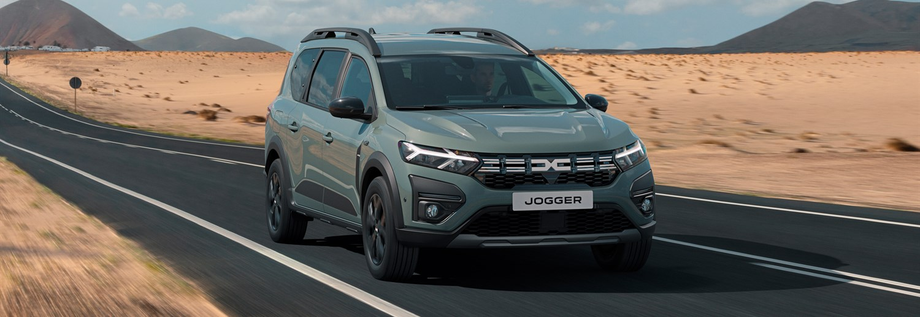
The Jogger did not appear as a development of one specific model. It came to replace two family cars of the brand at once:
- Logan MCV wagon;
- Lodgy compact van.
At the same time, the Jogger cannot be considered a direct successor to any of them. This is a completely independent development built on the modern modular architecture CMF-B.
It is curious that it was on this platform that the French side planned to transfer the entire model range of AvtoVAZ by 2025. As you might guess, these plans were never destined to come to fruition.
Platform: past vs. present
The Russian Lada Largus still uses the B0 platform, the age of which has long exceeded twenty years. From the point of view of the basic layout, the cars are largely similar. In both cases, the following are used:
- MacPherson struts at the front;
- torsion beam at the rear;
- disc brakes on the front axle and drum brakes on the rear.
However, the differences begin in the details. The Dacia Jogger is already equipped with an electric power steering, while the Largus is still content with a hydraulic booster, which today is perceived as a clear greeting from the past.
Dimensions and practicality
In terms of dimensions, the European wagon is slightly superior to the domestic one:
Dacia Jogger:
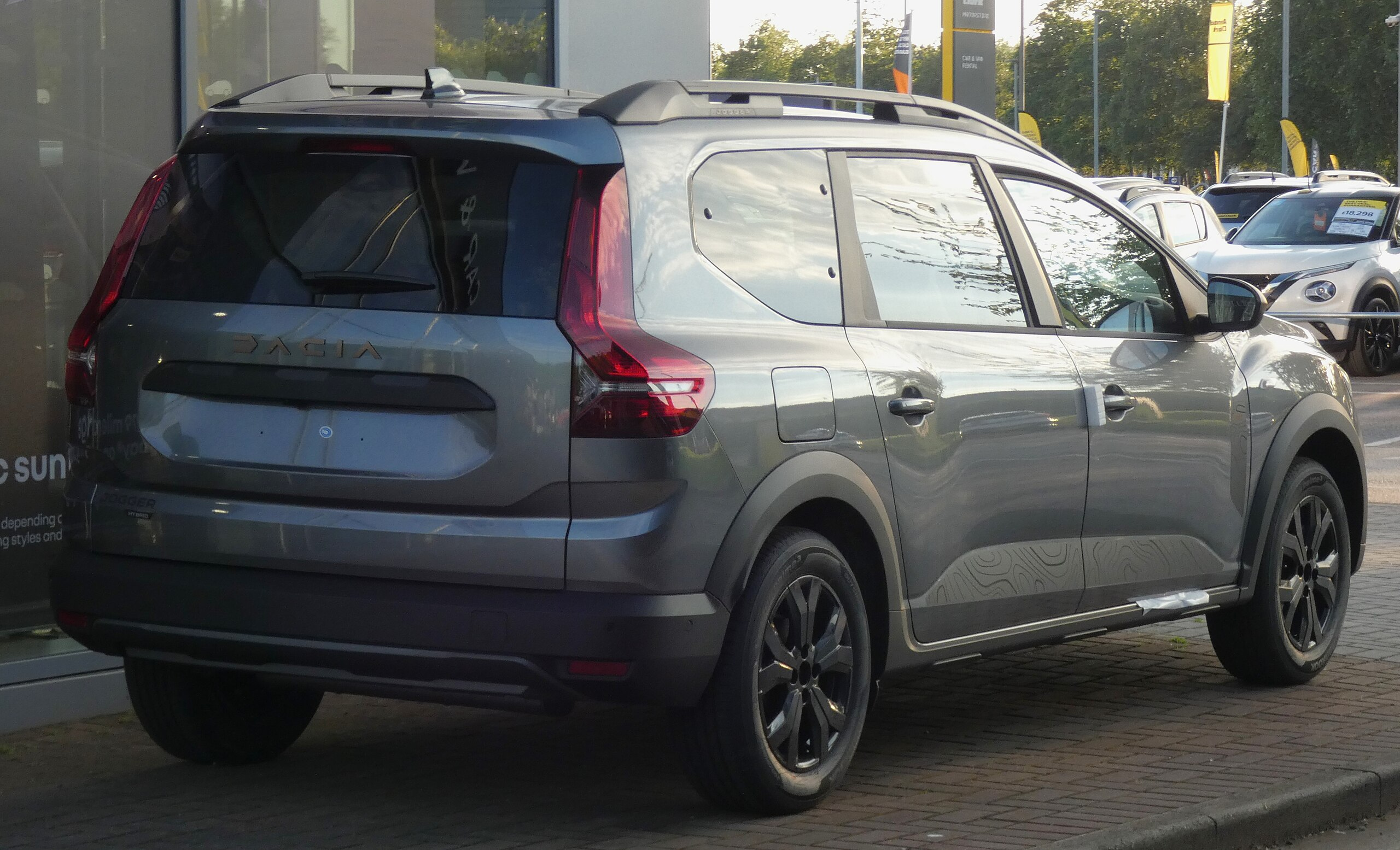
- length – 4547 mm;
- width – 1784 mm;
- height – 1674 mm;
- wheelbase – 2897 mm;
- ground clearance – 200 mm.
The car is offered in five- and seven-seater versions. The volume of the luggage compartment varies from 213 to 1819 liters, depending on the configuration of the cabin. The curb weight is 1262 kg, the gross weight is 1889 kg.
Lada Largus looks a little more compact:
- length – 4470 mm;
- width – 1750 mm (or 1756 mm for the Cross version);
- height – 1670 mm (1682 mm for the Cross);
- wheelbase – 2905 mm.
Its ground clearance is noticeably less: 172 mm for the standard version and 195 mm for the Cross. But the Largus wins in terms of trunk capacity – from 560 to 2350 liters. The curb weight is almost identical – about 1260 kg, the gross weight is 1850 kg.
Power units: different levels of capabilities
The Dacia Jogger engine range for the European market looks much richer.
The basic version is the three-cylinder TCe 110 turbo engine:
- volume – 1.0 l;
- power – 110 hp;
- torque – 200 N·m;
- gearbox – six-speed manual.
The next option is the ECO-G 120. This is a 1.2-liter turbocharged engine that can run on both gasoline and gas. It develops 120 hp and the same 200 N·m, combined with either a "mechanics" or a six-speed preselective robot.
The flagship of the range is the Hybrid 155 with the new generation E-Tech system. Instead of the previous 1.6 atmospheric engine, a 1.8-liter engine is used here, developing 109 hp. The 50 hp traction electric motor, starter-generator and robotic gearbox without clutch and synchronizers remained the same. Gears are switched using cam clutches, and possible jerks are smoothed out by electronics. The total power of the hybrid installation has increased to 155 hp, and the battery capacity has increased from 1.2 to 1.4 kWh.
Against this background, the Lada Largus looks extremely simple. Only two atmospheric engines are available for it:
- VAZ-11189 – 1.6 l, 90 hp, 143 N·m;
- VAZ-21129 – 1.6 l, 106 hp, 148 N·m.
In both cases, there is no alternative to the five-speed manual gearbox.
Design and equipment update
The restyling of the Dacia Jogger affected not only the technology, but also the appearance. The wagon received:
- radiator grille with a pixel pattern;
- new headlights in the shape of an inverted letter "T";
- rear lights in the same style.
The body trim features protective elements made of Starkle composite, partially made from recycled plastic. They cover the wheel arches, as well as the front and rear of the car. In addition, a new body color has been added to the palette – "sandstone".
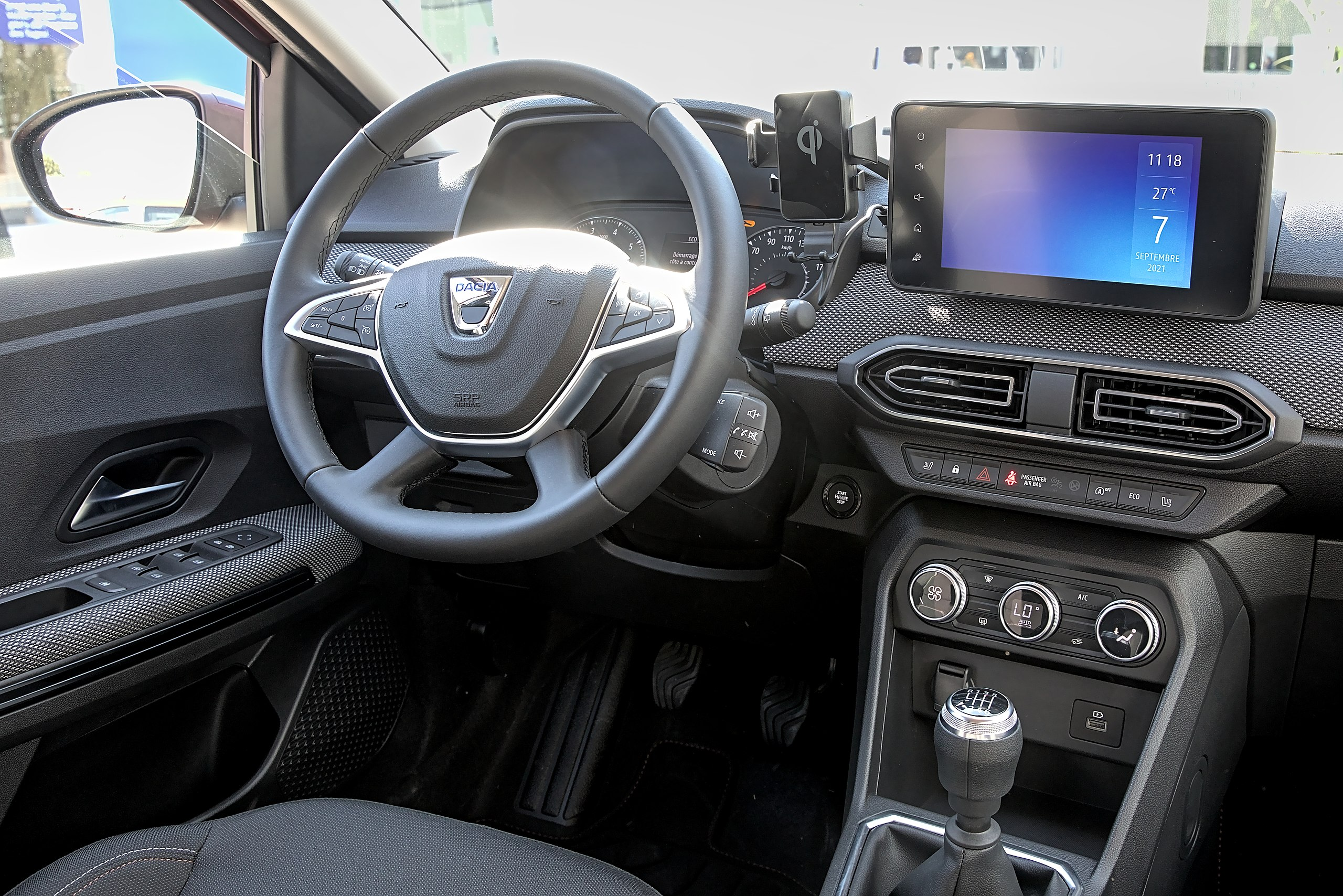
In the cabin, the changes affected the materials and design: new fabrics, fresh color combinations and a redesigned steering wheel appeared. All versions, with the exception of the basic Essential, now have a central 10-inch touch screen.
The standard set of electronic assistants includes automatic high beam switching, an emergency braking system and driver fatigue monitoring. Electrically folding mirrors and a surround view system are also available.
Prices: almost on equal terms
The cost of the updated Dacia Jogger varies depending on the country. For example, in Spain, prices range from 19,190 to 28,150 euros, which corresponds to approximately 1,781,000 – 2,614,000 rubles.
In Russia, the first-generation Lada Largus is offered at a price of 1,660,000 to 1,915,000 rubles, and the Cross version is estimated in the range of 1,815,000 – 2,020,000 rubles.
As a result, a clear picture emerges: in Europe, the buyer receives a modern, technological and spacious Dacia Jogger, in Russia – a time-tested, but already frankly outdated Lada Largus.
At the same time, the cost of cars is approximately at the same level, if we do not take into account the hybrid modification of the European cross-wagon.
Read more materials on the topic:
Now on home

The financial messaging system of the Central Bank of the Russian Federation became mandatory in 2023

First batch of Wink Box Mini to be delivered to customer in 2026

New fiber optic system can protect enterprises from explosions

The technology increases the corrosion resistance and wear resistance of materials
The method uses a single laser pulse and allows flexible frequency tuning without complex multilayer crystals

The launch of a train on the Moscow — Yaroslavl route is being considered

Суда будут использоваться в зимней навигации Санкт-Петербурга

New vessel improved the accuracy of work

The technology controls the loading of dump trucks using AI, laser scanning, and machine vision

The power plant for the aircraft was developed at the Ural Civil Aviation Plant

The plant is once again producing for the Russian defense complex

Компания «Ридан» собирает водохлаждающие парокомпрессионные холодильные машины из российских компонентов