Just the mention that a car of Chinese origin could begin to be produced in Russia under the "Volga" brand is enough to provoke sharp rejection among the marque's devoted fans. For them, the "real Volga" is the GAZ-21, GAZ-24, and GAZ-3102, while everything else is seen as an attempt to capitalize on the legendary name. However, Volga enthusiasts themselves remember perfectly well how for many years GAZ tried to extend the life of the aging model, limiting itself to compromise solutions.
Attempts to Preserve a Legend
The project of the fundamentally new GAZ-3111 was accompanied by a broad advertising campaign, but ultimately proved commercially unsuccessful: the car turned out to be expensive and did not meet expectations. The 31029, 3110, and 31105 models essentially remained a deeply modernized version of the same GAZ-24. Against this background, the rare GAZ-311055 stands out in particular, produced in a run of only about 60 units — far too few to speak of a full-fledged series.
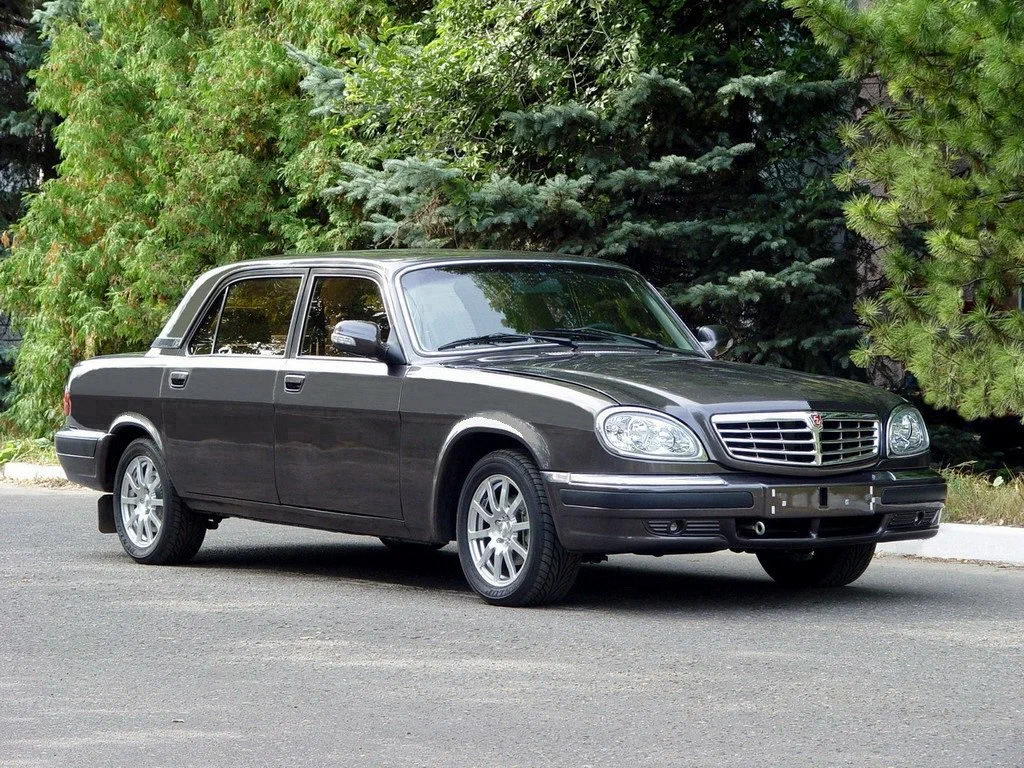
An Extended "Volga" for Special Passengers
The model was presented to the public at the MIMS-2005 auto show. Externally, the car resembled projects from tuning studios of the early 2000s: a light-colored interior, decorative "wood-look" inserts, and chrome elements. However, the main difference was the wheelbase increased by 300 mm. Of that, 110 mm was added to the front door and 190 mm to the rear door. In essence, it was a factory-built "stretch" aimed at second-row passengers.
The extra space was made the model's main focus. The rear doors became wider and more substantial, emphasizing status. It was assumed that the car would be used with a chauffeur, so special attention was paid to the ease of entry for VIP passengers.
Comfort and Interior Details
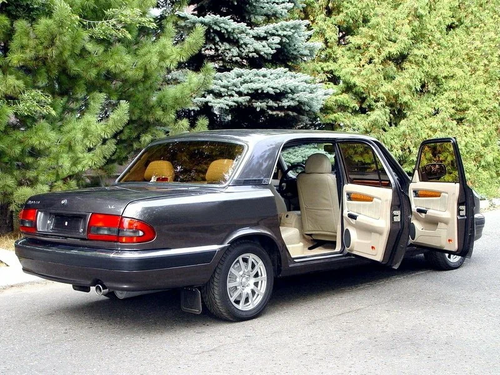
The rear seat received a transformation function, allowing occupants to assume a more relaxed, almost semi-reclining position. The climate system supplied warm air directly to the passengers' feet from under the front seats rather than from the center console.
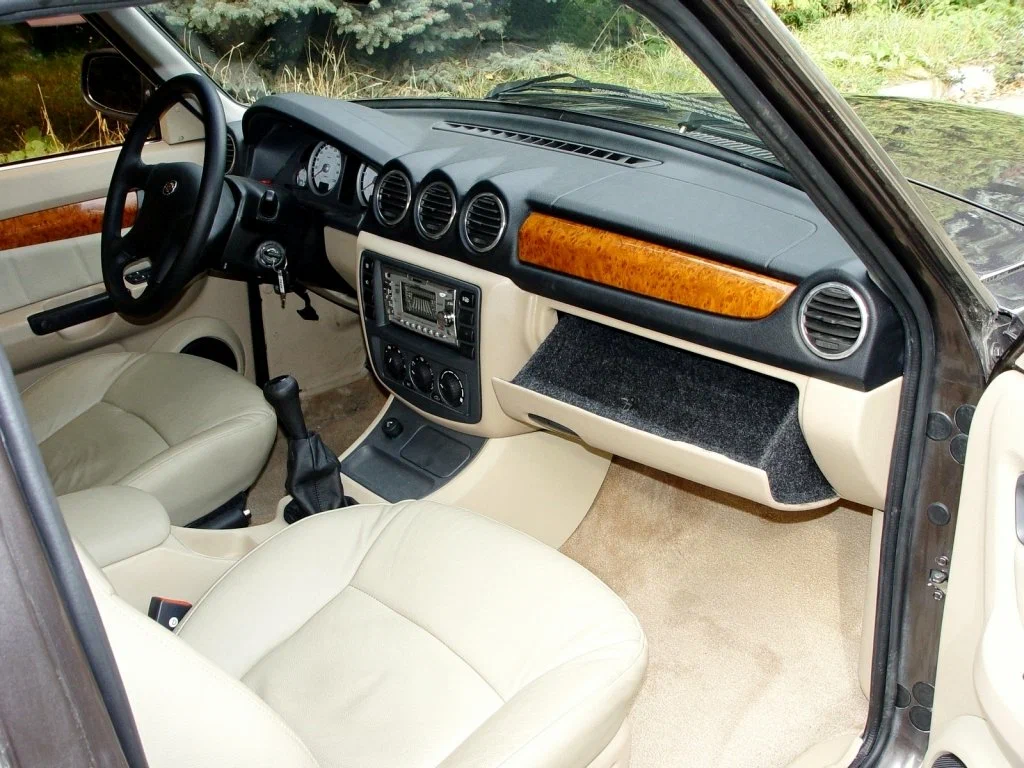
The interior design used round air vents with chrome trim, blue-backlit instruments, and large decorative wood-look inserts. The two-tone finish — black upper section and beige lower section — was intended to create a sense of solidity and comfort.
Technical Upgrades
The car was equipped with an impact-safe steering column adjustable for reach and tilt, borrowed from the GAZ-3111 project. In an accident, the structure would collapse, reducing the load on the driver. The gear lever became shorter and more convenient to operate, while the parking brake received a cable drive. The handle was neatly integrated into the center console.
Uncertainty Over Powertrains
Under the hood, it was planned to install either a 2.4-liter Chrysler engine producing 147 hp or ZMZ-40621 and ZMZ-4052 engines compliant with the Euro-2 standard. A version with a partition and a retractable glass divider was also envisaged — effectively a "limousine" version.
Too Late to Market
If a model like this had appeared on the market 10 to 15 years earlier, it might have had a chance to occupy a niche as official transport or VIP transport. But by 2005, Russian buyers had already made their choice in favor of foreign cars, and the updated interior could not compensate for the outdated design, high fuel consumption, and modest dynamics. The outcome was predictable — limited production and rare-item status.
Read more materials on the topic:
- A Collection of USSR-Era Cars Discovered in St. Petersburg
- Why the "Moskvich-412" Engine Became a Revolution in the USSR
- GAZ-Siber: How and Why the "American" Volga Failed to Take Off
Комментарии