In engineering circles, an almost indisputable rule has long been established: the piston must be round. This is perceived as an axiom. All the more striking is the decision of a group of engineers who once decided to break this dogma and proposed a completely different approach — to create a piston whose shape more closely resembles an elongated oval, similar to a "stadium", and make it work at extreme speeds.
The story dates back to the late 1970s, during the World Motorcycle Racing Championship. At that time, light, high-revving, and characteristically smoky two-stroke engines dominated the tracks. However, Soichiro Honda came up with another crazy idea. He insisted that victory should be achieved with a four-stroke engine. The task seemed almost impossible.
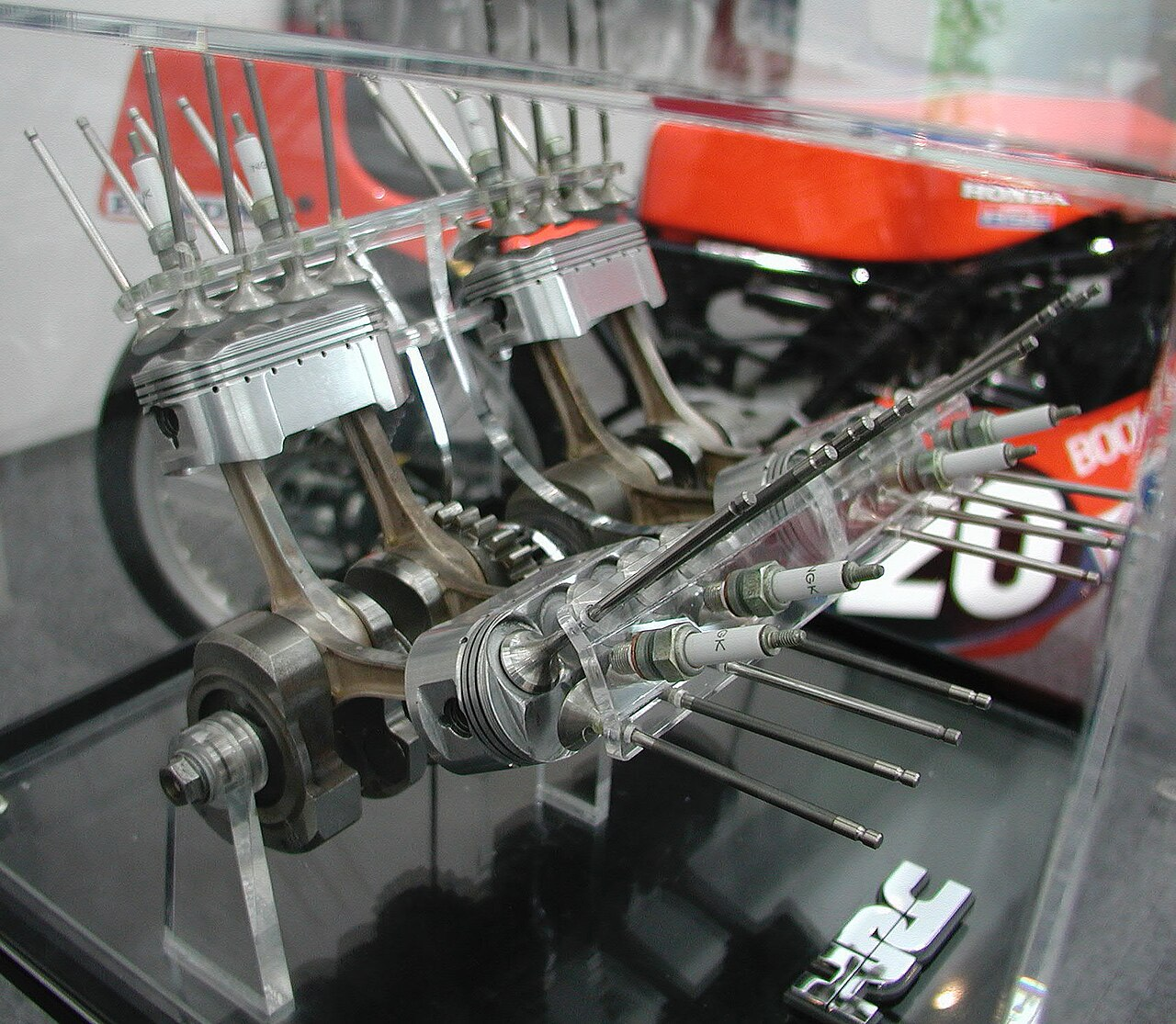
To compete with two-stroke units, a 500 cubic centimeter four-stroke engine needed to be revved to around 20,000 rpm. For efficient operation in such modes, the engine needed high throughput — and therefore, an increased valve area. The most obvious solution would be a V8 engine configuration with eight cylinders and many small valves. However, the racing regulations strictly limited the design: no more than four cylinders. The situation seemed to have reached a dead end.
Honda engineers found an unexpected solution. Instead of increasing the number of cylinders, they actually combined two cylinders into one, developing a piston of an unusual, elongated shape. Formally, the engine remained a four-cylinder V4, but in terms of valve area and the ability to "breathe," it was close to a V8.
The design turned out to be extremely complex. Each such piston had eight valves and two spark plugs. To ensure stable operation at extreme speeds and prevent skewing, each piston was connected to two connecting rods at once. All this made the engine a unique engineering solution, a kind of legal circumvention of the regulations.

However, serious problems arose in practice. The main difficulty was in the piston rings. In a traditional engine, a round ring is evenly pressed against the cylinder walls, ensuring tightness. In the case of an oval shape, it turned out to be extremely difficult to achieve such uniform pressure. On straight sections, the rings did not provide sufficient sealing, and gases broke through downwards, while in the rounded areas, on the contrary, the pressure was excessive, which led to increased friction and destruction of the oil film. As a result, the engines overheated and often failed.
The problems were so obvious that the project was openly ridiculed in the paddock. The abbreviation NR (New Racing) was ironically deciphered as "Never Ready," hinting at constant technical problems.
Nevertheless, the project was not closed. The engineers continued to work, spending about ten years refining the technology. During this time, new materials were developed, special methods for processing cylinders were created, and non-standard components were perfected.
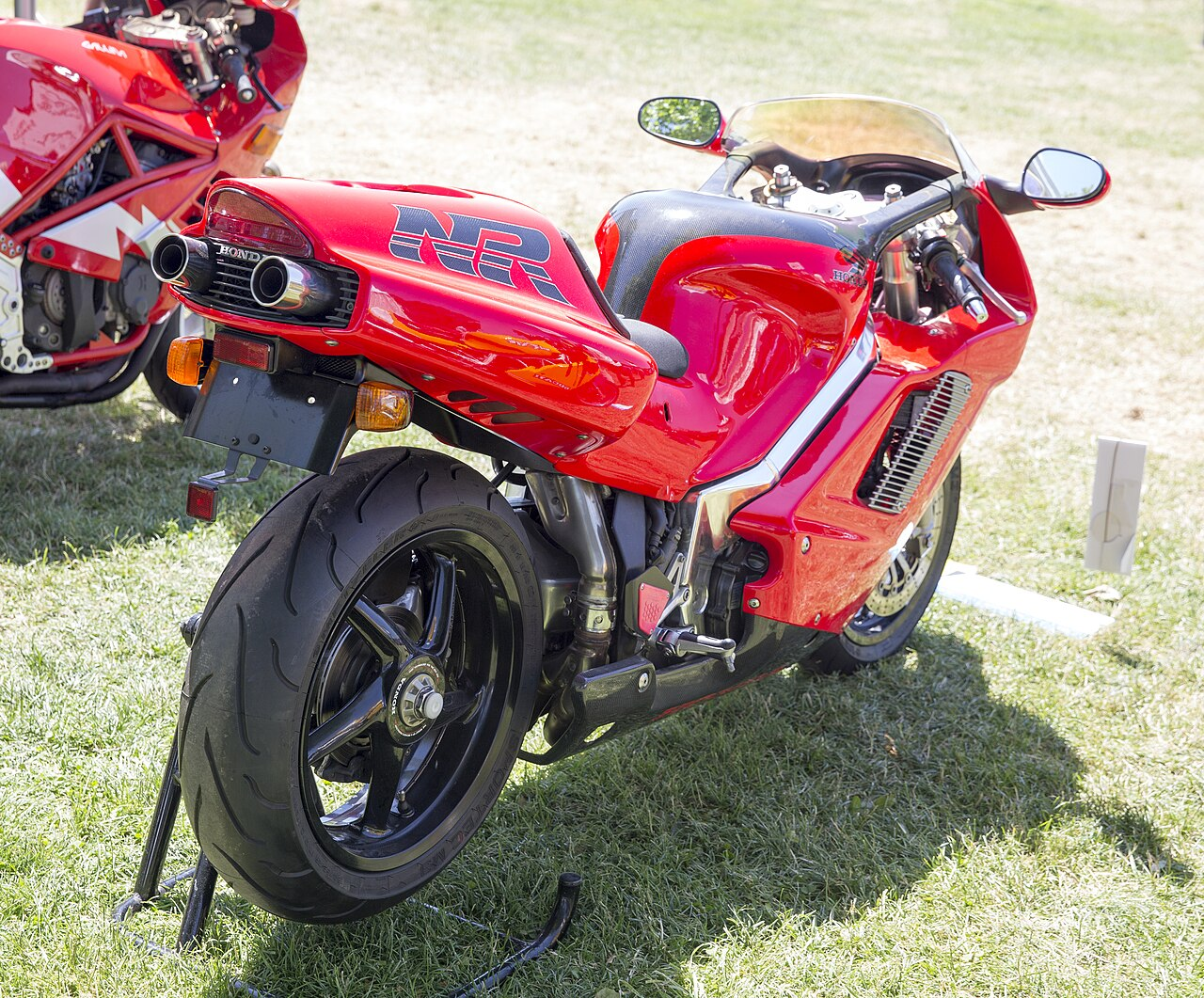
The result was a road version — the Honda NR750, introduced in 1992. This motorcycle combined advanced materials, including carbon fiber and titanium, as well as a unique engine with oval pistons. The model cost $50,000 and quickly gained cult status.
From a practical point of view, this solution is difficult to call rational. However, the very fact of its implementation became a clear example of how engineering persistence can overcome limitations. History has shown that even fundamental rules can be revised if people who are ready to look for non-standard ways take up the cause.
Read more materials:
- Why car tires are flat and motorcycle tires are round
- Changing the color of a car: rules and restrictions
- Why does the engine need "warm-up" on the track
Comments