Among motorists, the idea has long been rooted: the wider the tires, the more reliably the car "holds" the road. That is why powerful and sports models are most often associated with massive wheels of increased width.
Visually, such tires really make an impression — the car looks more aggressive and stable. However, if we consider the issue from the standpoint of physics and engineering calculation, the picture turns out to be much less clear.

Let's figure out what role the width of tires actually plays in the formation of adhesion to the road surface.
What physics says
The basic principle, studied even in school, boils down to a simple dependence:
friction force = coefficient of friction × pressure force
In the context of a car, the pressure force is formed by the mass of the car falling on each wheel. It follows that the level of grip is primarily determined not by the geometry of the tire, but by other factors.
These include:
- the mass of the car distributed over the wheels;
- the composition and properties of the rubber compound;
- the condition of the road surface.

Thus, the contact area of the tire with the road is not a determining parameter.
Why increasing the contact area does not increase grip
At an intuitive level, it seems logical: a larger contact patch should provide better grip. However, in practice, a different mechanism works.
When the contact area increases, the pressure created by the car is distributed over a wider surface. As a result, the load per unit area decreases.
This leads to the fact that the total friction force remains approximately at the same level. In other words, increasing the width of the tire by itself does not provide a noticeable increase in either traction or braking efficiency.
How to correctly select the width of tires
The tire size must match the parameters of the wheel rim. Violation of this ratio inevitably leads to a change in the shape of the tire profile and a deterioration in its performance.
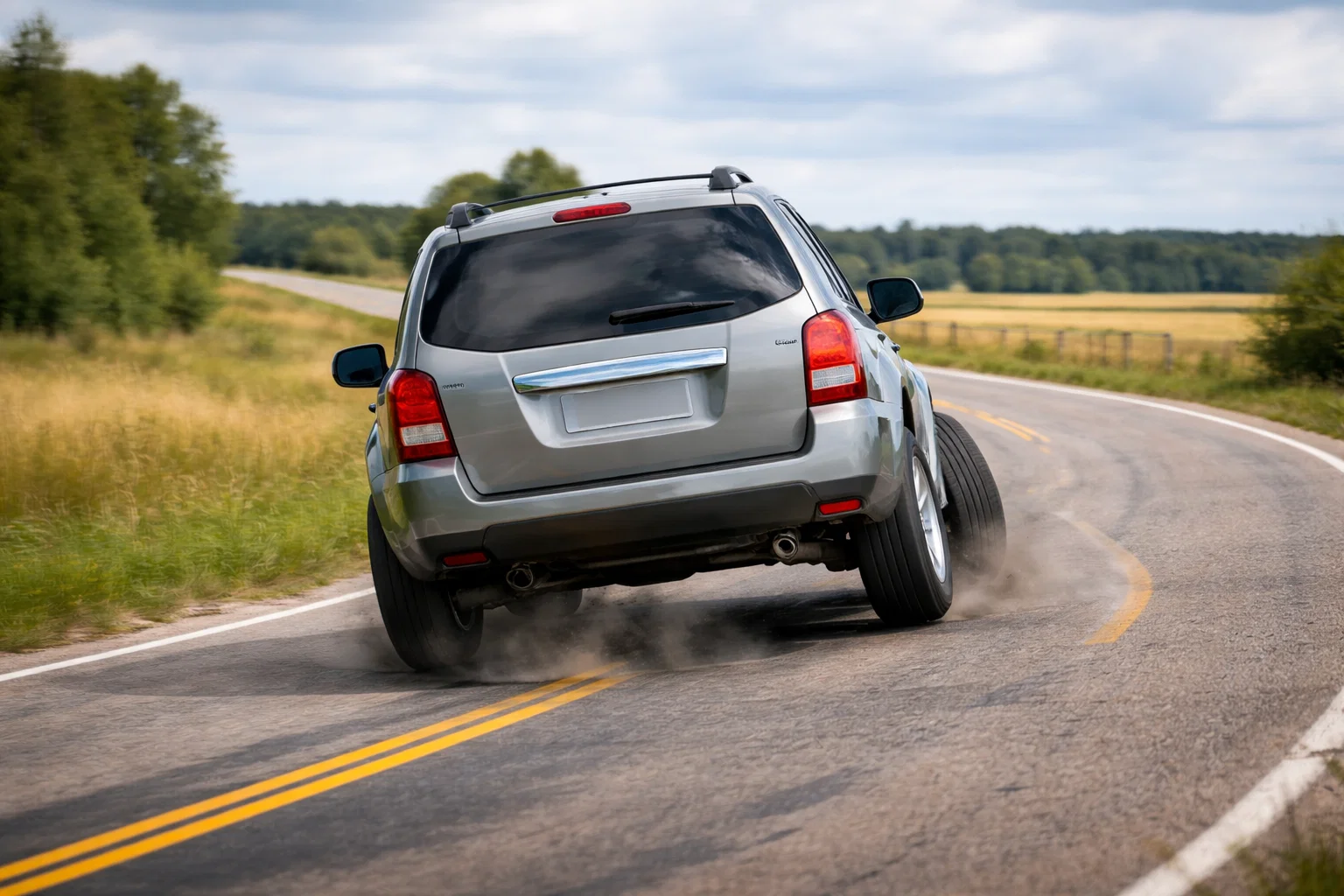
If you install too wide rubber on a narrow rim, the following consequences are possible:
- accelerated tire wear;
- overheating during operation;
- reduced steering accuracy;
- unstable vehicle behavior in corners.
That is why automakers select tire sizes not by chance. The calculations take into account the mass of the car, engine power, suspension parameters and steering features.
Why you need a tire calculator
When they want to change the size of the wheels, drivers often resort to the so-called tire calculator. This tool allows you to assess the consequences of the replacement in advance.
With its help, you can determine:
- the final diameter of the wheel;
- the height of the tire profile;
- the change in ground clearance.
Such a preliminary check helps to avoid mistakes and maintain the correct characteristics of the car when choosing alternative sizes.

The widespread opinion about the unconditional advantage of wide tires is not true. The main contribution to grip is made by the mass of the car and the characteristics of the rubber, and not the width of the tire as such.
At the same time, the width itself is important in other aspects — for example, in matters of heat dissipation and stability under high loads.
Therefore, when choosing tires, it is wiser to focus on factory settings and manufacturer's recommendations. This allows you to maintain a balance of handling, reliability, and safety without unnecessary experiments.
Read more materials:
- Wheel imbalance: a hidden threat on the road
- Car breakdowns that cannot be ignored
- Honda's crazy idea: oval pistons
Comments