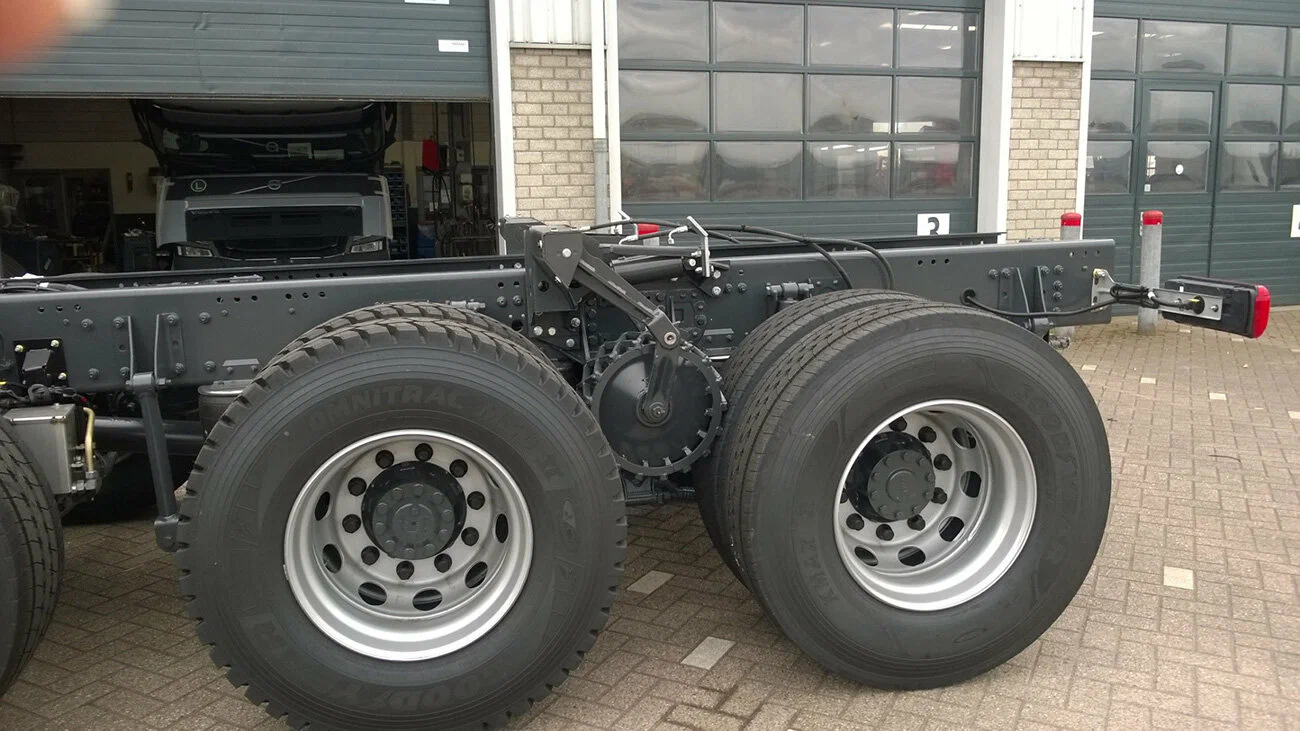
On some European trucks, an unusual steel drum with a toothed surface can be seen between the wheels of the rear bogie. At first glance, it seems that it should be connected to the engine or gearbox, but no cardan shafts, chains, or other mechanical drives are connected to it.
When driving off-road, the driver presses a button in the cabin, after which the drum lowers and presses tightly between two adjacent wheels. As a result, a truck, which previously had only one rear drive axle, unexpectedly gains additional traction and is able to get out of deep mud or softened clay without full all-wheel drive.
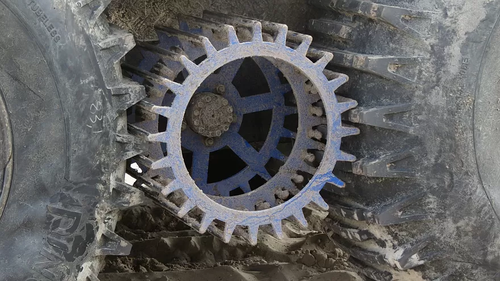
This device is known as the Robson drive, although among drivers, another name is more common – "medvedka" (mole cricket).
Where the Robson drive is used
Most often, such a system can be found on trucks operating in Finland and Sweden.
Many trucks use a rear bogie with three axles, but only one of them is a drive axle. The other axles can be raised to avoid tire wear when driving without cargo and to reduce fuel consumption. It is in such designs that the Robson drive allows temporarily connecting another axle without installing a full-fledged transmission.
How the drum transmits torque
The principle of operation of the device is based on the transmission of rotation directly through the tires.
There are two variants of execution:
- The first uses friction force. The roller, pressed against two adjacent tires, begins to rotate together with the drive wheel and simultaneously transmits rotation to the second tire.
- The second, toothed, option is more common. Protrusions are located around the circumference of the drum, which engage with the lugs of a special tire. In essence, this scheme works like two interacting gears.
Therefore, special tires are used for such systems, designed to transmit torque not only through the hub but also from the outside.
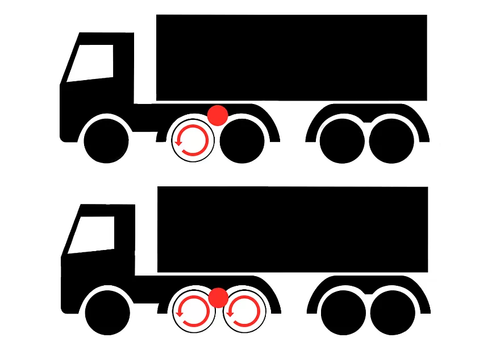
How a 6×2 truck becomes a 6×4
On a truck with a 6×2 wheel formula, only one rear axle is a drive axle. After engaging the Robson drive, the drum is installed between the drive wheel and the wheel of the adjacent axle. As a result, the device:
- receives rotation from the drive wheel;
- transmits it to the adjacent axle;
- makes two rear axles drive axles.
At the same time, there is no need to install:
- a second drive axle;
- a transfer case;
- additional cardan shafts;
- an inter-axle differential with a lock.
The weight of the entire system is about 215 kg, and its engagement is carried out by the same button that controls the lifting axle.
The Finnish company Sisu installs such mechanisms at the factory. For Volvo, the Robson drive is available in the list of factory options, and for Scania and DAF trucks, specialized European workshops offer similar kits. The main advantage is that the raised roller does not affect fuel consumption in any way, whereas permanent all-wheel drive increases it regardless of road conditions.
Why the system cannot be used constantly
Despite its effectiveness, the Robson drive is designed for short-term operation only. Torque is transmitted through direct contact of metal with rubber, so the tires experience increased loads. That is why among drivers, the device received another unofficial nickname – "tire killer." There have been cases when, after one shift, the inner tires of the drive axle had to be completely replaced due to tread pattern destruction.
In addition, there are operating restrictions:
- the speed of movement should not exceed 30 km/h;
- it is recommended to engage the system at almost minimum speed;
- it must be activated in advance.
If the drive wheels are already deeply submerged in mud, there may simply be no room to lower the roller. For this reason, some truck owners prefer to completely dismantle the mechanism.
Where the Robson drive is used constantly
In heavy logging equipment, this scheme has found a completely different application. On some logging trucks and trailers, the roller is no longer an auxiliary system, but the main method of traction transmission. In such machines, rotation is created by a hydraulic motor, which drives the drum. It, in turn, transmits force directly to the wheels.
At the same time, there are no:
- cardan shafts;
- traditional drive axles;
- half-shafts.
Power transmission is carried out only through the hydraulic system. Such a design is especially interesting for all-terrain vehicles. It allows simultaneously reducing the weight of the machine and using very large low-pressure tires. Such wheels themselves act as shock absorbers, so the need for classic suspension practically disappears.
Another advantage is the absence of external oil-filled units that require maintenance after overcoming deep fords. The entire transmission is located inside a sealed housing, thanks to which such machines are able not only to confidently move through swamps but also to overcome water obstacles without additional maintenance.
Why the device is called "medvedka"
In Russia, the origin of this nickname is often associated with the toothed drum, which clings to the tread like a mole cricket digs the ground with its front paws. However, the true story of the name is completely different. In Finland, the device is called telikarhu. This word consists of two parts: teli – a bogie with several axles, and karhu – a bear. Over time, the foreign word was reinterpreted by Russian-speaking drivers and turned into the more familiar "medvedka".
Where did the name "Robson drive" come from?
The name is associated with the Swedish company Zetterbergs, where the modern version of the mechanism was developed. Initially, the system was created as a temporary all-wheel drive for trucks with lifting axles.
Later, the device began to be produced under the RobsonDrive brand, which still exists today.
A similar scheme was even used on a moped
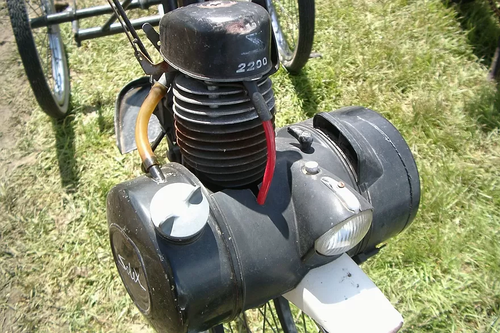
Interestingly, the principle of the Robson drive has long been used on two-wheeled vehicles. The French moped VeloSolex used an engine mounted directly above the front wheel. On the engine shaft there was an ordinary rubber roller, which was pressed against the tire from above and rotated it due to friction.
The design was as simple as possible:
- standard bicycle tire;
- absence of gear engagement;
- gasoline engine with only 0.3 hp.
The maximum speed was about 30 km/h, and the engine was started with pedals. The scheme had a serious drawback: on wet asphalt, the roller began to slip, and the driver had to help the engine by pedaling. This feature was one of the reasons why purely friction drive did not become widespread on heavy equipment.
Nevertheless, the VeloSolex was extremely successful. About 8 million units were produced over the years of production, and the model was discontinued only in 1988. Special fuel was even produced for the moped – a mixture called Solexine, which was sold in sealed two-liter yellow metal cans.
Read more materials:
- Why tractor rear wheels are much larger than front wheels
- Land Cruiser 70: an SUV that outlived dozens of car generations
- Why AvtoVAZ abandoned the short fender
Комментарии