In the first half of the 20th century, automotive engineers were concerned not only with engine power. One of the serious problems remained ordinary car tires. Tires wore out quickly and poorly tolerated heavy loads: cord manufacturing technologies could not keep up with how quickly the demands on cars grew.
The solution turned out to be quite simple — increase the number of tires. If one tire could not cope with the load, two were put in its place.
Limousines and armored vehicles were the first to appreciate the solution
Dual wheels on the rear axle first appeared on executive limousines and armored vehicles. The reason was obvious: additional armor and expensive interior trim significantly increased the weight of the car, but its ability to move normally had to be maintained. Two tires on each side of the rear axle allowed the weight to be distributed more effectively than one.
Moreover, it was not just about greater carrying capacity. This scheme had another practical advantage:
- if one tire punctured, the second continued to bear the load;
- the driver could avoid stopping in the middle of the road for an immediate wheel change and reach a workshop.
A similar principle was used in the USSR. For example, the three-axle ZIS-6 received dual wheels on both rear axles. Here, the reason was no longer the car's executive function, but the need to increase its carrying capacity.
From heavy vehicles — to racing cars
Over time, dual rear wheels also found application in motorsport. Pre-war racing cars with supercharged engines became increasingly powerful. Some engines were already approaching 500 hp — for example, the legendary German car with a 16-cylinder engine developed about 520 hp in 1936.
For the narrow tires of that time, such output was a serious test. During sharp acceleration, they could not effectively transfer power to the surface and began to helplessly spin.
Installing four rear wheels instead of two allowed the situation to change. Torque was distributed among a larger number of contact patches, so grip on the asphalt became more effective. Acceleration was no longer accompanied by the same massive wheelspin and cloud of smoke from under the wheels.
New tires made the dual setup unnecessary
Ultimately, the widespread use of dual wheels was abandoned due to the development of the tire industry itself. Radial tires with multi-layer cords, using nylon and steel wire in their construction, appeared on the market. They gained the ability to withstand loads for which it was previously necessary to increase the number of wheels.
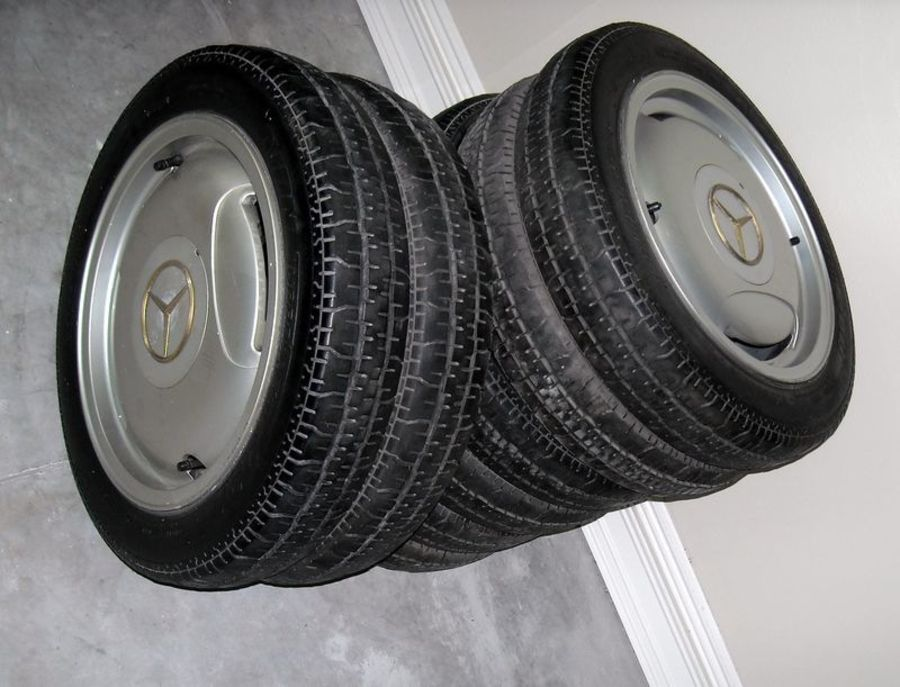
At the same time, the disadvantages of the scheme itself became obvious. Additional wheels increased unsprung mass, which caused the suspension to wear out faster. The car also acquired other disadvantages:
- the complexity of control in high-speed turns increased;
- cabin noise and fuel consumption increased;
- additional mass became a constant load on the structure.
When wider and stronger tires solved the original problem, the need for dual wheels practically disappeared. They began to be perceived more as extra weight than as a way to gain real advantages.
An unusual experiment of the 1980s
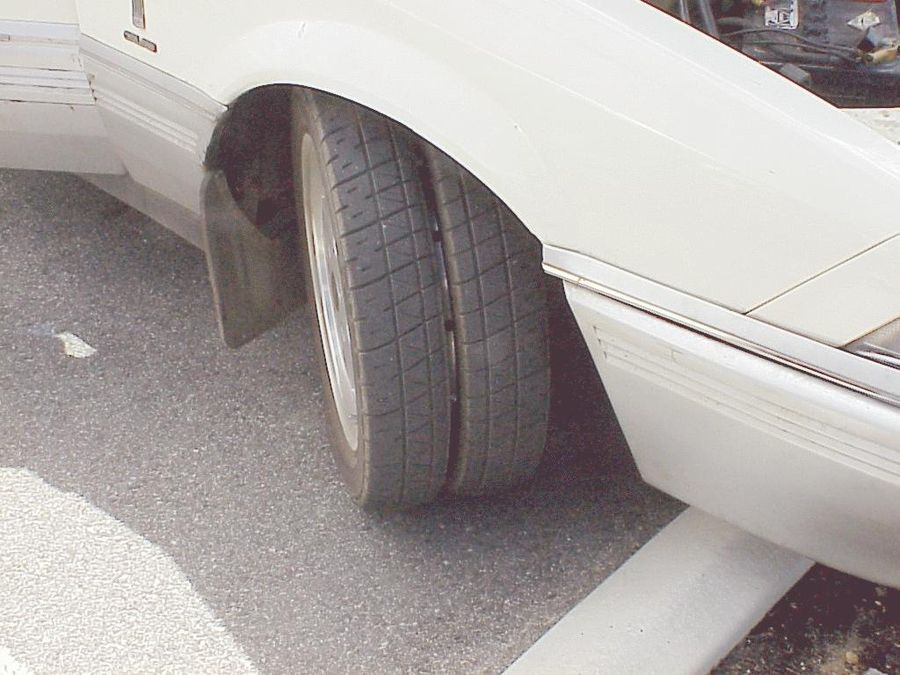
However, the story received another unexpected episode. In the 1980s, an inventor named Jerry tried to bring back the idea of dual tires, but used it on the front axle. And this time the goal was not carrying capacity.
The idea came after a race in pouring rain. A small French car, known by the nickname "Deux Chevaux" and equipped with narrow tires, unexpectedly proved more confident than its rivals on the wet track. The inventor suggested that two narrow tires mounted on one rim could provide better grip on wet roads than one wide tire.
The development was patented in 40 countries at once. Moreover, a small batch of such wheels actually reached production. In normal dry conditions, their difference from standard tires was almost imperceptible, but in heavy rain, the design significantly reduced the risk of aquaplaning.
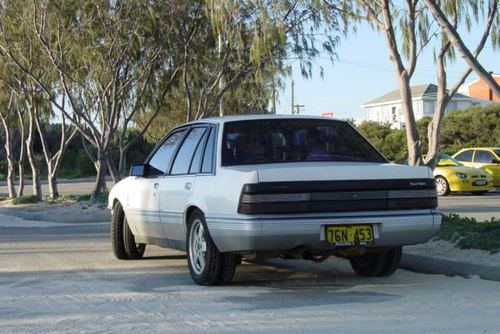
However, it was not possible to completely get rid of the old problems. The dual design still increased unsprung mass, and its production was expensive. Therefore, the technology never reached mass distribution.
Where dual wheels are used today
This scheme could not completely disappear after all. Today, dual rear wheels can be found primarily on heavy-duty pickups, such as the Ford F-350 and Ram 3500. They are used for towing trailers weighing up to 15 tons.
Formally, such vehicles are still classified as passenger cars. However, in terms of size and purpose, they are much closer to light trucks than to ordinary family sedans.
It turns out that dual wheels have not become a useless relic of the past. The technology has been preserved where its capabilities are truly in demand, but it has ceased to be a universal way to solve the problem of tire load. The development of rubber simply made it possible to do without it in most cars.
Read more materials:
- Solid axle or independent suspension: why off-road vehicles still choose the former
- Why an automatic car moves on its own when you release the brake
- Why the timing belt in oil turned out to be a failure