“Miami Vice” had such a recognizable visual style that it's easy to imagine it even without footage from the series itself. Pastel suits, neon signs, palm trees, music, wet asphalt of night streets — and, of course, cars that looked like a natural part of this world.
One of the main automotive attributes of the show was Sonny Crockett's car. Initially, the detective drove a black car that depicted a Ferrari Daytona Spyder. But this car was not a real Ferrari: replicas built on the basis of a Chevrolet Corvette were used for filming.
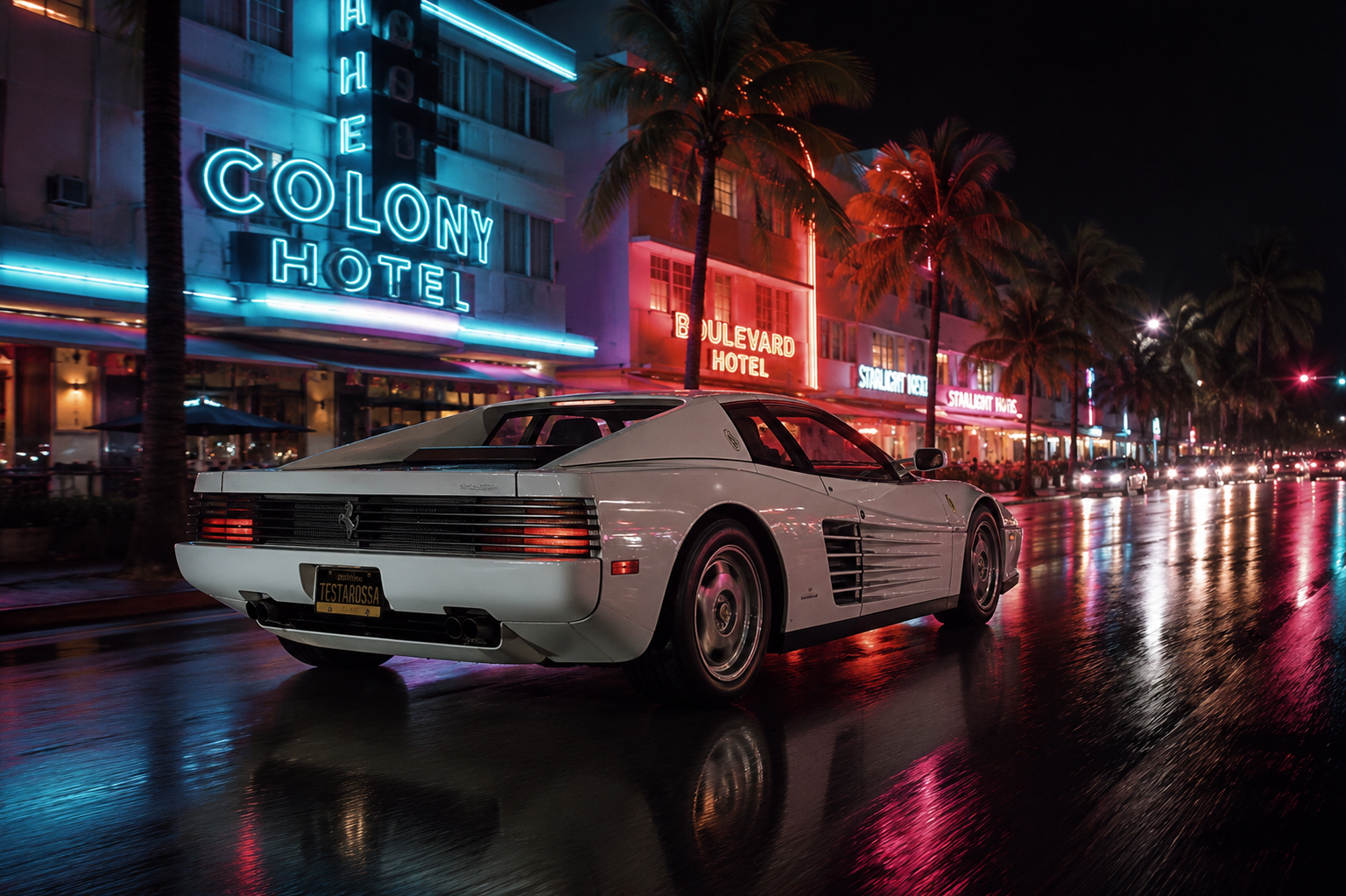
Later, the car was replaced with a real Ferrari Testarossa. The white, wide, and at that time almost futuristic supercar was so organically integrated into the aesthetics of the series that decades later, it's enough to see it under the light of night lamps to remember “Miami Vice”.
Crockett didn't drive a Ferrari at first
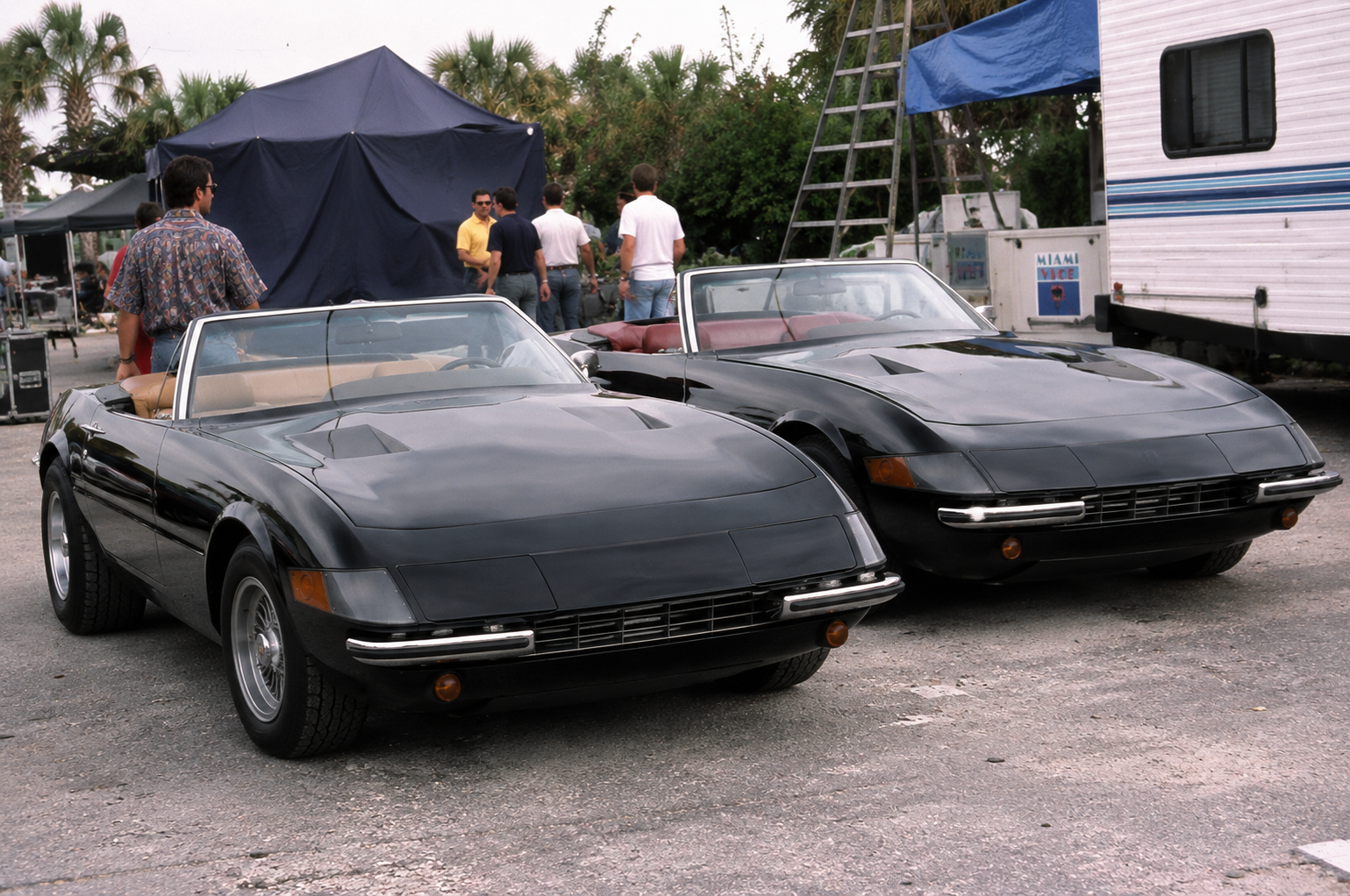
In the first seasons, Sonny Crockett's car externally copied the Ferrari 365 GTS/4 Daytona Spyder. On screen, the replica looked convincing, but its technical basis was a Chevrolet Corvette C3.
Two such cars were prepared for production. One was mainly used for spectacular scenes and beautiful shots, while the second was intended for heavier work directly on the set.
However, the story with the replica unexpectedly found an opponent — Ferrari itself. The Italian manufacturer did not like that the extremely popular series actually showed a car with Ferrari emblems, although under the body there was Chevrolet technology.
As a result, it was decided to find a replacement for the black “Daytona”. The farewell turned out to be quite in the spirit of the series.
At the beginning of the third season, Crockett's car was destroyed by a shot from a portable missile system. Within the plot, this was another dangerous episode from the life of an undercover police officer. For the creators of the series, the scene simultaneously became a convenient way to get rid of the old car and prepare for the appearance of a new one.
A real Ferrari appeared on screen
This time, there was no need to substitute a Ferrari. The company provided the film crew with two real 1986 Testarossas.
Initially, both cars were black, but specifically for the series, they were repainted white. The reason turned out to be extremely practical: with numerous night shoots, a light body stood out much better in the frame.
This decision turned out to be more important than it might seem at first glance. The white paint not only improved the car's visibility. It became part of an image that later became inextricably linked with the series.
Why the Testarossa looked so good on screen
Even without television, the Testarossa was a car that was hard to miss. Its low wedge-shaped silhouette, unusually wide rear, and famous side air intakes with horizontal slats made it almost unlike ordinary cars of the mid-1980s.
Behind the driver was a 4.9-liter 12-cylinder flat engine. In the American specification of the mid-1980s, it developed about 390 hp and was paired with a five-speed manual transmission.
For its time, the characteristics were appropriate for a real supercar capable of competing for public attention with the Lamborghini Countach. But in “Miami Vice”, technical indicators were far from the main advantage of the Testarossa.
Its appearance had a much stronger impact on the viewer.
The white body perfectly reflected the neon lighting, the black side air intakes created an expressive contrast, and the huge rear of the car literally filled the frame as it drove past the camera. The low silhouette instantly distinguished the Ferrari from ordinary cars on the streets.
Especially interesting is how the color specifically influenced the perception of the car. A red Testarossa would have looked like a classic Ferrari. A white one turned into a completely different image — Sonny Crockett's car.
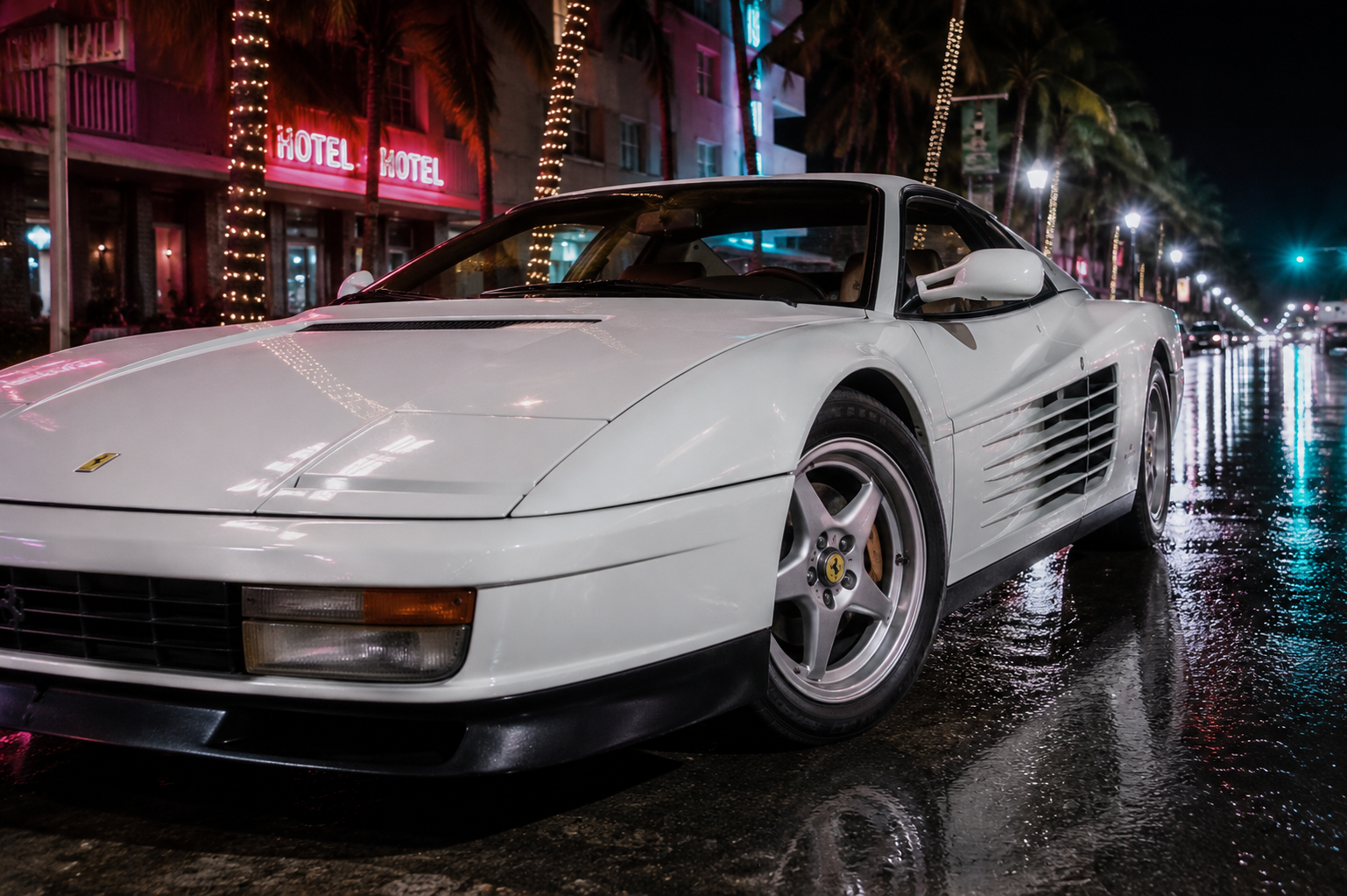
That is why in the series the supercar constantly found itself among night lights, palm trees, hotels, and brightly lit streets. In this environment, the Ferrari ceased to be perceived simply as an expensive car. It became part of the television version of Miami — a city where even police work took place against the backdrop of yachts, clubs, and luxury cars.
The car became part of Crockett's image
The Testarossa in the series also had a perfectly logical plot purpose. Crockett worked undercover, so he needed to look like a person belonging to a completely different social circle.
An expensive car solved this problem even before the hero had a chance to speak. In this sense, the Ferrari performed roughly the same function as his clothes: it told the viewer about the character through his external image.
The appearance of the Testarossa was especially successful from the point of view of the era. In the 1980s, the supercar gradually transformed from just an expensive car into a full-fledged object of mass culture.
Ferrari Testarossa and Lamborghini Countach appeared on posters and magazine covers, became decorations for teenage rooms, and turned into a symbol of success that remained unattainable for most people.
“Miami Vice” offered the viewer a completely different way to see this world. The Testarossa didn't just stand in a photograph. It started up, sped through the night streets, stopped near expensive establishments, and participated in the adventures of the main characters.
As a result, the car received what an ordinary advertising photograph could not give — its own story.
Why the image turned out to be so durable
The most interesting thing is that the series did not just use a popular supercar. It placed it in an environment that perfectly matched the car's appearance.
Several elements coincided here at once:
- white Testarossa;
- Miami night streets;
- neon lighting;
- Sonny Crockett behind the wheel;
- music and the overall aesthetics of the series.
Each of these components worked separately, but together they created a single visual image.
That is why the connection between the Ferrari Testarossa and “Miami Vice” has been preserved even decades later. The white supercar became not just a prop, but part of the television representation of 1980s luxury.
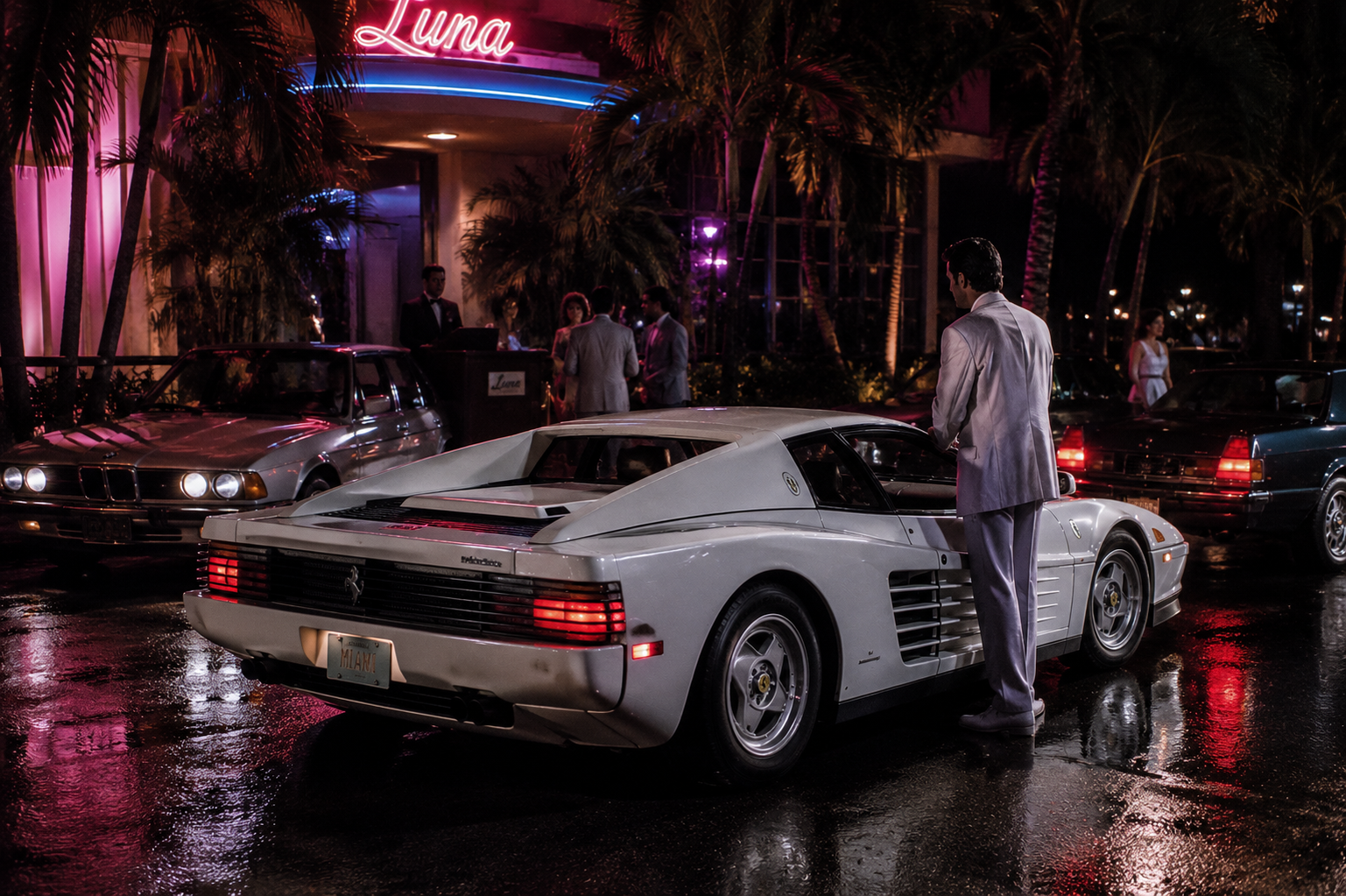
This is the paradox of the story. The Testarossa existed in the real world as an expensive and extremely fast supercar, but “Miami Vice” gave it an additional image — the car became a symbol of a specific city, era, and character.
Remove the Testarossa from this picture, and the Miami of the series will immediately lose some of its luxury. Leave it — and even decades later, a few familiar silhouettes and neon reflections can instantly bring back the atmosphere of the 1980s.
Read more articles:
- Not just power: what really pleases a driver
- From 1499 to 150 hp: how boundaries dictate engine building
- Rinspeed Presto: the car that could shorten itself