Translated with AI from the Russian original.
The small button with a car icon and a circular arrow is present in almost every car, but not all drivers use it. Meanwhile, recirculation can be a very useful function — especially in traffic jams, tunnels, on dusty roads, or when you need to quickly heat or cool the cabin.
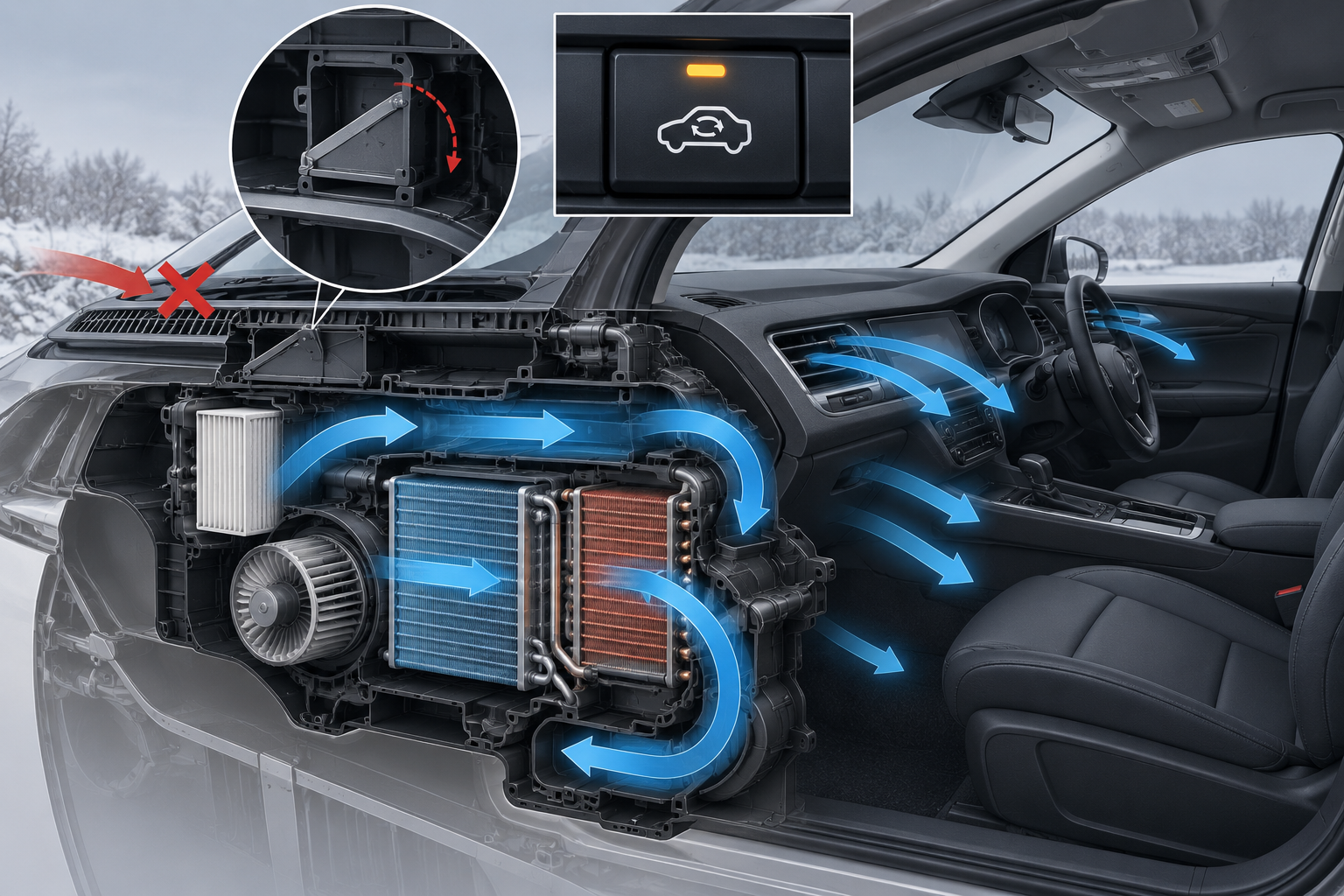
Its operating principle is quite simple. In normal mode, the climate control system draws air from outside through the air intake, passes it through the cabin filter, then heats or cools it, and supplies it into the car.
When recirculation is activated, the external channel is blocked by a flap. The fan starts drawing air directly from the cabin, passes it through the air conditioner evaporator or heater core, and returns it to the passengers.
In modern cars, the flap is usually controlled by an electric actuator. In older designs, a cable or vacuum actuator was used for this purpose.
Some cars can activate recirculation automatically. For example, this may happen when reverse gear or the washer fluid is engaged — to prevent exhaust gases and fluid vapors from entering the cabin.
How to tell if recirculation is on
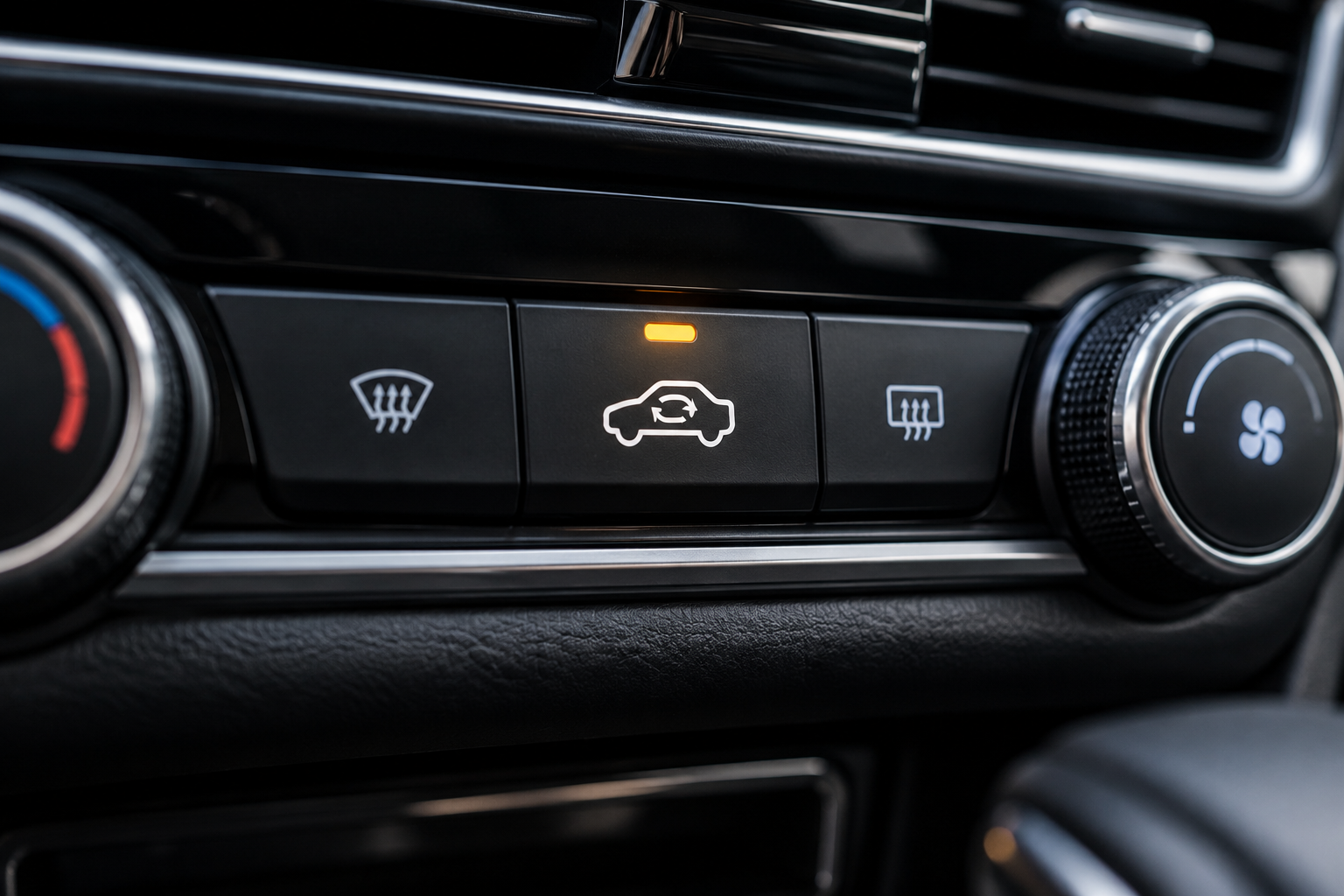
The pictogram for the mode usually depicts a car silhouette with an arrow forming a circle inside the cabin. When activated, a corresponding indicator lights up — most often yellow or orange.
Recirculation can be turned off by pressing the button again or by selecting the external air intake mode.
In cars with full climate control, the driver doesn't always have to manage this function manually. In automatic mode, the system can independently decide when to block the external flow and when to add fresh air.
It's important to understand that even with recirculation on, the cabin doesn't become an absolutely sealed capsule. Air still gradually penetrates through various gaps and seals. But the main influx from outside does indeed stop.
The cabin filter continues to do its job, trapping dust and some airborne particles. However, it does not remove carbon dioxide, which passengers constantly exhale.
That's why recirculation is primarily intended for temporary use.
Why the cabin heats and cools faster
From a physics perspective, this mode has a clear advantage. It's easier for the climate system to work with air that has already approached the desired temperature than to constantly process a new flow from outside.
In summer, outside air can be very hot, and in winter, conversely, almost icy. If the air conditioner or heater receives air from an already partially cooled or heated cabin, it requires less energy to further adjust the temperature.
As a result, a comfortable microclimate is achieved faster, and the load on the air conditioner compressor and fan is reduced. In some conditions, this also affects fuel consumption.
The effect is especially noticeable in traffic jams and when driving on the highway.
But there's an important limitation here: even if the air constantly circulates inside the cabin, it gradually becomes saturated with carbon dioxide and moisture. The more people in the car, the faster this happens.
When recirculation is truly useful
Exhaust gases, dust, and unpleasant odors
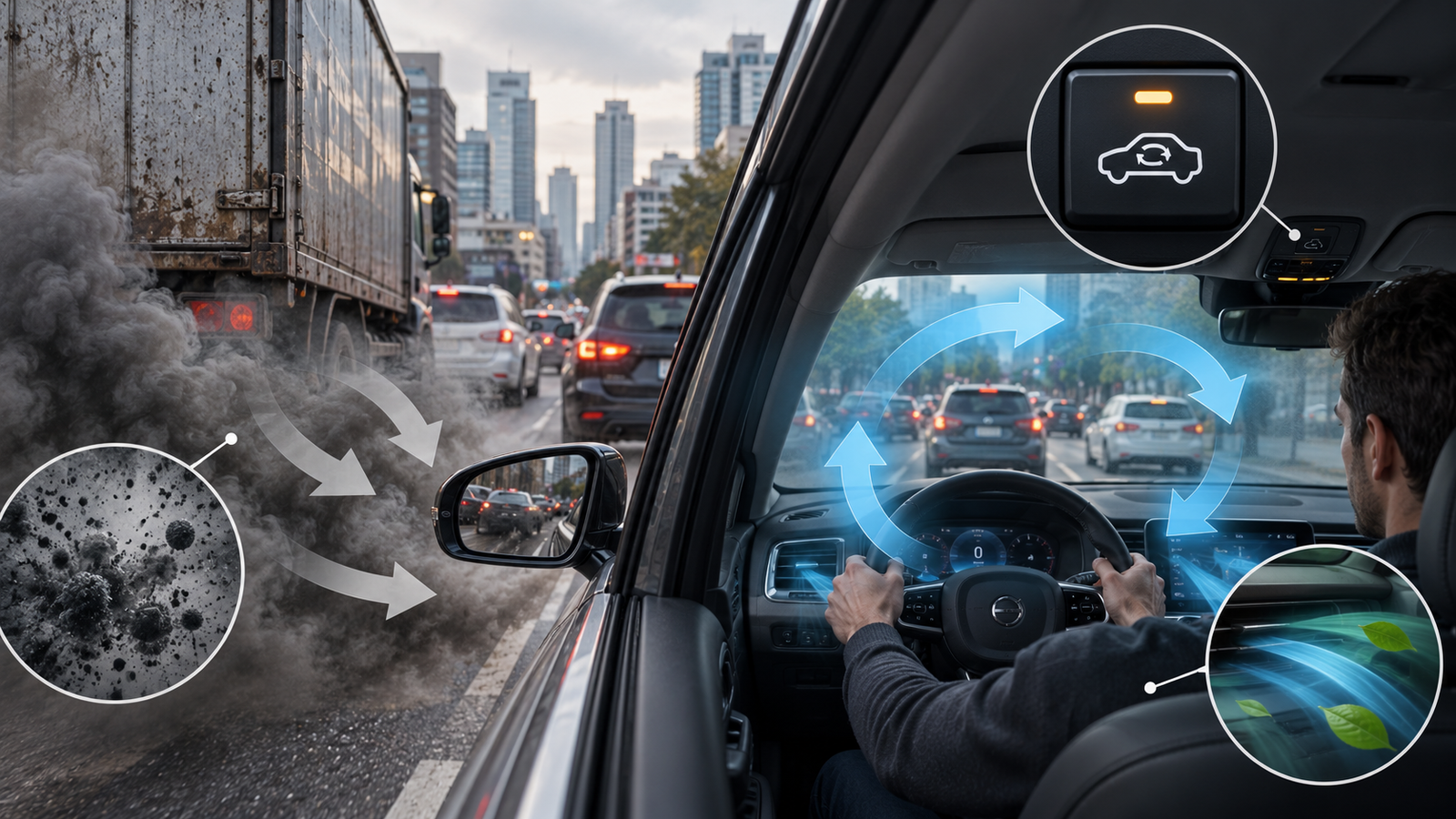
The most obvious use of the mode is protection from polluted outside air.
In city traffic, many engines can be running near the car. A similar situation arises in tunnels, underground parking lots, or when driving behind a truck with noticeable exhaust.
Switching to internal circulation significantly reduces the intake of external pollutants. According to automotive publications, with proper use of the mode, the impact of harmful substances from exhaust gases is reduced by approximately 20%.
This capability is especially relevant for allergy sufferers, people with breathing problems, and families transporting children.
Recirculation is also useful outside the city. On a dirt road, it helps prevent dust from entering, and near industrial facilities, it allows the cabin to be temporarily isolated from unpleasant odors.
After activating the mode, the difference can be felt in about half a minute.
Fast cooling in summer
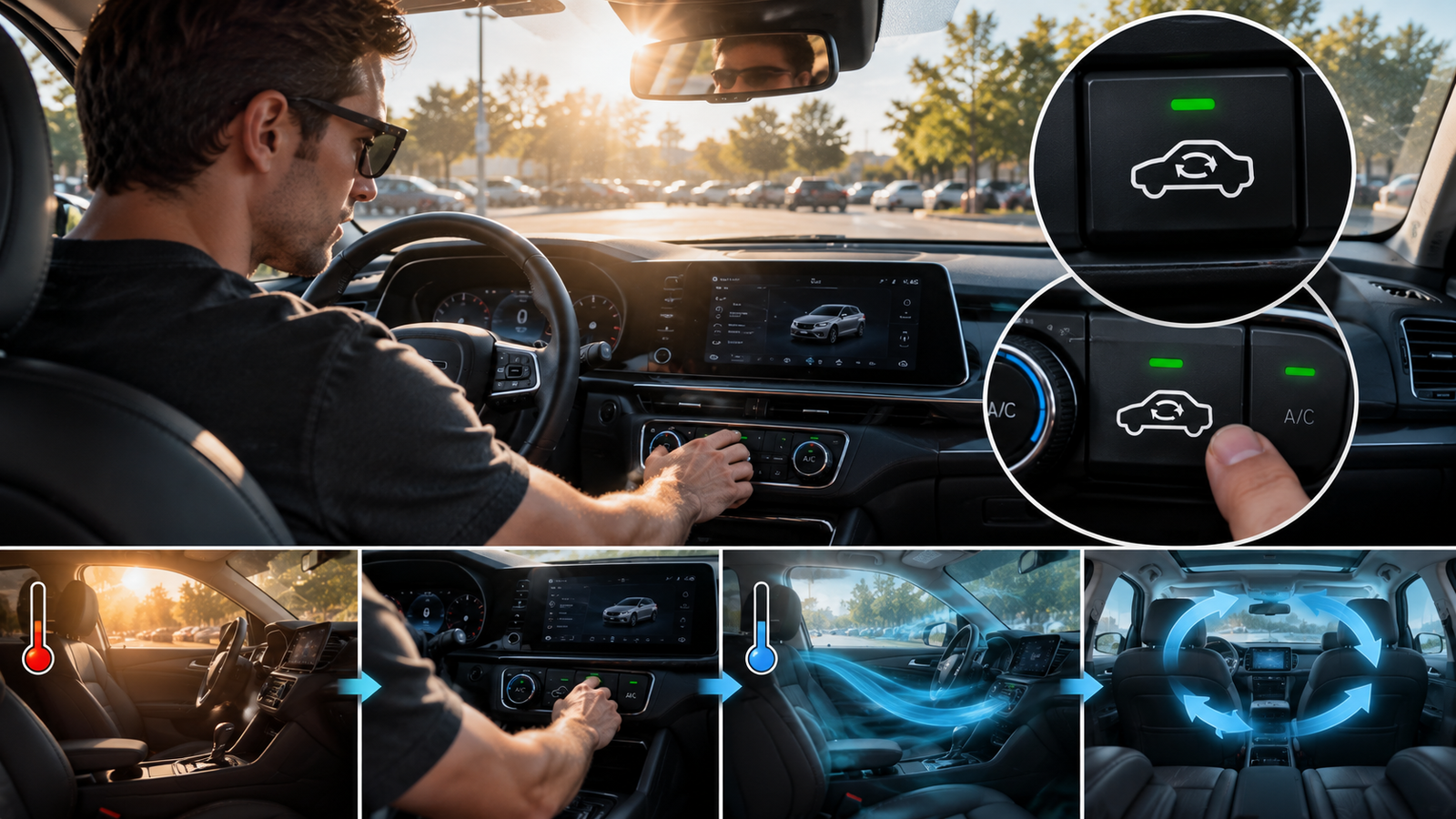
There's another common situation. The car has been parked in the sun for several hours, and it's become extremely hot inside.
In such a case, it's advisable to first release the accumulated hot air, for example, by opening the doors. After that, you can turn on the air conditioner and recirculation.
Ford Australia engineer Ethan Ng explains the principle as follows: "On a hot day, if you close the door, warm air from outside will stop entering the car. In recirculation mode, cooler air from the cabin will enter the system. This will allow the air conditioner to cool the cabin completely faster."
It creates a closed loop: the air conditioner gradually cools the air already inside, instead of constantly cooling a new hot flow from outside.
This reduces the load on the compressor, and potentially decreases fuel consumption.
Fast heating in winter
In winter, the same principle applies, but in reverse.
Even after an overnight stop, the air inside the car is usually slightly warmer than outside. Therefore, it's easier for the heater to repeatedly warm the air already in the cabin than to constantly receive icy air from outside.
This effect is especially noticeable in the first minutes after starting the engine.
Recirculation can also be useful when idling with the engine running in severe frost, when it's necessary to quickly warm up the cabin without letting cold air in.
However, in such situations, the mode should not be used indefinitely. It's usually for a short period — about 10–15 minutes, after which it's advisable to restore external air intake.
Is there any benefit for thermostat problems?
Recirculation can also be useful in a specific situation when the thermostat is stuck open.
In such a case, the coolant constantly circulates in a large loop. When driving at high speed in cold weather, the engine can overcool, and the heater's efficiency decreases.
Temporarily engaging recirculation reduces the amount of heat dissipated through the heater core and helps retain more heat inside the car.
But this is a temporary measure. After solving the specific problem, fresh air intake must be restored.
What are the dangers of prolonged recirculation?
Constant internal circulation has a downside. The main problem is the gradual increase in carbon dioxide concentration.
Passengers continuously exhale CO₂, and with the external flow blocked, its concentration in the cabin increases significantly faster. Studies show that within 5–15 minutes with two or three passengers, the concentration can exceed comfortable levels.
This can cause:
- drowsiness;
- reduced concentration;
- headache;
- in extreme cases — dizziness.
Ethan Ng points out another feature of modern cars: "Especially in modern cars, we have good door and window sealing for quietness and comfort, but at the same time, because of this, carbon dioxide can increase in a closed space when using recirculation mode."
Therefore, during long trips, it is necessary to periodically switch to external air.
Cars with automatic climate control can automatically mix in fresh air, reducing the likelihood of excessive CO₂ accumulation. In simpler cars, the driver must monitor this themselves.
The second problem is moisture on the windows
There's another unpleasant effect. Humidity gradually increases in a closed cabin.
There are enough sources: passengers' breathing, wet clothes, water and snow on the floor mats. If outside air is not entering, excess moisture begins to condense on the windows.
As a result, they fog up, impairing visibility. This becomes especially dangerous at night or during rain.
In wet weather, it's better to use the air conditioner along with external air intake. The air conditioner dehumidifies the incoming air, keeping the windows clearer.
If there's no air conditioner, warm air can be directed to the windshield and side windows. This helps equalize their temperature and reduce the likelihood of condensation.
Experts recommend not keeping recirculation on continuously for longer than 15 minutes.
Humidity also affects the cabin's condition
Constant use of internal circulation can create problems not only during a specific trip.
Increased humidity promotes the growth of mold and unpleasant odors in upholstery and floor mats. This is especially undesirable for people prone to allergies.
In addition, regular moisture accumulation can accelerate corrosion processes, especially if water or snow constantly enters the cabin.
Therefore, the cabin must be periodically thoroughly ventilated. Even if the outside air is far from ideal, the car occasionally needs a normal influx from outside.
How to use recirculation without problems
This mode is not meant to operate constantly. Its purpose is to temporarily solve a specific problem: protect the cabin from polluted air, cool the car faster in summer, or heat it in winter.
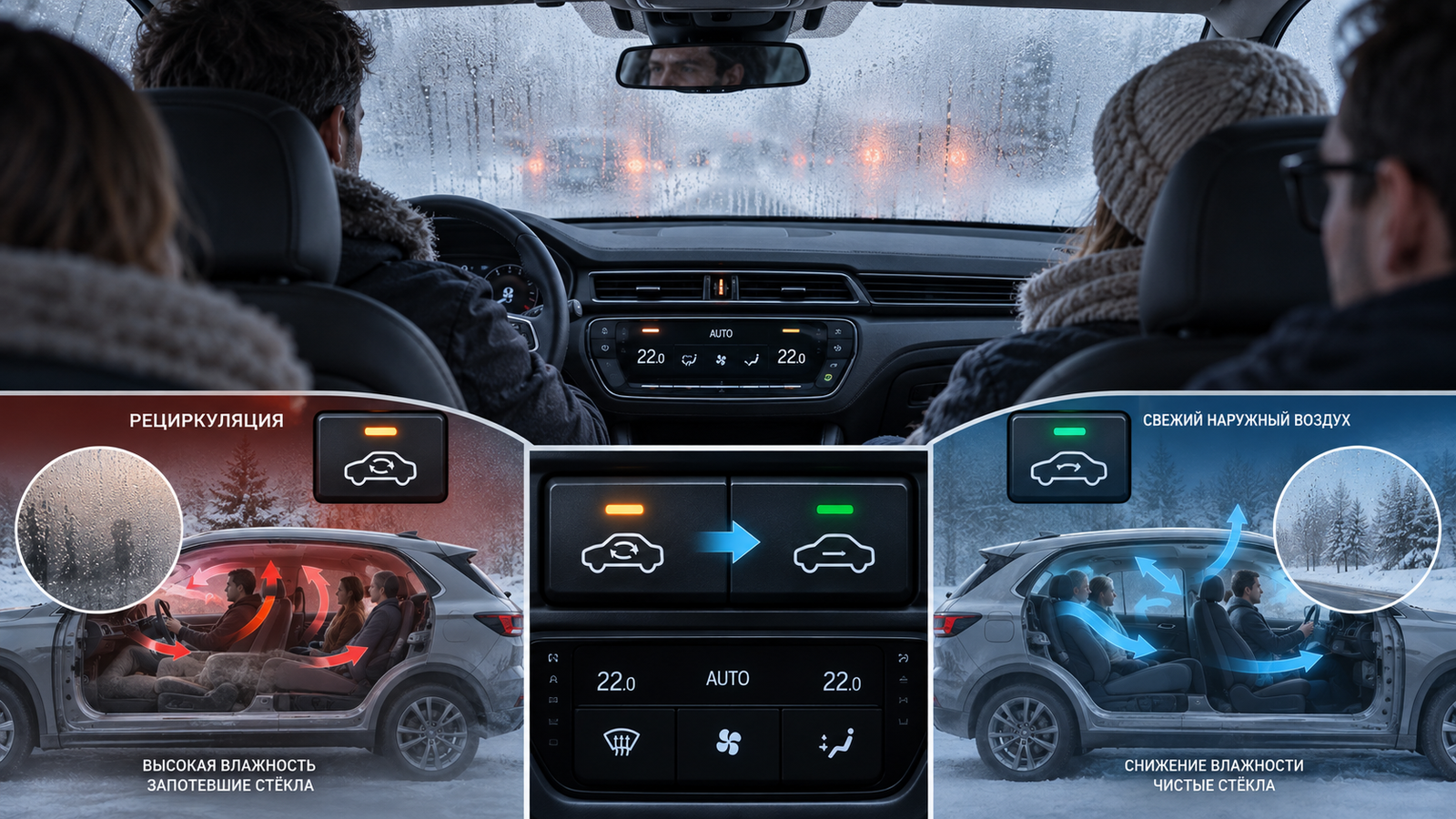
The optimal scheme is quite simple:
- turn on recirculation when entering a traffic jam, tunnel, or dusty area;
- use it to speed up heating or cooling;
- during a long trip, periodically return to external air;
- in wet weather, use the air conditioner to dehumidify the cabin;
- monitor the condition of the cabin filter;
- pay attention to your own well-being and avoid stuffiness.
The recirculation button is not a useless detail on the dashboard. It genuinely helps make the trip more comfortable and, under certain conditions, reduces the intake of pollutants.
But turning the car into a completely closed space for the entire trip is not advisable. Short-term recirculation is beneficial, while constant recirculation gradually creates problems with carbon dioxide and humidity. The main thing is to return fresh air to the cabin in time.
Read more materials:
- Why you shouldn't "pump" the brakes on a car with ABS
- Car discount, tax, and OSAGO: who is eligible for benefits
- Kerosene was once burned as waste. Why kerosene never became automotive fuel