Translated with AI from the Russian original.
Drivers with extensive experience, especially those who learned in Soviet driving schools, probably remember the old rule for emergency braking on a slippery road. The pedal couldn't just be pressed sharply and held. It had to be pressed in short pulses: press, release, press again.
This technique was called pulse braking or "pumping the pedal." In cars without an anti-lock braking system, it really helped maintain wheel rotation and at least partially keep the car under control.
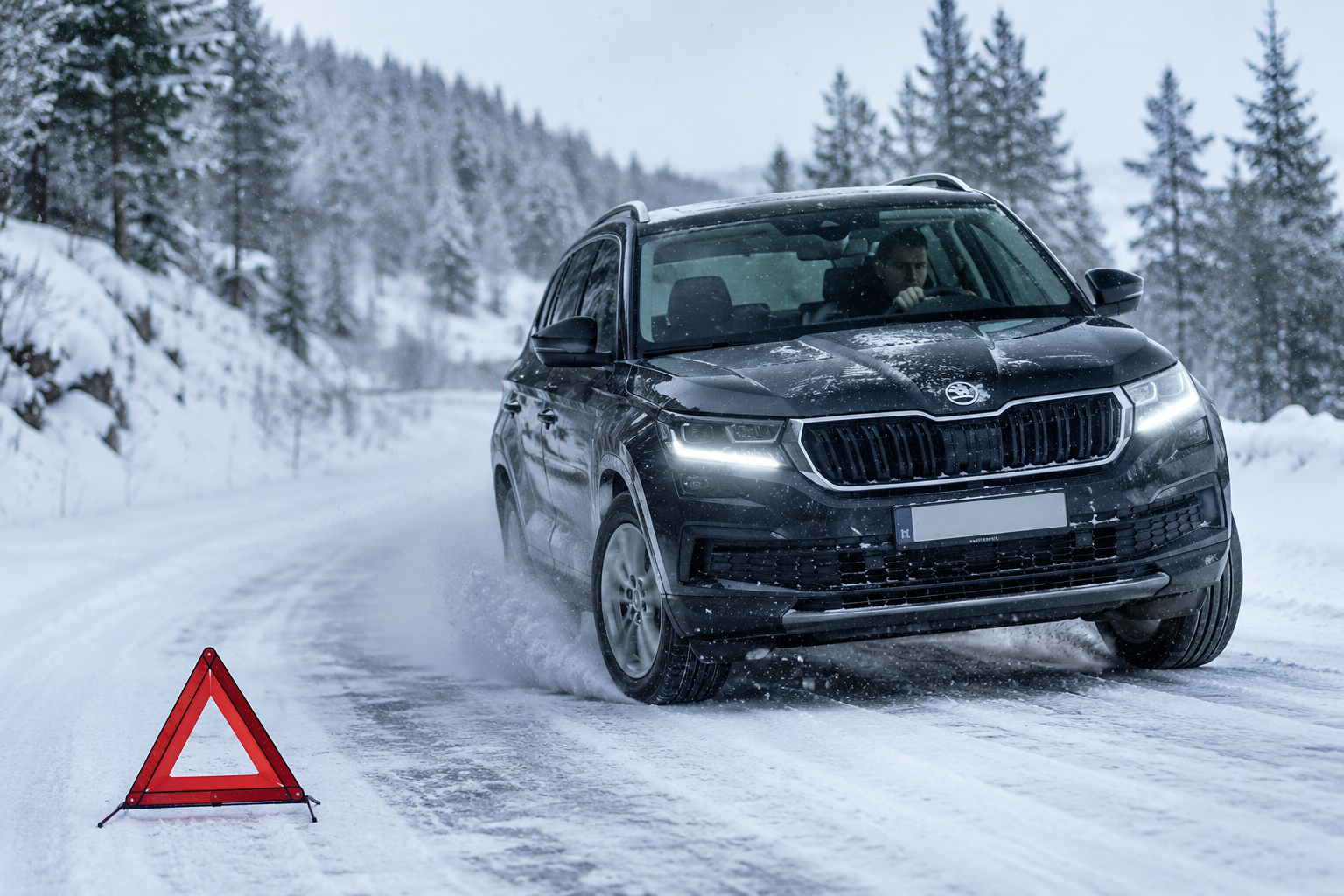
But then car designs changed. In modern cars, ABS is responsible for preventing locking, but people often continue to act out of old habit.
In winter, the situation might look like this: the driver presses the brake, the pedal starts to vibrate, a characteristic crackling sound is heard, after which the frightened motorist releases the pedal. Then he presses it again, ABS starts working again, the pedal pulsates again — and everything repeats.
As a result, the car continues to roll, braking is constantly interrupted, and stopping before an obstacle becomes significantly more difficult.
Why drivers used to release the brake
In a car without ABS, sudden braking on a slippery surface could almost inevitably lead to wheel lock-up.
When a wheel stopped rotating and started sliding on the road, the car lost a significant part of its steerability. Turning the steering wheel no longer yielded the expected result: a locked wheel could not properly change direction, and the car continued to slide forward.
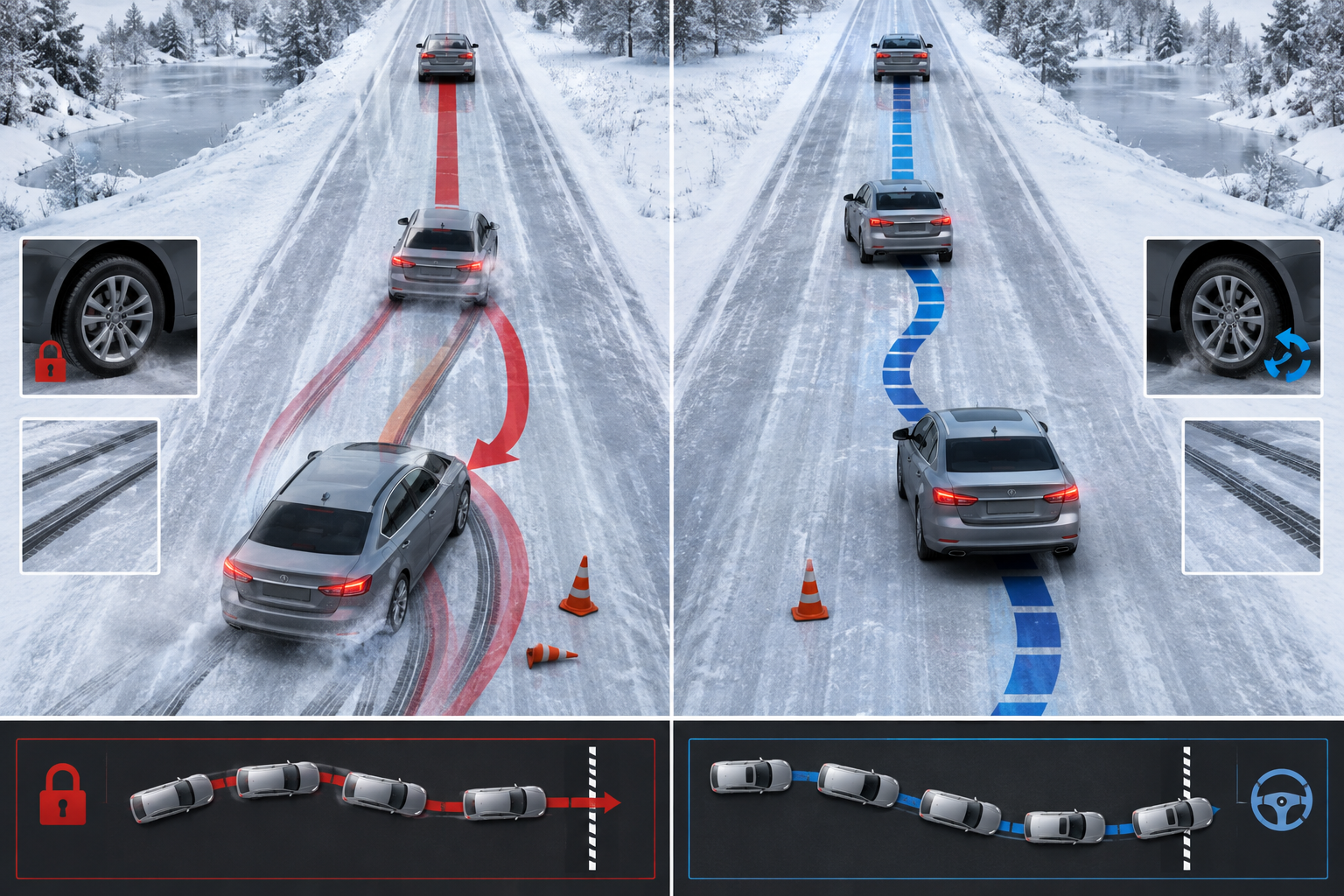
Therefore, drivers were taught to manually simulate the operation of future ABS. The pedal was quickly pressed, then released, allowing the wheels to spin again, after which braking was repeated.
The sequence was:
- press the brake;
- feel the approach of locking;
- release the pedal;
- allow the wheels to start rotating again;
- repeat braking.
A well-trained driver could perform several such cycles in a couple of seconds. Experienced motorists "pumped" the pedal about 2-4 times during this period, guided by the feel of the car and the road surface.
The method required good coordination, reaction, and practice. But in a car without electronic systems, it really allowed for some steerability to be maintained instead of complete sliding of locked wheels.
With the advent of ABS, the need for manual repetition of this process disappeared. Electronics began to perform the same task automatically, and significantly faster than a human.
What ABS does during emergency braking
The anti-lock braking system is a complex of sensors and actuators. It includes wheel speed sensors, an electronic control unit, and a hydraulic modulator that regulates brake fluid pressure.
After the pedal is pressed, the system constantly monitors the rotational speed of each wheel. If one of them starts to slow down too quickly relative to the others, the control unit recognizes the risk of locking.
Then the hydraulic modulator reduces pressure in the corresponding brake circuit, allowing the wheel to rotate again. After that, the pressure increases again. This sequence is repeated over and over.
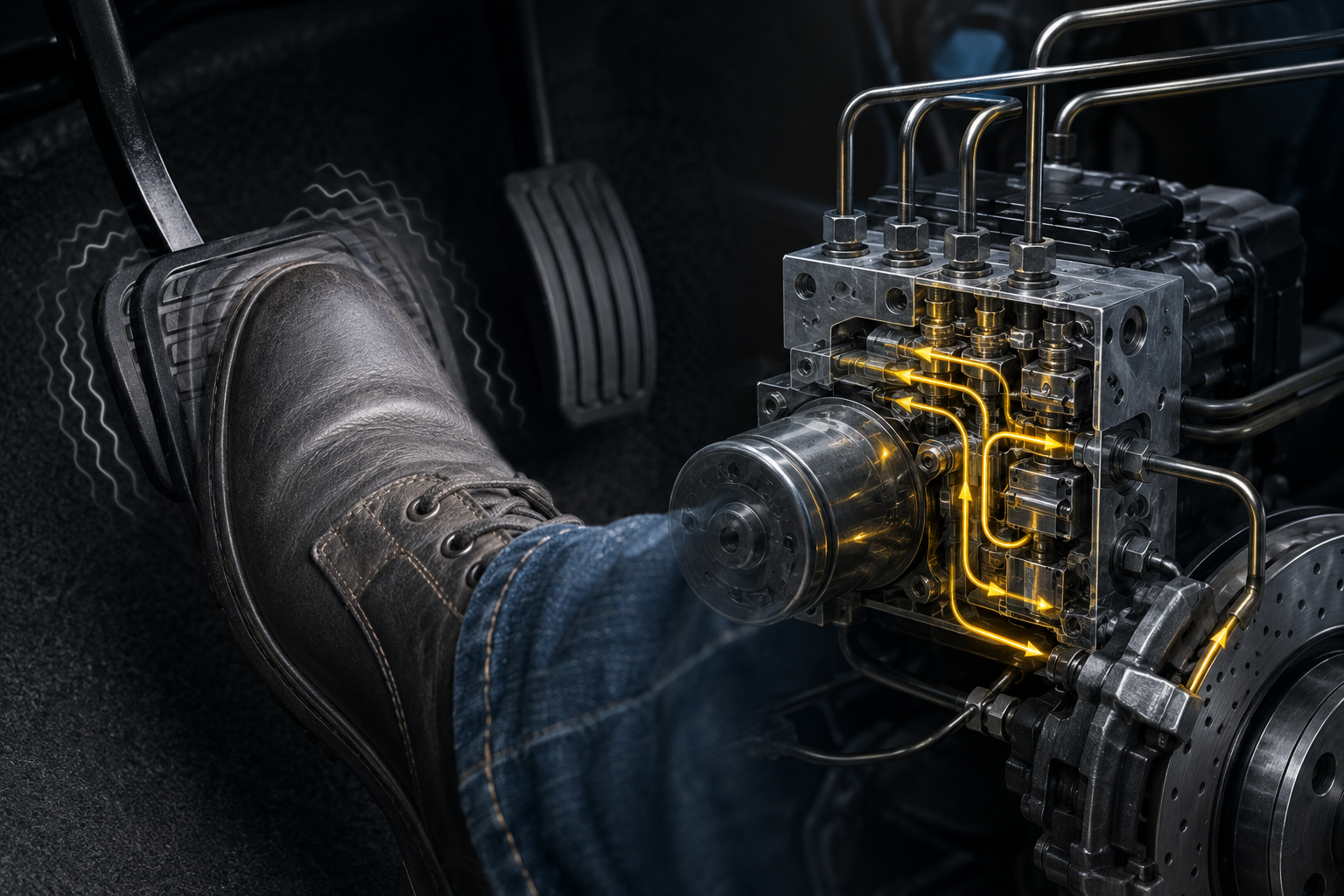
The cycle occurs up to 15-20 times per second – such a reaction speed is unattainable for a human. This is why the driver feels the characteristic pulsation of the pedal, and a crackling or knocking sound may come from the brake mechanisms. This does not mean that the braking system is broken. On the contrary, at this moment ABS is doing its job.
For normal operation, the system requires one fundamentally important action from the driver – constant and strong pressure on the brake pedal. The electronics independently analyze the deceleration of the wheels, compare their speed, and assess the situation with tire grip on the road. After that, the modulator regulates the pressure where necessary.
Why "pumping" interferes with ABS
The main mistake of the driver is that he perceives the pedal vibration as a warning of locking and immediately takes his foot off the brake. After the first press, ABS begins to analyze what is happening and enters active pressure regulation mode. The driver feels the pulsation and releases the pedal.
At this moment, the pressure in the braking system sharply decreases. The sensors continue to work, but the driver has already limited the braking force himself. The car practically does not slow down for some time. Then the pedal is pressed again. ABS again begins to actively regulate braking, and the system needs to re-evaluate what is happening and enter an effective operating mode.
At first glance, we are talking about negligible time intervals. But at a speed of 60-90 km/h, even 0.3-0.5 seconds of movement without effective braking adds approximately 5-9 meters to the stopping distance.
Then the same thing happens: the driver feels the pulsation, releases the pedal, then presses it again. Each such break means a loss of precious meters. With constant "pumping," braking can be one and a half to two times longer than with proper emergency braking with the pedal held down.
If you press and release the brake too often, ABS may not even have time to work optimally. A paradoxical situation arises: the car is equipped with a system that can prevent locking faster than a human, but the driver himself constantly prevents it from performing this task.
How to brake with ABS
In a car equipped with ABS, the rule for emergency braking is extremely simple: the pedal must be pressed as hard as possible and held until a complete stop. Do not ease the pressure just because the pedal has started to vibrate or a characteristic sound has appeared from under the hood and wheels.
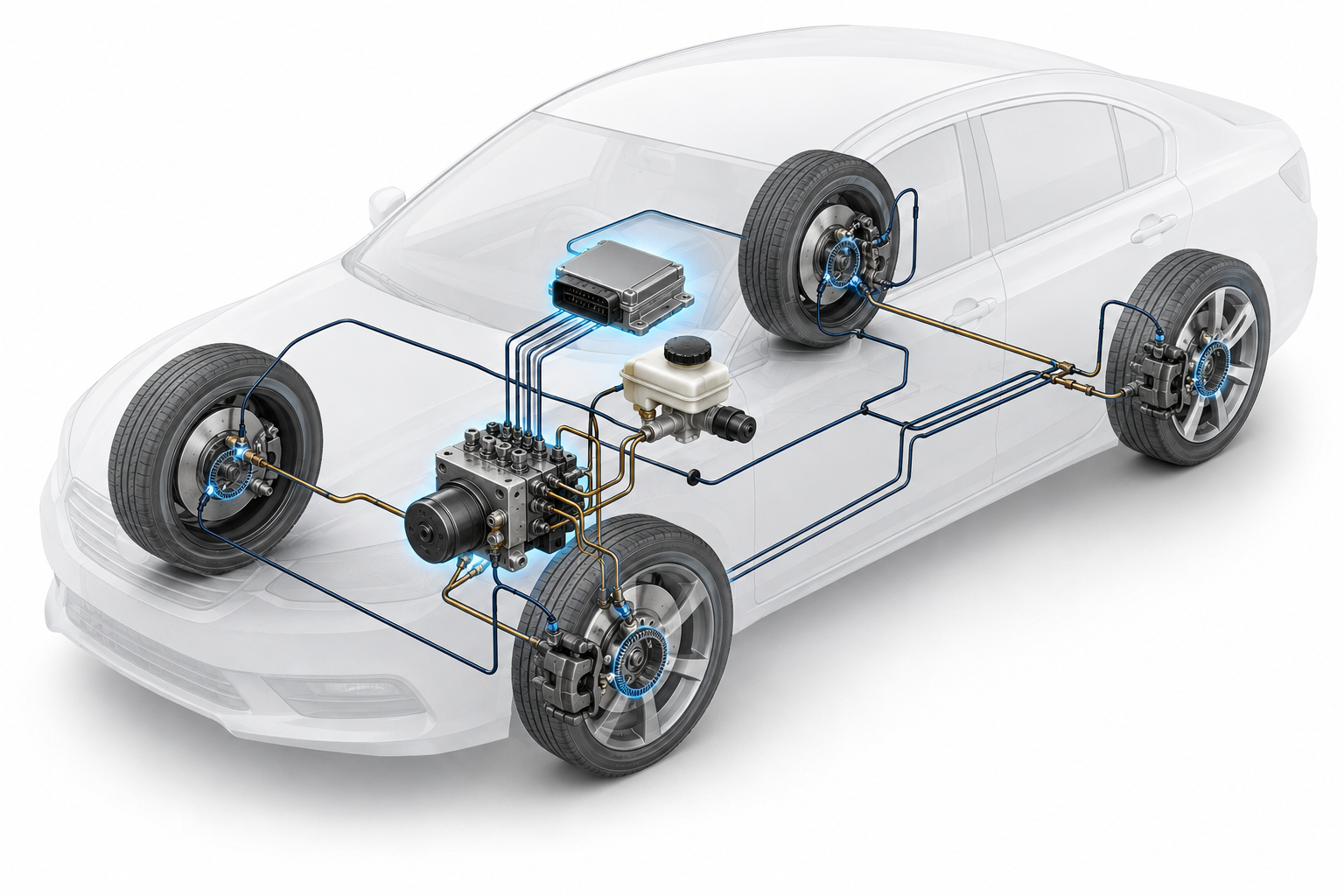
Pulsation is a normal feedback from the hydraulic modulator. The system quickly opens and closes valves, changing pressure in the brake circuits.
Therefore, when ABS is activated, the driver must:
- press the pedal sharply and firmly;
- continue to hold it down;
- do not react to vibration by releasing the brake;
- simultaneously adjust the steering wheel if necessary.
The last point is especially important. Unlike fully locked wheels, wheels continue to rotate when ABS is working and retain the ability to transmit steering force.
This is why the car remains steerable during emergency braking. If an obstacle appears ahead, the driver can brake and try to avoid it at the same time.
Why ABS is not always felt
During normal deceleration, the anti-lock braking system may not manifest itself at all. If the driver brakes smoothly enough and the wheels are not at risk of locking, there is simply no need to interfere with the brakes.
ABS is activated when the system detects a risk of wheel lock-up. Therefore, the absence of pedal vibration during normal braking does not mean that the system is faulty. It simply sees no need to intervene.
Dry asphalt, ice, and loose snow
On dry asphalt, ABS allows for the most effective use of available tire grip, without bringing the wheels to a complete lock. In modern cars, this allows the braking distance to approach the theoretical minimum – that which can be achieved when braking at the limit of locking.
On ice, snow, and wet asphalt, the importance of the system is even higher. With a low coefficient of adhesion, a wheel can lock even with relatively little pedal force. Without ABS, a car in such a situation quickly loses control.
With the anti-lock braking system working, the wheels continue to rotate, so the driver retains the ability to correct the trajectory.
However, loose snow, sand, and gravel have a peculiarity. If the wheels are completely locked, they begin to dig into the surface, creating additional resistance to movement. In some conditions, this can shorten the braking distance.
ABS, on the contrary, does not allow the wheels to completely go into a skid. Therefore, on a loose surface, the stopping distance with the system working may be slightly longer.
But here an important compromise appears: a slight increase in distance is compensated by maintaining steerability. The car continues to respond to the steering wheel, which means the driver gets the opportunity to avoid an obstacle.
Modern electronics can account for the road surface
Some modern cars use more complex electronic systems, including ESP with additional braking assistance functions.
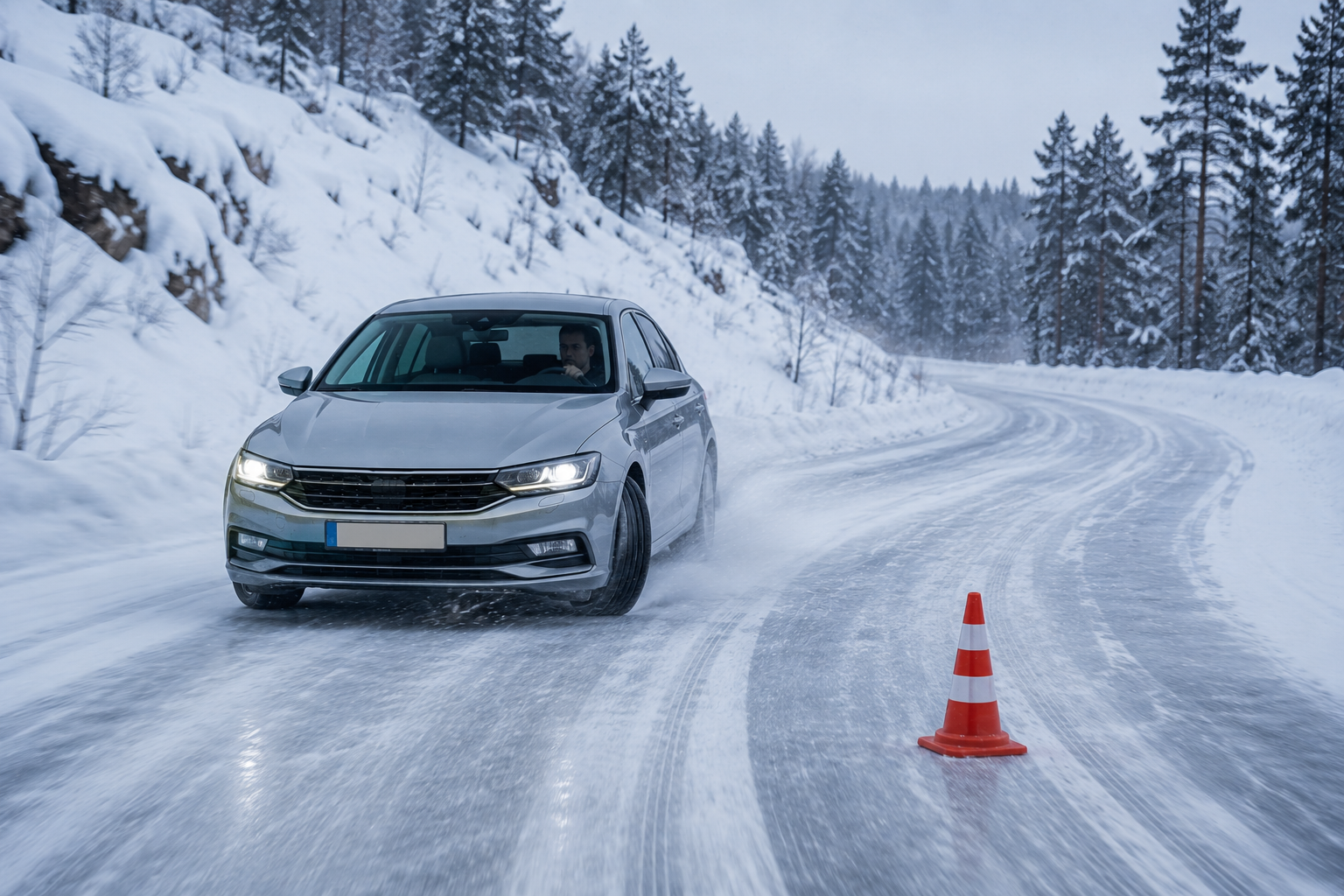
Such electronics can take into account the nature of the road surface and adjust the operation of the braking system. In certain conditions, the system can recognize a loose surface and allow partial wheel lock-up if it helps reduce the braking distance. But this does not change the main rule for the driver.
Even the most complex modern system does not require a person to imitate its work in the old way. There is no need to manually dose the brake with a series of short presses.
If the car has ABS, during an emergency stop, you need to press the pedal firmly and continue to hold it down. The system will do everything else itself – faster and more accurately than the driver, no matter how much experience he has.
Read more articles:
- Mercedes NAFA: The Smart that appeared 15 years earlier
- Why the white Testarossa became forever associated with Miami
- New rules for motorists from September 1