Why is the side turn signal repeater on some cars located on the front fender, while on others it is integrated directly into the housing of the exterior mirror? At first glance, it seems that the manufacturer simply chooses the most aesthetically pleasing solution for a particular model. In reality, the location of the turn signal is primarily related to its visibility.
The repeater's task is not just to indicate an activated turn signal, but to make the driver's intention visible to other road users as early as possible. This is especially important in heavy traffic, when a car is directly to the side or diagonally from another vehicle.

The history of the transition from fenders to mirrors is precisely linked to the search for a more advantageous location for the side signal.
Why turn signals used to be placed on fenders
For a long time, side repeaters were mainly located on the front fenders or in the bumpers. On classic "Zhiguli" cars like VAZ-2101 and VAZ-2106, small orange indicators were placed directly above the wheel arches. The VAZ-2107 used a similar solution.
Even today, it can be found on inexpensive cars. For example, the LADA Granta in the flatbed platform version has side repeaters in the front fenders, while the mirror housings do not have their own indicators.
For manufacturers, this scheme is attractive primarily due to its simplicity and low cost. However, it has an obvious drawback.
Imagine a dense traffic jam. Another car is next to yours, and its driver is looking at you from the side and slightly from behind. A low-mounted fender repeater in such a situation may be obscured by the car's body or another vehicle. This means the turn signal is formally working, but the person it is intended for may simply not see it.
How Mercedes moved the signal to the mirror
A significant step in the spread of mirror repeaters was the Mercedes-Benz S-Class W220 generation, introduced in 1998. Initially, such a solution was perceived more as a feature of an expensive car. But behind the spectacular detail lay a very specific engineering idea: to raise the side signal higher and move it out from behind the body plane.
After this, turn signals gradually began to move from fenders to mirrors.
Initially, the technology spread mainly among premium cars. Then it reached mid-range cars, and over time it became a common solution for mass-produced models as well.
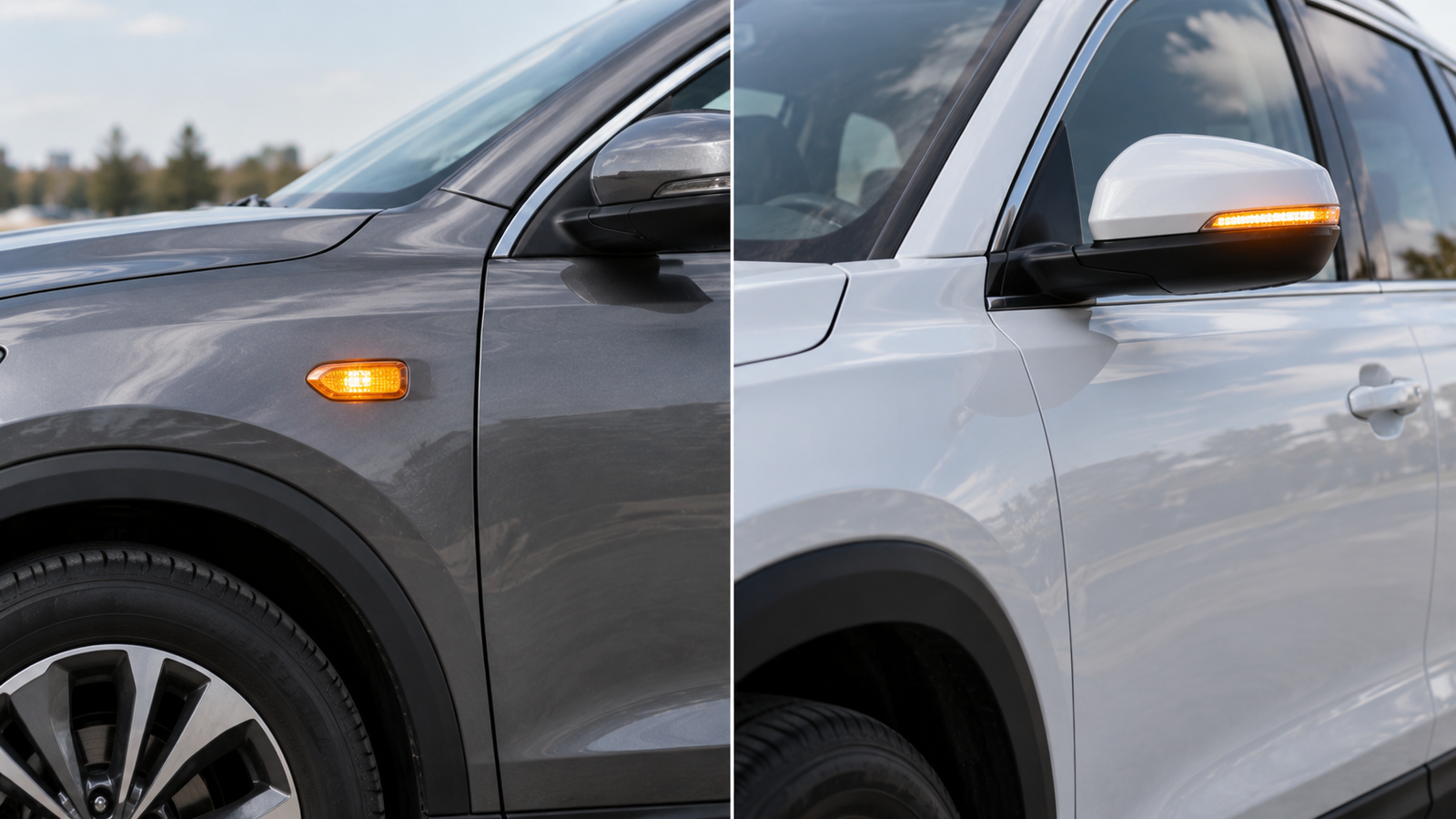
Today, such a design can be found even on budget cars. For example, the LADA Iskra has side repeaters integrated into the exterior mirrors even in the basic configuration.
This shows an interesting evolution: what initially seemed like an expensive design feature gradually became an almost standard technical solution.
What the research showed
The question of whether the location of the repeater on the mirror actually improves safety has been studied not only by car manufacturers.
In 2006, researchers from the University of Michigan analyzed accident statistics for 13 car models. The peculiarity of these cars was that within one model year, the location of the side repeaters changed: they moved from the fenders to the exterior mirrors.
The data obtained showed a tendency to reduce the number of accidents related to the use of turn signals in cars with mirror repeaters.
However, the researchers did not draw a final conclusion. The statistical significance of the result was insufficient, meaning there was not enough data to unequivocally prove a causal link. Nevertheless, the direction proved interesting.
Separate studies of geometric visibility also indicate the advantage of mirror placement: such a repeater is more visible to drivers in an adjacent lane, especially when changing lanes or merging traffic.
Why the mirror is a good location
The reason becomes clearer if you imagine the car from above. When a driver is about to change lanes, the front and rear turn signals may be partially hidden from a person moving directly to the side.
The mirror repeater is higher and at the same time extends further from the body. Therefore, it is in the field of view of precisely the driver who particularly needs to understand the intentions of the adjacent car. This is especially relevant in situations where cars are moving almost parallel.
This arrangement also has other potential advantages. An additional light signal may be more noticeable in conditions of limited visibility — for example, during snowfall or fog.

In addition, the car gets another source of visual signal. If one of the turn signals stops working, the duplicate element on the mirror is still able to inform others about the maneuver.
Of course, this does not turn a car with mirror repeaters into an absolutely safe vehicle. But the geometry of the placement itself can indeed improve signal visibility in certain situations.
What about turn signals on fenders?
The presence of a repeater on the fender itself does not mean that the car is unsafe. Such a design complies with established requirements, and the side indicator performs its function. It's just that in some road situations, its geometric visibility may be worse than that of a similar element located on the mirror.
Therefore, when choosing a used car, you should not automatically consider cars with fender repeaters a bad option. The difference lies rather in the degree of signal visibility in individual positions relative to other cars.
If you have to choose between two comparable designs purely from the point of view of visibility in heavy traffic, the mirror option looks preferable.
There's a downside too
Moving the turn signal to the mirror also has a very practical disadvantage, which is especially well understood after a minor accident. The exterior mirror itself is a rather vulnerable part. It can be easily damaged by contact with another car, in a parking lot, or during careless maneuvering.
If the repeater is integrated into the mirror housing, damage may require replacing not only the light element itself, but also part of the mirror structure.
As a result, a minor contact, which in the case of a conventional fender repeater could be limited to damaging an inexpensive part, can lead to more expensive repairs. Therefore, moving the turn signal to the mirror is not an unconditional improvement in all respects.
What to choose when buying a car
If you compare two cars solely by the location of the side repeaters, the mirror option has a clear advantage: its signal is more visible to drivers on the side, especially in heavy traffic and when changing lanes. It is for this reason that manufacturers gradually began to move the indicators from the fenders to the mirrors.
At the same time, a car with fender repeaters does not become dangerous. It still complies with requirements, and its indicators fulfill their purpose. Ultimately, the difference lies in how well others see the signal in a particular road situation.
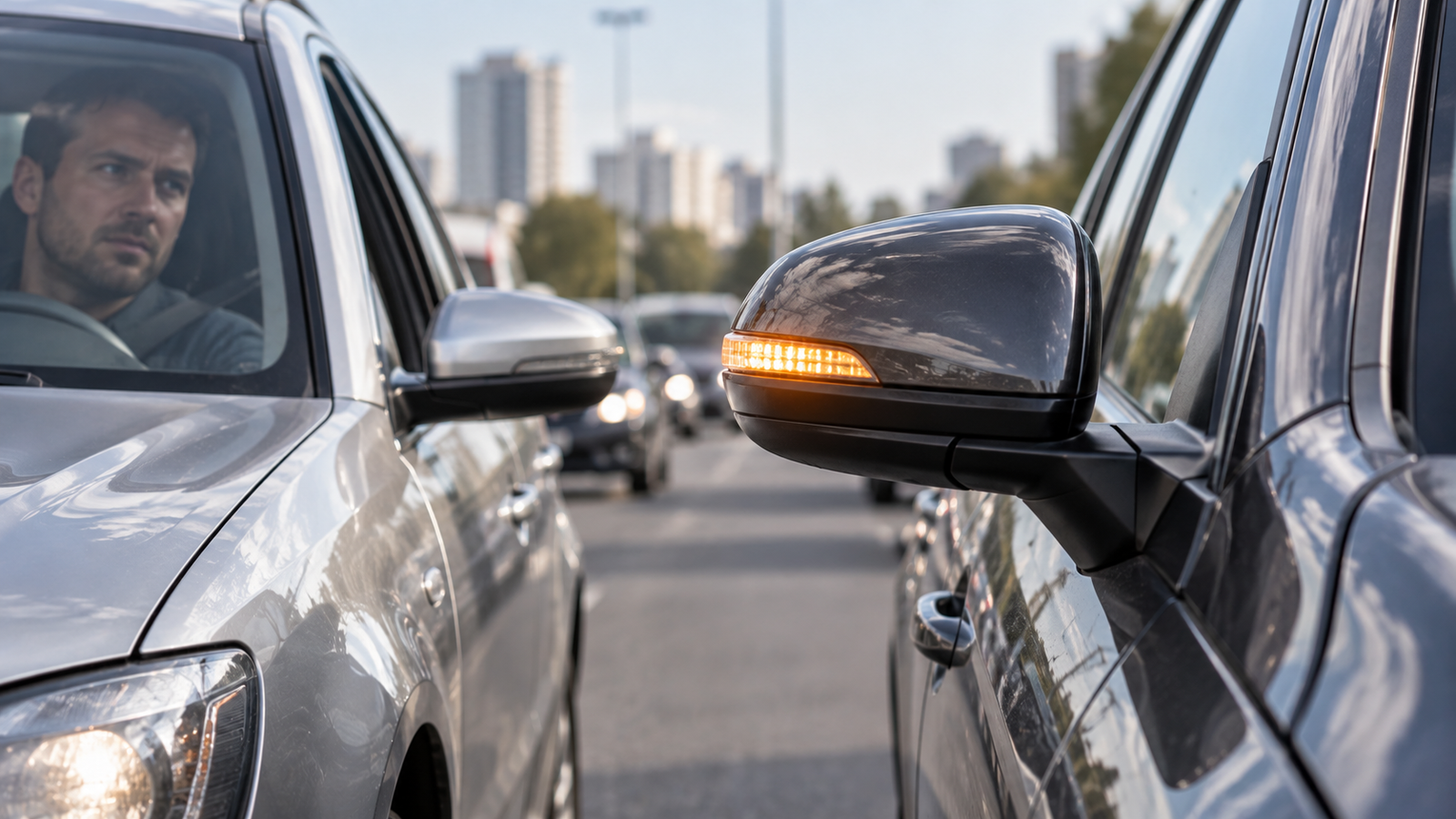
And here the mirror repeater has an objective advantage: it is located higher, extends relative to the body, and is in a more favorable viewing area for the driver of the adjacent car. But for additional visibility, you have to pay for potentially more expensive mirror repairs.
So next time you see a turn signal integrated into the side mirror, don't perceive it solely as a design element. Behind this small glowing strip lies a very specific engineering task — to make the driver's intention more visible precisely where a conventional fender indicator might be hidden.
Read more articles:
- Supreme Court explained controversial overtaking rules
- Why the Russian 7-speed automatic did not go into production
- Why the engine chokes during acceleration
Комментарии