A trailer has one unpleasant feature: in a parking lot, it seems completely harmless, but at speed, it can literally start controlling the car.
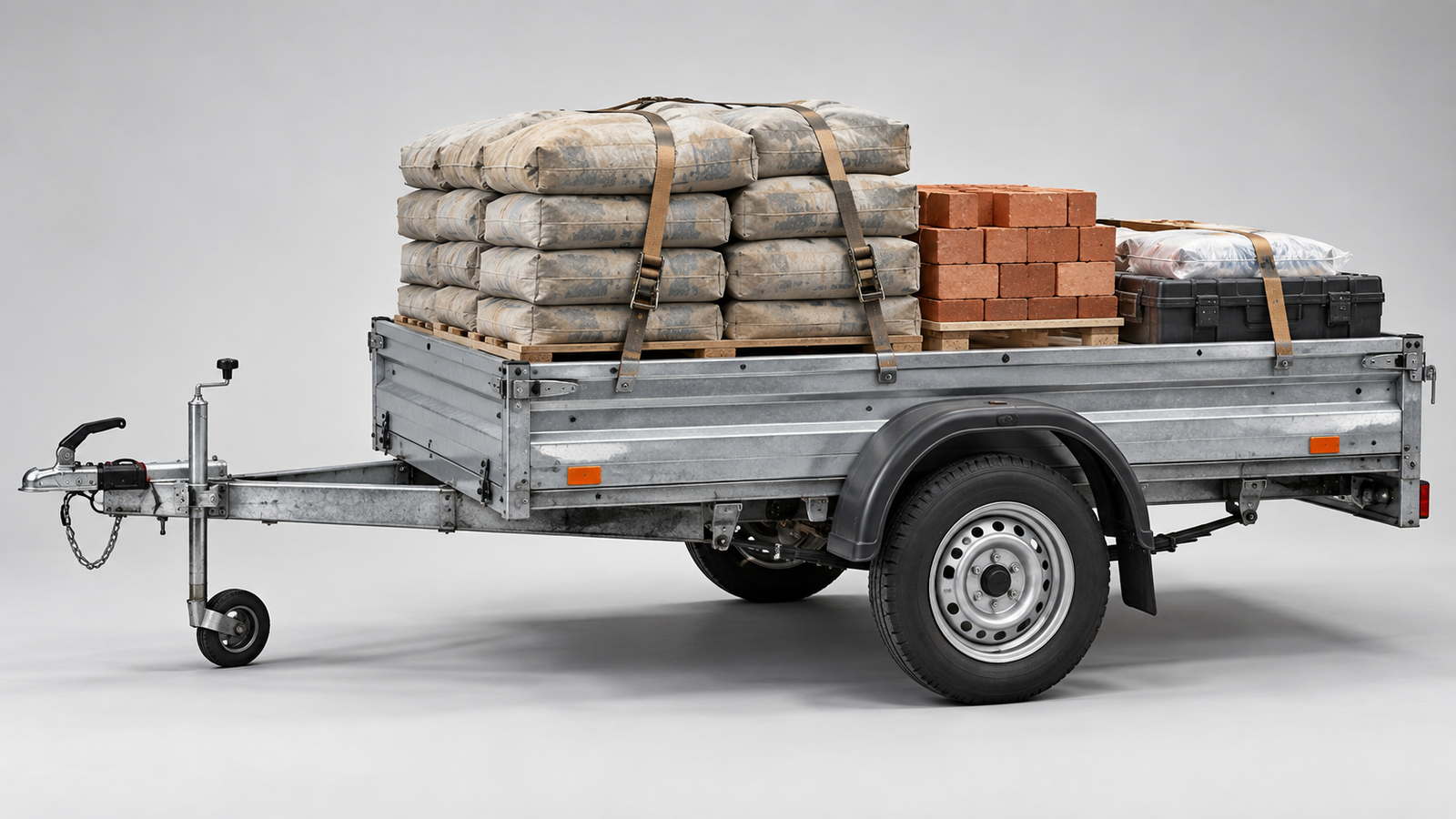
The situation is especially dangerous when heavy cargo — bricks, cement bags, boards, or other building materials — is placed closer to the rear tailgate. It's convenient to do this: open the tailgate, pull out the cargo — and you don't have to drag heavy items across the entire platform. But for driving, this is one of the most dangerous loading schemes.

When the center of gravity is too far back, the trailer begins to affect the rear of the car. At a certain speed, which depends on the trailer's design and the nature of the load, and in some cases can start at around 40 km/h, swaying occurs.
Initially, the driver may only feel a slight movement of the rear. Then the trailer begins to move further and further to the right and left. The amplitude increases, the car starts to wander, and the situation can end with going into a ditch or into the oncoming lane.
The trailer acts as a lever
To understand the reason, it is enough to imagine what happens to the weight. The trailer has its own axle, around which the load is distributed. Cargo located in front of it presses on the drawbar and through it transfers a vertical load to the car's tow hitch. But the mass behind the axle creates an opposite moment. It begins to try to lift the drawbar.
This creates a kind of lever: the further the heavy load is behind the axle, the stronger its influence on the car. That is why the problem is not just the total weight of the cargo. It is also important where its center of gravity is located. If it is shifted too far back, the rear of the car is unloaded. Part of the mass is redistributed to the front axle, and the rear wheels lose some of their grip on the road.
For a rear-wheel drive or all-wheel drive car, this additionally means reduced traction. For a front-wheel drive car, stability decreases when driving straight and in turns. At low speeds, such a change may be almost imperceptible. The steering wheel becomes lighter, the rear of the car seems to start to "float" a little. But the margin of stability has already decreased.
How wobbling occurs
Further, a small external impact is enough. This can be:
- a gust of side wind;
- uneven road surface;
- a slight steering movement;
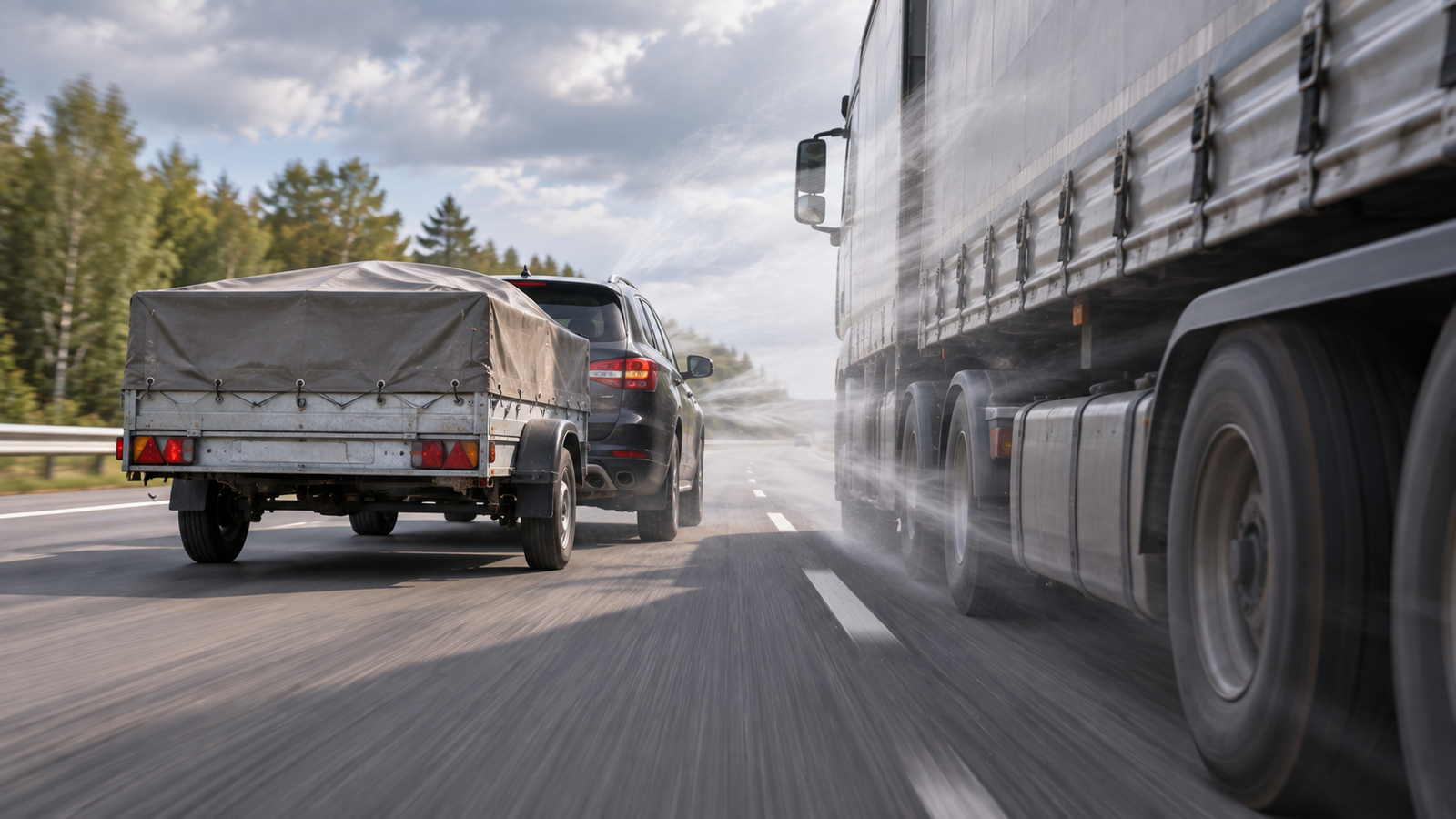
- airflow from an overtaking truck.
The trailer gets a lateral deviation and begins to move relative to the car's longitudinal axis. Then it pulls the car's rear in the same direction.
The car starts to wander. A dynamic pendulum arises: the trailer deviates to one side, then returns and goes to the opposite side. If conditions are favorable for swaying, each subsequent movement becomes stronger than the previous one. This phenomenon is called wobbling — transverse oscillations of the trailer.
The most unpleasant feature is that the driver's instinctive reaction can only worsen the situation. A sharp turn of the steering wheel forces the car to change trajectory, but the trailer, due to inertia, reacts with a delay. When the driver tries to compensate for the first deviation, the trailer already begins to move back. The amplitude of oscillations increases.
How much weight should be on the drawbar
The basic loading rule is quite simple: the center of gravity must be in front of the trailer's axle. At the same time, the vertical load on the drawbar should be approximately 10–15% of the total mass of the loaded trailer. For example:
- with a trailer mass of 750 kg — 75–112 kg;
- with a mass of 500 kg — 50–75 kg;
- with a mass of 300 kg — 30–45 kg.
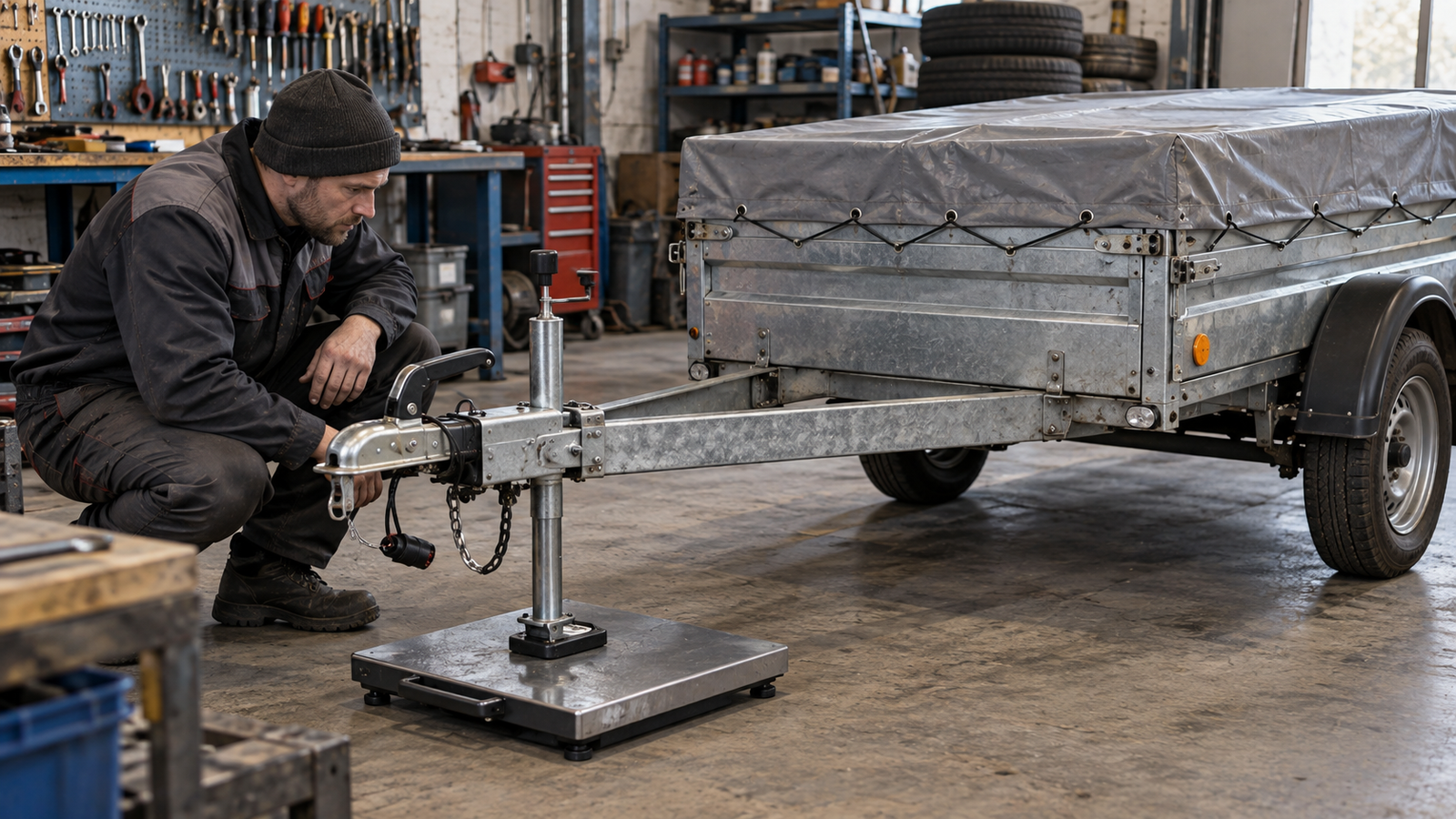
You can check the load even with ordinary floor scales.
To do this, the trailer is unhitched from the car, scales are placed under the drawbar support — for example, through a jack or a suitable stand — and the readings are checked. If the vertical load is less than 10%, this may indicate excessive rearward displacement of the cargo. If it exceeds 15–20%, the opposite problem arises: the cargo is located too far forward, the car's rear axle receives excessive load, and handling and braking efficiency worsen.
How to properly stack heavy cargo
The heaviest items should be placed in the front part of the platform, closer to the drawbar. But they should not be placed directly against the front wall either. The optimal location of the center of gravity in the original material is set at approximately one-third of the trailer's length from the front wall. Further, lighter items are distributed closer to the rear.
However, weight is not the only factor. The cargo must be secured. Imagine several heavy bags that shift backward during acceleration and forward during braking. The trailer's center of gravity constantly changes, and with it, the nature of its behavior changes. Therefore, even an initially correctly loaded trailer can become unstable if the cargo inside it moves freely.
What to do with boards and pipes
The situation is more complicated with long materials. Boards, pipes, and profiles should preferably be laid so that the main part of their length is in the front half of the platform.
But if the cargo is longer than the trailer itself, it is impossible to fully comply with this rule. Part of the material will inevitably be behind the rear tailgate. In this case, the rearward shift of the center of gravity must be compensated by an additional load in front. The same logic applies to covered trailers.
Heavy items should be in the front, light ones in the back. Gas cylinders, water canisters, tools, and batteries should be placed closer to the front. Clothes, sleeping bags, and light furniture can be left in the back. Water containers require special attention. If the trailer has built-in tanks, it is recommended to keep them completely full or empty. A half-empty container creates a variable load: the liquid moves during acceleration and braking, additionally affecting the trailer's stability.
What to do if the trailer has already started swaying
Let's imagine the worst moment: the car is driving, and the driver suddenly feels that the trailer has started to sway from side to side. The main thing is not to try to overcome the swaying with sharp actions. Sharp braking transfers the load to the car's front axle and further unloads the rear axle. This can increase instability.
Do not sharply turn the steering wheel from side to side either. Such actions can increase the amplitude of oscillations. If wobbling has started, you should:
- smoothly release the accelerator pedal;
- do not brake sharply;
- keep the steering wheel straight;
- allow the speed to gradually decrease;
- after the swaying stops, brake smoothly and stop in a safe place.
As the speed decreases, the transverse oscillations should decrease.
After stopping, it is necessary to find out the reason. First of all, it is worth checking whether heavy cargo was too far back and whether it shifted during movement. At the same time, you need to check the cargo fastening and the tire pressure of the trailer. Insufficient pressure can also contribute to swaying. If the trailer is equipped with shock absorbers, their condition should also be checked: worn elements dampen oscillations worse.
Sometimes the problem is not in the loading
It happens that the driver did everything correctly, but the trailer still remains nervous. The reason may be in the combination of the car and the trailer. For example, a too light rear of the car reduces the load on the rear axle. If there are no passengers in the cabin and the trunk is empty, stability may be worse. As an additional measure, the original material suggests increasing the load on the rear axle with ballast — for example, a bag of sand or a couple of canisters of water.
The length of the drawbar also matters. The shorter the distance from the trailer axle to the coupling point, the lower the critical speed for wobbling. Therefore, if possible, use a trailer with a longer drawbar. Another factor is the height of the center of gravity. If the cargo is stacked in several high layers, the trailer becomes less stable. Therefore, it is better to distribute the mass over the platform area, rather than building a high stack.
Speed with a trailer is limited for a reason
Even a properly loaded trailer does not turn a car into an ordinary car without additional load. Separate speed limits apply to cars with trailers. Outside populated areas, on highways, it is allowed to drive no faster than 90 km/h, on other roads — 70 km/h. In populated areas, the limit is 60 km/h. The higher the speed, the less time there is to react and the stronger the consequences of a sudden lateral impact.
Open sections and bridges are especially dangerous, where side wind directly affects the car and trailer. Trucks create a separate problem. When overtaking them or passing oncoming, a powerful air flow arises that can deflect a light trailer. In strong side winds, on bridges, and when overtaking by trucks, the speed should be reduced to about 50 km/h.
Before the trip, you need to check not only the cargo
Stability begins even before hitting the road. Before a long trip, it is worth inspecting the tow hitch: check the tightening of the mounting bolts, the condition of the ball, and the absence of cracks. The trailer's coupling device must also be in good working order. The lock must be securely fixed on the ball, and the safety cable or chain must be properly attached to the car.
If the trailer is equipped with brakes, their serviceability should be checked. All lighting devices are also checked. And, of course, do not forget about the tires. Correct pressure is one of the basic things on which the trailer's behavior depends.
The first trip is better to do without cargo
For a person who is towing a trailer for the first time, not only moving forward becomes a separate problem. You need to get used to the dimensions, understand how the trailer takes turns, how the braking distance changes, and how the car behaves during acceleration. Reversing is especially unusual: the trailer reacts to turning the steering wheel in the opposite direction.
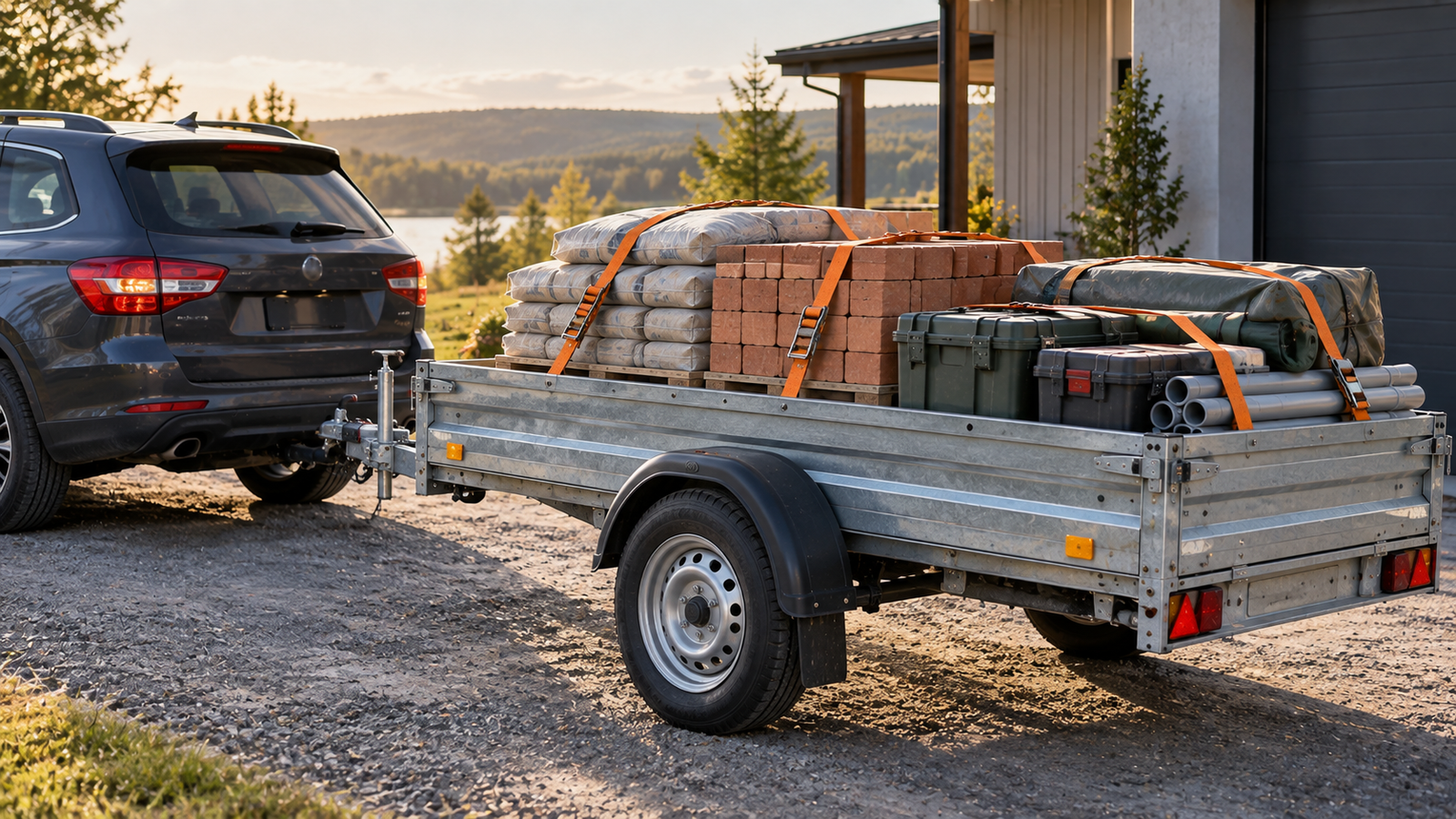
Therefore, the first maneuvers are best practiced on an open area and without cargo. The main rule remains extremely simple: heavy cargo — forward, light — backward, and all the contents of the trailer must be securely fastened. The trailer does not forgive attempts to save a few minutes during loading. It is indeed more convenient to put bricks in the back, but it is precisely this convenience that can cause the trailer to sway the entire car at speed.
Read more materials:
- Turn signals on mirrors: fashion or real safety
- Why you can't tighten wheels with a pipe and foot
- Electronic handbrake: how it works and what breaks
Комментарии