Morning, approaching a traffic light. The brake pedal is pressed as usual, like all summer, but the car stops a little later. There is no snow or ice, the asphalt is just wet. The first thought in such a situation is usually related to the brakes, and they certainly cannot be ruled out. But another reason is possible: the tire grip on the road has already changed, although outwardly the autumn road is almost no different from the summer one.
It is important here to distinguish between two phenomena that are often confused. Complete aquaplaning, where the tire effectively loses contact with the surface on a layer of water, and a normal reduction in grip on wet asphalt are not the same thing. For braking to worsen, the car does not necessarily have to “float”: it is enough for water to partially separate the tire surface from the micro-irregularities of the road surface.
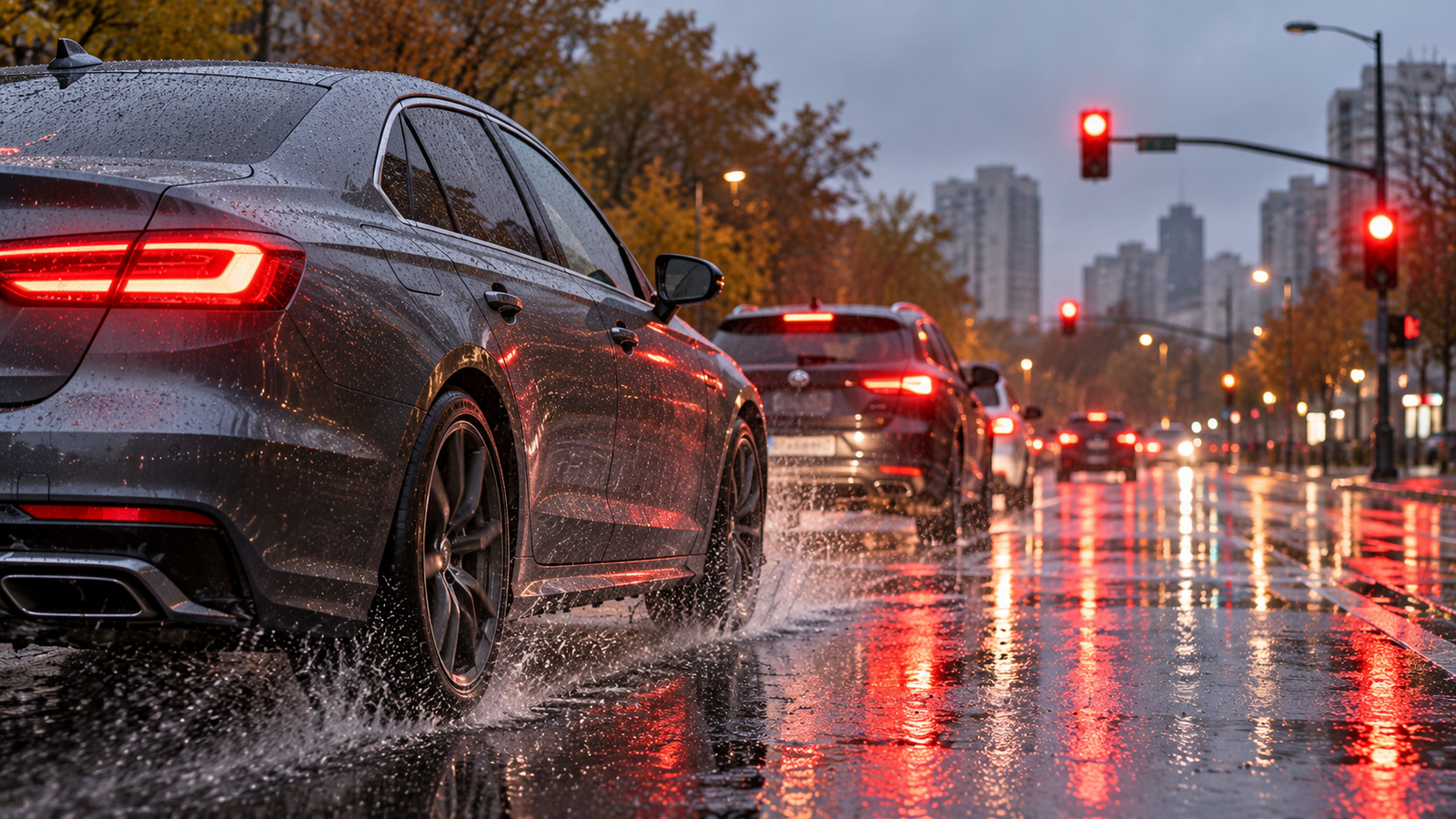
How thin can such a film be? The Federal Highway Administration (FHWA) in its wet weather driving materials cites the results of specific tests where a water layer about 0.002 inches thick, or approximately 0.05 mm, under certain conditions reduced the coefficient of friction by 20–30%. These figures cannot be applied to every car, tire, road, and speed: this is the result of specific tests, not a universal adjustment to braking distance. But the fact itself is indicative — for the grip to change, the water film does not have to be visible to the eye.
This is one of the main autumn traps. The driver sees snow or ice and instinctively changes their driving style. Thin water, road dirt, and cooling rubber outwardly change the road much less — at most, a characteristic sheen appears on the asphalt. As a result, grip conditions have already worsened, but the driver continues to drive as if the road surface remained summer-like.
Why the first rain after a dry period is especially dangerous
There is another factor that is easy to underestimate. While dry weather lasts for several days or weeks, dust, dirt particles, and traces of various contaminants accumulate on the road. The first rain does not necessarily wash them away immediately: water mixes the accumulated layer with the road surface, and grip can noticeably change.
This is why the official California DMV driver's manual recommends reducing speed at the first signs of rain or drizzle, especially if it has been dry for a long time. The meaning of this recommendation is not that any first rain automatically makes the road dangerous, but that the driver often underestimates the first minutes of precipitation after a dry period.
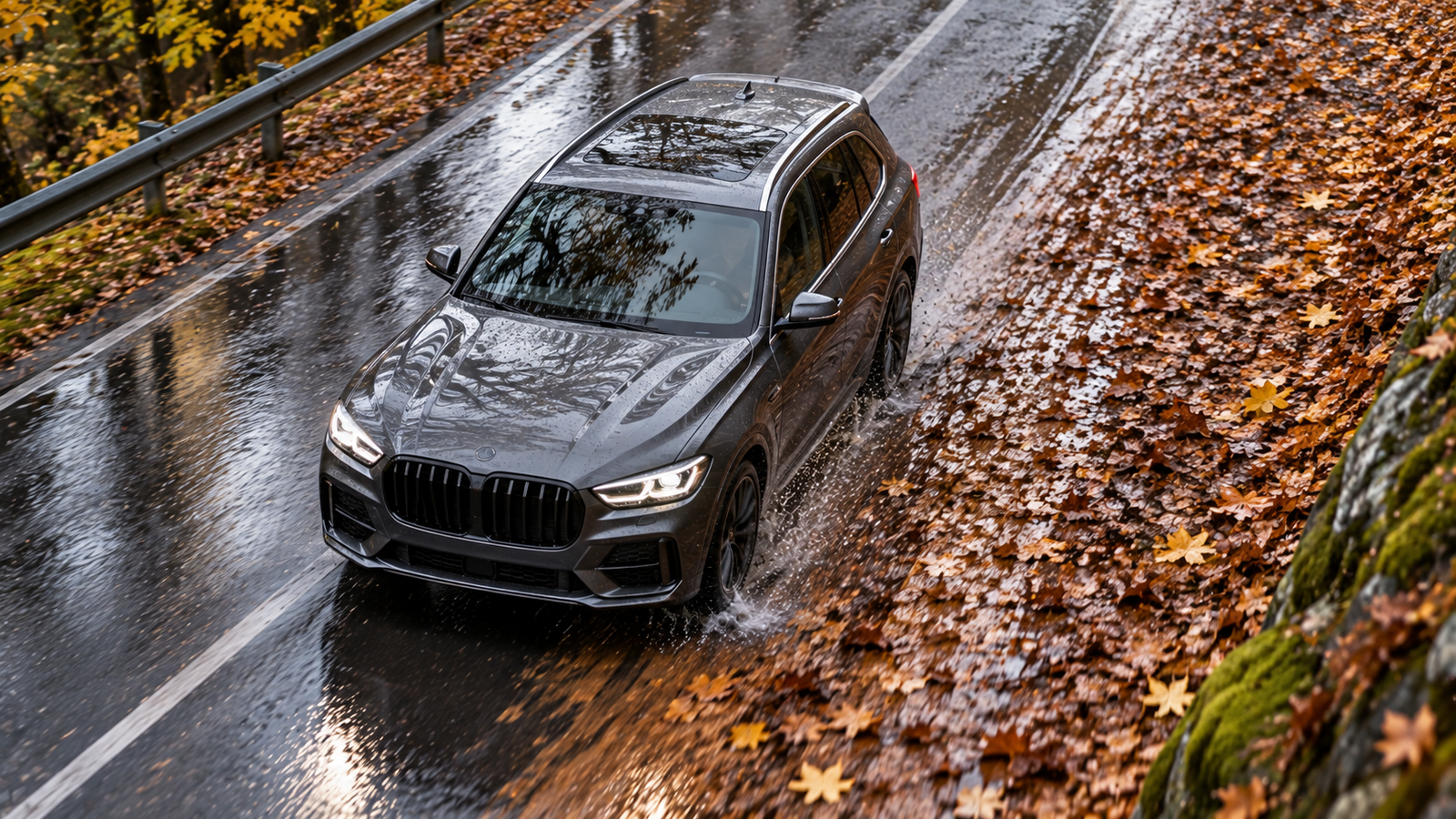
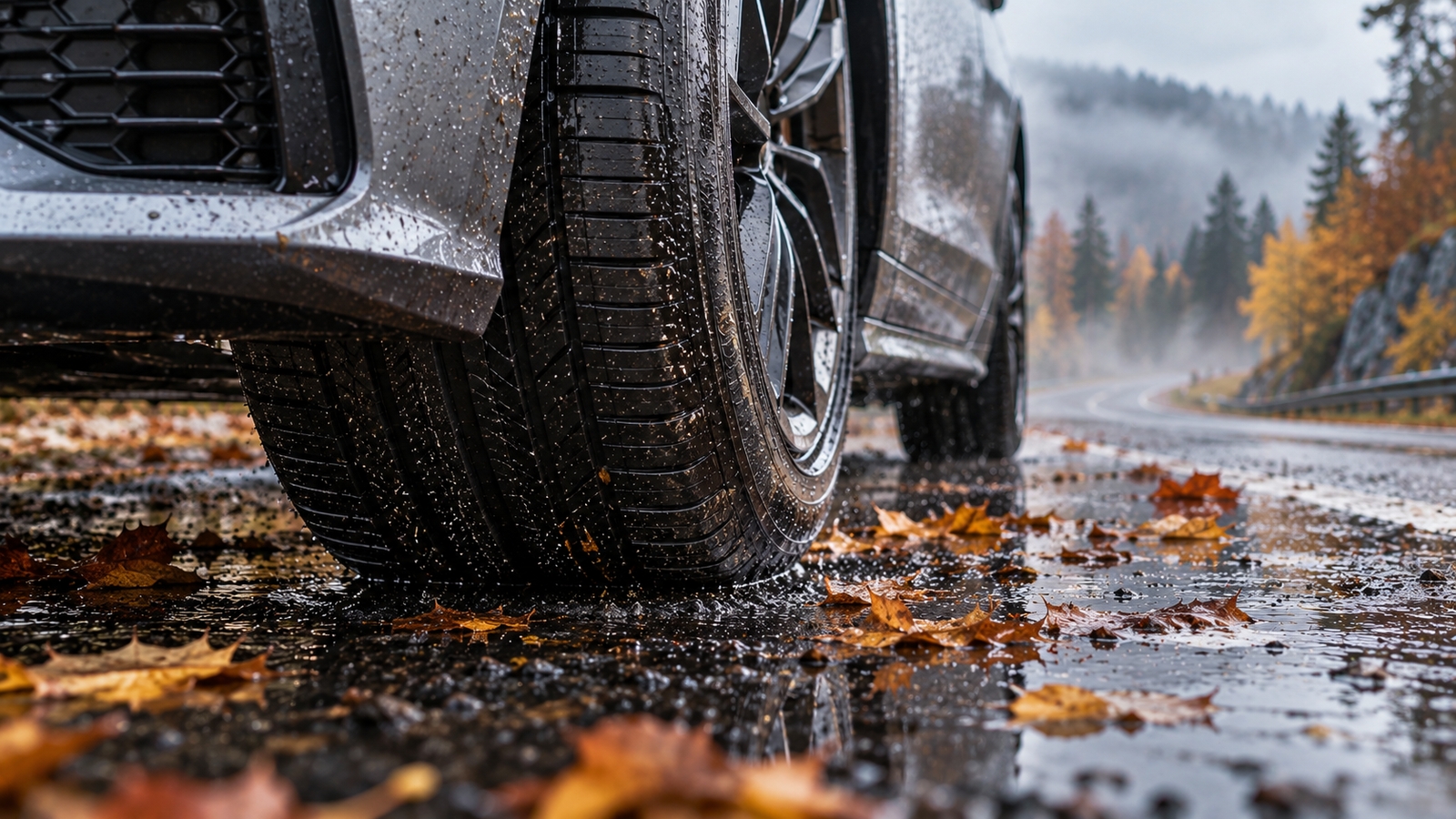
However, the problem is not limited to water alone. In autumn, the road surface becomes uneven: wet leaves, soaked dirt, sand, and fine gravel appear on the road. All of this can reduce grip. The situation is particularly unpleasant when different wheels are on different surfaces: on one side — clean wet asphalt, on the other — a layer of wet leaves or dirt. In such a case, the grip on the left and right differs, and with it, the car's behavior changes during braking or sharp maneuvers.
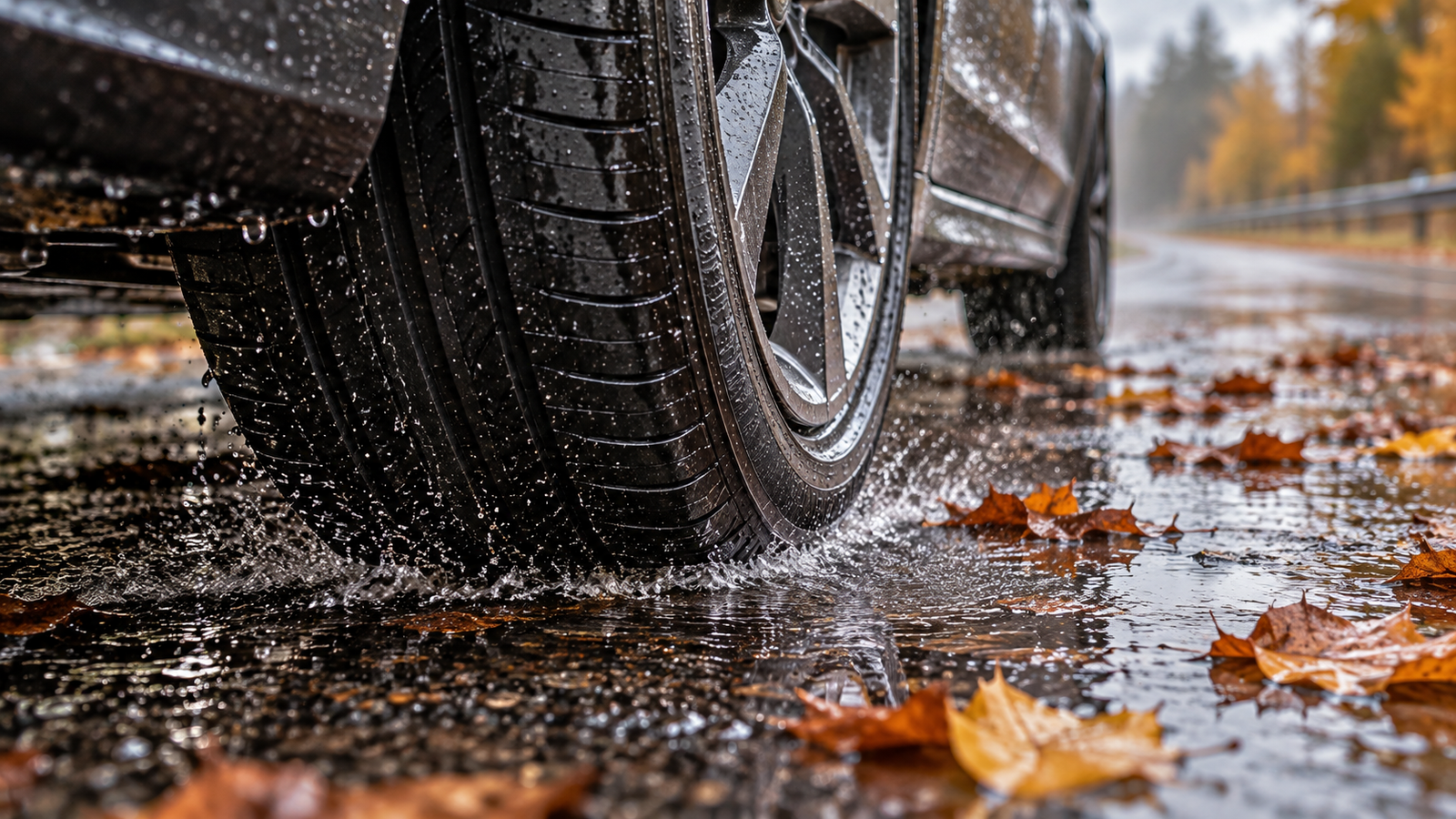
Road markings deserve special attention. The American MUTCD standard indicates that different pavement and marking materials can have different grip characteristics. Therefore, a wet stop line, a wide crosswalk, or an arrow painted on the asphalt may feel different under the wheels than an adjacent section of the pavement. This does not mean that any modern marking automatically becomes slippery: its properties depend on the material, condition, and application technology. But the difference in grip between individual sections of the road cannot be ruled out.
The same applies to wet leaves. Equating their coefficient of friction to ice would be incorrect without specific automotive measurements. It is more accurate to perceive foliage as a separate type of surface with potentially significantly less grip, especially when it is wet and forms a continuous layer.
Cold changes the performance of summer tires
In autumn, grip is determined by several factors at once: tire and road surface temperature, rubber compound, presence of water, asphalt texture, and driving speed. Therefore, attributing worsening braking solely to “cold asphalt” is incorrect.
A separate problem is the summer tire itself. As the temperature drops, its rubber compound becomes stiffer and adapts less effectively to the micro-relief of the surface. As a result, grip may worsen, and consequently, braking and handling. This does not require snow or ice: changes can manifest already on cold wet, and in some conditions, even on dry asphalt.
Continental uses a temperature of about +7 °C as a practical seasonal guideline for switching to winter tires. This is not a universal physical threshold after which any summer tire instantly loses its properties, but a recommendation that must be considered taking into account the specific model, tire condition, and actual temperature. But as a guideline for assessing seasonal conditions, it shows the main point: there is no need to wait for the first snow to change tires.
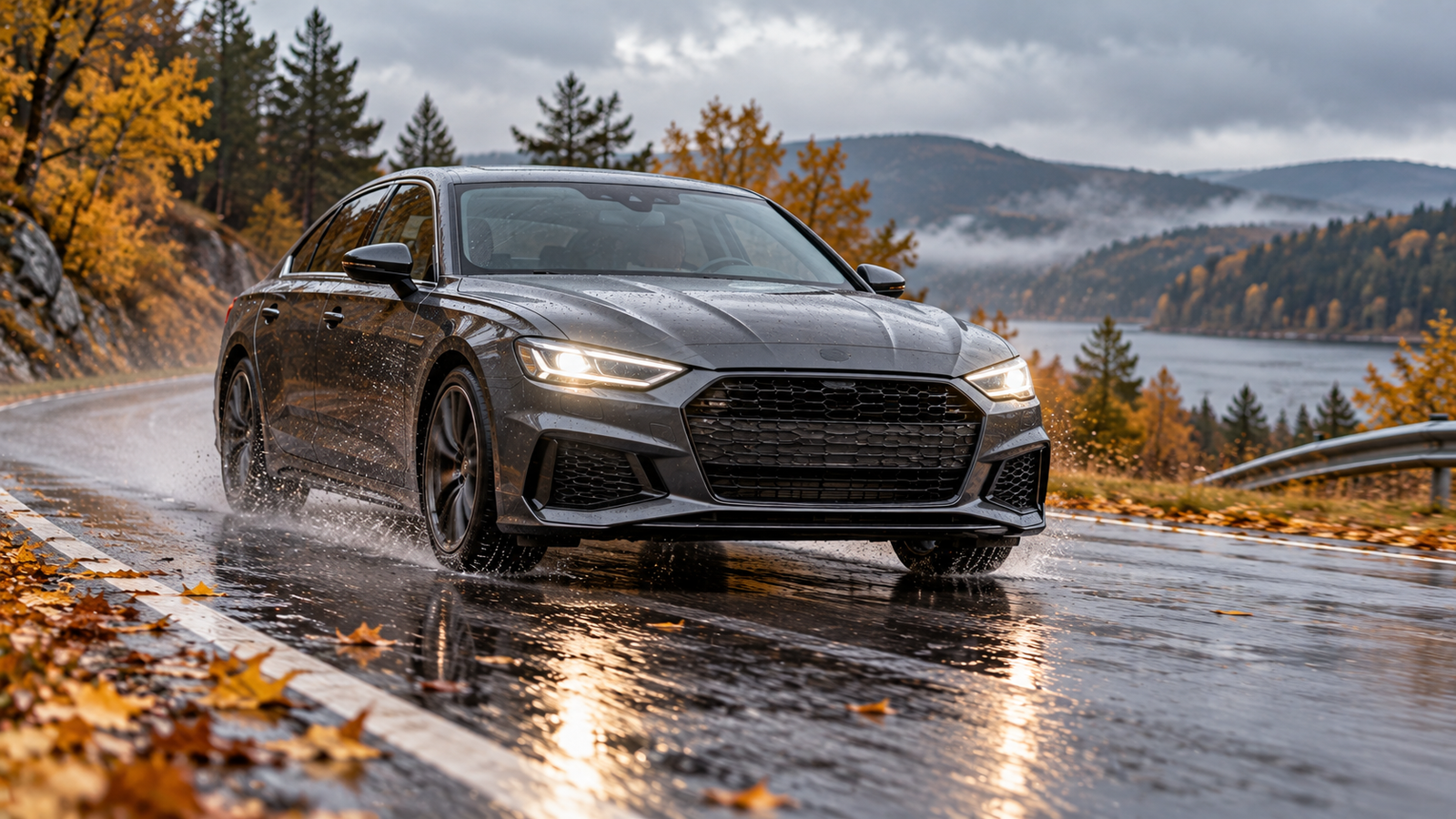
In autumn, a borderline situation arises: it's not yet winter on the calendar, roads remain mostly clear, but the temperature has already dropped low enough for the properties of summer rubber to begin to change. The appearance of the road may practically not warn the driver about the change in grip.
Why ABS does not increase grip
Another common misconception is associated with ABS. The system does help the car maintain steerability during intense braking. Bosch describes its operating principle as follows: the system monitors the wheel rotation speed and, if there is a risk of locking, reduces pressure in the brake circuit, after which it increases it again. Thanks to this, the wheels continue to rotate, and the driver retains the ability to steer the car.
But ABS is not capable of creating additional grip where it is physically insufficient. Maximum deceleration is still limited by the interaction of the tires with the road. The British Highway Code specifically states that the presence of ABS does not automatically mean a reduction in stopping distance: the main task of the system is to help maintain control and prevent wheel lock-up.
Therefore, during emergency braking in a car with working ABS, the pedal must be pressed firmly and held. The pulsation of the pedal at this moment is normal system operation and does not mean that the pressure on the brake should be eased or that the pedal should be pressed rhythmically.
It is also important here not to confuse braking distance and stopping distance. Braking distance is measured from the moment braking begins, while stopping distance also includes the distance the car travels during the driver's reaction time. These are different values, so using them interchangeably is incorrect.
Why you should increase your following distance in autumn
There is no universal figure by which the following distance or braking distance should be increased in autumn. The result is simultaneously affected by temperature, rubber composition and condition, road surface type and texture, speed, vehicle load, tire pressure, tread depth, and the amount of water on the road. Therefore, a statement like “in autumn, braking distance increases by a certain percentage” without specifying the conditions of a particular test says little about the real situation.
The practical conclusion from this is much simpler. It is better to increase the following distance in advance and reduce speed before the car reaches a problematic section. If the driver has already realized that they cannot stop in time, it is impossible to create an additional safety margin.
In autumn, it is also advisable to avoid sudden steering and pedal actions on uneven surfaces. With smooth changes in speed and direction, tires have more opportunities to maintain grip, especially when different wheels are on different surfaces.
Finally, it is necessary to monitor the condition of the tires themselves: pressure, tread depth, overall condition, and compliance with seasonal conditions. These parameters do not work in isolation, but together with temperature, water, asphalt condition, and driving speed.
However, you should not test grip by sudden braking on a public road. Such an experiment will not give the driver an accurate estimate of the future braking distance, but it will create a real risk of losing control of the car.
What actually changes in autumn
The main problem with autumn roads is that the deterioration of grip often occurs without a noticeable visual signal. Snow and ice make the driver wary immediately, while a thin film of water, wet leaves, road dirt, or the cooling of summer tires may practically not change the appearance of the road surface.
Therefore, in autumn, the driving style must be adjusted earlier than obvious signs of winter appear. The first rain after a dry period, wet leaves, a cold morning, and wet shiny asphalt are already sufficient reasons to treat the road more cautiously. This does not mean that every autumn rain turns the road into an ice rink: it is the grip margin that changes, and how much depends on the specific tires, road surface, temperature, speed, and amount of water.
Read more articles:
- What to lubricate caliper guides with: main mistakes
- Why a balanced wheel still vibrates at speed
- High beam, low beam, or DRL: which light should the driver turn on
Comments