Tires remain the only part of a car that directly contacts the road surface. It is through them that acceleration, braking, and steering forces are transmitted, which is why safety, stability, and driving comfort directly depend on their condition. Natural rubber wear is an inevitable process and one familiar to every driver. What should cause concern is not the fact that the tread is wearing down itself, but the nature of that wear. When wear occurs unevenly — in patches, on one side, or much faster than expected — this is no longer normal, but a warning sign.
If one edge of a tire becomes noticeably more "bald" than the other, if bare spots appear on the tread, and the inner or outer edge wears faster than the center, this means the load on the wheel is being distributed incorrectly. In such a situation, certain tread areas operate under overload, taking on what should be evenly distributed across the entire contact patch. Ignoring such signs leads not only to premature tire replacement, but also to a direct safety threat: grip deteriorates, especially on wet pavement, the risk of aquaplaning increases, directional stability decreases, and braking effectiveness is reduced.
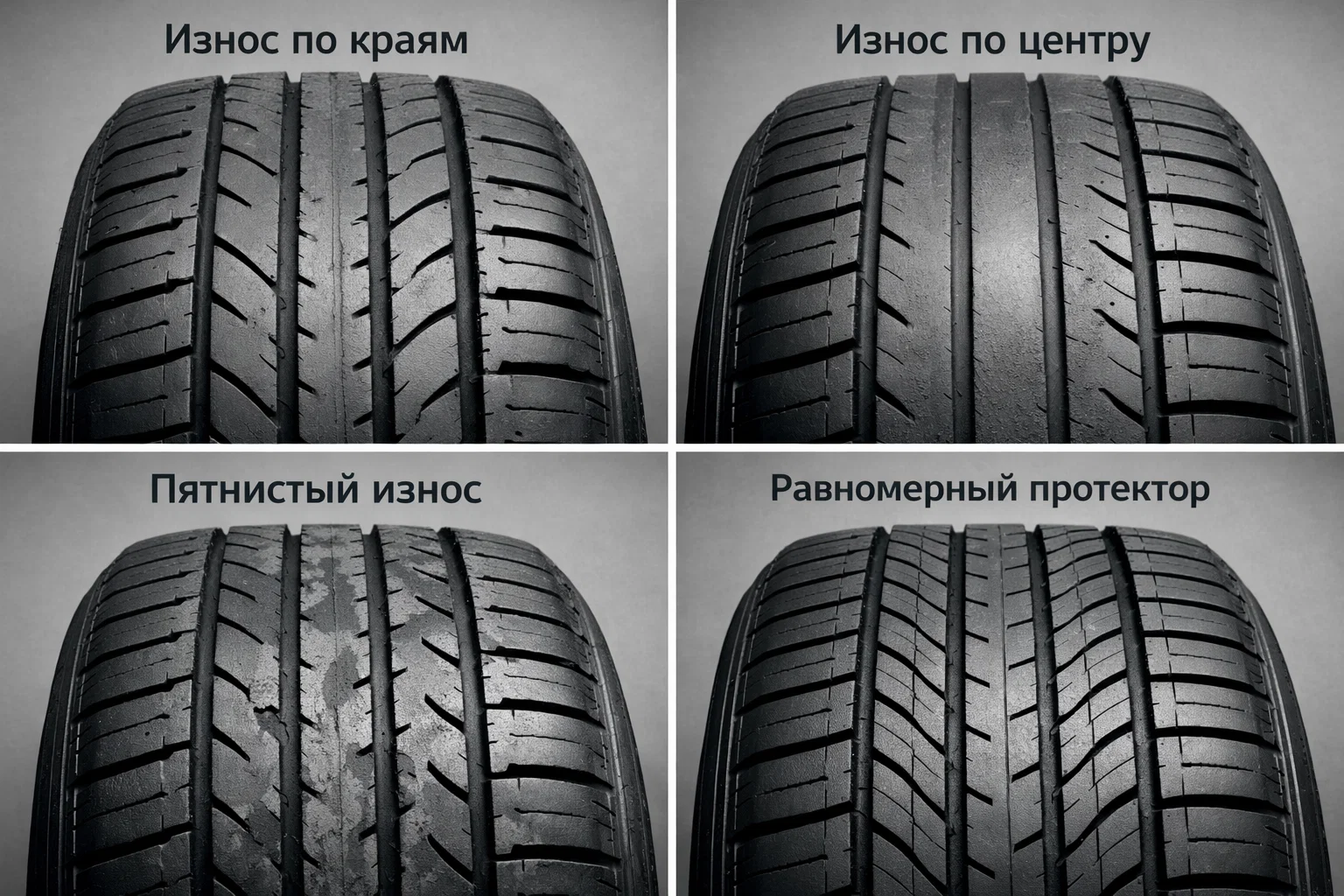
The reasons for this kind of tire behavior always lie in the car's technical condition or in the specifics of its operation. Let us examine the main types of uneven wear to understand exactly what problems they indicate and how to eliminate them.
Tire Pressure: A Simple Cause with Serious Consequences
The most common and at the same time often underestimated factor is incorrect pressure. Even a deviation of just a few tenths of an atmosphere from the standard recommended by the manufacturer gradually changes the shape of the contact patch during regular use. Many drivers check pressure irregularly, relying on the wheel's appearance or on sensor activation, even though sensors usually respond only after a critical drop.
With reduced pressure, the sidewalls become softer, and the main load shifts to the shoulder areas — the inner and outer tread edges. As a result, the center of the tire may look almost new, while the edges wear at an accelerated rate. An additional danger comes from carcass overheating due to increased internal friction, which in extreme conditions can lead to sudden tire failure.
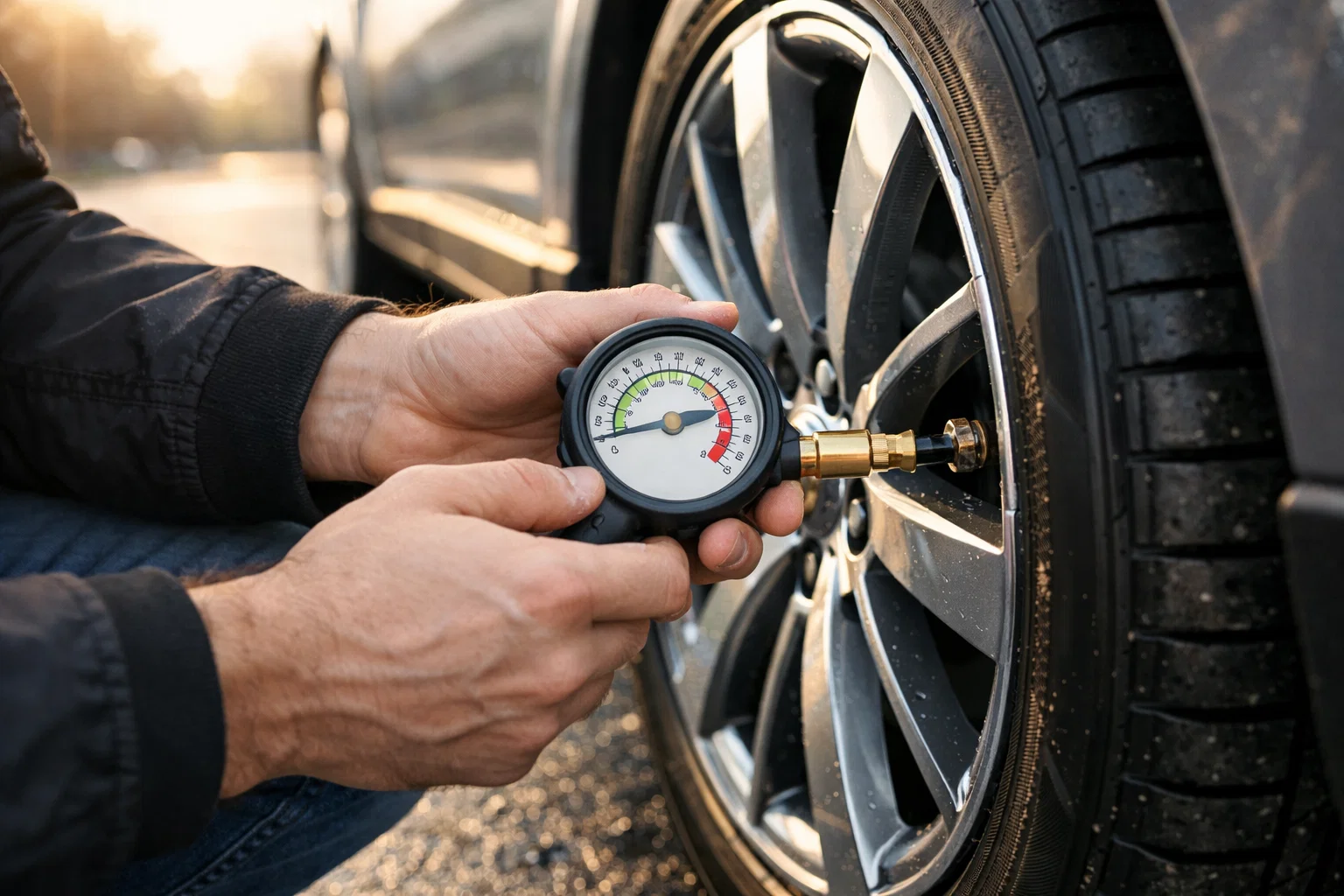
Overinflated tires behave in the opposite way. Excessive stiffness makes the wheel bulge outward, and the road is contacted mainly by the central part of the tread. That is exactly the area that wears the fastest. At the same time, the actual grip area is reduced, comfort worsens, and the suspension begins to react more harshly to irregularities. Pressure should be checked on cold tires at least once a month and always before a long trip, using your own pressure gauge, since readings at filling stations are often inaccurate.
Wheel Alignment: When the Wheels Roll Incorrectly
If the pressure is fine, but wear consistently appears on one side of the tire — most often on the inner side, less often on the outer — then in most cases the cause lies in incorrect wheel alignment angles. Camber and toe determine the position of the wheel relative to the body and the road surface. Over time, these parameters inevitably drift out of specification due to impacts from potholes and curbs, as well as wear of suspension and steering components.
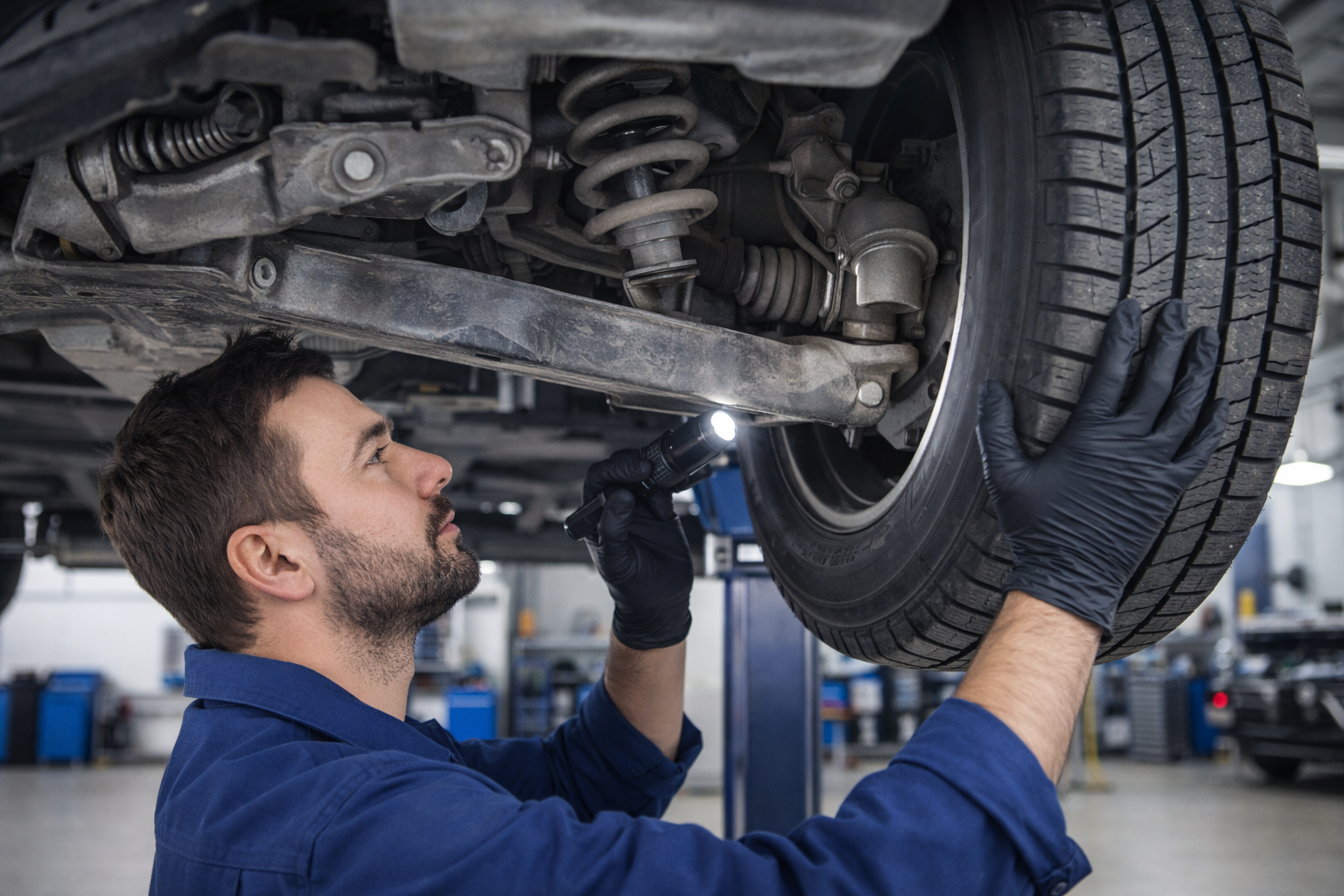
When the angles are off, the wheel stops rolling strictly in the direction of travel and begins to slightly "slide" with the side of the tread. This leads to intense, often sawtooth wear on one edge. Such a problem not only destroys the rubber in a single season, but also worsens the car's behavior: there is a need to constantly correct the steering, fuel consumption rises, and wear of steering components accelerates.
Wheel alignment should be adjusted on a modern alignment stand by a qualified specialist. The procedure is mandatory after major chassis work, after strong impacts to the wheels, and also for preventive purposes — about once a year or every 15,000 to 20,000 kilometers. Limiting the procedure to the front axle alone is not enough: the geometry of the rear wheels also affects both handling and the uniformity of wear.
Suspension and Running Gear: Hidden Sources of Problems
Uneven or excessively rapid tread wear may be the result of faults hidden in the suspension. Worn parts lose the ability to hold the wheel in a stable position under load, which changes the rolling path, causes vibrations, and creates localized areas of increased wear.
Faulty shock absorbers and struts stop damping oscillations effectively, and the wheel begins to bounce over bumps, periodically losing contact with the road. At such moments, slipping occurs, forming patchy wear. Play in ball joints, worn support bearings, or damaged silent blocks allow the wheel to change its angle chaotically while driving. Even a slight imbalance, if left uncorrected, causes vibrations over time that are transmitted to the tread and accelerate its destruction.
Wheel rim deformation deserves special attention. An invisible-to-the-eye "figure eight" that appears after hitting a pothole can significantly change the nature of rolling. Diagnosing such problems requires inspection of the car on a lift. Indirect signs of faults may include unusual knocks, the car pulling to one side while driving or braking, as well as steering wheel and body vibrations at certain speeds.
Driving Style and Operating Mistakes
Driving manner directly affects tire service life. Sharp starts with wheelspin, emergency braking, and cornering at high speed literally "shave off" the tread. During intense acceleration, the central part of the tread track suffers, while in turns, under lateral loads, the shoulder zones wear faster. The habit of "cutting" corners or driving onto curbs also contributes to one-sided wear.
Operational factors also include the absence of regular wheel rotation. Even with a completely serviceable suspension, the front axle is usually more heavily loaded and wears the rubber faster. Periodic wheel rotation according to the recommended pattern helps even out wear and extend the service life of the entire set. Neglecting this procedure leads to tires on one axle becoming unusable significantly earlier than the others.
One should not forget about the suitability of the tires for the vehicle. Violating the speed and load indices indicated on the sidewall almost guarantees accelerated and improper tread wear.
Wear as an Accurate Indicator of a Car's Condition
Uneven tire wear is never accidental. It is a kind of diagnostic tool that points to specific problems — from something as simple as neglected pressure checks to the need for geometry adjustment, suspension repair, or a revision of driving style. Ignoring such signals leads to unnecessary spending on new tires and, what is far more dangerous, a reduction in active safety.
Tires with disturbed tread geometry drain water worse and lose grip, especially on wet or icy roads. That is why regular visual inspection, pressure monitoring, timely servicing of the running gear, and a calm driving manner are not abstract recommendations, but basic conditions for preserving tire life and the safety of the driver and passengers. The condition of the rubber can tell you much more about a car than it may seem at first glance, and these clues should definitely not be ignored.
Read More Materials:
- The Law Does Not Apply to Them? Why Truck Drivers Are in No Hurry to Change Tires After the First Snow
- The Most Powerful Dump Truck of the USSR — BelAZ-7520
- What Is Really Hidden Behind the Word "Platform"
Комментарии