On almost all service trucks of the Soviet period—whether ZILs, URALs, GAZes, or MAZs, as well as their civilian three-axle versions—unusual metal elements could be seen on the wheels. They outwardly resembled either handles or small shovels, although the shape clearly did not lend itself to a comfortable grip. Because of this, drivers and the general public long lacked a clear explanation for their purpose.
The common assumption that these were "handles" for carrying wheels does not hold up to scrutiny: the mass of one wheel could reach almost one hundred kilograms, and even two people would not be able to move it using such an element. Nevertheless, discussing the purpose of these parts was not particularly common, and rare questions were usually met with a short answer—"inflation."
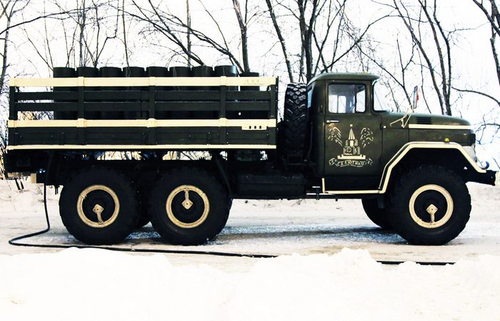
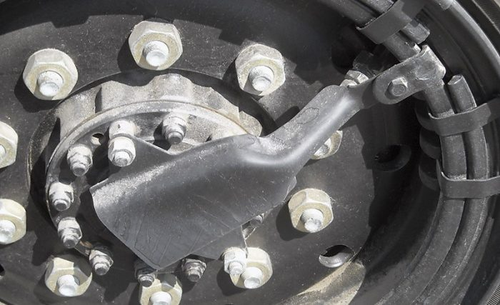
That's right: this metal element was none other than a protective cover for the tire inflation system. It covered not so much the rubber hose itself as the brass valve fitting protruding from the hub. The entire system was connected to the receiver and air compressor of the vehicle.
To use the inflation system, the driver needed to perform several actions:
- unscrew the mount and fold back the protective cover
- use a wrench to turn the valve to position "1" or "2"
- thereby opening or closing the air supply to the tires
This scheme allowed not only to regulate the pressure, but also to quickly shut off the system in case of hose damage to avoid air leakage. Under normal conditions, the inflation system remained off and was only turned on when driving on difficult surfaces—dirt roads, mud, or deep snow.
The practical benefit of the system was quite significant. Depending on the operating conditions, the driver could change the tire pressure:
- when driving without a load—slightly reduce the pressure to reduce shaking and increase comfort
- on heavy loads—maintain standard values
- when driving on muddy or snowy terrain—significantly deflate the air, sometimes almost by half
Reducing the pressure increased the contact patch of the tires with the surface and allowed the truck to sink less. Thanks to this, for example, the ZIL-131 could move even through fresh snow with a full load. The machine literally "raked" the snow in front of it, forming a ridge up to the bumper level, and moved forward at low speed on almost flat tires.
Initially, this system was developed for specialized equipment, so special attention was paid to the ability to quickly restore pressure. In convoy conditions, delays were unacceptable, and the driver had to quickly return the tires to working condition.
The inflation system was controlled from the cab:
- there was a control lever on the front panel
- nearby was a pressure gauge showing the total pressure in the system
There was an opinion that the inflation system could compensate for a tire puncture. In practice, it really helped maintain control, especially on trucks like ZILs and URALs. When driving at a speed of 60–70 km/h, an instant stop of a heavy vehicle is difficult, so maintaining pressure allowed the driver to safely pull over to the side of the road. Further work was carried out by a repair vehicle, which usually followed at the rear of the convoy.
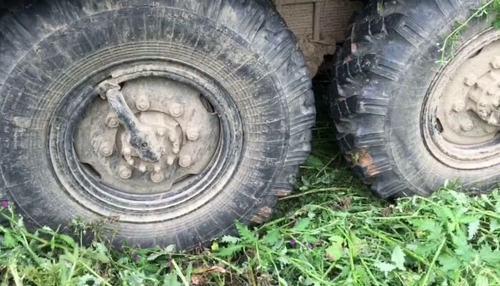
The system was also useful in other situations. For example, when pulling a stuck car out of a ditch:
- tire pressure was reduced
- traction with the ground increased sharply
- traction capabilities, especially for the ZIL-131, allowed the task to be successfully completed
Despite its apparent simplicity, the design had its own peculiarities. The protective cover was often lost, so drivers tried to replace it at the first opportunity, sometimes borrowing it from colleagues. The absence of this part was considered a serious drawback—in fact, the car was considered not fully ready for operation.
This was no accident: when driving, for example, through bushes, the hose attachment could be damaged. Without a protective element, the risk of such problems increased, and the consequences could be much more serious.
In general, the inflation system with its characteristic "cover-handle" looked simple and even rough. However, it performed its task reliably, and this was key for Soviet technology. Such machines often conceded in convenience, were distinguished by their massiveness and simplicity of execution, but at the same time demonstrated high survivability and adaptability to harsh operating conditions.
Read more materials:
- How Hyundai experimented with design
- Caravan vs motorhome: the key difference
- Peel P50: the smallest car in the world