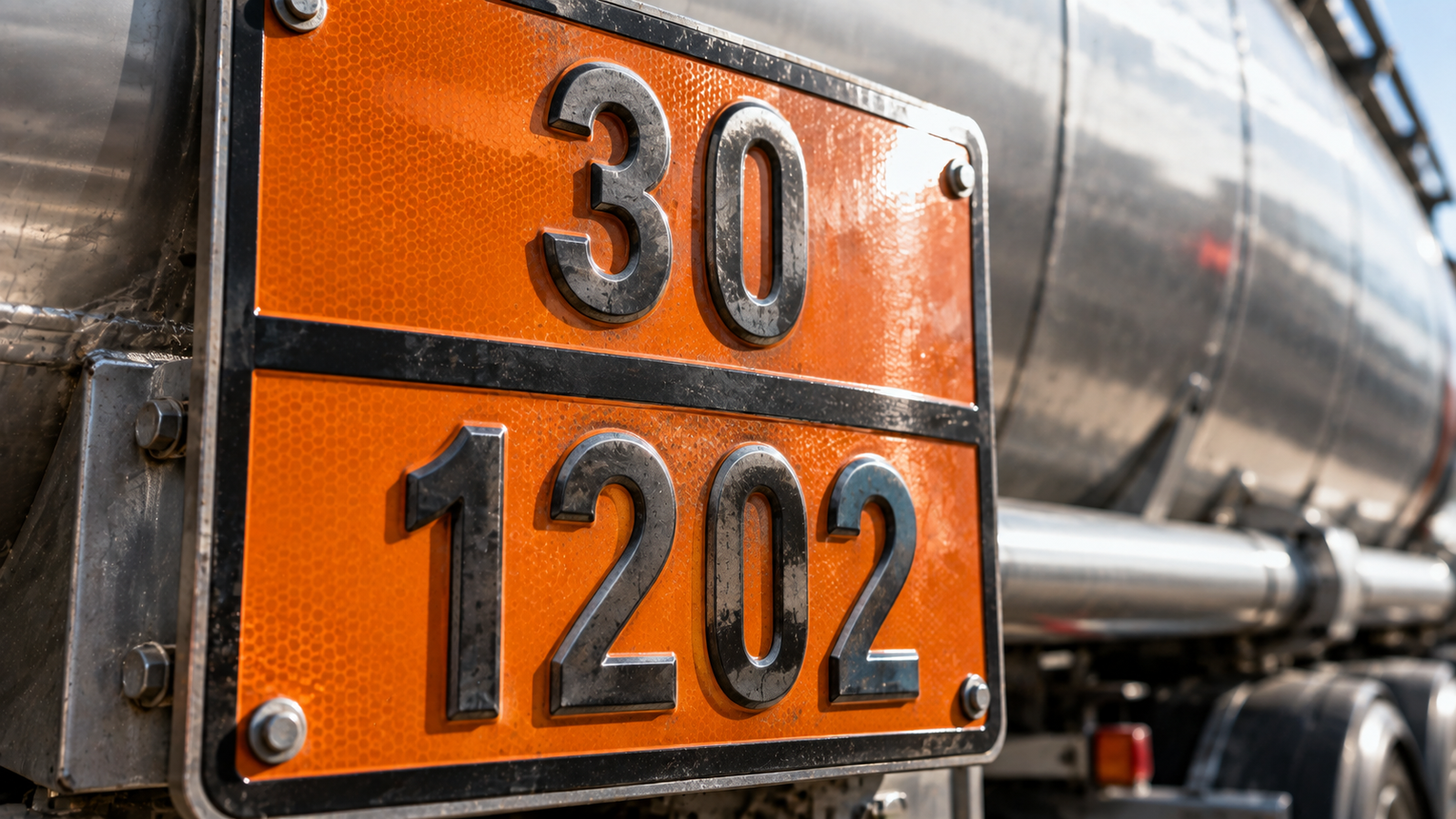
The orange plate on a fuel truck is not just a bright marking. The numbers on it are not applied with ordinary paint: they are either embossed directly into the metal or assembled from individual overlay metal signs. The size of the plate is 40×30 cm, it is installed on the front of the cabin and on the back of the tank, and a horizontal black stripe divides the field into two parts.
On a fuel truck, you can see the combination 33 and 1203, on a diesel fuel truck — 30 and 1202, and on a bitumen truck — 99 and 3257. This is where the common expression among drivers, “fuel truck 33,” came from.
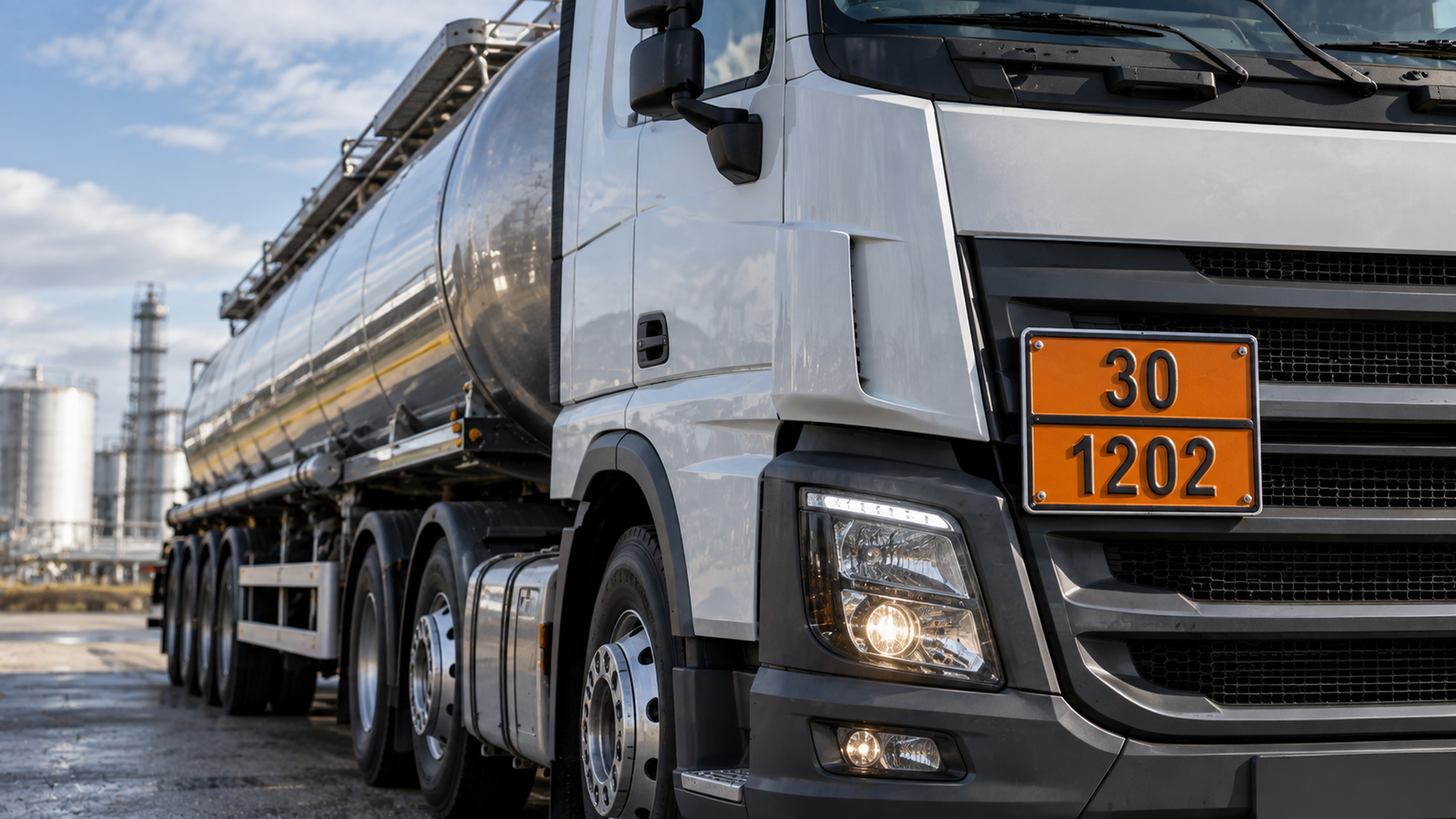
At the same time, the marking system has an international origin. The rules are enshrined in the agreement on the international carriage of dangerous goods by road — ADR, which is signed by 54 states. Russia uses these requirements both for international and domestic transportation, so the combination 33 and 1203 in any signatory country has the same meaning.
The top line describes the danger
The upper part of the plate indicates two or three digits. In official documents, this is the identification number of the hazard, and in everyday speech, the name “Kemler code” is more often used — named after the French professor, at whose initiative tanks began to be marked in this way. Later, the system began to be applied not only to road but also to rail transport.
Each digit is associated with a specific type of danger:
- 2 — means gas emission — due to pressure or chemical reaction;
- 3 — indicates the possibility of ignition of liquid, its vapors or gas, and 4 denotes a similar danger for solid substances;
- 5 — refers to oxidizers that do not burn themselves but support the combustion of other materials;
- 6 — warns of toxicity or infectious hazard;
- 7 — is associated with radioactive radiation;
- 8 — denotes a corrosive substance capable of affecting both metal and skin;
- 9 — indicates the possibility of spontaneous development of a dangerous reaction.
If the danger is present in a single form, a zero is placed after the corresponding digit. Repeating the same digit means that the severity of this danger is increased.
This is how the difference between gasoline and diesel fuel arises. The classification takes into account the flash point — the temperature at which a sufficient amount of vapors forms above the liquid for them to ignite from an external source.
For gasoline, this temperature is below 23 °C, so it corresponds to code 33. Diesel fuel requires heating to 23–60 °C, so 30 is used, and for modern diesel fuel with a flash point of 55 °C and above, this designation is also applied.
Three digits allow simultaneously showing several characteristics of the cargo. For example, 336 means a flammable and simultaneously toxic liquid, 338 — a flammable corrosive liquid, and 263 — a toxic flammable gas.
Special combinations and the letter X
In the system, there are combinations that cannot be deciphered only by individual digits. Some combinations have their own meaning. Thus, 22 denotes gas cooled to a liquid state and posing an asphyxiation hazard. Therefore, tanks with liquid carbon dioxide are marked with the combination 22 and 2187. For liquid oxygen, 225 and 1073 are used: this is also a cooled gas, but one that supports combustion.
The combination 23 means flammable gas. For example, propane-butane mixture for gas stations is transported with numbers 23 and 1965. There are other special designations:
- 333 refers to a liquid capable of igniting spontaneously, without an external source of fire;
- 90 is used for substances posing a danger to the environment;
- 99 denotes other dangerous substances that are transported in a hot state.
Sometimes the letter X appears before the digits. This is a separate warning for those who find themselves at the scene of an accident: contact with water for such cargo is unacceptable or can increase the danger. It can only be handled after appropriate authorization from specialists.
For example, X423 means a solid substance that, when interacting with water, releases flammable gas. The designation X88 refers to a highly corrosive substance that also reacts with water. The letter is actually addressed to those who will arrive at the scene with a fire hose.
The bottom line shows what is being transported
The lower part of the orange plate contains a four-digit UN number. This system is managed by the United Nations Committee of Experts. Theoretically, four digits allow for 10,000 combinations, but currently, approximately 3,500 numbers are used — from 0001 to 3500. The combination 0000 is not assigned to anyone.
A certain sequence in the list is still maintained. Explosives and related goods start with zero: for example, pyrotechnic articles correspond to 0335, and smoke signals — to 0197.
At the same time, one UN number can combine several substances with similar purposes. Under number 1203 are motor gasoline, gasolin, and petrol. Number 1202 refers simultaneously to diesel fuel and gas oil. For petroleum distillates and blended petroleum products, 1268 is used, and for aviation kerosene — 1863.
The opposite situation also occurs: one substance is assigned two different numbers if it poses a different danger in solid and liquid states. For the same reason, solutions with different concentrations can receive different designations.
For a bitumen truck, the combination 99 and 3257 means a hot liquid, heated to 100 °C and above, but not yet reaching its flash point. For bitumen, it is approximately 230 °C. If it is transported at a temperature above this value, the number will change to 3256.
It turns out that the two parts of the plate perform different tasks. The top shows what danger should be expected from the cargo, the bottom identifies the cargo itself. By the UN number, you can refer to the index and find an emergency card describing the course of action in case of a leak or fire.
Why a diesel fuel truck can drive with numbers 33 and 1203
One fuel truck tank is divided by partitions into several sections. Therefore, the truck can go on a trip with gasoline in some compartments and diesel fuel in others. Under normal rules, in such a case, separate plates would be required on the sides — for each section with its own designation.
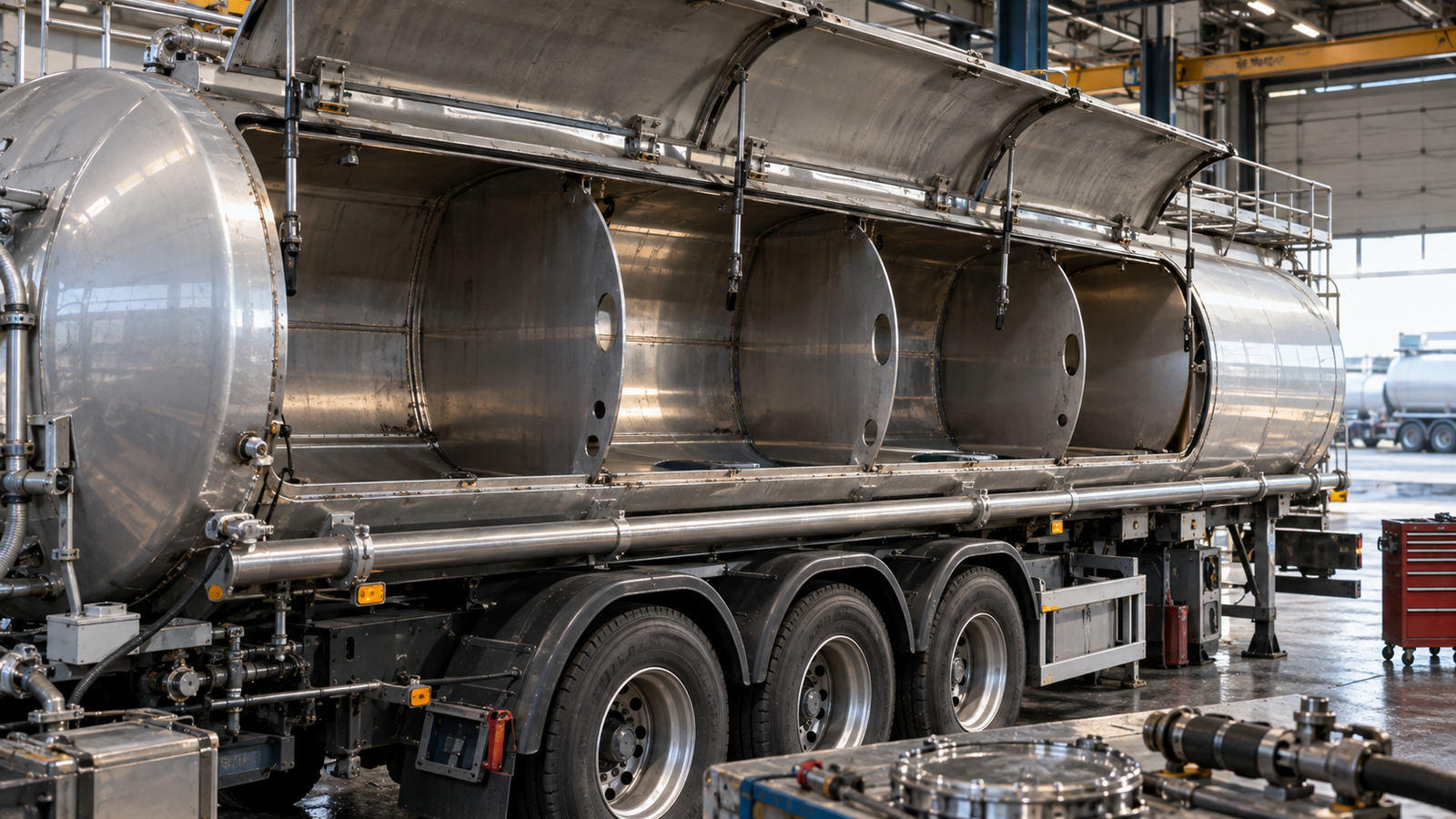
A concession is provided for motor fuel. If individual sections are filled only with gasoline, diesel fuel, kerosene, or aviation fuel, two plates are sufficient: one in front and one in back.
At the same time, both indicate the designation of the most dangerous of the transported goods. The flash point serves as the criterion again: the lower it is, the more dangerous the corresponding fuel is considered. Therefore, if in one tank part of the sections are occupied by diesel fuel, the presence of numbers 33 and 1203 in front and behind is not an error.
However, adding another cargo to the tank can completely change the marking order. If motor oil is added to diesel fuel, the previous concession ceases to apply.
In such a case, each section must receive its own plate on both sides, with the corresponding numbers indicated on it. In front and behind the vehicle, clean orange rectangles without designations are installed.
The same empty plates are used on ordinary trucks carrying dangerous goods in packaging. The marking must correspond to the actual contents of the vehicle at any given moment.
If gasoline is poured into the tank instead of diesel fuel, the designation changes from 30 and 1202 to 33 and 1203. This is why the vehicles are equipped with frame holders, folding structures, and empty plates designed for installing interchangeable metal digits.
There is a fundamental rule: the information on the orange panel must coincide simultaneously with what is inside the tank and with the data in the transport documents.
Why the numbers are made in relief
A separate requirement is imposed on the marking: both numerical designations must remain legible even after the plate has spent 15 minutes in fire.
On the tank itself, red diamonds with a flame image — hazard signs of class 3 — are placed nearby. However, the question remains whether such signs will survive after prolonged exposure to fire and whether the information applied to them can then be deciphered.
With metal digits, the problem is solved differently. They are physically protruding or embossed in the metal, so the information is preserved even with serious surface damage. Overlay signs have a height of 10 cm, and the line thickness on them is 15 mm.
The orange base of the plate is made of reflective film. At the same time, the design itself is designed for operation in all weather conditions. It is also important in an emergency: the marking must remain accessible even when it is no longer possible to get into the cabin and access the documents.
Why an empty fuel truck still retains its marking
After unloading, a fuel truck does not necessarily become an “empty” vehicle from the point of view of dangerous goods transportation rules. For example, the vehicle has drained fuel at a gas station and returned to the oil depot. The orange plates remain in place.
The reason is that until the fuel residues are removed from the tank and its vapors are eliminated, it continues to be considered loaded. Consequently, the designations cannot be removed.
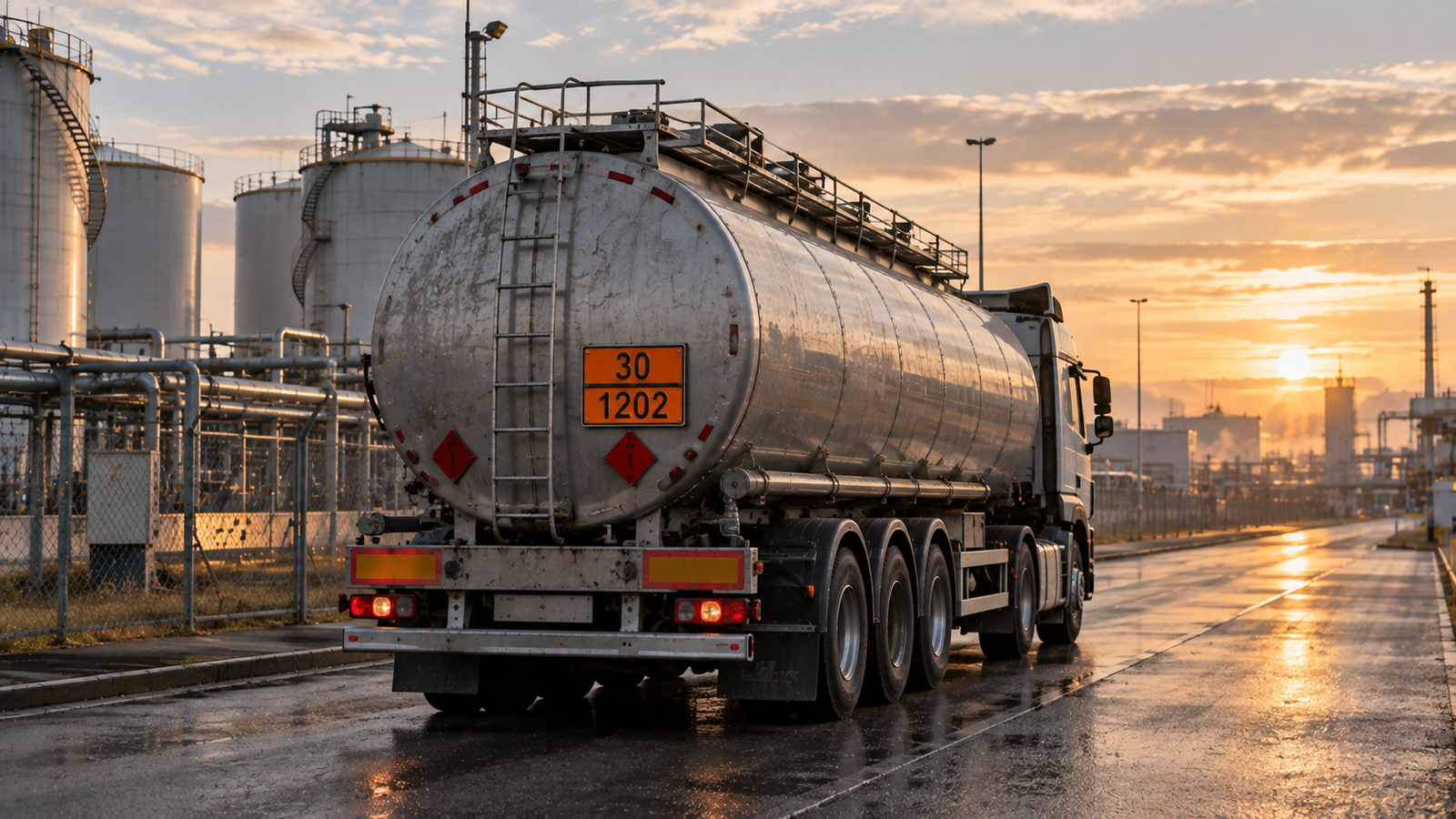
The danger in such a situation is not only related to the remaining gasoline itself. Vapors above the liquid play a significant role. If the tank is filled with fuel, it will burn in a fire, whereas a container in which a predominantly vapor-air mixture remains can explode.
Therefore, the orange plate continues to perform its task even after the bulk of the cargo has been unloaded. Until the tank is brought to a state where residues and vapors are eliminated, its marking must be maintained.
Read more materials:
- Engine 'knocked' after sale: who will pay for repairs
- 'Atom' went into production: can the market accept its price
- How an electric car was the first in history to accelerate to 105 km/h
Комментарии