Among the most unusual domestic cars of the late 1990s, the GAZ "Ataman" family holds a special place. Unusual proportions, a frame structure, and plans to create several models at once made this project one of the most ambitious in the history of the Gorky Automobile Plant.
Despite successful tests and the production of a pilot batch of cars, mass production never materialized.
From Pickup to a Full-Fledged Family
The project's history began in 1995 with the rear-wheel-drive pickup GAZ-2307.
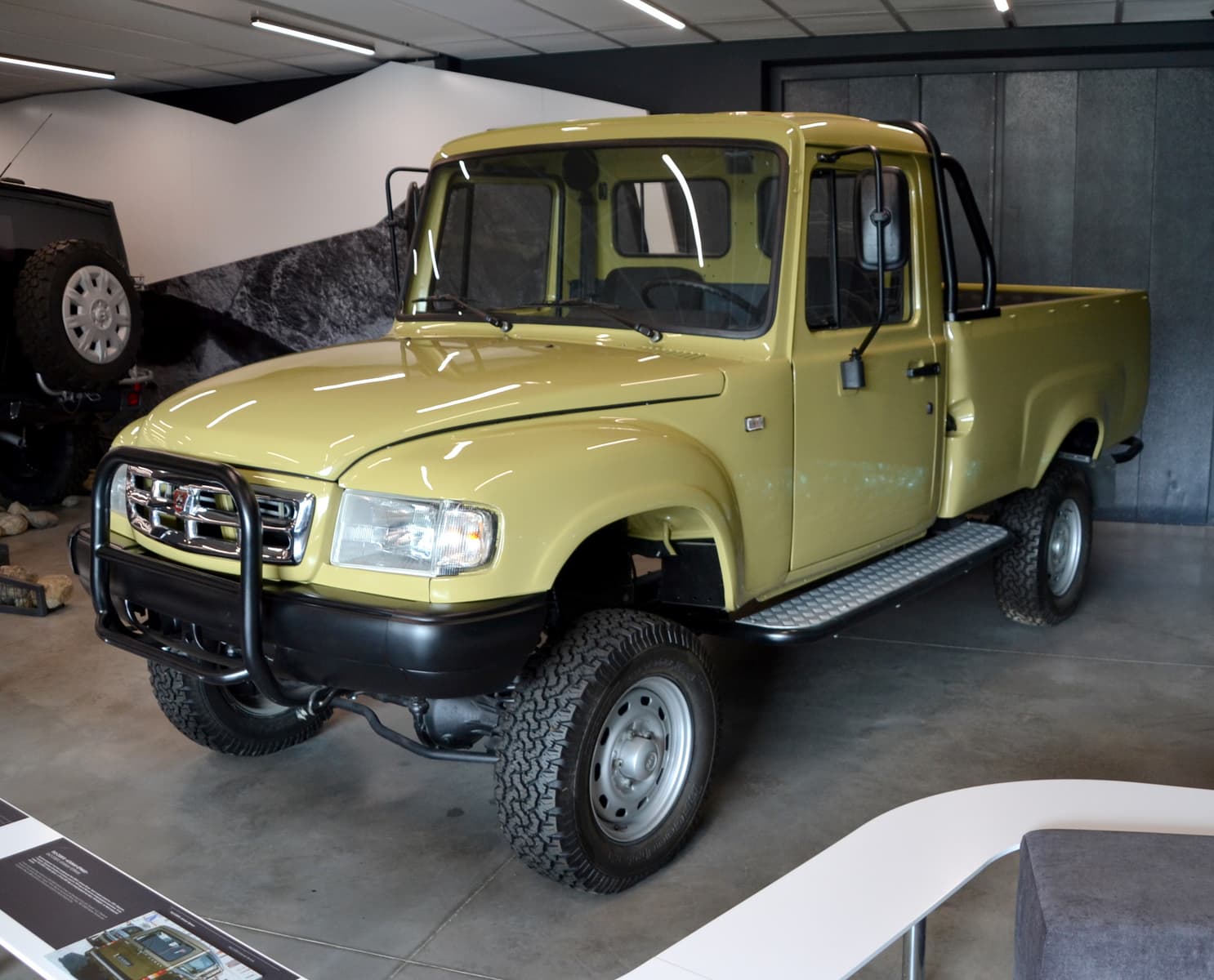
Soon, an all-wheel-drive version, designated GAZ-2308 "Ataman," was developed based on it.
Initially, designers considered the platform not as a separate model, but as a basis for an entire family of vehicles.
It was supposed to include:
- pickups of various carrying capacities;
- frame-based SUVs;
- passenger station wagons;
- special versions for various services.
All vehicles were planned to be built on a common frame with maximally unified components.
Unusual Appearance
One of the most memorable features of the car was its design.
To reduce costs, developers used components already mastered by the plant.
The cabin was borrowed almost unchanged from the GAZ-3307 truck.
The front part of the car was redesigned, using elements made with optics from the "Volga" family.
The result was an unusual silhouette, combining a truck-like stance and a car-like front end.
It was thanks to this that the "Ataman" quickly became one of the most recognizable domestic experimental cars.
Construction and All-Wheel Drive
The car received a classic frame layout.
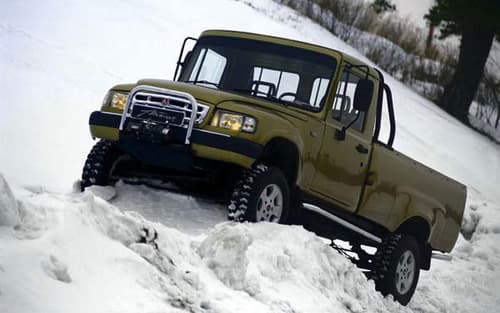
The design included:
- welded ladder frame;
- front dependent suspension on springs;
- rear leaf spring suspension.
In addition to rear-wheel-drive modifications, versions with permanent all-wheel drive, a transfer case, and a reduction gear were developed.
This combination provided good off-road capabilities.
What Engines Were Planned to Be Installed
Initially, the project envisioned a wide range of power units.
Among the options considered were:
- licensed Steyr diesel engines;
- ZМZ-406 family gasoline engines with a volume of 2.3–2.7 liters;
- promising V6 and V8 engines with a volume of up to 5.5 liters.
Some experimental vehicles used the GAZ-560/561 turbodiesel with a working volume of 2.1 liters and a power of 110 hp, created on the basis of the Austrian Steyr design.
Several Modifications of One Platform
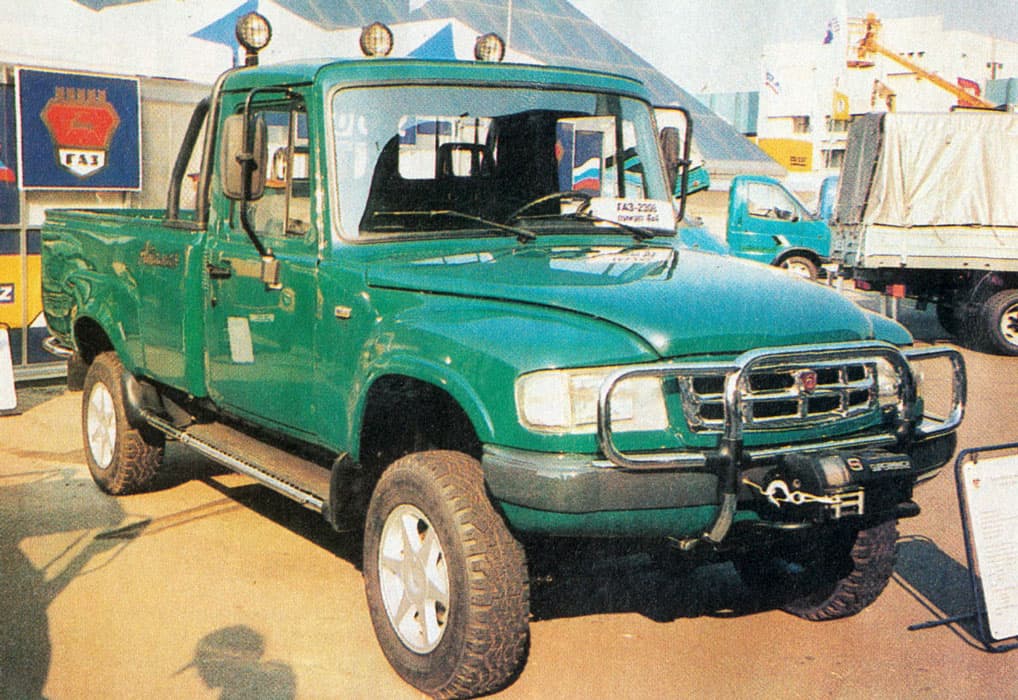
The all-wheel-drive GAZ-2308 "Ataman" was first presented to the public at the MIMS-96 Moscow International Motor Show.
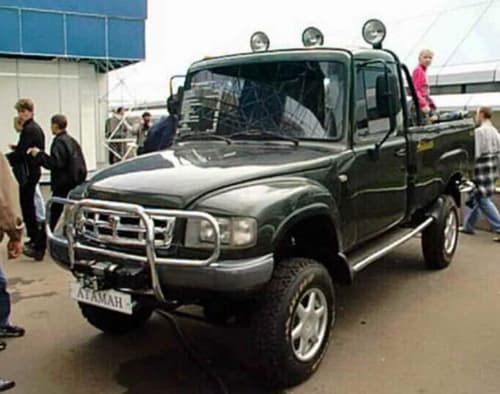
Later, the family was supplemented with new versions.
Among them:
- GAZ-230812 with a double cab and a closed body;
- nine-seater station wagon GAZ-230810 "Ataman Yermak";
- rear-wheel-drive GAZ-2309, which received the unofficial nickname "Atamansha".
During tests, both versions confidently overcame climbs with a gradient of up to 20–25 degrees on unpaved surfaces.
At the same time, on loose sand, the advantages of all-wheel drive became significantly more noticeable.
In total, engineers worked on about 20 different modifications, but most projects never went beyond design documentation.
Why the Project Was Canceled
By the end of development, the Gorky Automobile Plant had already produced about 100 experimental vehicles for fine-tuning tests.
The launch of serial production of the all-wheel-drive pickup was planned for November 2000.
However, these plans could not be realized.
After control of the enterprise passed to the "Basic Element" company, a large-scale reorganization of production began.
As part of the change in development strategy, some promising projects, including the "Ataman" family, were closed even before the start of serial production.
Related Project – "Kombat"
In parallel, another interesting car was created based on "Ataman" components – the compact SUV GAZ-2169 "Kombat".
Compared to the base platform, its wheelbase was reduced from approximately 2820 to 2350 mm, and its appearance acquired features of the classic GAZ-69.
The car's design was unusual for the domestic automotive industry.
The body was made of fiberglass panels attached to a tubular steel frame.
In 2001, the only running prototype was modernized:
- the body was repainted in metallic blue;
- a rigid plastic roof was installed;
- the model received the index GAZ-3120.
In 2004, another experimental version of the "Kombat" appeared with a modified design and increased dimensions.
However, this project also did not receive serial continuation.
Why "Ataman" Remains Interesting Today
Although the family never reached the conveyor belt, "Ataman" is considered one of the most ambitious and unusual projects of the Gorky Automobile Plant of the late 20th century.
The car combined a frame structure, all-wheel drive, wide unification possibilities, and a large number of planned modifications.
Today, surviving examples are of interest not only to collectors but also as a reminder of what a Russian SUV could have become if the project had been given a chance for serial production.
Read more materials:
- Disc-less wheels: why they were invented and why they were forgotten
- How Alfa Romeo turned its flagship sedan into a fire pickup and built a racing car with a V10 engine
- Cylinder head gasket fails: 5 dangerous symptoms
Комментарии