Almost every Russian motorist has heard the common phrase: «More speed — fewer potholes». It sounds like folk wisdom and seems quite reasonable at first glance. The logic is simple: if you drive fast, the wheel supposedly doesn't have time to fall into the pothole and «jumps» over it, which means the impact on the suspension will be minimal.
In practice, it is this logic that most often leads cars to the lifts of auto repair shops. It is no coincidence that mechanics smirk at fans of high-speed «treatment» of bad roads: they are the most frequent customers. To understand why, you need to turn not to feelings, but to physics.
The illusion of softness: where does the feeling of «flying» come from
There is a rational kernel in the myth. At high speed, the wheel really has less time to lower down under the action of the spring and shock absorber. If the pothole is narrow, the tire can partially «lick» its edges or pass along the upper edge. In the cabin, this is felt as a slight jolt, and not as a sharp blow.
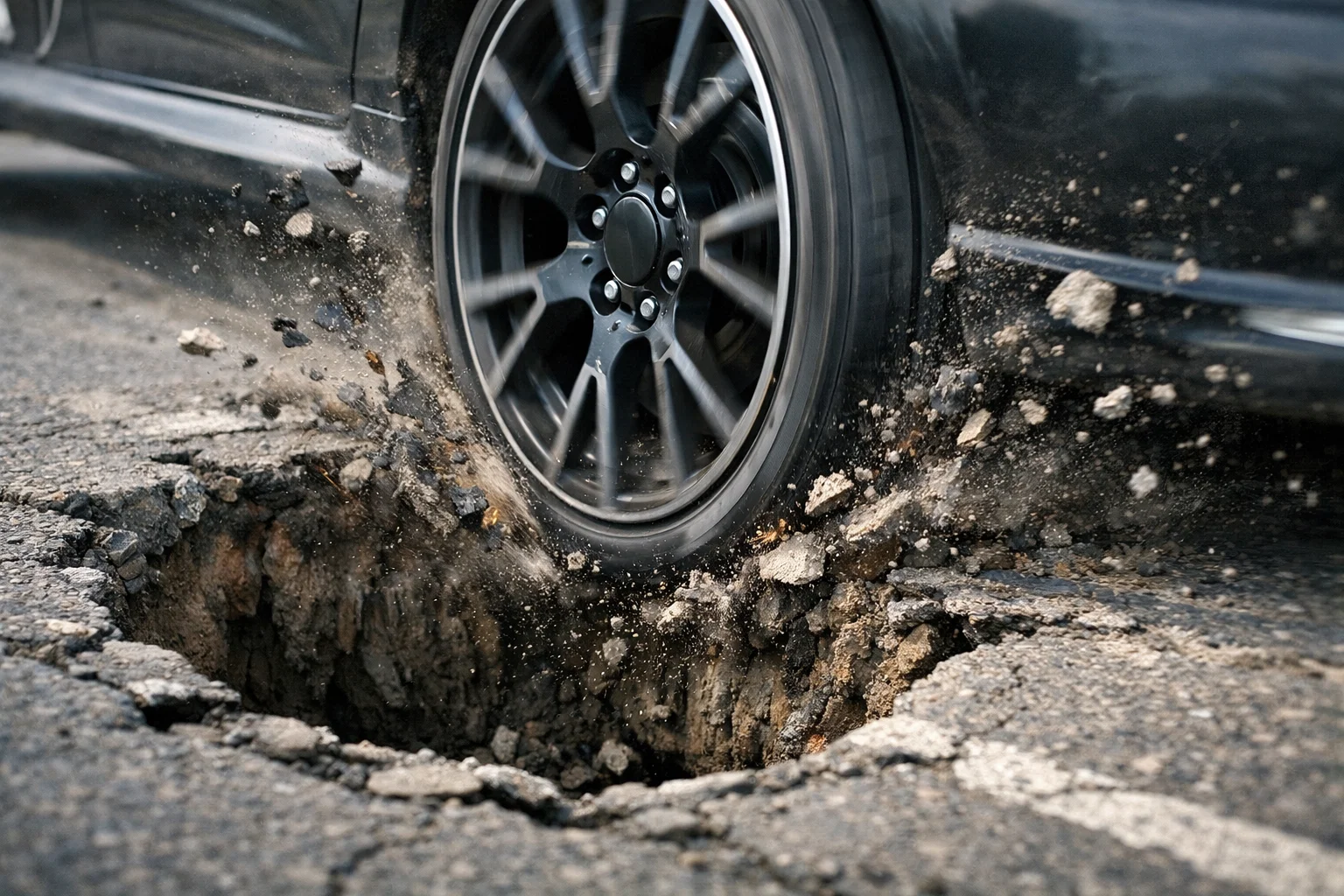
This is what misleads the driver. It seems that the car «skipped» the bump almost without consequences. However, this picture is possible only if several factors coincide at once: shallow depth, small width, and a good angle of entry. If at least one parameter goes beyond the limit, the situation changes dramatically.
If the pothole turns out to be deep or wide, the wheel still falls into it. And then a law comes into force that does not forgive mistakes: the impact energy increases in proportion to the square of the speed. Simply put, doubling the speed means a fourfold increase in the load on the suspension. And it is almost impossible to recognize a «safe» pothole on the go.
How speed destroys a car
Comfort in the cabin is a poor indicator of the car's condition. What the driver did not feel, the suspension «felt» in abundance.
Shock absorber breakdown. At high speed, the suspension does not have time to smoothly work out the bump. The shock absorber compresses instantly and rests against the bump stop. Regular such impacts lead to leaks, loss of efficiency, or complete failure of the shock absorber.
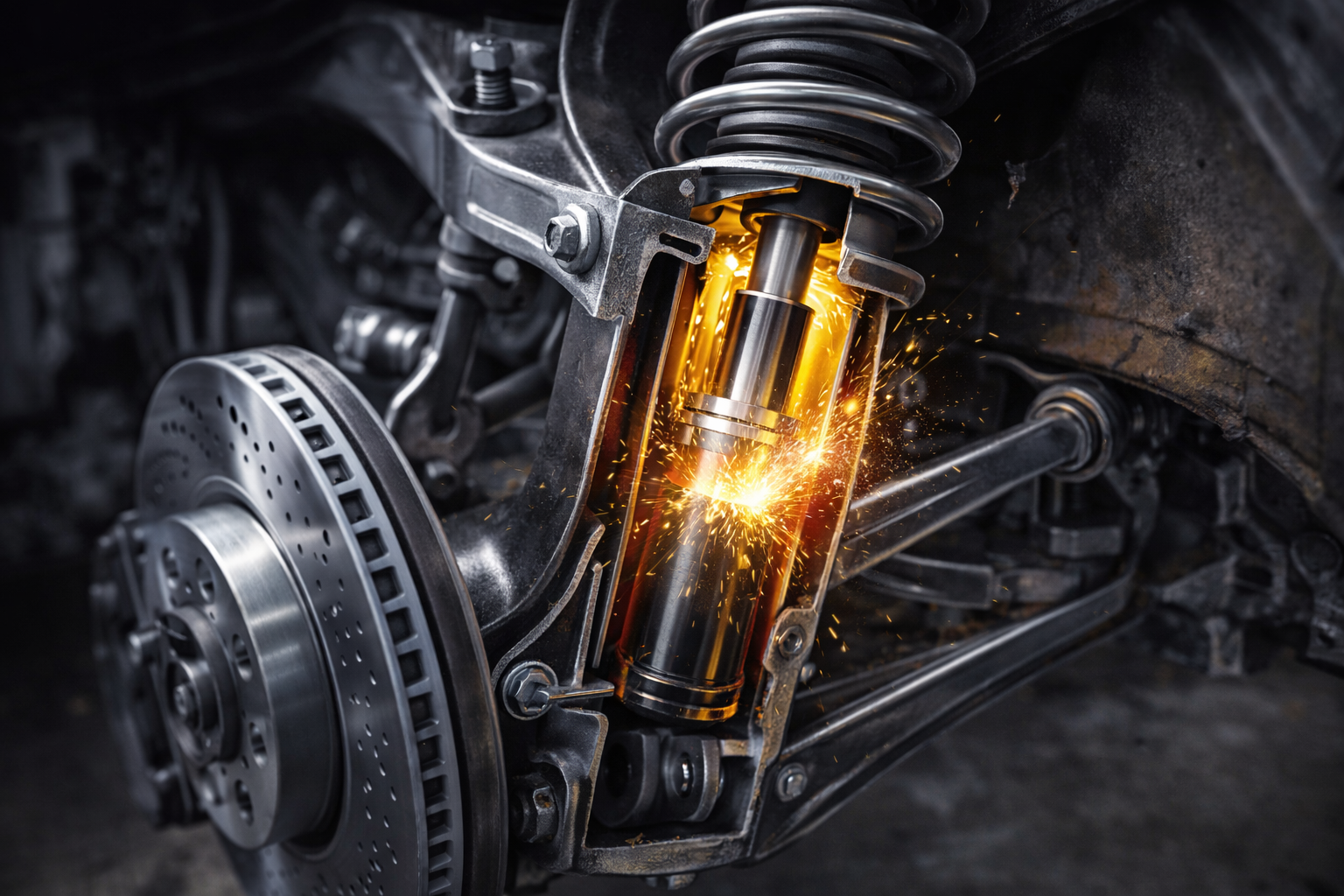
Hernias and disc deformation. The wheel at speed crashes into the sharp edge of the pothole. The tire is clamped between the disc and the asphalt, which often ends in a cord rupture and the appearance of a hernia. Aluminum discs are easily bent and sometimes cracked.
Hidden damage. Even if the impact «did not echo» in the cabin, the load is transmitted further — to the ball joints, silent blocks, steering rack. These elements rarely break immediately, but the accumulated effect manifests itself after months in the form of play, squeaks, and knocks.
Impacts on the body. Modern cars have a load-bearing body. Hard impacts at speed gradually «shake» it, causing squeaks, distortions, and even cracks on the windshield.
Where did this phrase come from at all
The popular saying has a continuation that is usually not quoted: «…and more grief to the locksmiths».
Initially, it was invented by drivers of old trucks, military equipment, or rigid SUVs with huge wheels and leaf spring suspension. Such cars could indeed afford a barbaric attitude to the road.
For a modern car with low-profile tires, aluminum levers, and a complex multi-link suspension, this strategy is akin to slow suicide. The softness of sensations is just an illusion. The impact simply does not have time to reach the driver, but it perfectly reaches the iron.
How to drive properly on broken roads
If there is a section ahead that looks like a minefield, gas is the worst advisor. Technique is much more important.
Brake in advance. The most common mistake is to press the brake when hitting a pothole. At this moment, the car's nose pecks down, the suspension compresses and loses its stroke. The impact goes directly into the body.
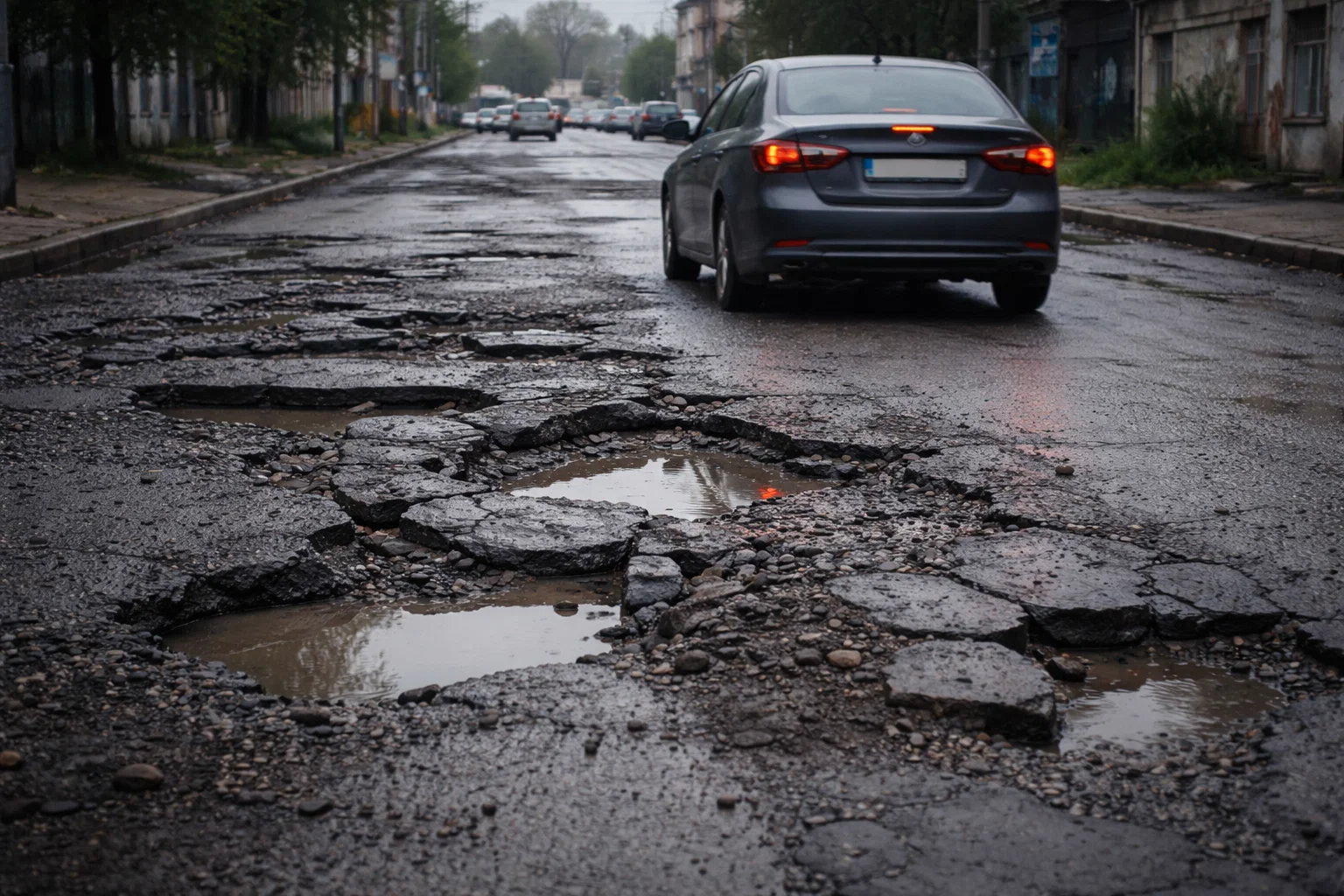
Release the brake before the pothole. A fraction of a second before the bump, the pedal must be released. The suspension will unload and be able to work out the impact as efficiently as possible.
Unloading the wheel is a technique for experienced drivers. A brief transfer of weight from one side to the other really helps, but requires accurate calculation of speed and coverage. On a slippery or loose surface, a sharp turn of the steering wheel easily ends in a skid. For most drivers, this technique is redundant.
Look into the distance. The further the gaze is directed, the smoother the trajectory. It is always safer to drive around a pothole in an arc than to fly into it in a straight line, even at a lower speed.
Speed does not cure bad roads. It only masks the impacts, making them more destructive to the car. Saving a couple of minutes today almost always turns into repair costs tomorrow.
The suspension is one of the most expensive units to maintain. Driving a section 15–20 km/h slower is much more profitable than spending weekends and money in the service later. And the main conclusion remains simple and universal: you can't fool physics — neither with sayings nor with sensations.
Read more materials on the topic:
- Air filter as new: a simple way to restore a part with your own hands
- Why did they drive without winter tires in the USSR in winter
- Music while driving: helper or hidden threat
Комментарии