After the completion of new asphalt paving on a road, one can sometimes notice neat round holes about 10–15 centimeters in diameter. At first glance, it might seem that the pavement has already been damaged, but in reality, such cuts are part of mandatory quality control.
It is through these holes that specialists obtain samples of the road pavement for laboratory research.
What is a road core
A cylindrical sample of asphalt concrete is called a core.
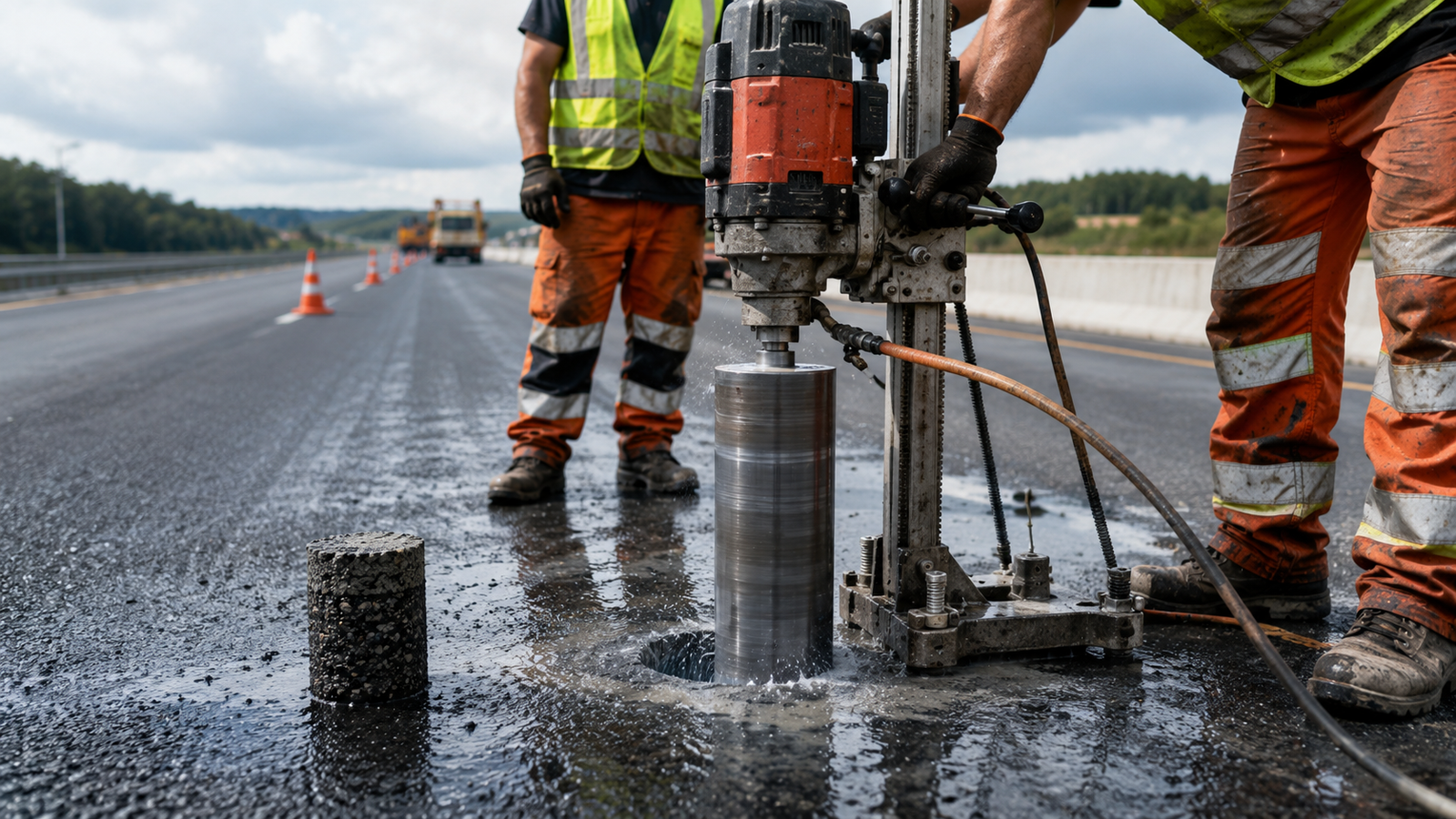
This term comes from geology, where it refers to a cylinder of rock extracted from a borehole during drilling.
A special device — a core drill — is used for sampling.
Its working tool is a hollow metal crown with diamond segments.
During drilling, water is continuously supplied to the working area.
It performs several tasks at once:
- cools the cutting tool;
- reduces crown wear;
- prevents overheating and softening of bitumen.
After reaching the required depth, the cylindrical sample is carefully removed from the pavement.
On some sites, diamond saw cutters are used instead of core drills.
In this case, the cut is rectangular, not round.
Why samples are cut
The main purpose of the core is to verify that the constructed road complies with the project documentation.
It is impossible to visually determine the thickness of the road pavement.
Under the top layer of pavement are other structural elements:
- asphalt concrete layers;
- crushed stone base;
- sand preparation;
- additional reinforcing materials.
Only after extracting a sample does it become possible to measure the thickness of each layer and ensure that it corresponds to the project.
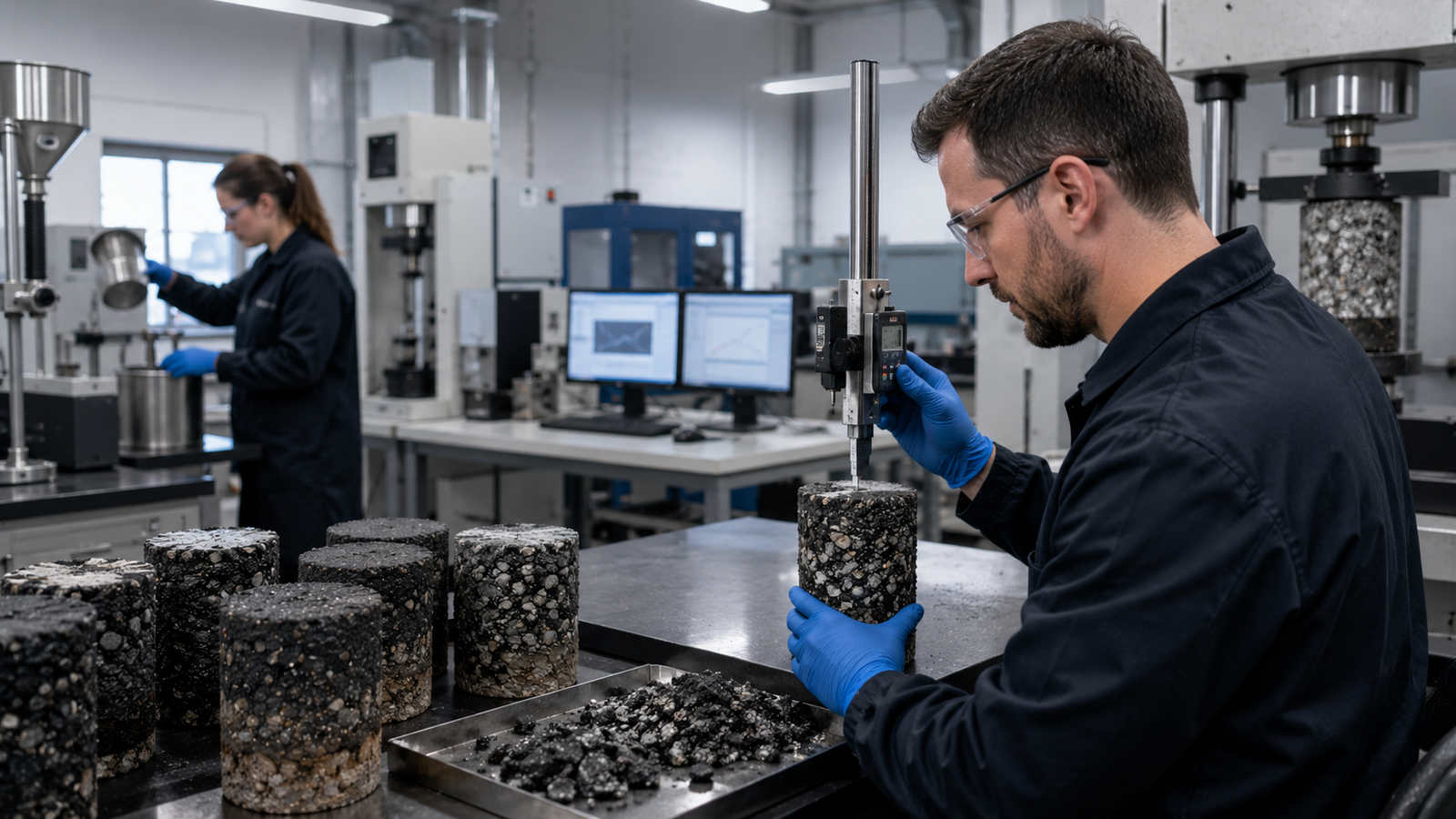
What is checked in the laboratory
Pavement thickness is far from the only parameter assessed by specialists.
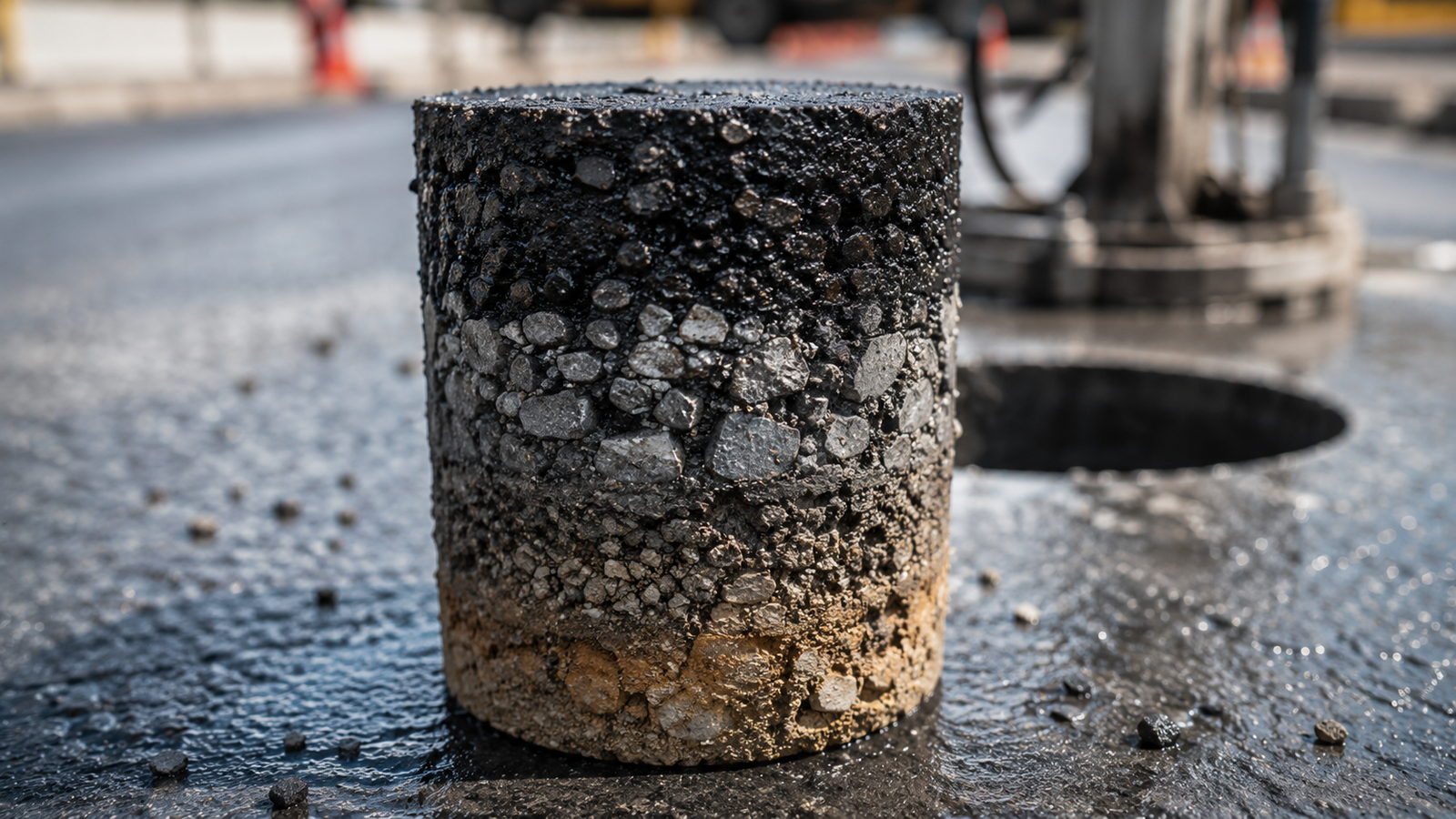
During testing, the following are determined:
- asphalt concrete density;
- air void content;
- material strength;
- adhesion between pavement layers;
- mixture composition and bitumen binder content;
- compliance with regulatory requirements.
Insufficient pavement density leads to moisture penetration into the structure.
At sub-zero temperatures, water freezes, expands, and gradually destroys the asphalt.
In addition, the laboratory assesses the quality of adhesion between layers.
If it is insufficient, the pavement may begin to delaminate in the first years of operation.
Modern non-destructive testing methods are also used in road construction, but it is the core that allows the most complete assessment of the internal structure of the pavement.
Where the extracted core is sent
After sampling, each sample is marked.
The documentation records:
- sampling location;
- date;
- section number;
- information about the construction object.
Then the core is placed in protective packaging and delivered to the laboratory.
Sampling times depend on the type of mixture used.
When using hot asphalt concrete, testing usually begins the day after paving.
If a cold mixture was used, the material is allowed to gain the necessary strength, after which testing begins.
In the laboratory, samples are prepared and tested in accordance with the requirements of current state standards.
Based on the test results, a decision is made on the compliance of the completed work with the established requirements.
If serious deviations are found, the contractor is obliged to eliminate the deficiencies in the manner provided for by the terms of the contract and current regulations.
How many samples are taken
One core is not enough for an objective assessment of the quality of the entire road.
Pavement thickness can vary slightly even on adjacent sections.
Therefore, the number of samples is determined by regulatory documents.
As a rule:
- on roads up to 7 meters wide, three cores are taken for every kilometer;
- on wider objects, the number of samples is calculated based on the pavement area.
The sampling location is chosen taking into account regulatory requirements, stepping back from the edge of the roadway by at least half a meter.
That is why on one section of the road you can sometimes see several identical holes at once.
What happens to the hole after inspection
After sampling is completed, the hole must be restored.
Usually, the following are used for this:
- hot asphalt concrete mixture;
- cold asphalt concrete with subsequent compaction.
The rules provide for prompt restoration of the pavement after testing is completed.
If the hole is not filled in time, water and contaminants begin to accumulate in it.
During repeated freezing and thawing cycles, the edges gradually collapse, which can eventually lead to the formation of a pothole.
Why other versions appeared
There are several popular explanations for the origin of such holes.
One of them links them to the compensation of thermal expansion of asphalt.

Another version claims that water is supposedly drained from the road structure through them.
In practice, both hypotheses do not correspond to road construction technology.
Compensation for thermal deformations is provided by the pavement structure itself, and longitudinal and transverse slopes, a drainage system, and storm sewers are responsible for water removal.
The real reason
Round holes in new asphalt appear exclusively for taking control samples.
Without core research, it is impossible to reliably check the thickness of the road pavement, the quality of compaction, the composition of the mixture, and the compliance of the completed work with project requirements.
Therefore, such cuts are not a sign of defect, but one of the mandatory stages of construction control, allowing to assess the quality of a new road even before its full operation.
Read more materials:
- Spoiler on the trunk: real benefit or design element
- German car market in 2025: who is leading and why cars have become gray
- Disc-less wheels: why they were invented and why they were forgotten
Комментарии