There is one winter scene that repeats year after year and invariably brings a smile. The first truly proper snow falls, the asphalt is covered with ice — and the traditional show begins. You drive along the highway, look at the shoulders, and already picture the familiar scene: old Logans, tired Priors on bald tires, sadly sticking out of snowbanks. Everything is logical, right?
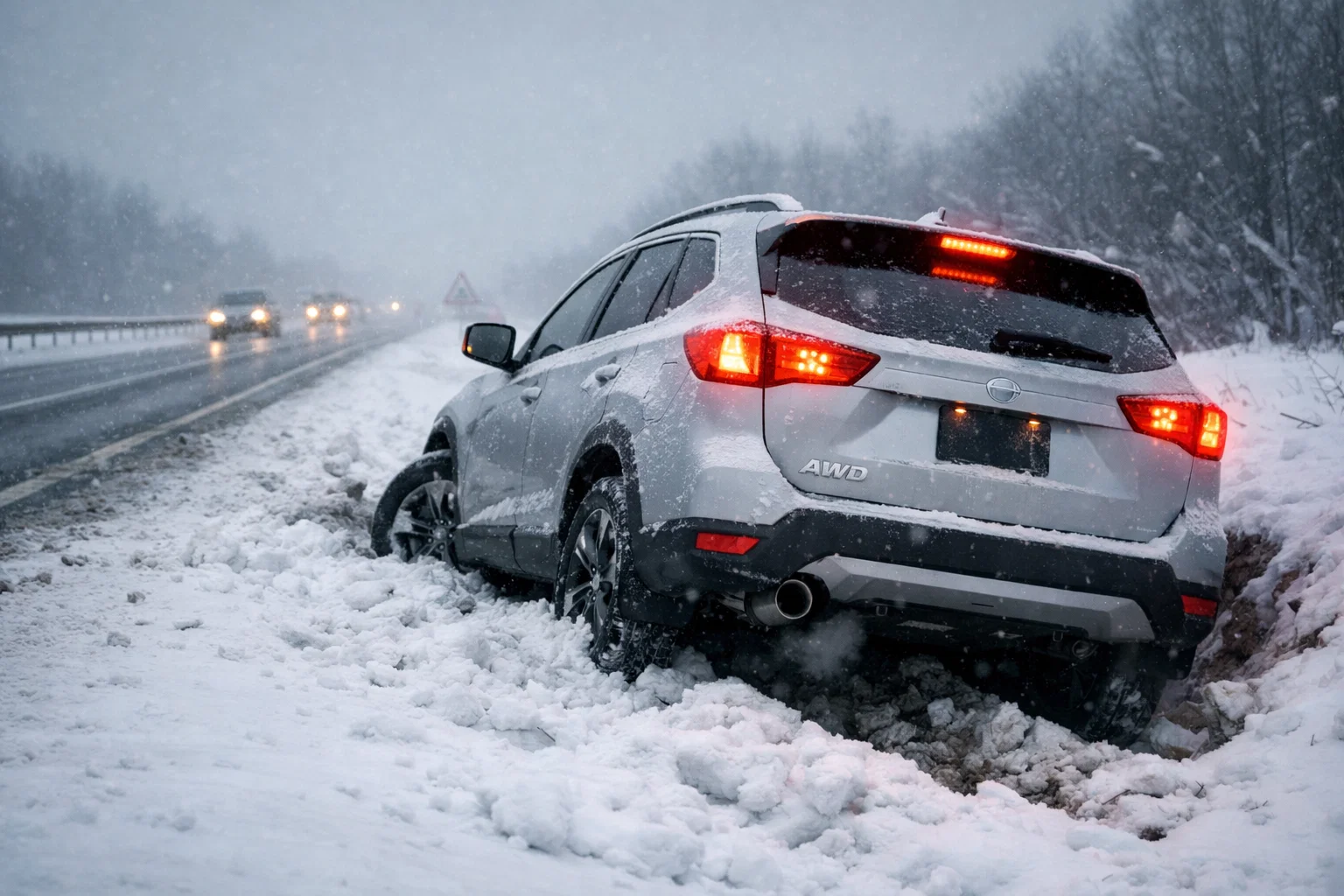
But reality turns out differently every time. For some reason, what end up in the ditches are fresh Tiguan, RAV4, and Sportage models. New, well-kept, with shiny AWD badges and proud 4Motion and xDrive lettering. Their hazard lights are blinking as they wait for help.
At first, it seems like a coincidence. Then, that they were simply unlucky. But if you look more closely, it becomes clear: there are no coincidences here.
The illusion of omnipotence
The root of the problem is simple. A person buys an all-wheel-drive car and sincerely believes that, along with it, they have acquired extra abilities. The car easily starts on an icy incline without wheelspin — so the machine "can do it." It got out of a snowbank in the yard — so now anything is possible.
And this is where the key misconception appears. All-wheel drive really does work — but only during acceleration. When four wheels are turning instead of two, grip at launch and under acceleration is objectively better. No one argues with that.
But after that, physics begins — and it is the same for everyone.
Braking: where AWD is powerless
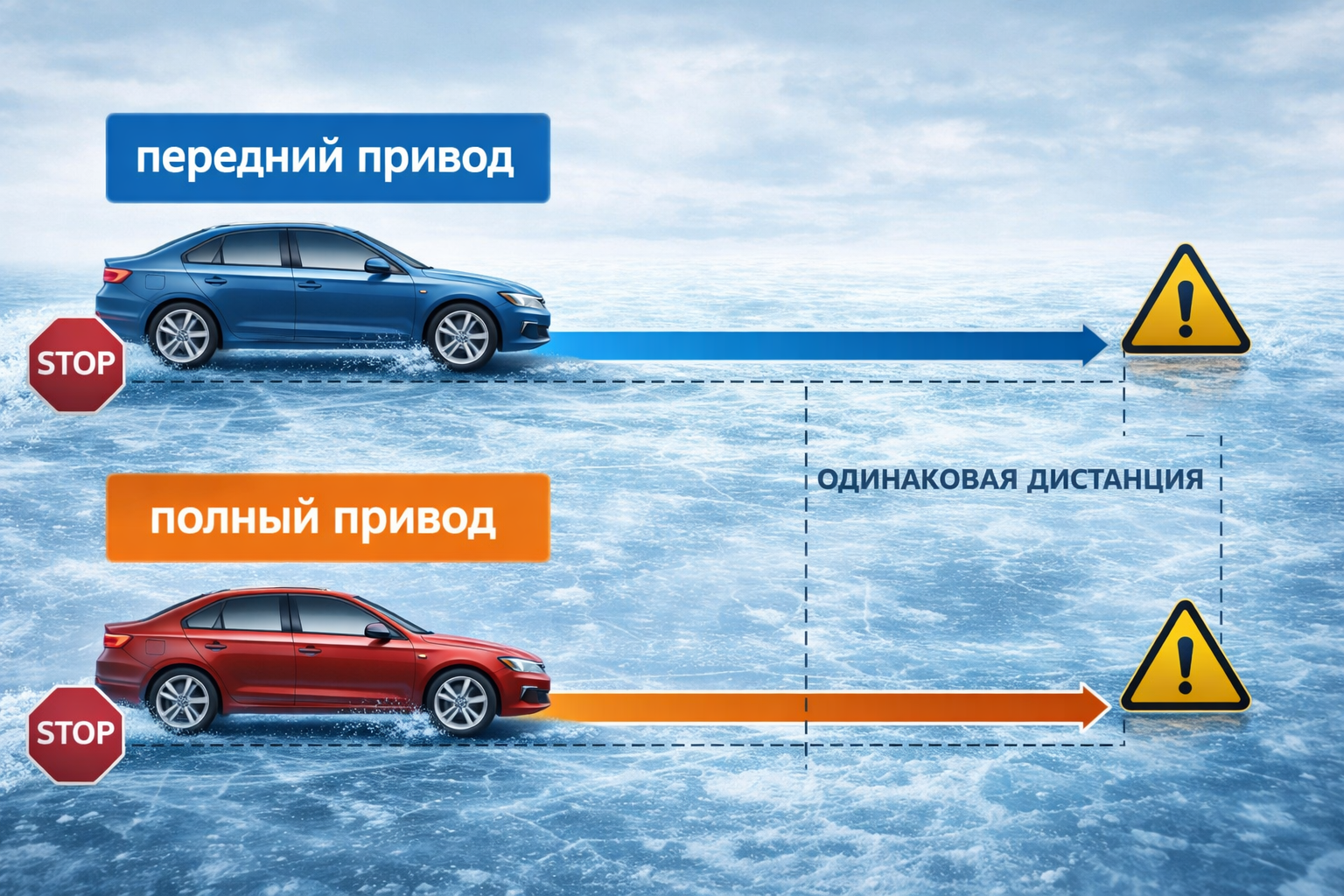
When slowing down, nothing magical happens. The brake pads press against the discs the same way — whether in a conventional Camry or a large Highlander. The type of drive plays no role at that moment. The tire-to-ice friction coefficient remains exactly the same, and it cannot be fooled by either a badge or marketing.
The American Insurance Institute for Highway Safety, IIHS, once closely studied winter accident statistics. The result was unexpected for many: all-wheel-drive cars get into accidents no less often, and sometimes even more often, than front-wheel-drive cars. The reason is simple — they more often end up in situations that a cautious driver in a front-wheel-drive car simply would not have ventured into.
Consumer Reports went even further and conducted timed measurements on ice. The braking distance of all-wheel-drive vehicles and ordinary cars turned out to be almost identical. The difference was within about a meter either way — a value comparable to measurement error.
The most dangerous part is not the technology, but psychology
The main problem is not even the car's design, but the driver's sensations. Behind the wheel of a modern crossover, a person feels confident, almost invulnerable. The high seating position, heavy body, and all-wheel drive — all of this creates an illusion of control.
And then small, almost imperceptible deviations begin: you enter a corner a little faster, the following distance shrinks by a couple of meters, braking is delayed by a fraction of a second.
Taken separately, these are trifles. But it is precisely from these "slight" changes that a crash is built.
Researchers at the Georgia Institute of Technology studied driver behavior in bad weather and got a revealing result: owners of all-wheel-drive cars exceed the speed limit 8–12% more often than others. All else being equal — on the same road and in the same snowfall.
People sincerely believe that technology will back them up. And then they find themselves in a ditch, with a puzzled question: how could this happen when there were four driven wheels?
A contrast that explains everything
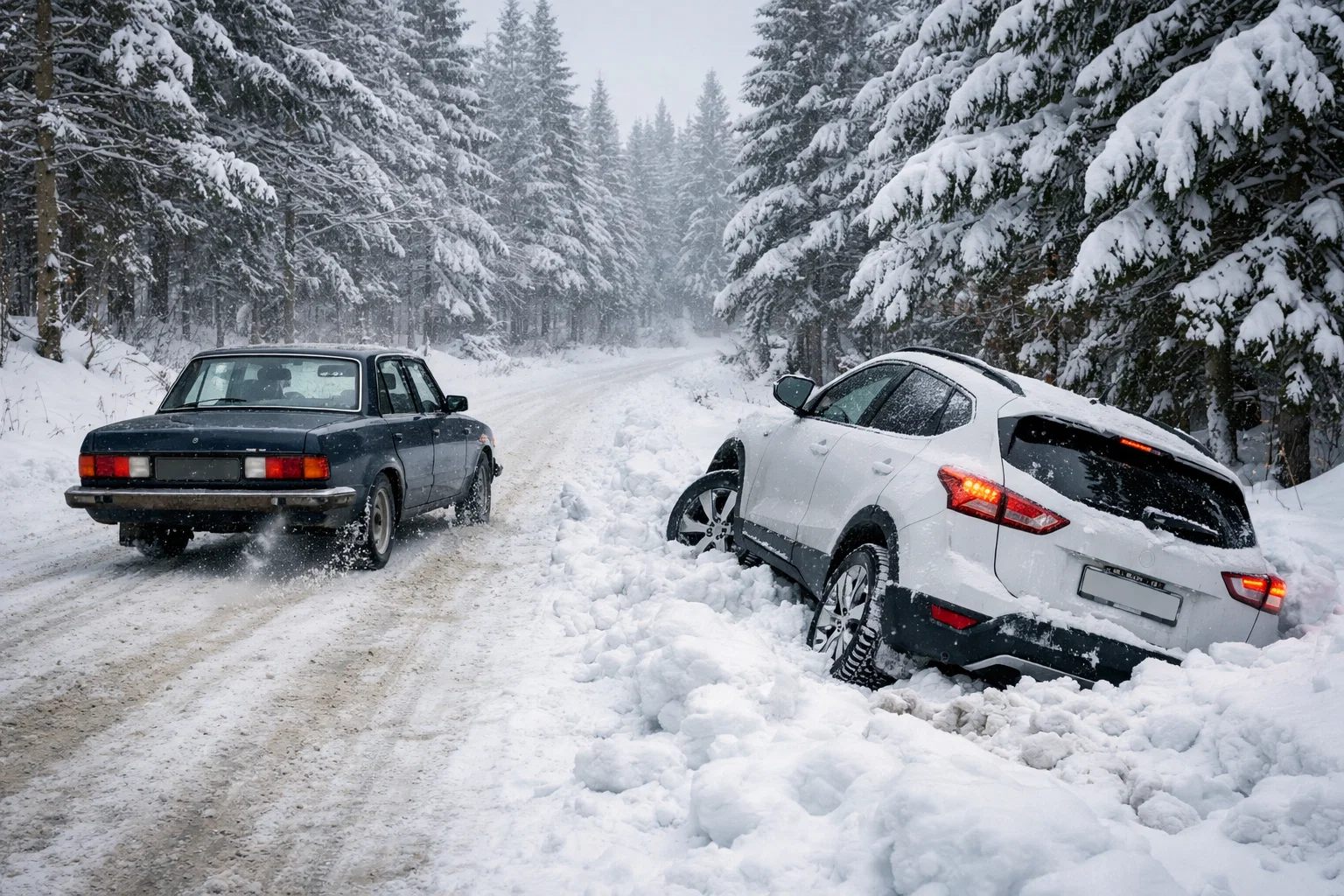
The picture becomes especially clear when a driver in an old front-wheel-drive Almera stops nearby. On proper studded tires. He calmly drove through the same place where the crossover flew into a snowbank. Not because the car is better, but because the person was driving according to the weather and was not trying to prove superiority to the road.
A crossover is not an SUV
There is another persistent misconception. A crossover looks substantial: large wheels, a tall body, plastic cladding. Visually, it is almost an off-road conqueror.
In reality, an ordinary passenger-car platform is hidden under that appearance. Ground clearance is increased by a little over ten centimeters, trim pieces are added — and that is all. Approach and departure angles are modest, overhangs are long, and geometric cross-country ability is limited.
Avtorevyu magazine regularly conducts illustrative comparisons: a fashionable crossover versus an old Niva in identical conditions. The result is predictable — the one that gets farther is not the car that costs twice as much.
Tires matter more than drive type
The situation is made worse by the fact that many crossovers come equipped with low-profile tires. Beautiful, striking, large wheels gleam — excellent in the city. But in loose snow, such a tire digs itself in instantly: the profile is small, the contact patch is weak.
If you look at winter tests over the last ten years — ADAC, Finland's Test World, Russia's Za Rulem — the conclusion is the same everywhere. Tire quality matters more than drive type. And not just slightly, but fundamentally.
Front-wheel drive on fresh studded tires consistently beats all-wheel drive on hardened all-season tires: in acceleration, in braking, in cornering handling.
This is not someone's opinion, but measurement results.
According to ADAC, switching from summer tires to winter tires reduces braking distance on ice by 1.5 to 2 times. No all-wheel-drive system provides an effect comparable to that.
All-wheel drive cannot be called useless. It really does help: start moving on an icy hill, get out of an unplowed yard, accelerate more confidently in loose snow.
But the moment the driver starts believing that the car can repeal the laws of physics, danger appears. Ice remains slippery for everyone. Inertia is the same. And during emergency braking in front of a truck that has suddenly come to a stop, all-wheel drive will do nothing.
Experienced drivers know this. But those who have recently switched from an ordinary passenger car to a crossover and have already been inspired by its new capabilities often overestimate the machine and underestimate the winter road. And it is they who most often become those very "unexpected" exhibits in the ditch.
Read more on the topic:
- "More speed — fewer potholes": why this is a dangerous myth
- Why is it sometimes worth turning off the Auto Hold function?
- Why can "Velcro" winter tires let you down at the most critical moment?
Комментарии