Sometimes it feels like cars have stopped aging. They just get updated - strictly on schedule, like electronic devices. A slightly bigger screen, a little faster response, the same interface, only with a new font. Everything is logical, verified, and predictable. And against this background, it looks especially strange when a glitch seems to occur: a car appears that doesn't fit into any timeline.
It doesn't look like retro. It doesn't try to quote the past and doesn't disguise itself as "stylization." Rather, it asks an awkward question: are we sure we're moving in the right direction? That's exactly the feeling left by the Audi GT50 concept - a car that seems stuck between eras.
When the Future Wasn't Yet Neat
The second half of the 1970s was a time of searching and doubt for Audi. The company was not yet perceived as equal to Mercedes-Benz or BMW and desperately needed its own identity. The market dictated simple rules: comfort, silence, a clear hierarchy of engines. Six cylinders meant status, four meant a reasonable compromise. But five looked almost like an engineering error.

But it is because of the limitations that non-standard solutions are born. A straight-six doesn't fit into the engine compartment of the future Audi 100, and with it, the car loses balance and dynamics. Retreating is not an option - and the engineers choose a strange path. This is how the five-cylinder engine appears: asymmetrical, unusual, with a firing order that cannot be immediately grasped by ear.
Five Cylinders as Character
The first such engine hits the road in 1976. Today, its characteristics look modest, but back then it sounded different from everything around it. Uneven, with internal tension, as if the engine is not just rotating, but constantly proving something.
Then comes the turbine. Pressure. A sharp, almost daring pickup. By the end of the 1970s, Audi realizes: this is no longer just a technical solution, but DNA. The five-cylinder turbo engine turns calm sedans into fast cars, and then goes out onto gravel and ice. With the advent of quattro in the early 1980s, this sound becomes part of rally mythology - as recognizable as flying stones and snow plumes.
A rare case when engineering goes beyond blueprints and becomes a cultural phenomenon. For Audi, five cylinders became exactly that.
An Idea That Has Survived Eras
The world has changed. Cars have become quieter, algorithms - more precise, responses - sterile. The five-cylinder engine has not disappeared, but has gone into a niche: RS versions, enthusiasts, fans of "that very" timbre.
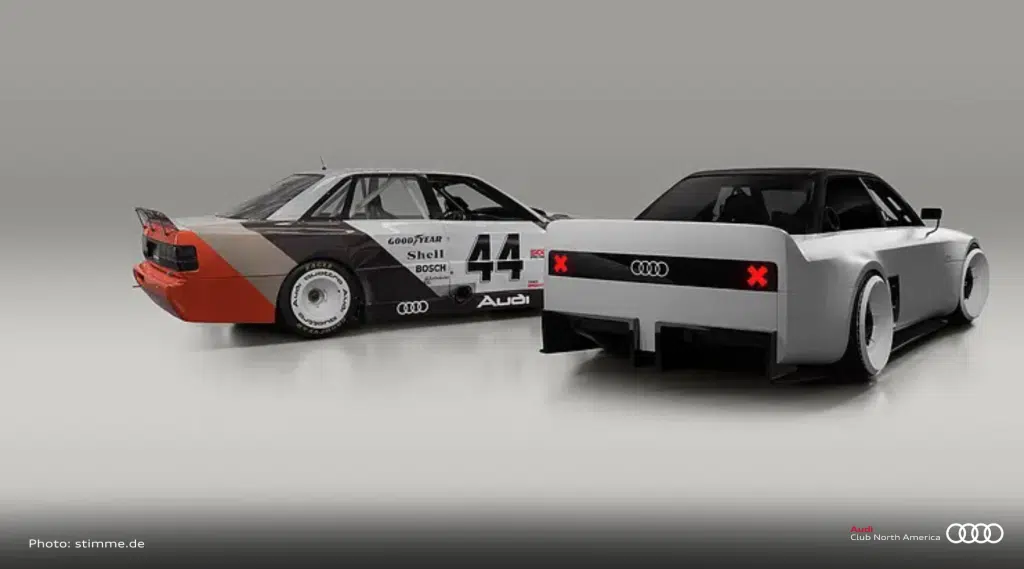
And now - half a century since its appearance. The usual path is a jubilee emblem or a special series. Audi chooses a different scenario. In Neckarsulm, a group of students is allowed to disassemble a modern RS3 to the last bolt and build a completely new car around it. Not a show car for an exhibition and not a nostalgic fantasy, but a harsh, almost rude statement.
A Car That Doesn't Flirt
The GT50 looks like it's looking from under its brow. The stance is not just low - it's defiantly low, as if the body is sliding over the asphalt, not rolling on it. Closed wheels, concave surfaces, X-shaped lighting - solutions that don't have to be liked at first glance. And that's exactly why they grab attention.
The body is made of fiberglass - an unexpectedly bold choice against the background of carbon fiber and aluminum. Inside - almost nothing superfluous: a safety cage, simple shapes, a feeling of a tool, not a design object. This car doesn't try to be comfortable or fashionable. It just exists as it wants to be.
Sound Instead of Arguments
Under the hood is a familiar 2.5-liter five-cylinder turbo engine, well known from the RS3. Audi is in no hurry to reveal the numbers, and they are secondary here.

The main thing is character. When the engine starts, the sound doesn't flow in a straight line. It pulsates, lives, pauses. The turbine doesn't react instantly, as if giving the driver a second to think. And then it becomes clear: the decision has been made, there is no turning back.
In the era of perfect electrical responses, this engine seems uncomfortable. Uneven. Not the most well-mannered. But that's exactly what makes it attractive.
Testing the Idea Itself
The GT50 doesn't promise a serial continuation - and that's its honesty. Audi is not selling a dream, but asking itself a question: what does heritage mean to us? Forms? Archival victories? Or the willingness to do strange things when it's easier to go down the beaten path?
The reaction turned out to be predictably contradictory. Delight from some, bewilderment from others. "Too sharp," "too un-Audi," "too from the past." But it is these cars that remain in memory. Those that suit everyone usually disappear without a trace.
There is also a beautiful rhyme: the roof of the GT50 is borrowed from the Audi 80 - a model that was also not immediately understood. History likes to repeat such stories.
What Remains in the End
The Audi GT50 will not become a production car. And perhaps that is why it is so important. It does not obey regulations, ratings, and market expectations. It exists as a reminder that the brand has its own sound, its own logic, and stubbornness.
The five-cylinder engine started as a compromise. Then it became a symbol. And now it has turned into an excuse to ask again the question that the modern automotive industry tries to avoid: do we even remember why all this?
I want to believe that such cars are needed not by the roads, but by ourselves - to sometimes stray from the route and listen to how the past sounds if you give it a turbine.
Read more materials on the topic:
- How to extend the life of a car
- Why the Passat B3 didn't have a radiator grille
- Export USSR: cars not for its own