Those who had the chance to drive on Soviet roads will never forget this sound. A dull, strained rumble, more like the sound of a tractor than a passenger car, followed by an angular silhouette emerging from a cloud of dust. In the USSR, LuAZ was the object of constant jokes: it was compared to a lunar rover and an iron. However, the irony ended exactly where the asphalt disappeared.
LuAZ-969 is a true car-paradox. Outwardly, it looked clumsy, inside it was noisy and uncomfortable, and by modern standards, frankly ascetic. At the same time, in terms of cross-country ability, it demonstrated capabilities that most modern crossovers simply cannot reach. To understand where this contradiction came from, it is worth referring to its origin and the logic of the designers. Then it becomes clear: this is not a failed experiment, but a carefully thought-out engineering tool.
From the Trenches to the Garden Beds
The strangeness of LuAZ is explained by its pedigree. From the very beginning, engineers did not set the task of creating a comfortable family car. Its direct ancestor was LuAZ-967 — a front-line transporter, abbreviated as TPK. It was a purely military vehicle designed to evacuate the wounded directly from the battlefield.
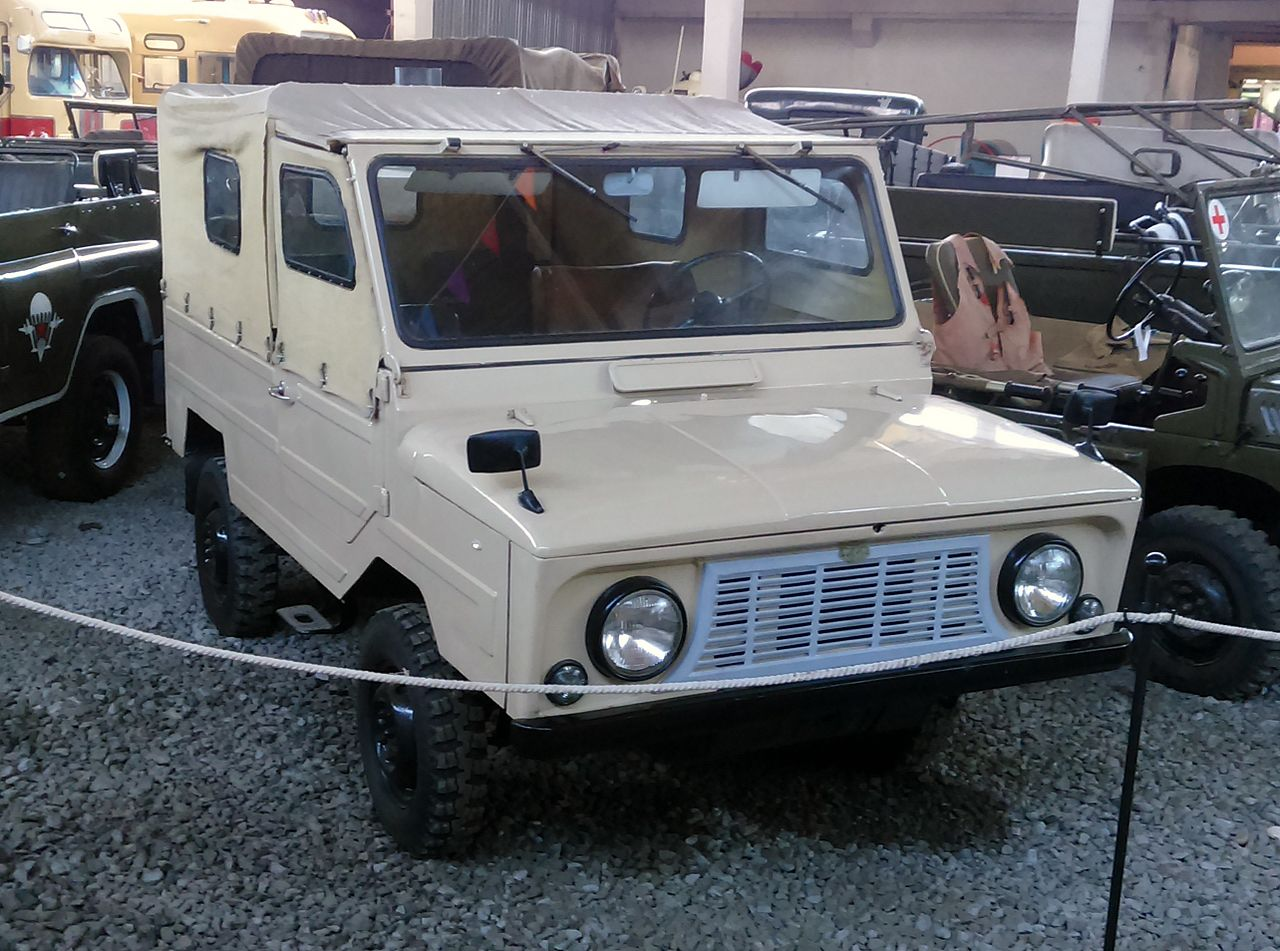
The design was dictated by the war: the driver could control the car while lying down to minimize the risk of being shot. Hence the unusual seating position, the strongly forward-shifted cabin, and the dashboard located almost at knee level. When in the mid-1950s, NAMI decided to adapt the military development to the needs of agriculture, the army base was not changed. It was simply disguised as a civilian car, without getting rid of the initially laid down logic.
From "Ogonyok" to an Iron Workhorse
In the early stages, the project looked much bolder and more modern. In 1958, NAMI, together with the Irbit Motorcycle Plant, presented the NAMI-049 prototype with the telling name "Ogonyok". For its time, it was a real technological leap: a fiberglass body, a mass of only 752 kilograms, and a fully independent suspension.
However, industrial reality quickly cooled the enthusiasm. Mass production of fiberglass bodies turned out to be too complex and expensive, especially for agricultural machinery. When the design documentation was transferred to the plant in Lutsk, the spectacular material was abandoned. It was replaced with rough but cheap and easily repairable metal. Thus, the promising and futuristic "Ogonyok" evolved into the very angular LuAZ that everyone knows.
A Quiet Revolution That Went Unnoticed
One of the least known facts about LuAZ is able to surprise even experts: it was the first mass-produced front-wheel drive car in the USSR. This is not a mistake or a slip of the tongue.
Usually, the primacy is attributed to the VAZ-2108, which appeared in the 1980s. However, already in 1967, the LuAZ-969V was put on the assembly line. The letter "V" stood for "temporary" — the plant did not have time to establish the production of gearboxes for the rear axle. As a result, the SUV, contrary to logic, began to be produced exclusively with front-wheel drive.
The paradox was that even in this form, the car remained surprisingly passable. The heavy engine, placed in front of the front axle, created additional load on the drive wheels, and aggressive tires helped to cling to the ground. A full-fledged all-wheel drive appeared only in 1971, but by that time the reputation of a car "crawling anywhere" had already developed.
What It Was Really Disliked For
If you discard the romance, LuAZ was an extremely difficult test for an unprepared driver. There was no question of comfort at all.
The air-cooled MeMZ engine, inherited from the "Zaporozhets", worked so loudly that a conversation in the cabin turned into a scream. The engine's lifespan rarely exceeded 50–60 thousand kilometers before a major overhaul, it was prone to overheating in the heat and did not differ in traction on climbs. Add to this chronic leaks: oil seeped from the engine, gearbox and wheel gears. LuAZ unmistakably indicated its presence with oil stains.
Absolute Superiority Off-Road
But as soon as the asphalt ended, all the shortcomings faded into the background. In the mud, in a soggy field or in a forest track, LuAZ was fully revealed.
Wheel gears, comparable in principle to solutions on military equipment, increased ground clearance to an impressive 280 millimeters. Add to this a small weight — about 950 kilograms — and a rigid rear differential lock. Where a heavy UAZ helplessly sat on the axles, a light LuAZ literally slid over the mud. And if it did get stuck, it could be easily pushed out by two people.
LuAZ-969 is difficult to call a car in the usual sense of the word. It is not a means for comfortable trips and not a universal transport. Rather, it is a mechanized mule — a simple, rough, but exceptionally honest tool. On the highway it was a torment, but in the village, forest or fishing it turned out to be indispensable. It did not promise comfort and silence, but almost always fulfilled the main thing — it took you where you needed to go and brought you back.
Read more materials on the topic:
- Porsche 911 Slept for 31 Years Under Pine Needles — and Turned Out to Be Alive
- Rare GAZ-21V in Perfect Condition Found in Togliatti
- Collectible "Moskvich-412" for 25 Million Rubles Put Up for Sale