Sooner or later, almost every car owner comes to the same thought: what if I change the ground clearance? Lower the car for appearance and more precise handling. Or, conversely, raise it to drive more calmly on broken roads, yards, and country roads. From this moment on, the search for a compromise begins: how to change the ground clearance with minimal costs and without serious harm to the car.
However, a key point often escapes attention. Any lowering or lift is a direct intervention in the geometry of the car. Such changes inevitably affect the behavior of the car, the lifespan of the suspension, and, ultimately, road safety.
What is Ground Clearance and Why is it Important
All such modifications boil down to one parameter — ground clearance. Ground clearance is the distance from the road surface to the lowest point of the car. This is not about the bumper or sills, but about the part that will first come into contact with an obstacle. It is this parameter that determines what the car will catch on a bump, curb, or snowdrift.
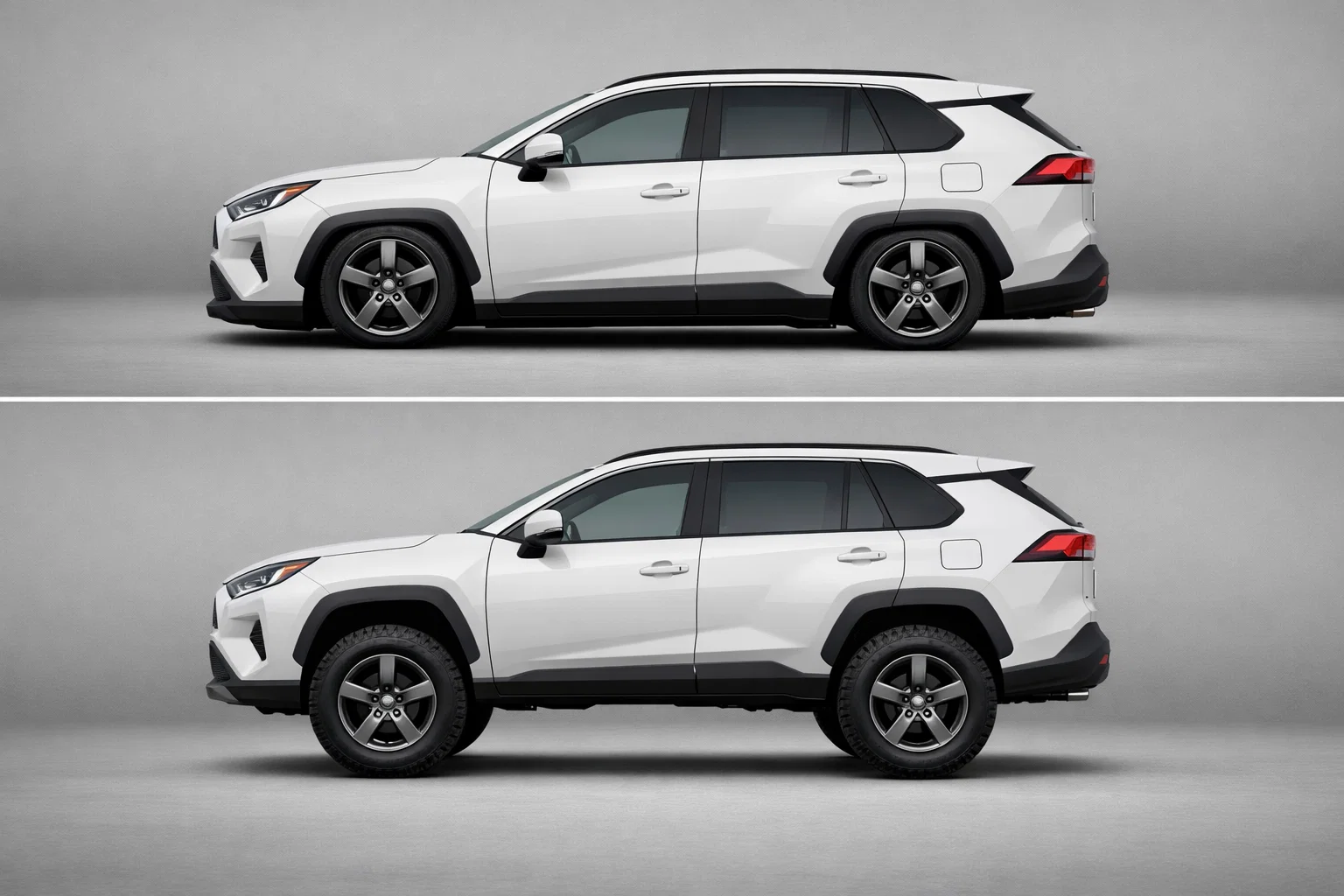
Ground clearance is directly related to the position of the center of gravity — an imaginary point where the mass of the car is concentrated. If you mentally suspend the car by this point, it will be in balance without distortions. Any change in ground clearance automatically shifts the center of gravity up or down, which affects stability and handling.
Conditionally, ground clearance can be divided into three main categories. The range of 90–130 mm is considered low. Such values are typical for cars with a low center of gravity, designed for stability and precise handling at high speeds — most often these are sports sedans and coupes. The range of 130–180 mm is the average ground clearance. This is a compromise option suitable for most drivers. Many sedans, hatchbacks, station wagons, and some crossovers have it. Values from 180 mm and above refer to high ground clearance. It is typical for crossovers and SUVs, improves off-road capability, but also raises the center of gravity.
Lowering: Why and at What Cost
Technically, reducing ground clearance is not difficult. It is much more difficult to honestly answer the question of why it is needed. Most often, lowering is associated with improved handling and a sporty character of the car — and there is logic in this. A lower center of gravity reduces body roll in corners and increases stability at speed. The visual effect also plays a role: the car looks squat, aggressive, and noticeable. There is also a practical point — it is easier to get into a low car, which is especially noticeable for people of short stature.
But the advantages end rather quickly. The first thing you have to face is a sharp drop in off-road capability. Driving off the asphalt, yards with ruts, country roads, or a regular trip out of town turn into a risk. The next point is the probability of damage. The oil pan, exhaust system, suspension elements, sills, and underbody are at risk. In the case of electric vehicles, the situation is even more serious: the traction battery becomes a vulnerable and extremely expensive element.

Comfort also suffers. The suspension becomes stiffer, especially on uneven roads. In winter, the list of problems expands: deep snow and uncleaned yards can make even a short trip impossible. The picture is complemented by the legal aspect — interference with the design of the car can cause difficulties with technical inspection and registration.
Lowering Methods
Lowering methods differ fundamentally in their consequences. The simplest and at the same time the most unsuccessful option is cutting the coils of the standard springs. This approach violates the calculated operation of the suspension, increases the load on the remaining coils, and almost guarantees problems with handling and reliability.
A more competent solution is to install an adjustable suspension, which allows you to change the height both downward and upward. But here much depends on the quality of the kit and the correctness of the settings. Good solutions are expensive, and cheap ones often fail in a short time.
Pneumatic or hydraulic suspension provides maximum freedom: ground clearance can be changed even on the go. However, this is the most complex and expensive option, which is more often related to tuning than to everyday use.
There is also a visual compromise — installing larger diameter wheels with low-profile tires. The car really looks lower, but the real reduction in ground clearance is minimal and almost does not affect the behavior of the car.
Increasing Ground Clearance: Advantages and Limitations
Raising a car technically is often even easier than lowering it. But the logic remains the same: the process itself is not important, but the goal is. High ground clearance solves some problems while creating new limitations.

The obvious advantages include improved off-road capability. It becomes easier to drive on bad roads, get out into nature, and in winter the risk of getting stuck in the snow is reduced. The probability of damaging the oil pan, gearbox, exhaust system, bumpers, radiators, and underbody is reduced. There is a margin in height when loading the car — it sags less and does not catch on the arches and coating. Parking in yards and overcoming curbs is easier. An additional bonus is the appearance: even a compact car visually seems larger and more "off-road".
But the lift also has a downside. Raising the ground clearance raises the center of gravity, which worsens handling. Body roll increases in corners, stability decreases at high speed, and the risk of rollover increases. Fuel consumption increases due to increased weight and worsened aerodynamics. The working angles of the suspension and drives change, which accelerates the wear of ball joints, steering tips, hub bearings, and CV joints. Even adjusting the camber-toe angle is not always able to compensate for these changes.
Let's add here possible problems with technical inspection and registration, as well as the fact that the lift is rarely limited to one modification. Often one modification entails the next, turning the process into an expensive and lengthy chain.
How to Increase Ground Clearance
The most common way is to install higher springs. This is relatively inexpensive and can give an increase of 10 cm or more, but at the same time changes the nature of the suspension. Another option is tires with a higher profile. Ground clearance really increases, but there may be errors in the speedometer readings, incorrect operation of ABS and ESP, as well as the risk of touching the wheel arches when fully loaded or actively maneuvering.
Additionally, spacers are used between the body and the upper support of the shock absorber. They give a small but stable increase in height and are relatively inexpensive. A similar effect is provided by buffers — inter-turn cushions that reduce suspension breakdowns and partially unload shock absorbers, although their real increase in ground clearance is minimal.
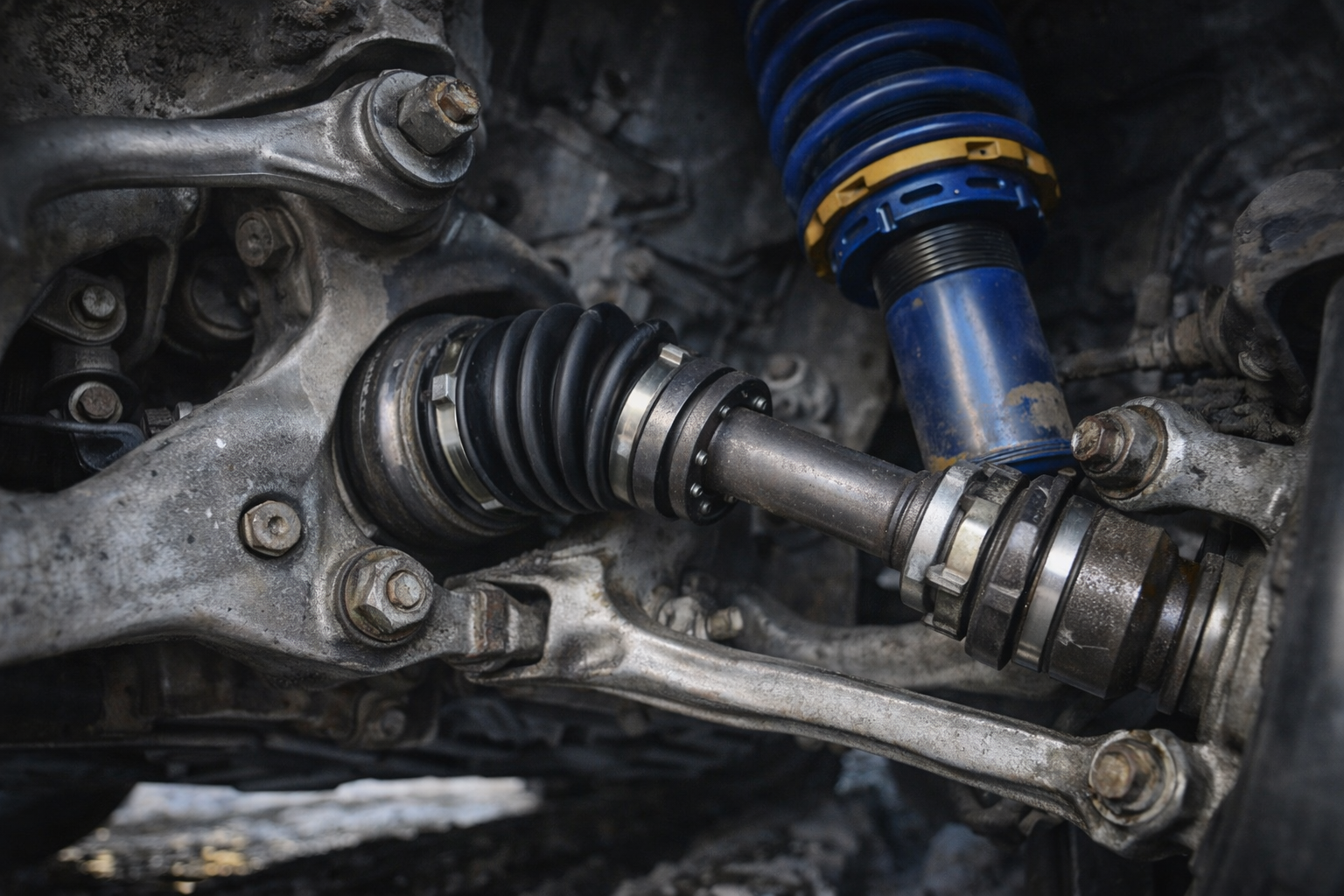
The most technological solution is considered to be air springs. They allow you to change the height on the go and increase the ground clearance up to 5 cm, significantly increasing off-road capability and load capacity. The main limitation is that such systems are usually installed only on the rear axle.
Changing the ground clearance of a car — up or down — is possible and technically not difficult. The main difficulties begin later. The Technical Regulations of the Customs Union No. 018/2011 "On the Safety of Wheeled Vehicles" prohibits making changes to the design not provided for by the manufacturer. Such alterations do not pass technical inspection and are formally not allowed to participate in road traffic. Similar restrictions are contained in the Traffic Regulations.
Therefore, it is often much more reasonable to initially choose a car with suitable ground clearance than to try to radically change the suspension. Ground clearance is not just a number in the specifications, but a fundamental parameter that affects handling, lifespan, and safety.
Read more:
- MAZ-532 — The Lost Legend of Soviet Off-Road
- How the USSR Tried to Break into the Leaders of the Motorcycle Industry
- Which Automakers Have Completely Lost Factories in Russia