The Soviet Union is associated not only with "Zhiguli" cars and the Kalashnikov assault rifle. Sometimes the domestic engineering school offered solutions that even today look almost like science fiction. One such project was the ZIL-132S, an experimental all-terrain truck from the 1960s, which makes one wonder: did this machine really move on its own?
In appearance, it resembled technology from science fiction: huge "pancake" wheels, the absence of traditional suspension, and an unconventional control scheme. However, behind the unusual appearance lay a very practical task.
Transport for a Country Without Roads
In the 1960s, designers faced an ambitious goal: to create a vehicle capable of moving where even tanks get stuck. The vast territory of the USSR included swamps, snowy expanses, and impassable forests, and the army needed transport that did not depend on the availability of roads.
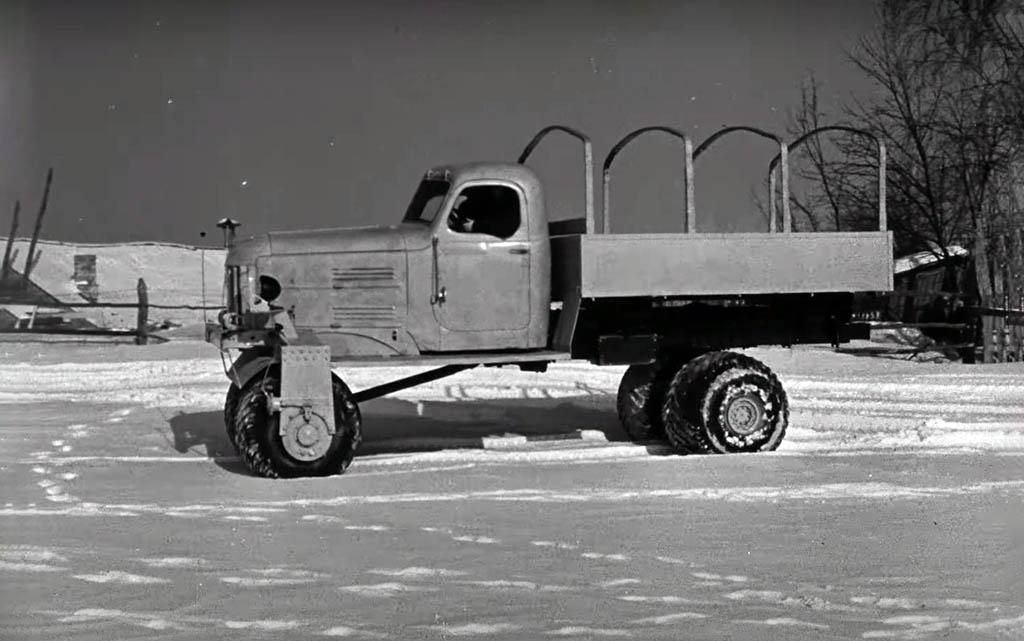
It was in this context that the 132S project appeared at ZIL: a four-wheel drive all-terrain vehicle equipped with pneumatic tires, that is, wide low-pressure tires. Visually, the machine looked like something between a truck and a lunar rover.
Wheels Instead of Suspension
The main distinguishing feature of the ZIL-132S was the I-245 ultra-low pressure tires. They performed two functions at once: they provided traction and replaced shock absorption.
The car had no traditional suspension: the wheels were rigidly attached, and the entire load for damping shocks fell on the massive layer of rubber. This solution simplified the design and reduced the likelihood of mechanical failures, but at the same time made the ride extremely harsh and specific in terms of sensations.
Steering "Backwards"
No less unusual was the steering control scheme. The front axle was rigidly fixed and did not participate in maneuvers. Turns were made using the controlled rear axle.
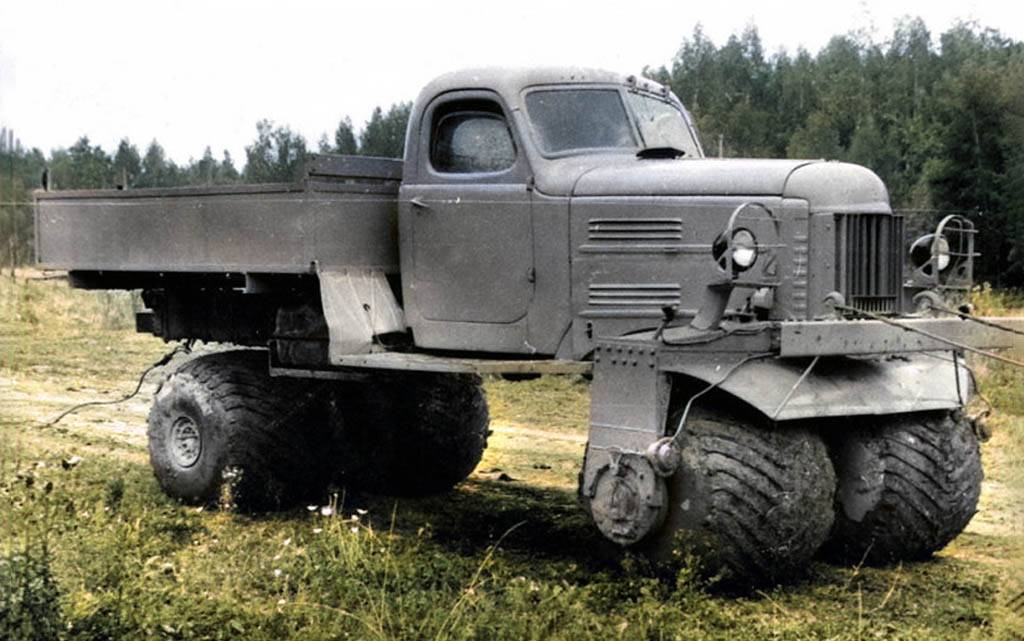
In fact, the truck "steered with its rear", resembling a forklift in its principle of operation. Theoretically, this reduced the turning radius and helped on difficult sections of the route. In practice, however, driving required high skill: the car reacted unusually, and the slightest mistakes led to jerks and skids.
Testing and Rejection of Series Production
The idea looked promising, but tests revealed a number of serious problems. Handling turned out to be inconvenient and unsafe. On public roads, the car had practically no advantages.
In addition, the army preferred more versatile and proven vehicles: GAZ-66, Ural-375, and ZIL-131. Against their background, the ZIL-132S looked like a highly specialized experiment. The production and maintenance of such non-standard equipment required significant costs, which also played a role. As a result, the project was recognized as interesting from an engineering point of view, but impractical for mass implementation.
What Remained of the Project
Several prototypes were built, which were actively tested at proving grounds. In swamps and sandy areas, the all-terrain vehicle demonstrated impressive capabilities, but overall the design turned out to be too complex for widespread use. It had no serial future.
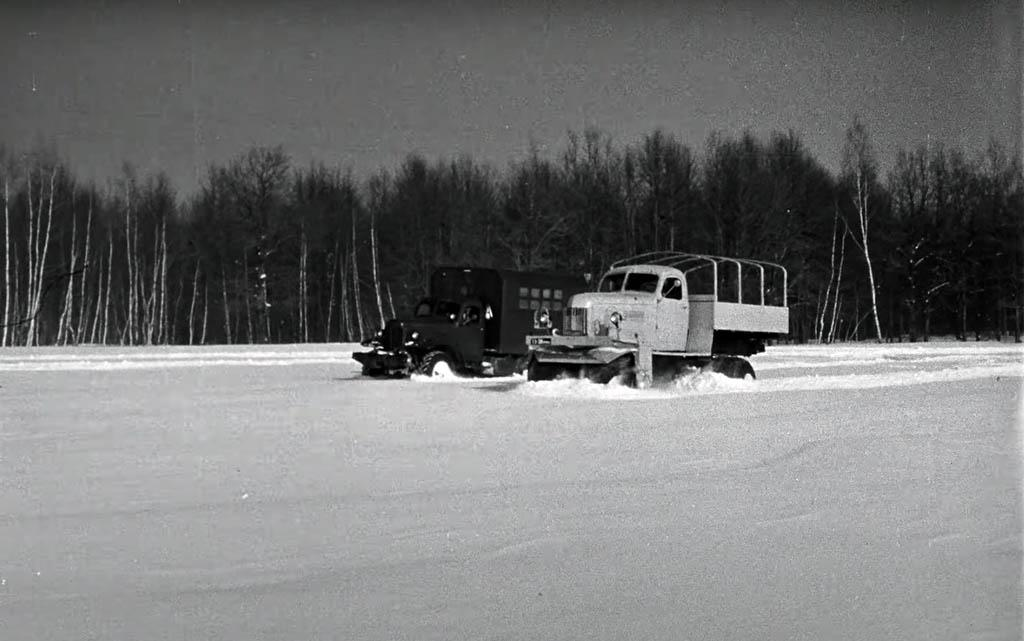
Even more than half a century later, the ZIL-132S makes a strong impression and reminds us of the boldness of designers who were not afraid of non-standard solutions.
Interest After Decades
Today, videos featuring the ZIL-132S collect millions of views on the Internet. The public is attracted by the combination of engineering audacity and a kind of exoticism: a truck with "pancake" wheels and "rear" steering looks both logical and paradoxical.
For viewers from the post-Soviet space, this project has become a kind of symbol of the era when experiments were not limited by standard frameworks. Not every one of them reached the assembly line, but each left a mark on history.
The ZIL-132S is an example of a bold engineering experiment from the 1960s. The car did not receive a serial continuation, but went down in history as one of the most unusual and memorable trucks of the USSR, a proof that technical fantasy sometimes outstrips practical necessity.
Read more materials:
- UralZIS-355M: The Ideal Worker of the Era
- From Pneumatics to ACC: Where It All Began
- Why Soviet Cars Rusted Slower Than Modern Ones