Under the hood of any passenger car with a transversely mounted engine, in the upper area of the front fenders, two metal cups are recessed. These are the upper mounts of the MacPherson suspension struts — a design that today is installed on the overwhelming majority of front-wheel-drive cars in the world: from the Lada Vesta and Volkswagen Golf to the Hyundai Tucson and Kia Sportage. For almost eight decades, this layout has maintained its leadership, and there are entirely pragmatic reasons for such longevity.
Its origins go back to the 1940s. General Motors engineer Earle S. MacPherson was working on the Chevrolet Cadet project, an affordable people's car. He faced a clear task: to reduce cost as much as possible without sacrificing handling and driving qualities.
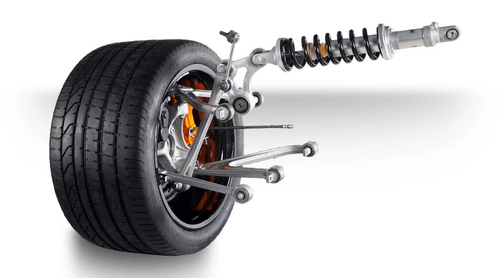
As a starting point, he used the classic double-wishbone suspension, but radically simplified it: the upper control arm was eliminated, and its functions were transferred to the damper strut. Instead of two assemblies — one. Fewer components, lower costs, simpler assembly-line production.
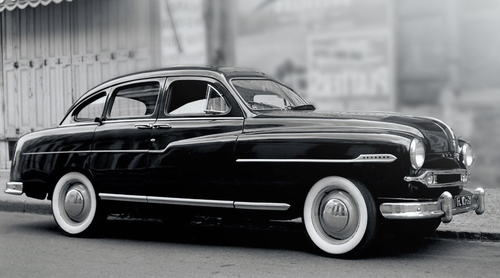
The Cadet itself never entered production, and MacPherson moved to Ford Motor Company. It was there that the idea received its industrial embodiment: in 1948, the suspension first appeared on the production Ford Vedette, built by the company's French division. It was then adopted by the early-1950s Ford Zephyr and Ford Consul.
At the same time, the very concept of a guiding strut was not MacPherson's invention. As early as 1925, Fiat engineer Guido Fornaca filed a U.S. patent for a layout based on a similar principle. However, it was MacPherson who developed the idea into a full-fledged mass-production solution: he added a transverse control arm, refined the packaging, and ensured functionality in large-scale manufacturing. That is why all the glory became attached to his name.
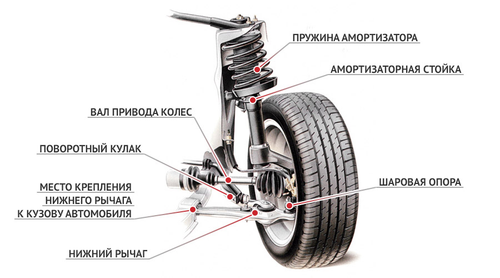
The design logic is extremely clear: the strut, combining the shock absorber and spring, serves as the guiding element, while from below the wheel is held by a single transverse control arm through a ball joint. The upper part of the strut is attached to the reinforced inner fender through a strut bearing, while the lower part is connected to the steering knuckle. The spring is clamped between the upper and lower spring seats.
The subframe, on which the control arms and steering mechanism are mounted, is connected to the body by means of silent blocks — rubber-metal bushings that damp vibrations. The anti-roll bar, which limits body roll in corners, is attached to this same structure.
When hitting a bump, the spring compresses, the shock absorber damps the oscillations, and the control arm with the ball joint allows the wheel to move up and down without involving the entire body in the movement. Each wheel works independently — unlike a beam axle, where an impact on one side is partially transmitted to the other.
The mass spread of this layout is explained by three factors. First of all — compactness in width. It was precisely this quality that allowed engineers to position the engine and gearbox transversely; without such a solution, the modern front-wheel-drive car format simply would not have taken shape.
The second reason is technological simplicity. A small number of parts makes production easier and assembly faster, which is critically important for the mass segment. The third argument is the low mass of the unsprung elements: a light suspension smooths out irregularities more effectively and places less load on the body.
In the 1980s, even manufacturers from whom this was not expected placed their bets on this design. Mercedes-Benz used it on the legendary Mercedes-Benz W124, Audi — on the 100 model, and BMW equipped a significant part of its lineup with MacPherson struts from the late 1970s onward. Production savings combined with acceptable driving characteristics proved more compelling than other arguments, and it seemed that the double-wishbone layout was becoming history.
However, by the mid-1990s the emphasis had changed. Audi A4 and Audi A6, Mercedes-Benz W210, updated BMW models — in the more expensive segment, engineers once again returned to two control arms. The reason lay in kinematics.
In a MacPherson suspension, wheel camber angle changes noticeably during compression, which directly affects handling and the tire's contact patch with the road. For a city car traveling at speeds up to 130–140 km/h, this is not critical. For a sports sedan taking corners at the limit of its capabilities, it is already significant.
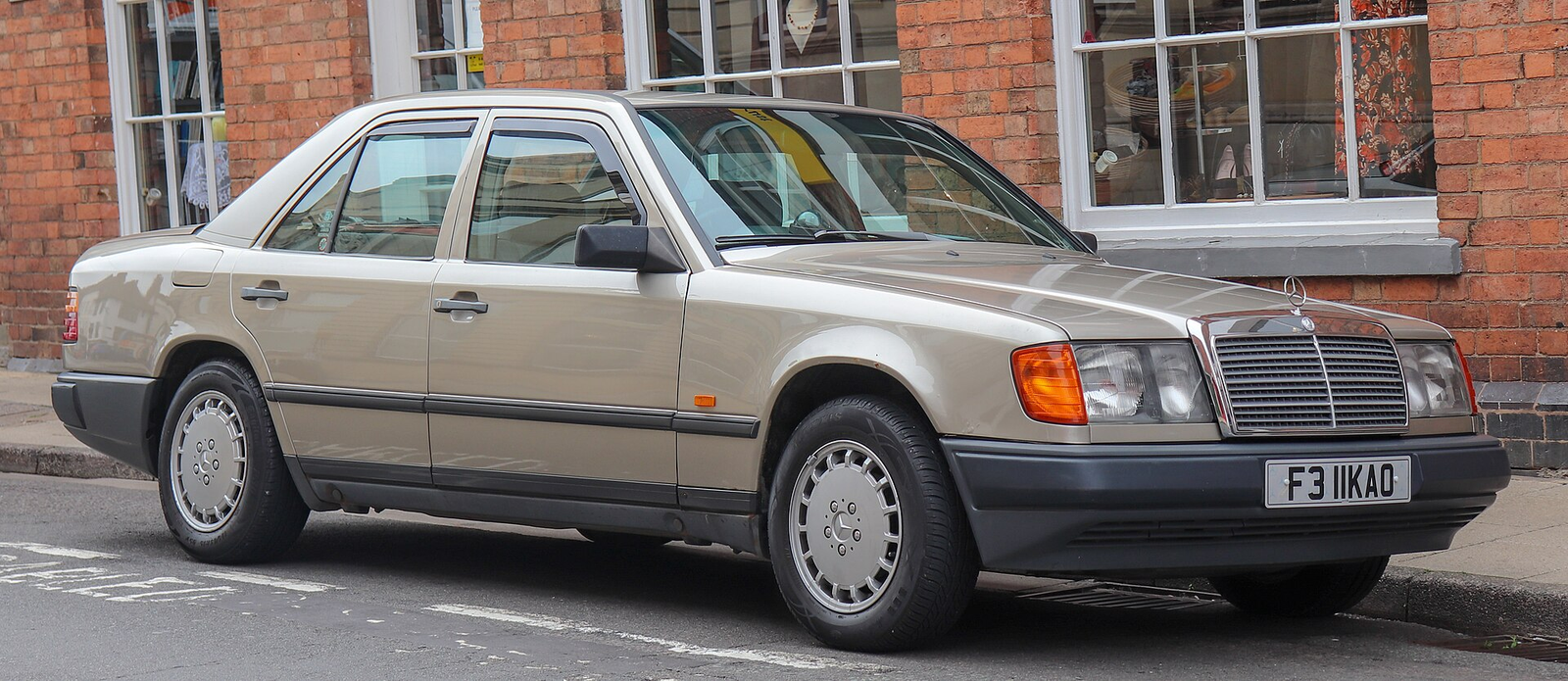
Nevertheless, the design was constantly improved. On early Porsche 911 models, a torsion bar was used instead of a coil spring, which made it possible to reduce the height of the front part of the body. On the Mercedes-Benz W124, the spring and strut were separated: the spring was placed separately, unloading the upper mount.
Since the 1990s, straight control arms have given way to L-shaped ones, which improved the car's behavior under braking and made it possible to stop using the anti-roll bar as a control-arm element. The next stage was the introduction of a separate steering knuckle on ball joints between the wheel and the strut.
Such solutions were used by Ford (RevoKnuckle) and Opel (HiPerStrut). When the steering wheel is turned, the strut remains stationary, and only the knuckle rotates — this reduces parasitic torque steer and makes feedback more informative.
The main drawback of the layout reveals itself on poor surfaces. Impact energy is transmitted through the strut to the upper mounting point on the inner fender. Thin metal in this area gradually accumulates fatigue cracks, and then corrosion develops. On high-quality asphalt, strut service life is high, but on broken dirt roads it is reduced many times over.
Replacement is expensive also because the entire assembly has to be removed as a whole; most modern struts are non-serviceable and are replaced only as complete units.
It is precisely for this reason that MacPherson suspension is not used on body-on-frame SUVs, trucks, and racing cars. In these categories, either increased strength, or precise kinematics in extreme modes, or a combination of both is required. Such tasks are solved by double-wishbone and multi-link layouts — more complex, heavier, and more expensive, but providing greater precision and durability.
Read more materials:
- Drive for a million: top 5 dynamic used models at a reasonable price
- Cylinder deactivation: savings or illusion?
- PSA and GM: two giants of the automotive industry
Комментарии